

SaaS financial reporting is the specialized process of recording, analyzing, and communicating the financial performance of subscription-based software businesses, governed by ASC 606 revenue recognition rules and metrics unique to recurring revenue models. Unlike traditional financial reporting, it tracks forward-looking indicators like Annual Recurring Revenue (ARR) and Net Revenue Retention (NRR) alongside standard GAAP statements. These metrics reveal what a SaaS business is worth today and where it is headed. Business owners and financial managers who master this discipline make faster, more confident decisions and communicate more clearly with investors.
What is SaaS financial reporting and how does it differ from traditional reporting?
SaaS financial reporting captures a fundamentally different business reality than traditional accounting. A software company selling annual subscriptions collects cash upfront but cannot recognize that cash as revenue immediately. Under ASC 606, subscription revenue is recognized ratably over the service period, not at the point of sale. That single rule changes how every financial statement reads.
The most visible difference shows up on the balance sheet. Deferred revenue represents cash received for services not yet delivered and is typically the largest liability on a SaaS company's balance sheet. This is not debt. It is a prepayment from customers, and a growing deferred revenue balance is actually a sign of business health, not financial stress.

The income statement tells a similarly counterintuitive story. SaaS companies can post GAAP losses while generating positive operating cash flow because they bill in advance and recognize revenue over time. A company showing a net loss on paper may be cash-flow positive and growing fast. Traditional financial analysis would flag that loss as a red flag. SaaS financial analysis reads it as a growth signal.
Two additional accounting rules shape SaaS profitability reporting:
- ASC 350-40 governs the capitalization of internal software development costs, allowing qualifying expenses to be recorded as intangible assets rather than immediate expenses.
- ASC 340-40 allows sales commissions to be capitalized as prepaid assets and amortized over the customer contract period, smoothing reported expenses.
Both rules affect reported profitability in ways that differ sharply from how a traditional product or services company would record the same costs.
Pro Tip: When reviewing a SaaS income statement, always check whether sales commissions are expensed immediately or amortized. Immediate expensing inflates early-period losses and makes growth-stage companies look less profitable than they are.
| Reporting Element | Traditional Business | SaaS Business |
|---|---|---|
| Revenue recognition | At point of sale | Ratably over subscription term (ASC 606) |
| Largest balance sheet liability | Accounts payable or debt | Deferred revenue |
| Cash vs. profit relationship | Closely aligned | Often diverge significantly |
| Commission accounting | Expensed immediately | Capitalized and amortized (ASC 340-40) |
What are the essential SaaS financial metrics and how are they reported?
SaaS financial reporting uses two parallel sets of metrics: GAAP financial statements and non-GAAP operating metrics. Neither can substitute for the other. GAAP revenue and ARR measure different financial realities, and investor-grade reporting requires both, reconciled clearly.
The core non-GAAP metrics every SaaS business owner needs to understand are:
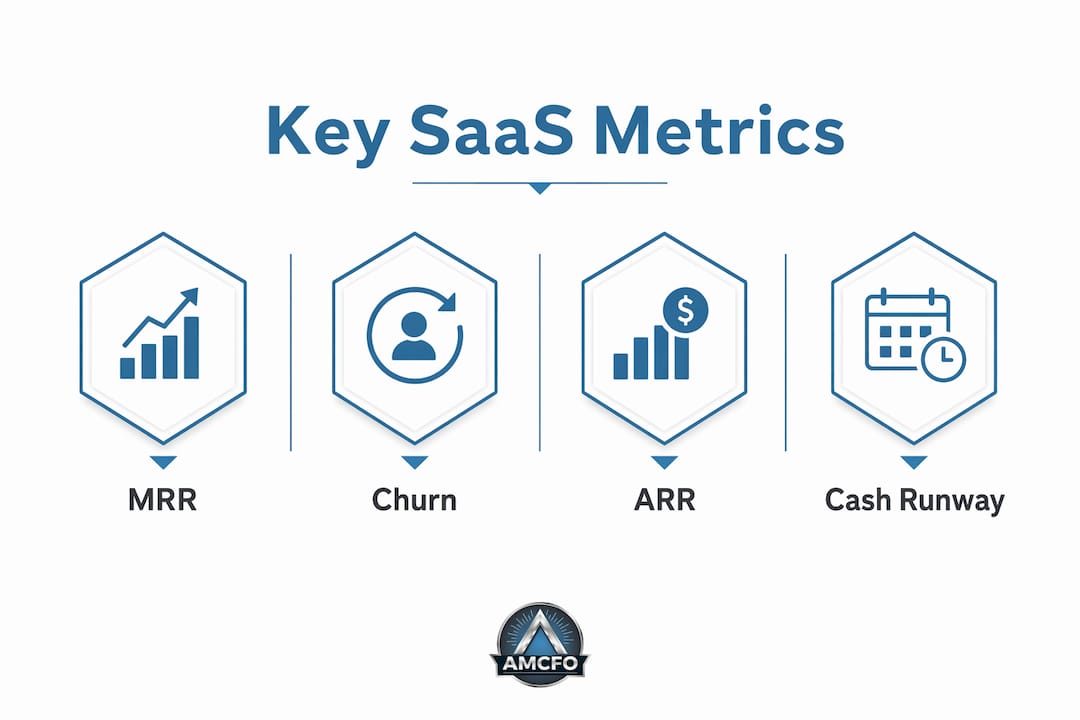
- ARR (Annual Recurring Revenue): The annualized value of all active subscription contracts. ARR is the single most watched metric in SaaS because it represents predictable, contracted future revenue.
- MRR (Monthly Recurring Revenue): ARR divided by 12. MRR is the operational heartbeat of a SaaS business, tracked monthly to catch trends early.
- NRR (Net Revenue Retention): The percentage of revenue retained from existing customers after accounting for churn, downgrades, and expansions. An NRR above 100% means existing customers are spending more over time, which is the most powerful growth engine in SaaS.
- Churn Rate: The percentage of customers or revenue lost in a given period. High churn destroys ARR growth even when new sales are strong.
- CAC (Customer Acquisition Cost): The total sales and marketing spend divided by the number of new customers acquired. CAC paired with customer lifetime value (LTV) reveals whether the business model is economically sound.
- Rule of 40: The sum of ARR growth rate and free cash flow margin. A Rule of 40 score above 40 indicates balanced growth and profitability, and it is a standard benchmark used by investors to evaluate SaaS company performance.
Reporting cadence matters as much as the metrics themselves. Monthly reports track MRR, churn, and cash runway for operational decisions. Quarterly board reports focus on ARR growth, NRR, and efficiency ratios. Annual financial reports present full GAAP statements alongside non-GAAP reconciliations for investors and auditors.
Pro Tip: Always include a GAAP-to-ARR reconciliation table in board and investor reports. Investors who see ARR without a GAAP bridge will build their own reconciliation, and their assumptions may not favor you.
For financial managers building monthly financial statements, the discipline of tracking these metrics consistently month over month is what separates reactive accounting from proactive financial management.
What are best practices and modern tools for SaaS financial reporting?
Effective SaaS financial reporting requires integrating data from three systems that rarely talk to each other by default: billing, CRM, and accounting. Many SaaS companies treat accounting as an end-of-period static task, which creates reconciliation errors, delayed reporting, and unreliable metrics. The fix is continuous data integration, not harder month-end closes.
A well-structured SaaS monthly financial report follows a specific sequence. A high-quality report includes five sections: ARR waterfall, profit and loss statement, operating efficiency ratios, unit economics, and cash runway. The ARR waterfall leads because it shows new ARR, expansion ARR, churned ARR, and net new ARR in one view. The P&L follows to validate the ARR story with GAAP numbers. Efficiency ratios and unit economics come next, and the report closes with cash position and runway.
Automation changes the economics of this work significantly. Automated usage reporting improves NRR by 18–24 percentage points within the first year. That improvement breaks down into 60% prevented churn, 30% expansion revenue, and 10% increased pricing power. Those are not marginal gains. They represent a structural improvement in the business model.
The reporting format also matters for customer-facing analytics. Over 80% of users prefer embedded analytics, and organizations that adopt embedded reporting see a 30–40% reduction in churn. Embedded reporting also cuts software development timelines from six months to a few weeks for companies building reporting features into their own products.
Common pitfalls to avoid in SaaS financial reporting:
- Mixing GAAP and non-GAAP metrics without labels. Unlabeled metrics confuse investors and auditors.
- Ignoring deferred revenue movement. A shrinking deferred revenue balance can signal slowing sales before ARR catches it.
- Reporting ARR without an expansion breakdown. Flat ARR with high churn offset by high expansion hides a retention problem.
- Skipping cash runway in board reports. Investors always want to know how many months of runway remain.
Pro Tip: Build your ARR waterfall before your P&L every month. If the ARR numbers do not reconcile to your billing system, your P&L will have errors too. Fix the source data first.
For a broader view of financial reporting best practices that apply across business types, the governance principles are the same: clean data, consistent methodology, and timely delivery.
How does SaaS financial reporting support strategic decisions and investor relations?
SaaS financial reporting is forward-looking by design. Finance leaders must treat SaaS reporting as a forward-looking practice that drives scenario modeling, growth forecasting, and goal setting. A trailing income statement tells you what happened. An ARR waterfall with NRR trends tells you what is likely to happen next quarter.
Investors in SaaS businesses expect specific reporting standards. They want to see ARR growth rate, NRR, gross margin, CAC payback period, and Rule of 40 alongside GAAP financials. Companies that present only GAAP statements without operating metrics signal that they do not understand their own business model. Companies that present only ARR without GAAP reconciliation raise audit and compliance concerns.
The strategic applications of strong SaaS financial reporting include:
- Scenario modeling: ARR and churn data feed directly into revenue forecasts. Changing one churn assumption shows the downstream impact on cash runway and hiring capacity.
- Fundraising readiness: Investors conduct financial due diligence using SaaS metrics. Clean, reconciled reports shorten due diligence timelines and increase investor confidence.
- Pricing decisions: NRR broken down by customer segment reveals which customer types expand over time and which churn. That data drives pricing and packaging decisions.
- Hiring and capacity planning: CAC payback period and sales efficiency ratios determine how aggressively a company can invest in sales headcount.
Accounts receiving automated monthly ROI reports show a 34% higher expansion rate than those receiving only annual reviews. That finding applies internally too. Finance teams that deliver monthly metric reports to department heads drive better resource allocation decisions than teams that report quarterly. Frequency of insight drives quality of action.
For SaaS businesses using financial modeling for growth decisions, the quality of the underlying financial data determines the quality of every forecast. Garbage in, garbage out applies to SaaS models more than almost any other business type because the metrics compound over time.
Key Takeaways
SaaS financial reporting requires integrating GAAP accounting standards like ASC 606 with non-GAAP operating metrics like ARR and NRR to give business owners and investors a complete, accurate picture of financial health.
| Point | Details |
|---|---|
| ASC 606 governs revenue timing | Subscription revenue is recognized over the service period, not at the point of sale. |
| Deferred revenue signals health | A growing deferred revenue balance means customers are prepaying, not that the company owes debt. |
| GAAP and ARR must coexist | Neither metric substitutes for the other; investor reports require both with a clear reconciliation. |
| Automation lifts NRR significantly | Automated usage reporting improves net revenue retention by 18–24 percentage points in the first year. |
| Report structure drives clarity | A monthly SaaS report leads with ARR waterfall, then P&L, efficiency ratios, unit economics, and cash runway. |
Angelica's take on SaaS financial reporting
Working with SaaS businesses across different growth stages, the most consistent mistake I see is treating financial reporting as a compliance exercise rather than a management tool. Teams spend weeks closing the books and then hand a GAAP income statement to the board. The board looks at the net loss, gets nervous, and asks questions the finance team cannot answer because they never built the ARR waterfall or calculated NRR.
The companies that grow well are the ones where the CFO or financial manager treats the monthly close as the starting point, not the finish line. They use the closed numbers to update their ARR model, recalculate churn, and stress-test the cash runway. That takes maybe two extra hours a month. The strategic clarity it creates is worth far more than the time it costs.
The other thing I push back on consistently is the idea that SaaS metrics are only for investors. ARR growth rate, NRR, and Rule of 40 are management tools first. If your sales team does not know the CAC payback period, they cannot make good decisions about which deals to prioritize. If your product team does not see churn by feature usage, they are building in the dark. The best SaaS financial reporting systems put the right numbers in front of the right people every month, not just in front of the board once a quarter.
— Angelica
How Amcfo supports SaaS businesses with financial reporting
SaaS financial reporting is one of the most technically demanding areas of business finance. Getting it right requires accounting expertise, metric fluency, and the ability to translate numbers into decisions.

Amcfo provides fractional CFO services and accounting and bookkeeping solutions built for businesses that need expert financial guidance without the cost of a full-time CFO. From QuickBooks setup and cleanup to ARR reporting, budgeting, and investor-ready financial statements, Amcfo handles the financial infrastructure so you can focus on growing your business. If your SaaS financial reports are not giving you the clarity you need to make confident decisions, Amcfo can help you build the systems and processes that will.
FAQ
What is SaaS financial reporting?
SaaS financial reporting is the process of recording and presenting the financial performance of subscription-based software businesses using both GAAP accounting standards and non-GAAP operating metrics like ARR and NRR. It differs from traditional reporting because recurring revenue models require specific rules around revenue recognition, deferred revenue, and capitalized costs.
What is deferred revenue in SaaS accounting?
Deferred revenue is cash collected from customers for subscription services not yet delivered, and it is typically the largest liability on a SaaS balance sheet. Under ASC 606, this revenue is recognized ratably over the subscription period, not when payment is received.
What is the Rule of 40 in SaaS reporting?
The Rule of 40 adds a SaaS company's ARR growth rate to its free cash flow margin. A combined score above 40 signals that the business balances growth and profitability at an acceptable level for investors.
How often should SaaS companies produce financial reports?
SaaS businesses benefit from three reporting cadences: monthly operational reports tracking MRR, churn, and cash runway; quarterly board reports covering ARR growth and efficiency ratios; and annual GAAP financial statements with full non-GAAP reconciliations.
Why do SaaS companies show losses while generating positive cash flow?
SaaS companies bill customers upfront and recognize revenue over the subscription term. This timing difference means a company can collect more cash than it recognizes as revenue in any given period, producing positive cash flow alongside a GAAP net loss.