

Most small business owners assume financial guidance means getting clean books and a tax return filed on time. That assumption costs them. What is strategic financial guidance, really? It's the ongoing process of turning your financial data into forward-looking decisions about growth, spending, hiring, and survival. It combines budgeting, forecasting, scenario planning, and cash flow management into a single continuous practice that tells you not just where you've been, but where you're headed and what to do about it. This guide breaks down exactly how it works and why it matters for your bottom line.
Table of Contents
- Understanding strategic financial guidance
- How strategic financial guidance improves your business decisions
- Mastering cash flow management with rolling forecasts
- Strategic cost management with the DEC framework
- Implementing strategic financial guidance in your business
- Why many SMBs miss the power of strategic financial guidance
- How AmCFO supports your strategic financial guidance
- Frequently asked questions
Key Takeaways
| Point | Details |
|---|---|
| Strategic financial guidance | Provides SMB owners with insights and tools to make informed, forward-looking business decisions. |
| 13-week cash forecast | Is a dynamic tool giving weekly liquidity visibility to prevent cash flow problems early. |
| DEC cost framework | Helps categorize expenses to allocate resources toward competitive advantage effectively. |
| Fractional CFO role | Offers affordable, expert financial leadership that focuses on judgment and strategy, not just reporting. |
| Ongoing process | Effective financial guidance requires continuous review, scenario planning, and variance analysis, not one-time plans. |
Understanding strategic financial guidance
Strategic financial guidance is not a report. It's a decision-making system built around your numbers. At its core, the financial strategy definition is simple: it's the practice of using financial data to make better business choices. But the execution is where most SMBs fall short.
Here's what it actually includes:
- Budgeting and forecasting: Setting realistic revenue and expense targets, then updating them as reality changes
- Cash flow management: Tracking exactly when money comes in and goes out, not just whether you're profitable on paper
- Scenario planning: Building base, downside, and upside models so you're never surprised by a market shift
- KPI monitoring: Watching the metrics that predict future performance, not just the ones that explain the past
- Capital allocation: Deciding where to invest profits for the greatest long-term return
The importance of financial guidance shows up most clearly when business conditions change fast. A company that knows its cash runway, break-even point, and top revenue drivers can pivot intelligently. One that only gets monthly P&Ls is always reacting.
This kind of guidance is often delivered by a fractional CFO, a senior finance professional who works with your business part-time. A fractional CFO delivers strategic financial leadership tailored to SMBs without the full-time cost. For businesses that don't need a $200,000 per year executive but do need sophisticated financial thinking, this model is a genuine game changer.
The benefits of strategic finance are concrete: better profit margins, fewer cash emergencies, smarter hiring decisions, and a clearer picture of which products or services are actually making you money. If you want to explore how this ties into broader business growth, strategic growth consulting and business consulting services are a natural complement to financial guidance.
How strategic financial guidance improves your business decisions
Having defined strategic financial guidance, let's explore how it directly enhances your business decisions.
Most business owners make financial decisions based on gut feel, last month's bank balance, or a conversation with their accountant once a quarter. Strategic financial advice replaces that guesswork with a structured process. Here's how it works in practice:
- Set measurable financial goals. Not "grow revenue," but "increase gross margin from 38% to 44% by Q3 by dropping our two lowest-margin product lines."
- Identify your key financial drivers. For a service business, this might be average billable rate and utilization. For a retailer, inventory turnover and return rate.
- Build a forecast tied to those drivers. When you raise prices by 8%, what happens to volume? When you hire a salesperson at $75,000, how many months before they break even?
- Model multiple scenarios. What if revenue drops 20%? What if a major client leaves? What if your supplier raises costs by 15%?
- Review and adjust monthly. Effective FP&A uses cadenced reviews emphasizing insights, trade-offs, and actions rather than only reporting lagging indicators.
That last point matters more than most people realize. The review isn't about looking backward. It's about using variance between what you predicted and what happened to improve your next forecast and catch problems before they compound.
Pro Tip: Limit your monthly financial review to three questions: What surprised us? What decision does that change? What do we do differently next month? This keeps reviews focused on action rather than explanation.
Financial modeling for smarter decisions gives you the tools to do this analysis yourself, while a structured financial forecasting process ensures you're doing it consistently enough to actually improve over time.
Mastering cash flow management with rolling forecasts
Next, let's focus on a fundamental tool within strategic financial guidance: effective cash flow management using rolling forecasts.

Profitable businesses go bankrupt. This is not a rare event. It happens when a company shows strong earnings on paper but can't cover payroll because receivables are slow, inventory is overstocked, or a big tax bill landed without warning. Cash is the actual lifeblood of your business, and a rolling forecast is the tool that keeps it visible.
The most reliable format for SMBs is the 13-week rolling cash flow forecast. The 13-week cash flow forecast is a dynamic, rolling model that provides actionable visibility into liquidity, helping prevent cash crises before they happen. Here's what makes it work:
- Weekly granularity: You track actual cash receipts and payments week by week, not just month to month
- Rolling horizon: As each week passes, you add a new week to maintain a 13-week view
- Variance tracking: You compare what you forecasted to what actually happened, then ask why
- Liquidity alerts: You set a minimum cash threshold and flag when the forecast drops below it
- Lender and board readiness: Investors and banks increasingly expect this kind of visibility before extending credit or capital
| Forecast type | Horizon | Update frequency | Best for |
|---|---|---|---|
| 13-week rolling | 3 months | Weekly | Cash crisis prevention, working capital management |
| Annual budget | 12 months | Monthly or quarterly | Goal setting, hiring plans |
| 3-year model | 36 months | Quarterly | Capital raises, strategic planning |
| Scenario model | Variable | As needed | Decision support for major choices |
"A 13-week rolling forecast isn't just a spreadsheet. It's the difference between knowing you're running out of cash in six weeks and finding out when the payroll bounces."
Pro Tip: Set your minimum cash threshold at 8 weeks of operating expenses, not the conventional 3 to 4 weeks. SMBs face more revenue volatility than large companies, and the extra buffer buys you time to react without panic.
Your fractional CFO services provider can build and maintain this model, or you can start a simpler version using the 13-week rolling forecast approach and refine it as your business grows.
Strategic cost management with the DEC framework
Beyond forecasting and cash management, controlling costs strategically plays a key role in effective financial guidance.
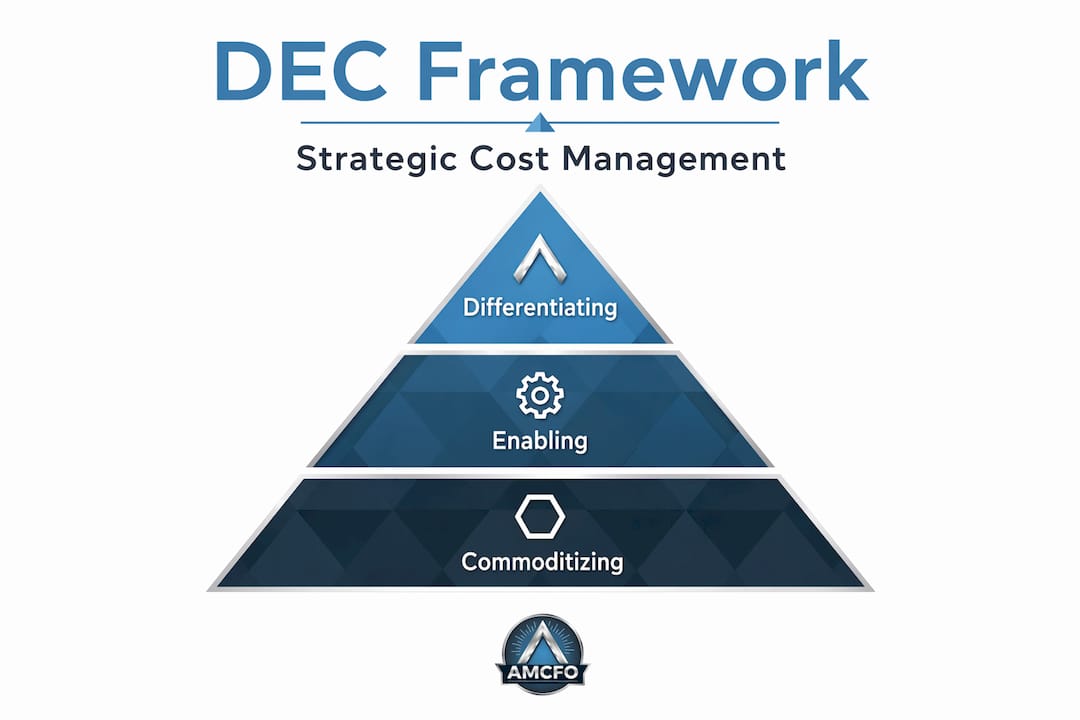
Most business owners cut costs by looking at the biggest line items. That's the wrong starting point. Cutting the wrong costs can hollow out your competitive position. The smarter approach is the DEC framework, which classifies costs as Differentiating, Enabling, or Commoditizing to align spending with value creation, driving competitive advantage and profitability.
Here's how the three categories work:
| Cost type | Definition | Strategic action | Example |
|---|---|---|---|
| Differentiating | Funds capabilities that make you unique | Invest and protect | Proprietary software, specialized talent |
| Enabling | Keeps the business running efficiently | Optimize and standardize | Accounting, HR, IT infrastructure |
| Commoditizing | Adds little competitive value | Minimize aggressively | Generic supplies, redundant subscriptions |
The power of this framework is that it reframes every budget conversation. Instead of asking "can we afford this?" you ask "does this make us harder to compete with?" That shift in question changes every answer.
Practical benefits of applying DEC to your business:
- Clearer investment priorities: You stop spreading budget evenly and start funding your actual advantages
- Faster cost reduction decisions: Cutting commoditizing costs becomes obvious and defensible
- Better vendor negotiations: When you know a cost is commoditizing, you negotiate harder or switch suppliers without hesitation
- Alignment across the team: When everyone understands why certain costs are protected, budget debates shrink
This is where strategic management thinking intersects directly with finance. Your financial management practices become a reflection of your competitive strategy, not just a ledger of expenses.
Implementing strategic financial guidance in your business
Now that you understand the what and why, let's look at how to implement strategic financial guidance effectively.
Getting started doesn't require a finance team or a six-figure software budget. It requires a process and the discipline to follow it. Here's a practical sequence:
- Run a financial health assessment. Before you forecast anything, understand your current state: gross margin by product line, days sales outstanding, fixed vs. variable cost split, and actual monthly cash burn.
- Set 3 to 4 clear financial goals for the next 12 months. Make them specific and measurable. "Improve net margin by 3 points" is a goal. "Grow the business" is not.
- Build your first rolling forecast. Start with a 13-week cash flow model. It doesn't need to be perfect. A rough forecast that you update weekly is worth more than a precise one you look at quarterly.
- Schedule monthly financial reviews. Block 90 minutes per month. Review actuals vs. forecast, identify the top three variances, and decide what changes.
- Bring in expert support. Fractional CFOs provide part-time senior finance leadership to implement and sustain strategic financial guidance affordably for SMBs. They also hold you accountable to the process.
- Automate your data feeds. Connecting your accounting software, payroll system, and bank feeds to a single dashboard removes the manual work that causes most businesses to abandon their forecasts.
Pro Tip: If your financial review is taking longer than two hours per month, your model is too complex. Simplify the inputs until the review is fast enough to actually happen every month without it feeling like a burden.
If you're weighing whether hiring a fractional CFO makes sense for your stage of business, consider the alternative: making major decisions on gut instinct with no structured financial process. The cost of bad decisions almost always exceeds the cost of financial planning services.
Why many SMBs miss the power of strategic financial guidance
Here's an uncomfortable truth most financial advisors won't tell you: the biggest reason small businesses don't benefit from strategic financial guidance isn't the cost. It's the mindset.
Most SMB owners treat their financials as a record-keeping obligation, something you do for the IRS and the bank. The monthly report comes in, they check whether profit is up or down, and they move on. That's not guidance. That's a rearview mirror.
Finance leaders are shifting from "steward" to "performance leader" roles using AI and driver-based models to enhance forecast accuracy and focus on insights. Even at the SMB level, this shift is happening, and the businesses that embrace it are separating from the ones that don't.
The companies we see getting the most value from strategic financial guidance share one trait: they use their financials to have arguments. Not hostile ones, but productive ones. "Our model says hiring that salesperson doesn't break even for 14 months. Is that acceptable given our growth targets?" That's a conversation that leads somewhere. "Revenue is up 12%" is not.
The other mistake is treating strategic financial guidance as a one-time engagement. You can't hire a consultant for a month, build a financial model, and call it done. Markets shift, costs change, customers leave. The model needs to breathe. It needs to be fed new data, challenged by new scenarios, and updated by people who understand your business. That's the ongoing collaboration that makes guidance genuinely strategic rather than just expensive.
If you want a practical starting point, business finance advisory that combines bookkeeping, forecasting, and CFO-level thinking is the most efficient path for most SMBs.
How AmCFO supports your strategic financial guidance
With these strategies in mind, AmCFO is here to help you put strategic financial guidance into action for lasting business success.
At AmCFO, we work directly with small and medium-sized businesses to build the financial clarity that drives real decisions. Our fractional CFO services bring senior finance leadership to your business without the cost of a full-time hire. We set up rolling forecasts, build scenario models, apply the DEC framework to your cost structure, and run monthly reviews that actually lead to action.
We also offer business consulting that connects your financial strategy to your operational goals, so your numbers and your business plan are always aligned. From bookkeeping and QuickBooks cleanup to full-service financial management and planning, our engagements are sized to your business and your budget. If you're ready to stop reacting and start leading with your financials, we're the team to help you get there.
Frequently asked questions
What is strategic financial guidance and why does my SMB need it?
Strategic financial guidance is expert support in managing your business finances to improve decisions, forecast future outcomes, and drive growth. A fractional CFO provides strategic leadership tailored to SMBs, helping you avoid cash crises and improve profitability in ways that standard bookkeeping alone cannot.
How does a 13-week rolling forecast help manage cash flow?
A 13-week rolling forecast projects your cash week by week over three months and updates continuously so you can spot shortfalls early. The 13-week cash flow forecast is a dynamic management tool that prevents cash crises by giving you enough advance warning to act before the problem hits your bank account.
What are the differentiating, enabling, and commoditizing costs?
Differentiating costs build your competitive edge and should be protected; enabling costs keep the business running and should be optimized; commoditizing costs add little value and should be cut aggressively. The DEC framework aligns cost management with value creation so your budget reflects your actual competitive strategy.
Can a fractional CFO really improve my strategic financial guidance?
Yes. Fractional CFOs provide strategic leadership without full-time cost, bringing senior finance expertise part-time to implement forecasting, scenario planning, and decision-focused financial management that most SMBs couldn't otherwise access.