

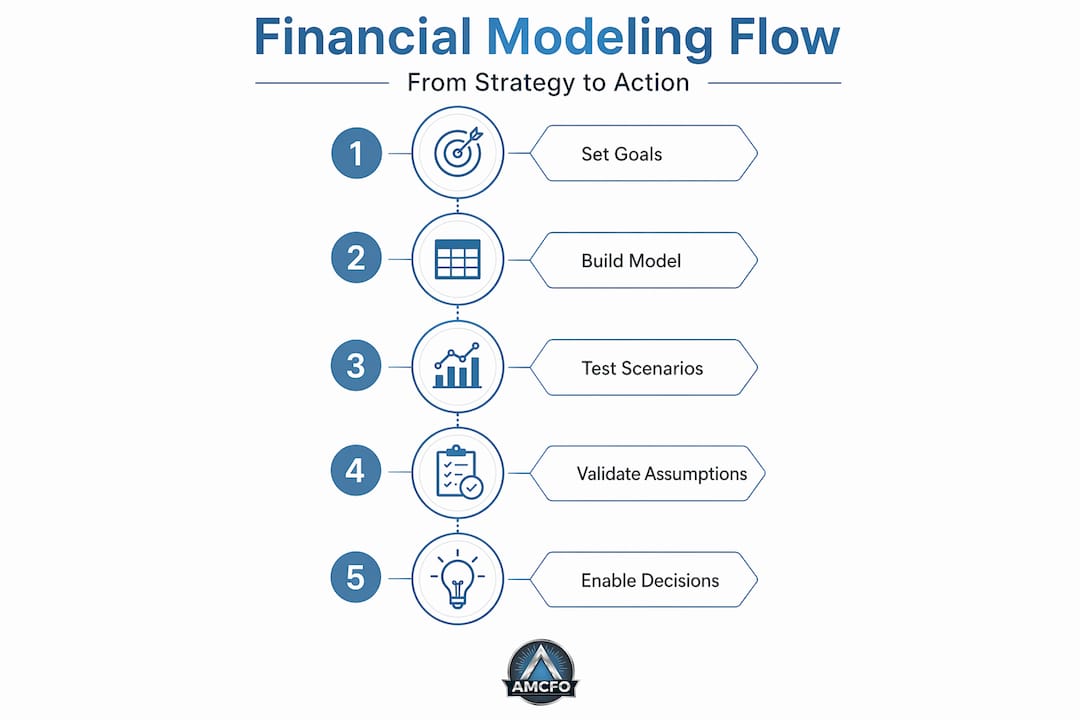
Most small and mid-sized business owners assume financial modeling belongs in the boardrooms of Fortune 500 companies, handled by analysts with MBA degrees and Bloomberg terminals. That assumption is costing you. Financial modeling, done right, is simply the practice of building a logical, number-based framework that connects your strategic choices to real financial outcomes. It tells you what a decision will actually cost, what it might earn, and where the risks are hiding before you commit a dollar. This guide breaks down how strategic financial modeling works, why it matters for growing businesses, and how to put it to work in your own planning process.
Table of Contents
- Defining financial modeling in a strategic context
- Translating strategy into financial assumptions
- Scenario analysis: Exploring alternatives and trade-offs
- Governing the process: Assumptions, KPIs, and actionability
- Addressing uncertainty: Beyond sensitivity to integrated scenario planning
- What most business owners miss about financial modeling
- Get expert support for strategic financial modeling
- Frequently asked questions
Key Takeaways
| Point | Details |
|---|---|
| Strategic modeling is accessible | Financial modeling enables even small businesses to make better decisions when it connects strategy and numbers. |
| Scenario analysis clarifies risk | Comparing 'what if' scenarios helps you foresee outcomes and choose smarter paths confidently. |
| KPIs drive actionable insights | Highlighting the right KPIs ensures your model leads to real decisions, not just more reporting. |
| Governance beats complexity | Simple, regularly updated models with defined assumptions and owners outperform unused, complex spreadsheets. |
| Address uncertainty explicitly | Combine sensitivity and scenario planning to account for surprises and avoid false confidence. |
Defining financial modeling in a strategic context
Now that we've established the importance of financial modeling, let's clarify what makes a model strategic.
Most people confuse financial modeling with bookkeeping or basic forecasting. Bookkeeping records what already happened. Forecasting projects what will probably happen based on current trends. Strategic financial modeling does something different: it frames a specific business decision into a set of financial assumptions, then shows you the likely consequences of that decision before you make it.
Think of it this way. A forecast tells you that revenue will likely grow 8% next year based on last year's trajectory. A strategic model asks: "What happens to revenue, margin, and cash flow if we launch a second product line in Q2?" Those are very different questions, and they require very different tools.
As financial modeling for strategy demonstrates, strong models translate strategic choices into explicit financial assumptions, making your thinking visible and testable.
Here's what every strategic model needs:
- A clear business question: What decision are you actually trying to make?
- Key drivers: The variables that most influence the outcome, such as price, volume, or cost per unit
- Realistic assumptions: Numbers grounded in your actual operations, not just industry averages
- KPI linkages: Connections between model outputs and the metrics you track daily
- Scenario flexibility: The ability to change inputs and see how outcomes shift
One important myth to address: you don't need a sophisticated, 40-tab spreadsheet to get value from financial modeling. A simple model that connects your strategy to your numbers, reviewed regularly, will outperform a complex one that nobody uses. The connection between business goals and financial outcomes is what creates value, not the complexity of the model itself. Our financial modeling guide walks through this in practical terms for business owners at every stage.
"Financial modeling supports strategy by translating strategic choices into explicit financial assumptions." — Corporate Finance Institute
Translating strategy into financial assumptions
With the basics in place, let's see how big-picture strategy is reflected in the numbers you use.

Here's where most owners get stuck. They have a strategy ("we're going to expand into a new market") but they struggle to turn that strategy into model inputs. The gap between strategic intent and financial assumption is where plans fall apart.
Strategic context improves assumption realism and forecast usefulness, which is why the translation process matters so much. Here's a numbered process that works:
- Identify the strategic choice: Be specific. "Enter the Dallas market with our core service offering by Q3 2026."
- Determine the key drivers: What variables will most affect the outcome? For a market entry, those might include target customer count, average deal size, sales cycle length, and local staffing costs.
- Translate drivers into assumptions: Assign actual numbers. "We expect to close 15 new clients in the first six months at an average contract value of $4,200, with two dedicated salespeople at a fully loaded cost of $85,000 each."
- Link assumptions to financial outputs: Connect those numbers to your revenue, gross margin, and operating cash flow projections.
- Validate against your operational plan: If your operations team says they can only onboard 10 clients in six months, your revenue assumption needs to change.
The table below shows why realistic, strategy-anchored assumptions produce far more useful models than generic industry benchmarks.
| Assumption type | Example input | Model output | Usefulness |
|---|---|---|---|
| Generic industry average | 12% revenue growth | Projected revenue: $1.12M | Low: doesn't reflect your market |
| Realistic, strategy-anchored | 15 new clients at $4,200 each | Projected revenue: $63,000 new | High: tied to actual sales plan |
| Overly optimistic | 50% market capture in Year 1 | Projected revenue: $2.5M | Dangerous: creates false confidence |
| Conservative, validated | 8 clients in 6 months, 15 by year end | Projected revenue: $63,000 to $126,000 | High: supports resource planning |
Pro Tip: Don't import industry averages without stress-testing them against your own data. If your average sales cycle is 90 days but the industry benchmark is 45, using the benchmark will make your cash flow projections dangerously optimistic. Anchor every assumption to your actual operational plans, and document why you chose each number. Our business consulting insights and CFO advisory engagement tips can help you build that discipline into your planning process.
Scenario analysis: Exploring alternatives and trade-offs
Once strategy is translated into numbers, the real power emerges when you compare different paths using scenario analysis.
Scenario analysis is the practice of building multiple versions of your model, each reflecting a different set of conditions or strategic choices, and then comparing them side by side. It's how you test your strategy before you bet real resources on it.
Scenario analysis is a core methodology for strategic financial modeling because it forces you to think through multiple futures rather than anchoring to a single prediction.
Common scenarios every SMB should model include:
- Base case: Your most realistic projection, built on validated assumptions
- Best case: What happens if key drivers perform 20 to 30% better than expected
- Worst case: What happens if revenue comes in 20 to 30% below plan
- Disruption event: What happens if a major customer leaves, a competitor enters your market, or a supply chain issue hits
- Strategic alternative: What happens if you pursue Option A versus Option B
Here's a simplified side-by-side comparison for a business considering a new product launch:
| Metric | Base case | Best case | Worst case |
|---|---|---|---|
| New product revenue (Year 1) | $180,000 | $260,000 | $95,000 |
| Gross margin | 42% | 48% | 34% |
| Break-even month | Month 9 | Month 6 | Month 16 |
| Net cash impact (Year 1) | ($22,000) | $38,000 | ($87,000) |
| Headcount required | 2 FTEs | 3 FTEs | 1 FTE |
Looking at this table, the worst case shows a significant cash drain and a break-even point well beyond the first year. That information is critical. It tells you whether you have the cash reserves to survive the downside, and whether the upside is worth the risk. Without scenario analysis, you're flying blind.
Pro Tip: Use scenarios to communicate operational risks and opportunities to your team, not just financial outcomes. When your sales manager sees that the worst case requires cutting back to one full-time employee, that's a conversation worth having before you launch. Our strategic management guide and financial forecasting tips offer deeper frameworks for building this kind of planning discipline.
Governing the process: Assumptions, KPIs, and actionability
Getting maximum value from strategic modeling requires more than just one-time analysis. It's an ongoing process.
A financial model built in January and never touched again is just a document. A model that gets reviewed monthly, updated as conditions change, and used to drive real decisions is a strategic asset. The difference is governance.
Practical strategic use requires governance and KPI discipline: define metrics clearly, validate assumptions, and ensure reporting is actionable. Here's a numbered framework that works for most SMBs:
- Define your KPIs upfront: Before building the model, agree on which metrics matter most. Gross margin, customer acquisition cost, monthly recurring revenue, and operating cash flow are common starting points.
- Set a review cadence: Monthly reviews for fast-moving businesses, quarterly for more stable ones. Put it on the calendar and treat it like a board meeting.
- Refresh key drivers regularly: If your supplier raised prices, update the cost assumption immediately. Don't wait for the annual review.
- Compare actuals to model outputs: Each month, compare what actually happened to what the model predicted. The gap is where learning lives.
- Tie outcomes to next steps: Every review should end with at least one action item. "Our customer acquisition cost is running 15% above assumption. We'll audit our marketing spend by the end of the month."
"Define metrics clearly, validate assumptions, and ensure reporting is actionable." — QuickBooks Financial Planning and Analysis
The biggest mistake businesses make is building models that produce reports nobody acts on. If your team reads the monthly model output and then moves on without changing anything, the model isn't doing its job. Strong cash flow management practices and a clear financial management planning framework both depend on this kind of active, ongoing engagement with your numbers.
Addressing uncertainty: Beyond sensitivity to integrated scenario planning
With robust governance in place, it's time to tackle uncertainty head-on without falling into the trap of false precision.
There's an important distinction between sensitivity analysis and scenario planning that most business owners miss. Sensitivity analysis changes one variable at a time to see its isolated impact. Scenario planning changes a coherent set of variables together to reflect a realistic alternative future.
Models should incorporate uncertainty by combining sensitivity analysis with scenario planning to avoid false precision. Both tools are valuable, but they answer different questions.
For example, a sensitivity analysis might show that a 2% drop in gross margin reduces annual profit by $40,000 on a $2M revenue base. That's useful. But a scenario plan goes further: it models what happens when margin drops 2% and a key customer reduces their contract and you need to hire an additional employee to handle compliance requirements. That combination is far more realistic and far more actionable.
Here's how to incorporate both into your monthly reviews:
- Run a sensitivity check on your top three drivers each month: Price, volume, and cost are usually the most impactful
- Build one new scenario per quarter: Reflect a realistic strategic alternative or market shift you're monitoring
- Document your assumptions explicitly: Write down why you chose each number so you can challenge them later
- Set trigger points: Define the conditions under which you'll shift from your base case to your contingency plan
- Share the analysis with your leadership team: Uncertainty is a team conversation, not a finance department secret
The most dangerous thing you can do with a financial model is fall in love with a single forecast. Overconfidence in one detailed projection is how businesses get blindsided. Build in uncertainty from the start, and your model becomes a tool for resilience rather than a source of false comfort. For a deeper look at the mechanics, our financial modeling basics resource covers the foundational structure in plain language.
What most business owners miss about financial modeling
After learning these practical methods, it's time for some candid advice on what really matters with financial modeling.
Here's the uncomfortable truth: the businesses that get the most value from financial modeling aren't the ones with the most sophisticated spreadsheets. They're the ones that use their models in actual conversations, every month, with the people who make decisions.
We've seen business owners invest significant time building elaborate, multi-tab models with dynamic charts and color-coded dashboards. Then those models sit untouched for six months because nobody made them part of the regular business rhythm. Meanwhile, a competitor running a simple three-tab model reviewed in every leadership meeting is making faster, smarter decisions.
The real value of a financial model isn't in its technical complexity. It's in what it forces you to do: articulate your assumptions, make your strategy explicit, and confront the gap between what you hoped would happen and what actually did.
Pro Tip: The best model is the one your team actually uses in ongoing strategy sessions. If your model lives only in the CFO's laptop, it's not a strategic tool. It's a filing cabinet.
Sophisticated spreadsheets don't compensate for poor strategic thinking or unclear business objectives. If you don't know what question you're trying to answer, no amount of modeling will help. Start with the decision, then build the model around it.
A simple model, reviewed monthly, with clear assumptions and direct ties to your KPIs, will consistently outperform an elaborate model that collects dust. The goal is to make financial modeling a living part of your business conversation, not a year-end ritual. Our practical modeling guide is a good starting point for building that habit.
Get expert support for strategic financial modeling
Ready to put strategic financial modeling into practice? Here's how you can take the next step.
Building a financial model that actually drives decisions takes more than a spreadsheet template. It takes someone who understands both your business strategy and the financial mechanics behind it.

At AmCFO, we work with small and mid-sized businesses to design, validate, and apply financial models that connect directly to strategic goals. Whether you need help building your first scenario analysis, cleaning up an existing model, or integrating financial modeling into your monthly decision-making process, our fractional CFO services are built for exactly that. We also offer business consulting solutions that help you align financial planning with your broader growth strategy. Reach out to start a conversation about how strategic modeling can work for your business.
Frequently asked questions
What is the difference between financial modeling and financial forecasting?
Financial modeling builds a logical framework to test strategies and scenarios, while forecasting typically projects a single set of expected results based on current trends. As financial modeling for strategy shows, modeling translates strategic choices into explicit financial assumptions, which goes well beyond a standard projection.
Which KPIs matter most in strategic financial modeling?
KPIs should link directly to your business strategy, such as margin, growth rate, or customer acquisition cost, and they must be clearly defined and actionable. Practical strategic use of financial modeling requires KPI discipline, meaning you define metrics clearly before building the model.
How often should I update my financial model?
Update your model monthly or quarterly to keep assumptions accurate and outcomes actionable. Rolling cadence and alignment to operations are critical for keeping models useful rather than decorative.
How does scenario analysis improve strategic decisions?
Scenario analysis lets you test multiple strategies and see financial and operational impacts before committing resources. Scenario analysis is a core methodology for strategic financial modeling because it evaluates multiple strategic alternatives simultaneously.
Do I need advanced software for strategic financial modeling?
No. Clarity in linking strategy and assumptions matters more than software complexity for effective modeling. Effectiveness depends less on spreadsheet sophistication and more on translating strategy into actionable, assumption-driven inputs.