

Before you run payroll, verify five things: worker classification and forms (W-4, I-9) are current, your EIN and state tax accounts are active, hours and overtime are approved, taxes and net pay are funded, and deposits will hit the IRS and state agencies on time. Skip any one of these and you're looking at penalties, back taxes, or a Department of Labor complaint. Everything below breaks those five checks into a routine you can actually run every pay period.
TL;DR:
- Most small businesses overlook updating employee classifications, which can trigger Department of Labor audits if not verified before each payroll.
- Confirming timely registration for state and local taxes, including advances on upcoming changes, helps avoid costly penalties and penalties for misfiling.
- Implementing a double-review system with initial and independent approval significantly reduces errors and provides a solid paper trail for audits.
- Regularly checking and updating exemption status and wage thresholds prevents violations related to overtime and minimum wage laws.
- Monitoring local payroll tax obligations in specific cities or counties ensures comprehensive compliance beyond state and federal regulations.
Table of Contents
- Building Your Payroll Compliance Checklist Step by Step
- Tax Registrations, Deposit Schedules, and Filing Deadlines
- Multistate Payroll: Where Nexus Traps Small Employers
- Internal Controls, Recordkeeping, and Payroll Security
- Year-End Reconciliation and Correcting Payroll Mistakes
- AmCFO Templates and When to Bring in Fractional CFO Support
- Pay Schedules, Overtime, and the FLSA Line Every Employer Must Get Right
- Handling a Payroll Audit Without Panicking
- Local Payroll Tax Rules Hiding Below the State Level
- Keeping Payroll Compliant as Rules Change Through the Year
- Accessibility Requirements for Payroll Systems
- Payroll as Strategic Finance, Not Just a Monthly Task
- How AmCFO Supports Payroll Compliance and Fractional CFO Needs
- Sources
Building Your Payroll Compliance Checklist Step by Step
A payroll compliance checklist only works if it gets used the same way, every time, by someone other than the person who just entered the numbers. That's the whole idea behind a "pre-flight" check: a short, repeatable review that happens between "payroll is entered" and "payroll is submitted." Airlines don't skip pre-flight because the pilot is experienced. Payroll teams shouldn't either, and the Department of Labor's guidance on payday laws treats this kind of per-cycle verification as the baseline for employer compliance, not an extra step for the cautious.
Here's the sequence worth running before every single payroll, regardless of whether you process weekly, biweekly, or monthly.
- Check for classification changes. Did anyone move from contractor to employee, part time to full time, or nonexempt to exempt this cycle? Misclassification is one of the most common triggers for a Department of Labor audit.
- Confirm W-4, I-9, and Social Security numbers are on file and current for every new hire before their first check goes out.
- Verify hours and overtime. Pull the timesheet totals against the schedule. Flag anyone whose overtime jumped unusually from their typical pattern. That's usually a data entry error, not a real spike.
- Confirm PTO and leave approvals. Unapproved time off that gets paid anyway is a recurring audit finding, especially for salaried exempt employees whose PTO tracking tends to get sloppy.
- Review special payments. Commissions, bonuses, retroactive raises, and expense reimbursements each carry different tax treatment. Mixing them up misstates withholding.
- Recheck benefit deductions. Did anyone add a dependent, change a health plan tier, or hit a 401(k) contribution limit mid-cycle?
- Verify garnishment orders. Confirm the amount and priority order haven't changed and that you're still within state and federal withholding limits.
- Confirm funding. Is there enough in the payroll account to cover net pay plus the employer's share of taxes? This sounds obvious until the week your biggest client pays late.
- Review the payroll register line by line. A quick script works here: "Does this pay period's gross wages align with hours worked and rate? Does the tax withheld match the employee's W-4 elections? Are deductions applied in the correct order?"
- Get a second person's sign-off. Someone other than the preparer approves the run before it submits.
That last step is the one most small businesses skip, usually because there's no second person available. It's also the one with the highest return. A Forbes Advisor analysis of payroll management practices points to this kind of "four-eyes" control, one person enters, a different person reviews, as a low-cost way to catch errors before they become a filing, not after.
Pro Tip: Don't try to review every line of every payroll register. Instead, pull a small sample of your highest-risk items each cycle, new hires, anyone with an overtime spike, and anyone with a garnishment, and check those in detail. You'll catch most real problems without spending an hour on a review nobody has time for.
Build this into a simple form with two columns: one for the preparer to initial each item, one for the approver to initial after independent review. It takes ten minutes once you have the fields memorized, and it's the single best paper trail you can hand an auditor who asks how you catch errors.
Tax Registrations, Deposit Schedules, and Filing Deadlines
You need an EIN from the IRS before you can file Form 941, plus a state withholding account and a State Unemployment Tax Act (SUTA) account in every state where you have employees. Most state labor department or department of revenue websites list registration requirements directly. A Shopify guide to payroll setup walks through this registration sequence, and it's worth completing before your first payroll run, not after.
Federal deposit timing depends on your lookback period: employers who reported more than $50,000 in Form 941 taxes during the lookback period deposit semiweekly; smaller employers typically deposit monthly. Miss a deposit deadline and penalties start accruing immediately, and they escalate the longer the deposit sits unpaid.
Build a filing calendar around these recurring dates:
- Form 941 (quarterly federal tax return): due the last day of the month following each quarter
- Form 940 (annual FUTA return): due January 31
- W-2 distribution to employees and SSA: due January 31
- State withholding and SUTA filings: deadlines vary by state, usually quarterly
Set your internal due date ahead of the actual deadline to allow for contingencies. That buffer catches bank holidays and the inevitable "the file didn't upload" moment.
The retention stakes are real. Federal rules require employers to retain payroll records for at least three years and time cards for at least two, and several states extend that window further.
Multistate Payroll: Where Nexus Traps Small Employers
The rule is simple to state and easy to get wrong in practice. You generally owe withholding and unemployment tax in the state where the employee physically performs the work, not necessarily where your company is headquartered. One remote hire in a new state can create payroll tax nexus you didn't plan for.
Run this check whenever you hire someone new or someone relocates:
- Confirm the employee's primary work location with a signed attestation, not just their mailing address.
- Register for withholding and SUTA in that state if you don't already have accounts there.
- Keep timesheets that show location, not just hours, for anyone working remotely across state lines.
- Update your remote-work policy to require notice before an employee relocates.
Documented attestation and contemporaneous time-location logs are what you'll need if a state auditor questions your withholding choices later, and DOL guidance on employer payday responsibilities backs the value of that kind of paper trail. If you discover a missed registration going back several quarters, most states have voluntary disclosure programs that reduce penalties. That's usually the point to bring in a payroll professional rather than untangle it alone. Our guide on handling multi-state payroll nexus covers the registration sequence in more detail.
Internal Controls, Recordkeeping, and Payroll Security
Retention is the floor, not the ceiling. Keep payroll records at least three years and time cards at least two, per federal DOL minimums, then check your state's rules since several require longer windows or specific pay-stub disclosures.
Beyond retention, four controls do most of the work:
- Segregation of duties. The person entering payroll shouldn't be the same person approving it or controlling the bank transfer.
- Payroll register reconciliation. Match each run against your general ledger before you close the books each month.
- Bank account controls. Limit who can initiate a payroll transfer, and require a second approval for any change to direct deposit routing numbers.
- Access logging on your payroll platform. Know who viewed or edited employee pay data and when.
If you outsource payroll, ask the provider for their SOC 2 report or equivalent vendor evidence. It's a fair question, and any legitimate provider will have an answer ready. Our checklist for organizing financial records covers retention practices that apply directly to payroll files.
Pro Tip: Review who has access to your payroll system every quarter, not just when someone leaves the company. Former employees, old vendor logins, and "temporary" access granted during a busy season are the most common gaps auditors find.
Year-End Reconciliation and Correcting Payroll Mistakes
January is unforgiving if you haven't reconciled all year. Here's the compact version:
- Reconcile cumulative tax liability for each quarter against your filed 941s and your annual 940 before you touch W-2s.
- Issue W-2s to employees and 1099s to contractors by January 31, and file copies with the Social Security Administration and IRS by the same date.
- Correct errors with Form W-2c for wage or withholding mistakes, and document why the correction happened, not just what changed.
- Address late deposits immediately. Penalties compound the longer a shortfall goes unresolved, so don't wait for the notice to arrive before fixing it.
- Assign sign-off responsibility. One person reconciles, a different person approves the final W-2 batch before it goes out.
Misclassified workers, late deposits, and sloppy overtime math remain the most common sources of payroll penalties, and January is when uncorrected mistakes from earlier in the year finally surface on a form the IRS actually reads.
AmCFO Templates and When to Bring in Fractional CFO Support
A simple pre-flight template covers five columns: pay period, item checked, preparer initials, approver initials, and notes. Copy that structure into a spreadsheet or your payroll software's audit trail and you've got documentation ready for any auditor who asks how errors get caught.
Complexity is the signal to bring in outside help. Multi-state hires, a sudden headcount jump, a state audit notice, or garnishment orders you've never processed before are all points where a fractional CFO earns their fee fast. Our guide to payroll support for growing businesses covers the specific triggers, and our piece on switching payroll providers without missing a payday walks through the transition mechanics if your current setup isn't holding up.
Pay Schedules, Overtime, and the FLSA Line Every Employer Must Get Right
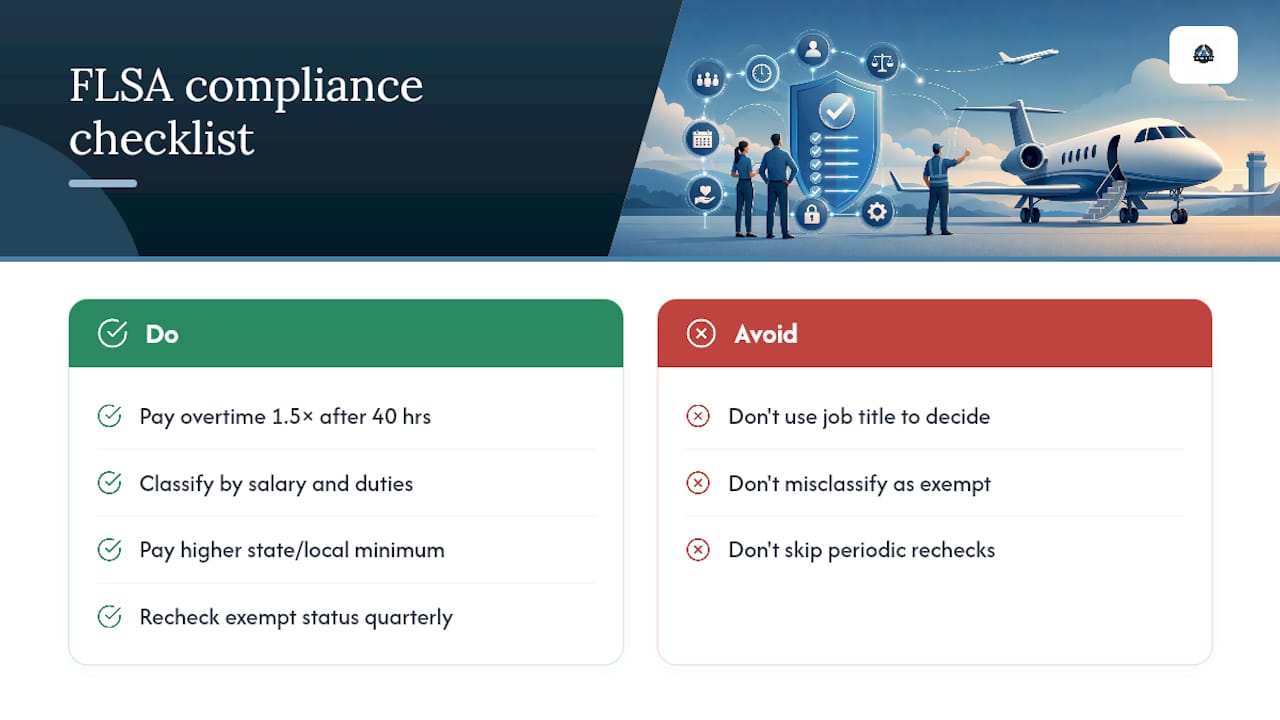
The Fair Labor Standards Act sets the floor: nonexempt employees earn overtime at 1.5 times their regular rate for hours worked beyond 40 in a workweek, regardless of whether they're paid hourly or salaried. Getting someone's exempt status wrong is one of the fastest ways to accumulate back pay liability, because it compounds every single pay period until someone catches it.
Exempt status isn't about job title. It depends on salary level and actual job duties under the executive, administrative, professional, or outside sales exemptions.
Pay schedule affects compliance too, not just cash flow. States set their own rules on minimum pay frequency, and some require weekly or semimonthly pay for certain industries regardless of what your payroll system defaults to. Federal minimum wage sets the floor at the national level, but many states and cities set their own, higher minimums, and you owe the higher of the two wherever your employee works.
Run this check quarterly, not just at hiring: pull anyone classified exempt and confirm their salary still meets the current threshold and their actual duties still match the exemption. Duties drift as businesses grow, salary thresholds get updated by regulation, and an exemption that was accurate two years ago can quietly become wrong without anyone changing a single form.
Handling a Payroll Audit Without Panicking
A payroll audit, whether it's a Department of Labor wage-and-hour investigation or a state unemployment insurance audit, usually starts with a request for records: time cards, payroll registers, tax filings, and employee classification documentation for a specific period. How fast and how completely you produce that documentation shapes the entire outcome.
The single best preparation is the recordkeeping you should already be doing: three years of payroll records, two years of time cards, and clean documentation of every classification decision. If those exist and are organized, most audits move quickly and close without penalty.
If the auditor finds a violation, misclassified overtime, an underpaid minimum wage claim, a missed deposit, respond in writing, correct the underlying error going forward, and calculate back pay or back taxes for the affected period rather than disputing the finding reflexively. Auditors generally treat voluntary, prompt correction more favorably than a drawn-out dispute over a clear violation.
Where the finding is genuinely disputable, involve a professional (a CPA, an employment attorney, or a fractional CFO who's handled audits before) rather than negotiating alone. The cost of representation is almost always smaller than the cost of a bad settlement or an expanded audit scope triggered by an inconsistent response.
Local Payroll Tax Rules Hiding Below the State Level
State compliance isn't the finish line. A number of cities and counties layer their own payroll taxes on top of state and federal obligations, and these are easy to miss because they don't show up in a general state registration search.
Local requirements to check for every location where you have employees include:
- City or county income tax withholding, common in several states with municipalities that levy their own earnings tax.
- Local business license or payroll tax registration, sometimes tied to gross payroll rather than revenue.
- Occupational privilege taxes, a flat per-employee fee some cities charge regardless of income level.
The safest approach is to check your specific city and county government websites directly rather than relying on your state's page alone, since local rules change independently of state legislation and rarely make it into general payroll guides.
Keeping Payroll Compliant as Rules Change Through the Year
Payroll regulations don't hold still. Pay transparency laws, paid family and medical leave (PFML) programs, and local minimum wage increases have all expanded steadily across states over the past several years, and 2026 is bringing another round of state-level adjustments to minimum wage floors, PFML contribution rates, and pay-equity disclosure rules.
The practical fix is a standing habit, not a one-time project: maintain a short log of every state and local rule change that affects your payroll, reviewed on a quarterly cadence rather than only when something breaks. That quarterly discipline is what catches a new state's paid leave contribution requirement before your first missed deduction rather than after.
Subscribe to your state labor department's employer bulletin. Most publish free email updates when rules change, and it beats finding out from a penalty notice.
Accessibility Requirements for Payroll Systems
Payroll systems fall under the same accessibility expectations as other employee-facing digital tools. If your business is covered by the Americans with Disabilities Act (ADA), employees need equivalent access to their own pay information, whether that means a screen-reader-compatible pay stub portal or an alternative format for employees who can't use the standard online platform.

Practical steps: confirm your payroll provider's employee portal meets basic accessibility standards, offer a paper or alternative-format pay stub on request, and make sure any required workplace postings about wage and hour rights are available in accessible formats too. This is a smaller line item than tax deposits, but it's an easy one to overlook until an employee requests an accommodation you haven't planned for.
Payroll as Strategic Finance, Not Just a Monthly Task
Payroll problems rarely start with fraud. They start with a classification nobody revisited, a new state hire nobody flagged, or a deposit deadline that quietly slipped for one quarter. Each one seems minor in isolation and expensive in the aggregate.
The businesses that avoid this treat payroll as a finance function with real strategic weight, not an administrative afterthought. When a client crosses into multiple states or their headcount jumps fast, that's the moment to escalate beyond internal checklists toward advisory support.
— Angelica
How AmCFO Supports Payroll Compliance and Fractional CFO Needs
A checklist catches errors. It doesn't fix a broken registration, untangle a multi-state misclassification, or tell you whether your current payroll setup can handle the growth you're planning for next quarter. That's where AmCFO's payroll support and fractional CFO services pick up where the checklist leaves off.

An initial engagement typically starts with a payroll health check: a review of your current classifications, tax registrations, deposit history, and internal controls, followed by a prioritized list of what needs fixing first and what can wait. From there, many businesses engage ongoing support covering payroll tax coordination, multi-state registration support, and fractional CFO oversight as complexity grows. If you're not sure whether your current setup would survive a state audit, that's exactly the question a health check answers. Visit AmCFO's accounting and bookkeeping services page to see how a first engagement typically starts, or explore the full range of fractional CFO services to find the right level of ongoing support for where your business is headed.
Sources
- Payroll Management: The Ultimate Guide – Forbes Advisor
- How to manage payroll (Shopify guide)
- DOL guidance on state payday laws and employer responsibilities