

Payroll support refers to the dedicated services and resources that help businesses accurately manage employee compensation, tax filings, regulatory compliance, and payroll-related inquiries. For business owners and HR managers, getting this right is not optional. A single missed filing or miscalculated wage can trigger IRS penalties, damage employee trust, and create audit exposure. This guide breaks down what payroll support actually includes, how processing differs from administration, and how to choose the right solution for your business.
What does payroll support actually include?
Payroll support covers far more than cutting checks on payday. Full-service payroll includes wage calculation, tax withholding, direct deposit, garnishment management, and ongoing compliance tracking. That scope means your payroll function touches employment law, benefits administration, and financial reporting all at once.
Most payroll management services fall into three delivery models:
- In-house payroll: Your HR or finance team handles all calculations, filings, and employee inquiries using internal software. This works well when your workforce is small and your pay structure is straightforward.
- Outsourced payroll solutions: A third-party provider manages the full payroll cycle, from data entry to tax deposits. This model reduces internal workload and shifts compliance responsibility to specialists.
- PEO or managed payroll services: A Professional Employer Organization co-employs your workforce and takes on payroll, benefits, and HR compliance under one contract. This is the most comprehensive option for businesses with complex pay scenarios.
Responsiveness is a defining quality of any reliable provider. High-touch payroll providers typically respond to support inquiries within 2 hours or less. That speed matters when a direct deposit fails or an employee questions a deduction on payday.
Pro Tip: Ask any payroll provider for their average response time in writing before signing a contract. A provider who cannot commit to a specific number is telling you something important.

How do payroll processing and payroll administration differ?
Business owners frequently treat these two terms as interchangeable. They are not, and the confusion leads to real problems.
Payroll processing refers to calculating and distributing wages, whereas payroll administration covers the broader system including tax filings, benefits, and compliance management. Processing is the mechanical step. Administration is the ongoing governance layer that keeps your business legal.
| Function | Payroll processing | Payroll administration |
|---|---|---|
| Core activity | Calculate and distribute wages | Manage filings, benefits, and compliance |
| Frequency | Each pay period | Continuous, year-round |
| Risk if neglected | Late or incorrect pay | Tax penalties, audit exposure |
| Who typically owns it | Payroll software or processor | HR manager, CFO, or outsourced advisor |
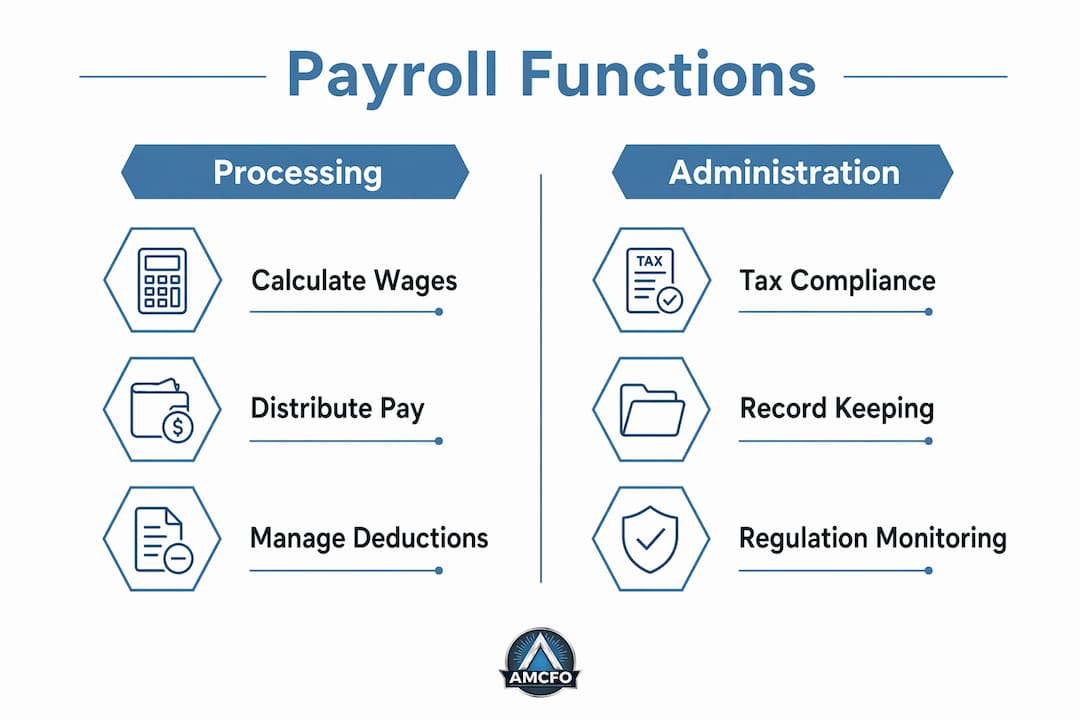
The gap between the two is where most payroll mistakes live. A business can run payroll processing correctly every two weeks and still face a penalty because someone missed a quarterly 941 filing or failed to update a state withholding rate. Payroll administration mistakes, such as missed filings or incorrect tax calculations, lead to costly penalties. Dedicated payroll support closes that gap by covering both functions under one accountable structure.
Pro Tip: When reviewing a payroll service contract, confirm explicitly whether tax filing and compliance monitoring are included. Many entry-level payroll platforms handle processing only and leave administration to you.
Best practices to reduce compliance risk and run cleaner payroll
Compliance failures rarely come from one catastrophic error. They accumulate from small process gaps repeated over months. These practices address the most common sources of payroll risk.
-
Use an integrated payroll platform. Integrated payroll platforms consolidate data into one unified system with up-to-date tax and labor laws that flag irregularities automatically. A fragmented setup, where timekeeping, payroll, and benefits live in separate systems, creates reconciliation errors and missed updates.
-
Set a payroll calendar with hard deadlines. Map every federal and state filing deadline for the full year in january. Include Form 941 quarterly deposits, W-2 distribution by january 31, and any state-specific requirements. Treat these dates the same way you treat invoice due dates.
-
Run a pre-payroll audit before every pay run. Check for new hires, terminations, rate changes, and benefit deductions before processing. A five-minute review before each cycle catches most errors before they reach employee paychecks.
-
Assign a single point of contact for payroll questions. When employees have multiple people to ask about pay discrepancies, answers become inconsistent and problems go unresolved. One designated contact, whether internal or at your outsourced provider, creates accountability.
-
Review tax law changes every quarter. Federal and state payroll tax rules change regularly. Subscribe to IRS payroll update notices and your state's department of revenue alerts. Your payroll provider should also flag changes proactively.
-
Document every payroll adjustment. Off-cycle payments, corrections, and manual overrides must be logged with a reason and an approver. This documentation protects you during an audit and helps identify recurring errors.
The primary reason organizations move to managed payroll services is not just to save time. It is to minimize compliance risk and protect business continuity. That shift in motivation explains why businesses with complex pay scenarios, multiple states, or variable compensation structures benefit most from professional payroll processing assistance.
How to choose the right payroll support solution
Choosing a payroll provider is a compliance decision as much as a cost decision. The wrong choice does not just waste money. It exposes your business to penalties, employee disputes, and reputational damage.
Evaluate providers on these criteria:
- Compliance track record. Ask for specifics. How many clients do they serve in your industry? Have they handled multi-state payroll? Evaluating provider experience with regulatory compliance and fast response times is the most critical factor in selecting payroll support solutions.
- Response time commitment. Dedicated payroll specialists with real people answering calls and emails within 2 hours reduce errors and increase workforce satisfaction. Get this commitment in your service agreement.
- Industry specialization. A provider experienced with restaurants handles tip credits and variable hours differently than one built for salaried office workers. Match the provider's expertise to your workforce structure.
- Transparent pricing. Payroll pricing models vary widely. Some charge per employee per pay run. Others bundle services into monthly retainers. Hidden fees for year-end filings or off-cycle runs are common. Request a full fee schedule before committing.
- Scalability. Your payroll needs will change as you hire, expand to new states, or add benefit plans. Choose a provider whose service model can grow with you without requiring a full platform migration.
Outsourcing payroll is as much about reducing compliance risk as it is about saving administrative time. This is especially true for businesses handling complex pay scenarios like commission structures, multiple pay rates, or employees across several states. Providers with over 25 years of experience in managed payroll have built the compliance infrastructure that most small and mid-size businesses cannot replicate internally.
Key Takeaways
Reliable payroll support requires both accurate wage processing and continuous compliance management, and separating the two creates the gaps where most penalties originate.
| Point | Details |
|---|---|
| Processing vs. administration | Payroll processing handles wages; administration covers tax filings and compliance year-round. |
| Response time matters | High-touch providers commit to 2-hour response times, which prevents unresolved errors from compounding. |
| Compliance is the primary driver | Most businesses outsource payroll to reduce compliance risk, not just to save time. |
| Audit every pay run | A pre-payroll review before each cycle catches most errors before they reach employee paychecks. |
| Match provider to your complexity | Multi-state, variable-pay, or high-headcount businesses need providers with proven compliance infrastructure. |
What I have learned from watching payroll go wrong
By Angelica
The businesses I see struggle most with payroll are not the ones that ignore it. They are the ones that assume their current setup is good enough. They process payroll on time every cycle, employees get paid, and nothing seems broken. Then a state audit arrives, or a key HR person leaves, and the gaps become visible all at once.
The most dangerous payroll mistake is treating processing as the whole job. Payroll administration, the part that covers quarterly filings, year-end reconciliation, and benefit deduction accuracy, gets neglected because it is invisible until something goes wrong. By then, the penalties are already accruing.
My honest recommendation: if your business has more than 10 employees, operates in more than one state, or pays any form of variable compensation, do not manage payroll administration internally unless you have a dedicated compliance specialist. The cost of professional payroll and accounting support is almost always lower than the cost of one significant penalty or a corrected W-2 filing season.
The businesses that get payroll right treat it as a compliance function first and a payment function second. That mindset shift changes which questions you ask, which providers you hire, and how much attention you give to the parts of payroll that do not show up on a pay stub.
— Angelica
Amcfo's approach to payroll and financial accuracy
Running payroll accurately requires more than software. It requires someone who understands your business structure, your workforce, and the compliance obligations that apply to both.

Amcfo provides accounting and bookkeeping services that support accurate payroll management, tax coordination, and regulatory compliance for businesses of all sizes. From QuickBooks setup and cleanup to fractional CFO advisory, Amcfo works alongside your team to keep payroll organized, filings current, and financial reporting accurate. Explore Amcfo's service and accounting packages to find the right level of support for your business.
FAQ
What is payroll support?
Payroll support is the combination of services that help businesses manage employee compensation, tax withholding, compliance filings, and payroll-related employee inquiries. It covers both the mechanical processing of wages and the ongoing administrative work required to stay compliant.
What is the difference between payroll processing and payroll administration?
Payroll processing calculates and distributes wages each pay period. Payroll administration manages the broader compliance system, including tax filings, benefits deductions, and regulatory reporting, on a continuous basis.
How fast should a payroll provider respond to issues?
High-touch payroll providers typically respond to support inquiries within 2 hours. That response standard is the benchmark for providers serving small and mid-size businesses with time-sensitive payroll needs.
When does outsourcing payroll make sense?
Outsourcing payroll makes sense when your business operates in multiple states, uses variable compensation structures, or lacks internal compliance expertise. The primary benefit is reducing compliance risk, not just saving administrative time.
What should I look for when choosing a payroll provider?
Evaluate providers on compliance track record, response time commitments, industry experience, transparent pricing, and the ability to handle your specific workforce structure. Ask for written confirmation of response time guarantees before signing any agreement.