

Payroll tax liability is the total amount your business legally owes to federal, state, and local governments — plus third-party payees — because you have employees on payroll. The moment wages are earned, that liability exists on your books, whether or not you have deposited the funds yet. Three things to do right now: check your payroll clearing account balance against outstanding tax liabilities, confirm which IRS deposit schedule applies to your business (monthly or semiweekly), and verify that every active employee has a current Form W-4 on file.
- Check your payroll clearing account to confirm the balance matches your outstanding tax liabilities from the last pay run.
- Confirm your deposit schedule with the IRS lookback period rules — your frequency is not based on how often you run payroll.
- Verify employee W-4s are current and complete; stale or missing forms cause withholding errors that compound over time.
The IRS and the Electronic Federal Tax Payment System (EFTPS) are the two official authorities for federal deposits and schedules. Bookmark both.
Table of Contents
- What types of payroll tax liabilities does your business owe?
- How to calculate your payroll tax liability each pay period
- How and when to deposit and report payroll taxes
- How to record payroll liabilities in your books and reconcile them
- What penalties and legal risks apply when payroll taxes go unpaid?
- Common payroll tax mistakes and the controls that prevent them
- Key Takeaways
- The payroll tax problem most businesses discover too late
- Amcfo helps you stay ahead of payroll tax liabilities
- Authoritative resources to bookmark
What types of payroll tax liabilities does your business owe?
Payroll tax liability covers two categories: amounts you withhold from employees and hold in trust for the government, and taxes your business owes directly as the employer. Getting these confused on your balance sheet is one of the most common bookkeeping errors small businesses make.
Employee-withheld (trust-fund) liabilities — you collect these from employees and must remit them on schedule:
- Federal income tax withholding: — Based on each employee's Form W-4 elections and the IRS withholding tables in Publication 15. This is the employee's tax, not yours — but you are responsible for collecting and remitting it.
Employer-paid liabilities — your business owes these directly:
Critical point: Withheld employee taxes are trust-fund taxes. The IRS treats that money as belonging to the government the moment you withhold it. Recording it as a general expense reserve instead of a fiduciary liability is a mistake that can expose you personally.
How to calculate your payroll tax liability each pay period
Calculating payroll tax liabilities follows a consistent sequence. The math is not complicated, but the jurisdictional layers — federal, state, local — add up fast.
- Calculate federal income tax withholding — Use the employee's Form W-4 and the IRS withholding tables in Publication 15. The withholding amount depends on filing status, pay frequency, and any additional withholding the employee elected.
Worked example: one employee, one pay period
Assume a salaried employee earns gross wages, contributes a specified pre-tax amount to a 401(k), and has no garnishments.

| Item | Amount |
|---|---|
| Gross wages | a typical paycheck amount |
| Pre-tax 401(k) deduction | a typical contribution |
| Taxable wages | gross wages minus pre-tax deductions |
| Federal income tax withheld (est.) | varies by filing status and elections |
| Employee Social Security (6.2%) | calculated on taxable wages up to the wage base |
| Employee Medicare (1.45%) | calculated on all taxable wages |
| Net pay to employee | gross wages minus deductions and taxes |
| Employer Social Security (6.2%) | matches employee amount |
| Employer Medicare (1.45%) | matches employee amount |
| FUTA (6.0% on wages up to wage base, if applicable) | based on taxable wages and credits |
| Total employer tax liability this period | sum of employer payroll taxes |
| Total payroll liability (withheld + employer) | sum of all withholdings plus employer taxes |
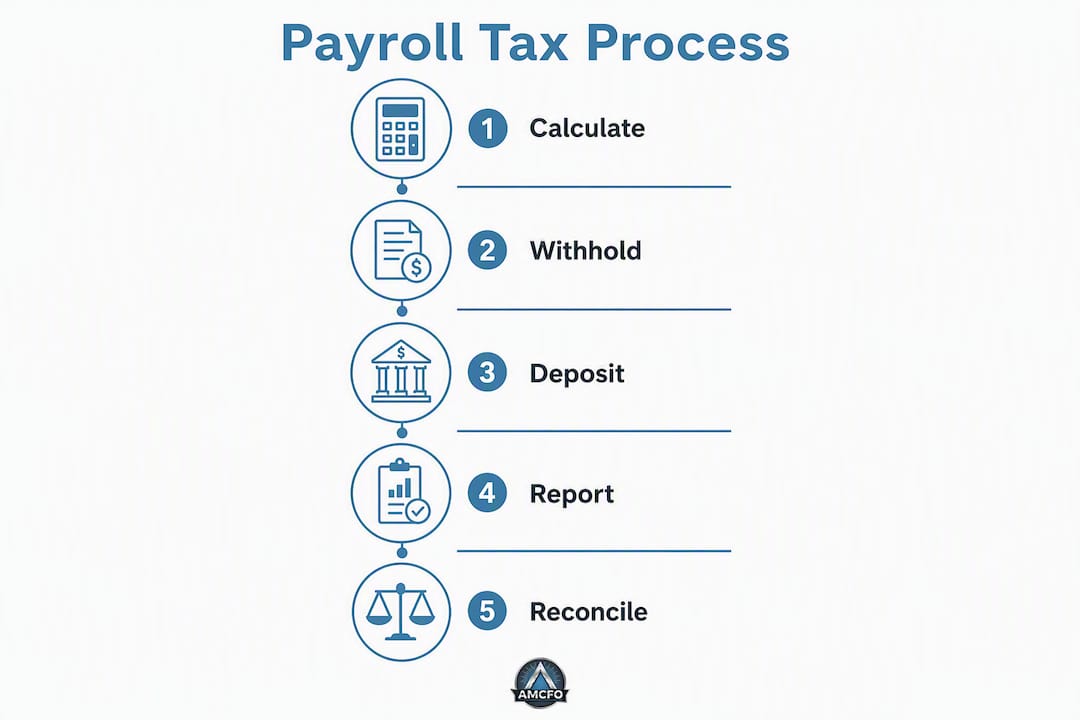
Amounts must be calculated per employee and pay period according to current tax rates and limits. IRS guidance
The total calculated payroll tax liability for this pay period must be deposited with the IRS on your assigned schedule and recorded as a current liability until remitted.
Pro Tip: Use payroll software like QuickBooks Payroll to automate these calculations and flag when the FUTA or SUTA wage base is met for each employee. Manual spreadsheets work for one or two employees; beyond that, the risk of a missed wage-base cutoff or a wrong withholding table compounds quickly.
How and when to deposit and report payroll taxes
Federal payroll taxes must be deposited electronically through EFTPS. Paper checks sent directly to the IRS are no longer accepted for most employers. State taxes go through each state's designated portal, which varies by jurisdiction.
Primary federal forms every employer needs:
- Form 941 (Employer's Quarterly Federal Tax Return): Filed four times per year, reporting wages paid, federal income tax withheld, and FICA taxes for the quarter.
- Form 940 (Employer's Annual Federal Unemployment Tax Return): Filed once per year to report and reconcile FUTA liability.
- W-2 / W-3: Issued to employees by January 31 each year; W-3 transmittal filed with the Social Security Administration.
- Form 944: Available to very small employers (annual liability under $1,000) as an annual alternative to quarterly Form 941 filing.
Always check your state's equivalent forms — most states require a quarterly wage report and a separate unemployment tax return.
Deposit schedules: monthly vs. semiweekly
Your deposit frequency is set by the IRS lookback period, which is the 12-month window ending June 30 of the prior year. The lookback period, not your payroll frequency, determines when deposits are due.

| Deposit Schedule | Who It Applies To | When Deposits Are Due |
|---|---|---|
| Monthly depositor | Employers with total taxes in the lookback period below a defined threshold | Deposits due by the 15th of the following month |
| Semiweekly depositor | Employers with total taxes in the lookback period above the threshold | Deposits due according to IRS rules based on payday timing |
| Next-day rule | Employers accumulating large tax amounts in a single day | Deposit due next business day |
| New employer | Employers with no prior lookback data | Default monthly depositor |
Deposit schedules are set by the IRS based on the employer's tax liability history. See IRS guidelines for specifics. IRS source
Pro Tip: Register with EFTPS before your first deposit deadline, not after. Enrollment takes up to five business days to process. Missing a deposit because enrollment was not complete is still a penalty-triggering event.
How to record payroll liabilities in your books and reconcile them
The accounting distinction here matters more than most owners realize. Payroll expense hits your profit and loss statement — it reduces net income. Payroll tax liability sits on your balance sheet as a current liability until you remit the funds. Mixing the two up means your financials misrepresent both profitability and what you owe.
Sample journal entries for a pay period
Using the example from the calculation section ($5,000 gross wages, $300 pre-tax 401(k), $3,820.45 net pay):
| Account | Debit | Credit |
|---|---|---|
| Payroll Expense (Wages) | $5,000 | |
| Payroll Tax Expense (Employer FICA + FUTA) | $641.55 | |
| Federal Income Tax Payable | $520 | |
| Employee FICA Payable | $359.55 | |
| Employer FICA Payable | $359.55 | |
| FUTA Payable | $282 | |
| 401(k) Contributions Payable | $300 | |
| Cash / Payroll Clearing | $3,820.45 |
When you remit the federal deposit, debit the payable accounts and credit cash. The liability accounts should return to zero after each deposit.
Reconciliation checklist — run this every pay period:
- Pull the payroll register and confirm gross wages match the GL payroll expense account.
- Verify each liability account (federal income tax payable, FICA payable, FUTA payable, state tax payable) matches the amounts on the payroll register.
- Confirm the net pay amount matches the ACH or check disbursements from your bank.
- After each tax deposit, confirm the payable accounts clear to zero.
- At month-end, reconcile the payroll clearing account to zero — any remaining balance signals a timing error or a missed deposit.
- Quarterly, tie Form 941 totals to your GL and payroll reports before filing.
Accurate bookkeeping at the pay-period level prevents the kind of cumulative discrepancies that trigger IRS notices months later.
Pro Tip: Reconcile weekly if you run payroll weekly; monthly if you run payroll twice a month. The longer you wait between reconciliations, the harder it is to trace a discrepancy back to its source. QuickBooks Payroll generates a payroll liability report that maps directly to these GL accounts — use it as your starting point every time.
What penalties and legal risks apply when payroll taxes go unpaid?
Missing a payroll tax deposit is not a minor administrative slip. The IRS treats withheld employee taxes as funds held in trust, and the consequences for mishandling them scale quickly.
Failure-to-deposit penalties are tiered by how late the deposit is:
- 1–5 days late: 2% of the unpaid amount.
- 6–15 days late: 5%.
- 16 or more days late: 10%.
- More than 10 days after the first IRS notice: 15%.
Failure-to-file penalties apply when Form 941 or Form 940 is filed late: 5% of the unpaid tax per month, up to 25%.
Interest accrues on unpaid balances from the due date forward, compounding the cost of every missed deposit.
The Trust Fund Recovery Penalty (TFRP) is the most serious risk. Because withheld employee taxes are trust-fund taxes, the IRS can pierce the corporate veil and assess the TFRP personally against any "responsible person" — an owner, officer, or even a bookkeeper with signing authority who willfully failed to remit. The penalty equals 100% of the unpaid trust-fund portion. Incorporation does not protect you here.
If you miss a deposit, act immediately:
- Make a catch-up deposit through EFTPS as soon as possible to stop the penalty clock.
- Notify your payroll provider so they can flag the gap in their records.
- File any overdue returns, even if you cannot pay in full — filing late is less costly than not filing.
- Contact a CPA or tax professional before the IRS sends a notice; voluntary disclosure is treated more favorably than a response to an audit.
Common payroll tax mistakes and the controls that prevent them
Most payroll tax problems are preventable. They tend to cluster around a few recurring errors.
Common mistakes:
- Misclassifying workers as independent contractors — If the IRS reclassifies a contractor as an employee, you owe back payroll taxes, interest, and penalties for every period they were misclassified.
Controls that reduce risk:
When payroll liabilities have gone unreconciled for multiple quarters, or when a business operates across several states, that is the point to bring in a CPA or fractional CFO for remediation. Catching up on multiple quarters of mismatched records without professional help usually creates more errors than it fixes.
For a broader look at where payroll tax compliance fits within your overall compliance requirements, a structured checklist approach helps ensure nothing falls through the cracks.
Key Takeaways
Payroll tax liability arises the moment wages are earned, and employers must recognize, reserve, deposit, and report every component on the IRS schedule or face penalties that compound fast.
| Point | Details |
|---|---|
| Liability arises at wage-earning | Record payroll tax liabilities when wages are earned, not when paychecks are issued. |
| Withheld taxes are trust funds | Employee withholdings belong to the government; mishandling them can trigger personal liability under the Trust Fund Recovery Penalty. |
| Deposit schedule is lookback-driven | Monthly or semiweekly status is set by your IRS lookback period, not your payroll frequency. |
| Reconcile every pay period | Tie payroll register totals to GL accounts and confirm payable accounts clear to zero after each deposit. |
| Amcfo provides payroll tax support | Amcfo offers bookkeeping, QuickBooks cleanup, payroll reconciliation, and fractional CFO oversight to keep liabilities current and accurate. |
The payroll tax problem most businesses discover too late
Payroll tax liability is one of those areas where the gap between "we think we're compliant" and "we actually are" tends to be widest. The mechanics are not complicated, but the combination of multiple jurisdictions, changing deposit schedules, and the trust-fund rules creates a specific kind of risk that most small businesses underestimate until they receive an IRS notice.
The conventional wisdom is to treat payroll as an administrative function — set up the software, run the numbers, and move on. The problem is that payroll tax compliance is a fiduciary responsibility, not an administrative one. The moment you withhold taxes from an employee's paycheck, you are holding government money. That reframes the entire obligation.
What I see most often is businesses that are technically running payroll correctly but have never properly set up the accounting side: no dedicated payroll liability accounts, no per-period reconciliation, and no clear separation between payroll expense and payroll tax liability on the balance sheet. The deposits get made, but the books do not reflect it accurately. That mismatch is invisible until a quarterly Form 941 does not tie to the GL, or until a year-end audit surfaces months of unreconciled clearing accounts.
The other underestimated risk is the Trust Fund Recovery Penalty. Business owners often assume that incorporating protects them from personal tax liability. For most business debts, it does. For withheld payroll taxes, it does not. The IRS can and does assess the TFRP against owners personally, and "I didn't know" is not a defense when you had signing authority over the payroll account.
Getting the bookkeeping right from the start is not about being cautious. It is about understanding that payroll tax liability is one of the few areas where the government has a direct claim on your personal assets if you get it wrong.
Amcfo helps you stay ahead of payroll tax liabilities
Payroll tax liability is manageable when the accounting is set up correctly from the start. The problem is that most businesses inherit messy payroll records, inconsistent GL accounts, and deposit schedules that were never properly confirmed.

Amcfo handles the full payroll accounting picture: bookkeeping and QuickBooks setup or cleanup, payroll clearing account reconciliation, deposit schedule review, and tax coordination to keep your filings current. For businesses dealing with multi-state payroll or catch-up remediation, Amcfo's fractional CFO services provide the strategic oversight to fix the problem and build controls that prevent it from recurring. You get a dedicated team that understands both the IRS rules and the bookkeeping entries behind them — not a software subscription that flags errors after the fact.
The next step is straightforward: reach out to Amcfo for an initial payroll liability review. The team will assess your current deposit schedule, reconcile your payroll clearing accounts, and identify any gaps before they become penalties. See what's included in Amcfo's accounting and bookkeeping services and schedule a discovery call to get started.
Authoritative resources to bookmark
Use the IRS and EFTPS links below for deposits, schedules, and official forms. The AccountingTools and Congress.gov resources are better suited for understanding the accounting treatment and structural context behind payroll taxes.
- IRS: Understanding Employment Taxes — deposit schedules, EFTPS instructions, and employer withholding responsibilities.
- IRS Publication 15 (Circular E), Employer's Tax Guide — the definitive reference for withholding tables, deposit rules, and employer obligations.
- EFTPS (Electronic Federal Tax Payment System) — enroll here and use this portal for all federal payroll tax deposits.
- Congress.gov: Payroll Taxes Overview (CRS) — authoritative structural overview of how Social Security, Medicare, and FUTA are funded and administered.
- AccountingTools: Payroll Taxes Payable — explains the current liability classification and accrual treatment for payroll tax accounts.
- AccountingTools: How to Calculate Payroll Tax Liabilities — step-by-step calculation guidance with employer and employee share breakdowns.
This article provides general information about U.S. payroll tax obligations and is not a substitute for professional tax or legal advice. Consult a qualified CPA or tax professional and verify current rules directly with the IRS or your state tax agency before making compliance decisions.