

Most payroll services cost between roughly $20 and $150 a month in base fees, plus between $4 to $22 per employee per month. For a small team, monthly costs can range from about $60 to $250; for 25 employees, costs are generally around $175 to $300 a month. Your real total depends on how often you run payroll, whether you operate in multiple states, and how many add-ons you stack on top.
TL;DR:
- Running payroll weekly instead of biweekly or monthly can nearly double annual costs under per-run pricing models, especially with high frequency.
- Multi-state operations and contractor payments add extra costs due to registration, nexus obligations, or different billing for 1099 versus W-2 workers.
- Add-on fees like year-end forms, off-cycle runs, and garnishment processing can significantly increase total expenses if not carefully managed.
- Using a fixed monthly fee with a predictable number of pay runs helps forecast costs and avoids surprises from fluctuating per-transaction or percentage-based charges.
- Outsourcing payroll becomes cost-effective when owner time exceeds two hours per pay period or when adding multiple states or contractors to prevent costly compliance errors.
Table of Contents
- How Much Does Payroll Cost on Average?
- What Are the Different Payroll Pricing Models?
- What Factors Increase Your Payroll Service Cost?
- How Do You Calculate Your Annual Payroll Service Cost?
- How Can You Lower Your Payroll Service Costs?
- Where AmCFO Fits Into Payroll Cost Management
- When Is Outsourcing Payroll Worth the Price?
- Get a Straight Answer on What You Should Be Paying
- Sources
How Much Does Payroll Cost on Average?
The base fee plus per-employee model dominates the market, and the ranges are wider than most vendor landing pages let on. Expect a monthly base fee between $20 and $150, with per-employee charges running $4 to $22. A company paying near the bottom of that range is usually buying bare-bones software with limited support. A company near the top is often getting tax filing, direct deposit, and a human being who answers the phone.
Team size changes the math fast. A typical 10-employee business running full-service payroll tends to land between $100 and $250 a month, depending on plan tier and how many add-ons get bundled in. Scale up to 25 employees and the market average moves to roughly $175 to $300 a month. At 100 employees, most businesses see monthly totals somewhere around $550 to $1,100.
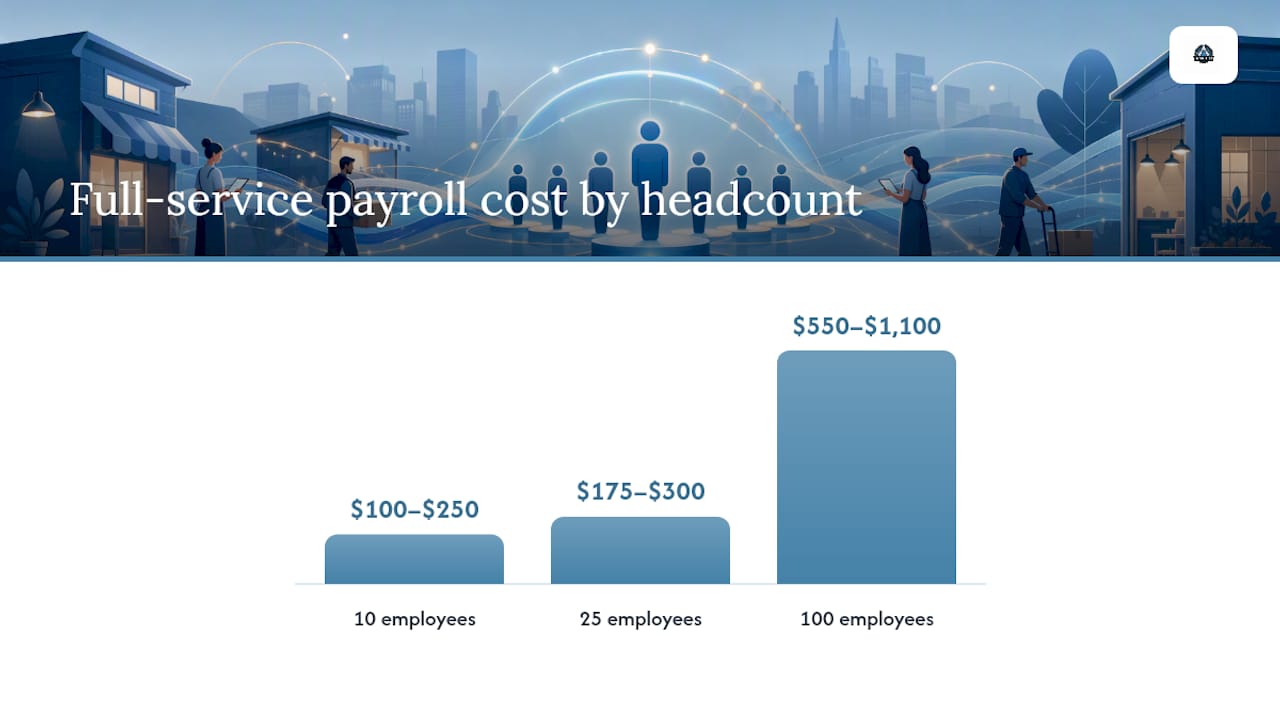
Here's how those numbers stack up across common team sizes:
Notice that the per-employee cost usually drops as headcount rises. That's volume pricing at work. A vendor charging $22 per employee for a 5-person team might charge $8 per employee once you hit 50, because the fixed cost of running your account gets spread across more paychecks.
The three broad cost bands worth knowing:
Self-service software sits at the low end. You're doing more of the work yourself, calculating withholdings, filing forms, handling corrections, so the fee reflects software access, not labor.
Full-service payroll is the middle band and where most small businesses land. The provider files your taxes, cuts checks or handles direct deposit, and generates year-end forms.
PEO or EOR arrangements sit well above both. These co-employment models can run $400 to $700 or more per employee per month in complex cases, because you're paying for HR administration, benefits management, and shared liability, not just payroll processing.
What Are the Different Payroll Pricing Models?
Vendors rarely price the same way, and that makes quotes hard to compare side by side unless you know what you're looking at. Four models cover most of the market:
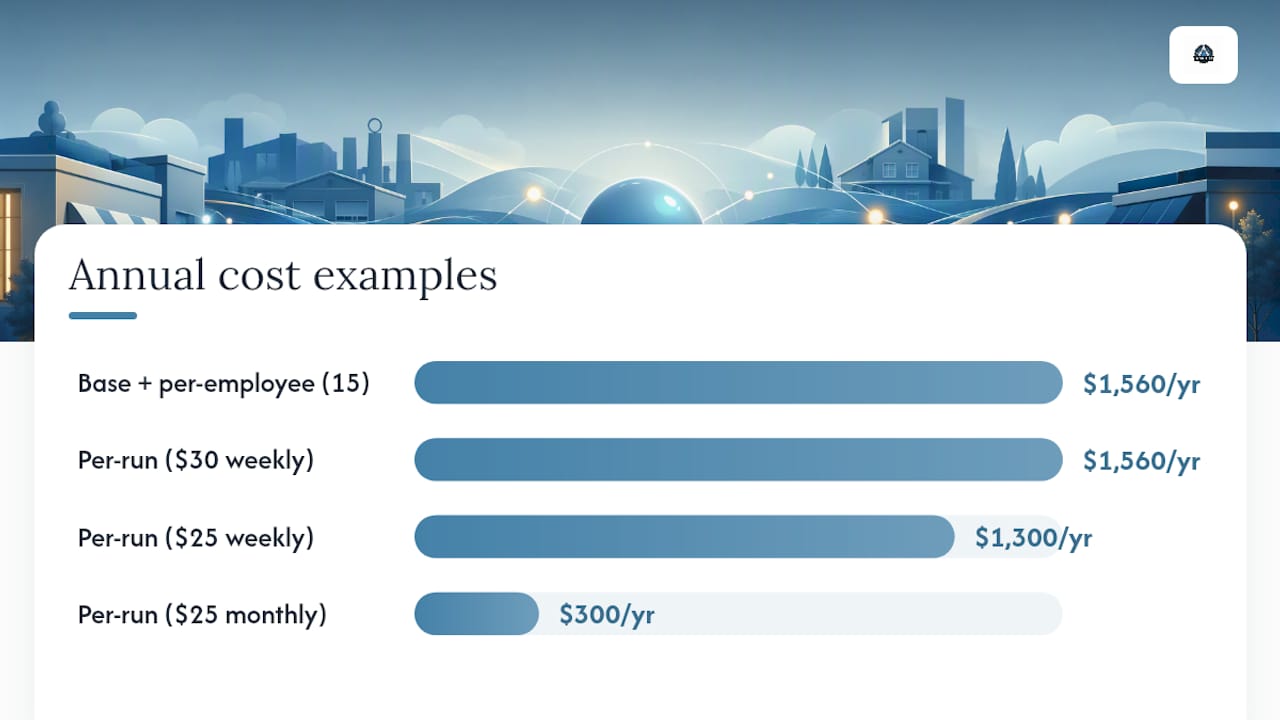
- Base fee + per-employee. A flat monthly charge (say, $40) plus a per-head fee (say, $6). For 15 employees, that's $40 + (15 × $6) = $130 a month, or $1,560 a year.
- Per-pay-run pricing. You pay a fee every time you process payroll, regardless of headcount. A $30 per-run fee sounds cheap until you multiply it by 52 weekly runs, which is $1,560 a year, the same as a base-plus-per-employee plan with a fraction of the transactions.
- Flat monthly fee. One price covers unlimited employees and runs, common with software aimed at very small teams. Predictable, but you may be overpaying if your headcount is small and static.
- Percentage-based pricing. Rare outside of PEOs and staffing agencies, where the provider takes a cut of total payroll dollars processed. This model scales against you as wages rise, even if headcount doesn't.
Converting between models is the real skill here. Multiply a per-run fee by your expected annual run count: weekly is 52 runs, biweekly is 26, semi-monthly is 24, monthly is 12. A $25 per-run fee costs $1,300 a year on a weekly schedule but only $300 a year if you switch to monthly runs. That single frequency decision can swing your annual payroll bill by $1,000 or more.
Per-pay-run and percentage-based models carry the most risk as you grow. Per-run pricing punishes frequent payroll, and percentage pricing punishes rising wages, exactly the two things that tend to happen as a business succeeds. Base-plus-per-employee pricing scales more predictably because you can forecast it against a headcount number you already track.
Pro Tip: Before signing anything, ask the vendor to quote your specific pay frequency and headcount as a single monthly number, not a menu of à la carte fees. That forces an apples-to-apples comparison with competing quotes.
What Factors Increase Your Payroll Service Cost?
Pay frequency is the biggest lever most owners overlook. Running payroll weekly instead of biweekly can nearly double your annual processing charges under a per-run model, even though total wages paid stay identical.
Multi-state operations add cost fast, and not just from the payroll vendor. Each state you operate in may require separate tax registration, unemployment insurance accounts, and withholding setups. Hiring one remote employee in a new state can trigger nexus obligations you didn't budget for, and most vendors charge extra per additional state on the account.
Contractor payments complicate pricing too. The IRS distinguishes employees from independent contractors based on behavioral and financial control, not on what you call the relationship. Misclassifying a worker doesn't just risk penalties. It also changes how your payroll vendor bills you, since 1099 contractor payments are often priced differently than W-2 employee runs.
Add-ons are where headline pricing quietly falls apart. Watch for these:
- One-time setup or implementation fees, which can run as high as $1,500 for larger accounts.
- Year-end tax form fees (W-2s and 1099s), typically $3 to $20 per form.
- Off-cycle payroll runs (bonuses, corrections, terminations), often $10 to $75 per extra run.
- Garnishment processing for wage orders, usually billed per employee per pay period.
- New-hire reporting and state registration fees for multi-state accounts.
Before signing a contract, get written answers on: how many states are included, what the per-form year-end charge is, whether off-cycle runs cost extra, and whether garnishment processing is bundled or billed separately.
How Do You Calculate Your Annual Payroll Service Cost?
Run the math before you sign, not after your first invoice arrives. The formula:
(Monthly base fee + per-employee fee × average headcount) × 12 + (per-run fee × number of runs) + estimated add-ons = annual cost
Here's how it plays out for a 25-employee company on a biweekly schedule (26 runs a year):
- Start with the base: a $75 monthly base fee.
- Add per-employee cost: $10 per employee × 25 employees = $250 a month.
- Combine and annualize: ($75 + $250) × 12 = $3,900 a year.
- Add any per-run charges, if the vendor bills separately for off-cycle runs: say 4 off-cycle runs a year at $40 each = $160.
- Add estimated year-end form fees: 25 W-2s at $8 each = $200.
- Total estimated annual cost: $3,900 + $160 + $200 = $4,260, or roughly $355 a month averaged out.
Run the same formula on a weekly schedule instead of biweekly and, if your vendor charges per run, that swaps 26 runs for 52, which can add hundreds of dollars a year even though headcount never changes.
| Input needed | Where to find it |
|---|---|
| Monthly base fee | Vendor quote, ask for the exact number in writing |
| Per-employee fee | Vendor quote, confirm if it's per employee or per active payee |
| Average headcount | Your own payroll records, use a 12-month average, not a single month |
| Number of pay runs | Your pay calendar (weekly=52, biweekly=26, semi-monthly=24, monthly=12) |
| Add-on estimate | Prior year's W-2/1099 count, plus expected off-cycle runs |
Get these five numbers in writing from every vendor you're comparing. Don't include broader employer costs like taxes and benefits in this specific formula. That's a separate, larger number, and the SBA's guidance on total employee cost is worth reviewing separately so you're not confusing "what the payroll service charges" with "what an employee actually costs you."
How Can You Lower Your Payroll Service Costs?
Ask about annual prepayment. Vendors frequently discount up to 20% for paying yearly instead of monthly, and most won't offer it unless you ask directly.
Consolidating your pay frequency is the single biggest lever under a per-run pricing model. Moving from weekly to biweekly cuts your run count in half, and moving from biweekly to semi-monthly trims it further, all without changing anyone's paycheck amount.
A few more tactics worth trying:
- Audit your add-ons annually. Garnishment processing or benefits administration you signed up for at launch may sit unused a year later.
- Bundle payroll with bookkeeping or accounting services where a single provider offers both. Combined billing frequently beats paying two separate vendors full price each.
- Keep headcount records accurate. Vendors sometimes bill on total enrolled employees rather than active ones. A terminated employee still on the account is a fee you're paying for nothing.
- Get multiple quotes using the identical formula above. Vendors price inconsistently, and the only way to compare is to force every quote into the same annual-cost structure.
DIY payroll software saves money on the invoice, but it shifts the labor and the compliance risk onto you. That trade-off makes sense for a five-person shop with a straightforward pay structure. It stops making sense the moment you add a second state, a contractor mix, or garnishment orders, where a filing mistake costs far more than the fee you were trying to avoid.
Pro Tip: Ask every vendor the same question in writing: "What is my all-in monthly cost including add-ons, for my exact headcount and pay frequency?" A vendor who can't answer that in one sentence is one you'll be chasing for surprise charges later.
Where AmCFO Fits Into Payroll Cost Management
Auditing a payroll quote is easier when someone's already done the math for hundreds of businesses. Amcfo works with small businesses on payroll support alongside bookkeeping, QuickBooks setup and cleanup, tax coordination, and forecasting, the pieces that surround payroll rather than replace it.
A typical engagement looks like this: cleaned-up payroll data inside QuickBooks, a fee audit comparing your current vendor invoice against market ranges, and a transition plan if switching providers makes sense. That last piece matters more than it sounds. A messy ledger going into a provider switch is where most migration errors and duplicate setup fees come from.
Amcfo also helps with the harder question behind the fee comparison: how payroll spending fits into your broader financial forecasting, especially once multi-state hiring or benefits administration starts changing your cost structure month to month.
When Is Outsourcing Payroll Worth the Price?
The break-even point is smaller than most owners assume. If you're spending more than two or three hours a pay period on payroll math, tax filings, or chasing compliance deadlines, the $100 to $300 a month a full-service provider charges usually costs less than your own time is worth.
The calculation shifts hard the moment you add a second state or your first contractor. That's when classification mistakes and missed filings get expensive, and when a provider's tax filing accuracy earns its fee. Teams under 10 employees on a single state often do fine with software. Past that, budget for the upgrade before you need it, not after a penalty notice arrives.
— Angelica
Get a Straight Answer on What You Should Be Paying
Comparing payroll quotes against market ranges only gets you halfway. The harder part is knowing whether your current invoice actually matches what your business needs, or whether you're paying for add-ons nobody uses while missing coverage you actually do need. Amcfo reviews payroll costs as part of broader bookkeeping and accounting work, so the audit isn't a one-off exercise, it's built into how your books get maintained month to month.

For businesses further along, fractional CFO support brings vendor negotiation and payroll forecasting into the same conversation as cash flow and profitability, so a payroll decision doesn't get made in isolation from the rest of your finances. If you're not sure whether your current payroll bill is reasonable for your headcount and state footprint, request a cost review from Amcfo and get a specific answer instead of a market average.
Sources
- Payroll Services Cost: Guide for Small Businesses in 2026
- Independent contractor (self-employed) or employee? | IRS
- How much does an employee cost you? | SBA
- Payroll Service Cost Guide | Forbes Advisor