

Tax planning is the proactive management of your financial activities to legally reduce tax liabilities and improve after-tax outcomes for your business. Unlike tax preparation, which looks backward at what already happened, effective tax planning happens throughout the year. Business owners who treat it as a year-round discipline consistently outperform those who scramble before the april 15 deadline. This guide covers the core principles, 2026 IRS rule changes, and practical strategies to maximize deductions and keep more of what you earn.
What are the key principles of tax planning?
Tax planning rests on four foundational pillars: income timing, deduction optimization, account selection, and credit capture. Each pillar targets a different lever in your tax liability. Together, they form a complete framework for reducing what you owe without crossing legal lines.
Income timing means controlling when revenue hits your taxable income. A cash-basis business can defer invoices sent in december to push income into the next tax year. Conversely, if you expect higher rates next year, accelerating income now locks in today's lower rate.
Deduction optimization means capturing every allowable expense at the right time. Section 179 expensing, home office deductions, and vehicle mileage all require documentation and timing decisions. Missing a deduction is not a minor oversight. It is a direct transfer of cash from your pocket to the IRS.

Account selection refers to placing assets in the right type of account. Tax-deferred accounts like a 401(k) or SEP IRA reduce current taxable income. Asset location strategy places tax-inefficient investments in tax-deferred accounts and tax-efficient ones in taxable accounts. That single decision can shift thousands of dollars in annual tax exposure.
Credit capture is the most underused pillar. Credits reduce your tax bill dollar for dollar, not just your taxable income. The R&D tax credit, Work Opportunity Tax Credit, and energy efficiency credits are available to many small businesses that never claim them.
| Pillar | Core tactic | Business example |
|---|---|---|
| Income timing | Defer or accelerate revenue | Push december invoices to january |
| Deduction optimization | Maximize allowable expenses | Section 179 equipment expensing |
| Account selection | Use tax-advantaged accounts | SEP IRA, 401(k) contributions |
| Credit capture | Claim dollar-for-dollar credits | R&D credit, WOTC |
Pro Tip: Schedule a quarterly tax review with your accountant every january, april, july, and october. Proactive decisions made throughout the year generate far more savings than any last-minute filing adjustment.
How do 2026 tax law updates affect business tax strategy?
Several 2026 changes directly affect how business owners should structure deductions, payroll, and retirement contributions. Knowing these updates before year-end is the difference between a good tax year and a costly one.
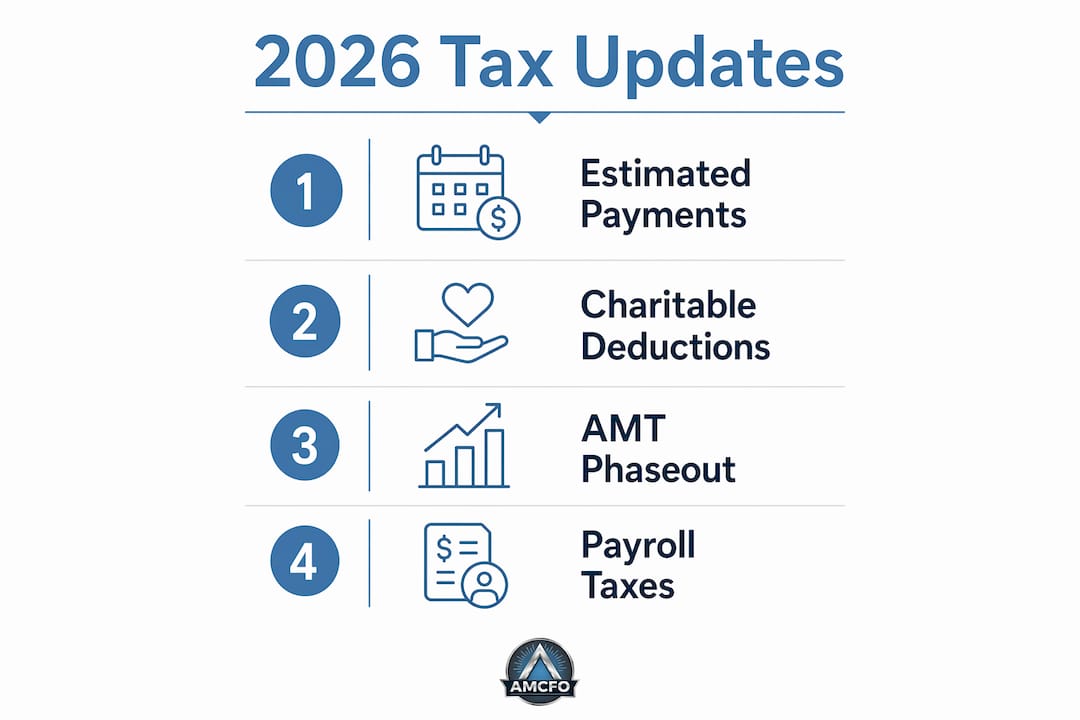
Estimated tax payments carry strict deadlines in 2026: april 15, june 16, september 15, and january 15 of 2027. Business owners can avoid underpayment penalties by paying at least 100% of their prior year tax liability, or 110% if their income exceeded $150,000. Missing these dates triggers penalties that compound quickly.
Charitable deductions now face a new floor. Starting in 2026, itemizers can only deduct charitable contributions that exceed 0.5% of their adjusted gross income. Non-cash gifts are subject to the same floor. Business owners who give regularly need to recalculate whether itemizing still makes sense or whether bunching donations into one year produces a better outcome.
AMT phaseout has tightened. The AMT phaseout begins at $500,000 for single filers and $1,000,000 for joint filers, with a 50% phaseout rate. This directly affects business owners exercising incentive stock options or carrying large itemized deductions.
Payroll taxes in 2026 apply the Social Security tax to wages up to $184,500. Medicare tax remains 1.45% on all wages with no cap. Self-employed owners pay both halves, totaling 15.3%, but can deduct half of that amount against their income. That deduction is automatic but only valuable if you claim it.
| Parameter | 2025 | 2026 |
|---|---|---|
| Social Security wage base | $176,100 | $184,500 |
| Charitable deduction floor | None | 0.5% of AGI |
| AMT phaseout threshold (single) | $539,900 | $500,000 |
| Estimated payment safe harbor (income >$150K) | 110% prior year | 110% prior year |
| Medicare tax rate | 1.45% | 1.45% |
High earners in 2026 are shifting focus toward optimizing income and capital gains taxes rather than purely estate planning. That shift reflects the new AMT and charitable deduction rules hitting harder at the top of the income scale.
What tax strategies maximize deductions for business owners?
The most effective tax savings strategies for business owners combine retirement contributions, income timing, and entity structure. No single tactic wins on its own. The combination is what moves the needle.
Retirement plan contributions are the fastest legal way to reduce taxable income. A SEP IRA allows contributions up to 25% of net self-employment income. A solo 401(k) allows both employee and employer contributions, pushing the ceiling higher. Funding these accounts before the tax deadline directly reduces your taxable income dollar for dollar.
Tax-loss harvesting means selling underperforming investments to realize a loss that offsets capital gains. The quarterly review cadence is critical here. Losses that go unrecognized before december 31 expire for that tax year. A business owner who checks portfolio performance only at year-end routinely misses this window.
Charitable giving through bunching solves the new 0.5% AGI floor problem. Instead of giving $10,000 per year for two years, you give $20,000 in one year. That single larger gift is more likely to clear the floor and generate a deduction. A donor-advised fund at Fidelity Charitable or Schwab Charitable lets you contribute a lump sum now and distribute grants to charities over time.
Top tax savings tips for business owners in 2026:
- Max out SEP IRA or solo 401(k) contributions before the filing deadline
- Review accounts for tax-loss harvesting opportunities each quarter
- Bunch charitable donations to clear the 0.5% AGI floor
- Use Section 179 to expense qualifying equipment purchases in the current year
- Verify your entity structure (S-corp, LLC, C-corp) still fits your income level
- Track home office, vehicle, and travel expenses with a dedicated app like Expensify or QuickBooks
- Pay the fourth quarter estimated payment by january 15 to avoid penalties
Tax brackets are progressive, meaning your marginal rate applies only to income within each bracket. A business owner earning $400,000 does not pay 35% on all $400,000. Understanding this prevents the common mistake of avoiding income out of fear of "moving into a higher bracket."
Pro Tip: Integrate your tax strategy with your financial planning calendar so that investment decisions, payroll adjustments, and retirement contributions align with your projected tax liability each quarter.
How do you measure and improve tax efficiency year-round?
Your effective tax rate is the clearest measure of tax efficiency. It is your total tax paid divided by your total income. Tracking this number quarterly tells you whether your strategy is working or drifting.
Benchmarking your effective rate against industry peers gives context. A manufacturing business with an effective rate of 28% when the industry average is 22% has a measurable gap worth investigating. Tools like the tax calculators at WeAreCalculator let you model different income and deduction scenarios in real time. That kind of projection work belongs in every quarterly review, not just at year-end.
Small annual tax savings compound significantly over time. A consistent $5,000 annual saving, invested rather than paid to the IRS, can grow to over $200,000 across 20 years. That figure reframes tax planning from an administrative task into a wealth-building discipline.
Tax optimization integrates portfolio and tax strategy to improve after-tax returns, not just pre-tax performance. Business owners who coordinate investment decisions with their tax advisor consistently outperform those who manage the two in separate silos.
Ongoing tax optimization habits that produce results:
- Calculate your effective tax rate at the end of each quarter
- Run a tax projection in october to identify year-end moves before december
- Review payroll withholding after any major income change
- Reconcile estimated payments against actual liability each quarter
- Confirm retirement contribution limits and deadlines with your CPA each january
- Document all business expenses in real time using accounting software like QuickBooks or Xero
What I've learned about tax planning that most guides won't tell you
Most tax guides treat planning as a checklist. In practice, the business owners who save the most treat it as a financial discipline woven into every major decision they make.
The biggest mistake I see is waiting until november to think about taxes. By then, most of the high-value moves are already off the table. Income timing decisions, retirement contributions, and loss harvesting all require lead time. A business owner who reviews their tax position in february has ten months to act. One who waits until november has weeks.
The second mistake is treating tax planning and accounting as separate functions. They are not. Your bookkeeping accuracy directly determines what deductions you can defend. Sloppy records do not just create audit risk. They cause you to miss deductions you actually qualify for because you cannot document them. Professional guidance is not optional for complex situations. Tax complexity demands it to safeguard against future risks and diversify liabilities effectively.
The third mistake is optimizing for this year's tax bill at the expense of next year's. Deferring income feels like a win until you realize you have stacked two years of revenue into one tax year. A good tax strategy looks at least two years forward, not just the current filing period. That longer view is where the real savings live.
— Angelica
How Amcfo supports your business tax planning
Tax planning works best when it connects directly to your accounting, cash flow, and financial reporting. Amcfo provides fractional CFO services and accounting and bookkeeping designed to keep your financials accurate and your tax position current throughout the year.

Amcfo works with business owners across industries to coordinate tax timing, retirement contributions, payroll accuracy, and deduction documentation. The result is a cleaner tax position and fewer surprises at filing time. If your current setup leaves tax decisions to the last minute, Amcfo's team can build the quarterly review process and financial infrastructure that makes proactive planning possible. Reach out to discuss a service package built around your business's specific tax and financial needs.
Key Takeaways
Proactive tax planning, built on income timing, deduction optimization, and quarterly reviews, is the most reliable way for business owners to reduce tax liability and protect cash flow year after year.
| Point | Details |
|---|---|
| Plan year-round, not at year-end | Most high-value tax moves require months of lead time to execute properly. |
| Know the 2026 rule changes | New charitable deduction floors, AMT thresholds, and payroll wage bases directly affect your strategy. |
| Use all four pillars | Income timing, deduction optimization, account selection, and credit capture work together, not in isolation. |
| Track your effective tax rate | Divide total tax paid by total income each quarter to measure whether your strategy is working. |
| Integrate tax with accounting | Accurate bookkeeping is the foundation of every deduction you can legally defend. |
FAQ
What is tax planning for a business?
Tax planning is the proactive process of managing income, deductions, and financial decisions throughout the year to legally reduce a business's tax liability. It differs from tax preparation, which only records what already happened.
When should business owners start tax planning?
Tax planning should begin at the start of each fiscal year and continue quarterly. Waiting until the fourth quarter eliminates most high-value strategies like income deferral, loss harvesting, and retirement contributions.
How do estimated tax payments work in 2026?
Quarterly estimated payments are due april 15, june 16, september 15, and january 15. Business owners avoid underpayment penalties by paying at least 100% of their prior year tax, or 110% if income exceeded $150,000.
What are the best tax deductions for small business owners?
The most impactful deductions include retirement plan contributions (SEP IRA, solo 401(k)), Section 179 equipment expensing, home office costs, vehicle mileage, and the self-employed health insurance deduction. Documentation is required for all of them.
How does the new 2026 charitable deduction rule affect businesses?
Starting in 2026, itemizers can only deduct charitable contributions that exceed 0.5% of their adjusted gross income. Bunching multiple years of donations into a single year is the most effective way to clear that floor and generate a deduction.