

Corporate tax planning is the deliberate process of arranging a company's financial activities to reduce its tax burden legally while supporting long-term business goals. Every business faces multiple tax obligations, including federal and state income taxes, payroll taxes, and sales taxes. Getting ahead of these obligations, rather than reacting to them at year-end, is what separates companies that grow confidently from those that face constant financial surprises. Understanding what is tax planning for companies gives you the foundation to make every major financial decision with tax consequences already factored in.
What is tax planning for companies, and why does it matter?
Corporate tax planning is defined as the structured analysis of a business's financial position to minimize tax liabilities within the boundaries of the law. It is not tax evasion. It is not aggressive avoidance. It is the deliberate use of legal provisions, timing strategies, and transaction structures to reduce what your company owes while staying fully compliant with IRS regulations and applicable state laws.
The distinction between tax planning and tax compliance is critical. Compliance means filing accurately and on time. Planning means improving cash flow predictability by aligning your tax position with your commercial goals before obligations arise. A company that only focuses on compliance will always pay more tax than one that plans proactively.
Tax planning covers every major tax type a business faces. Corporation income tax, self-employment tax, employment taxes, and excise taxes all require attention. The IRS requires estimated quarterly tax payments from most businesses, and missing those deadlines triggers penalties. A solid tax plan accounts for all of these obligations, not just the annual return.

How does corporate tax planning work in practice?
The biggest misconception about corporate tax planning is that it happens once a year, right before the filing deadline. Major tax savings arise from proactive decisions made throughout the financial year, not from last-minute scrambles in december. The timing of a single large asset purchase can shift thousands of dollars in taxable income from one year to the next.
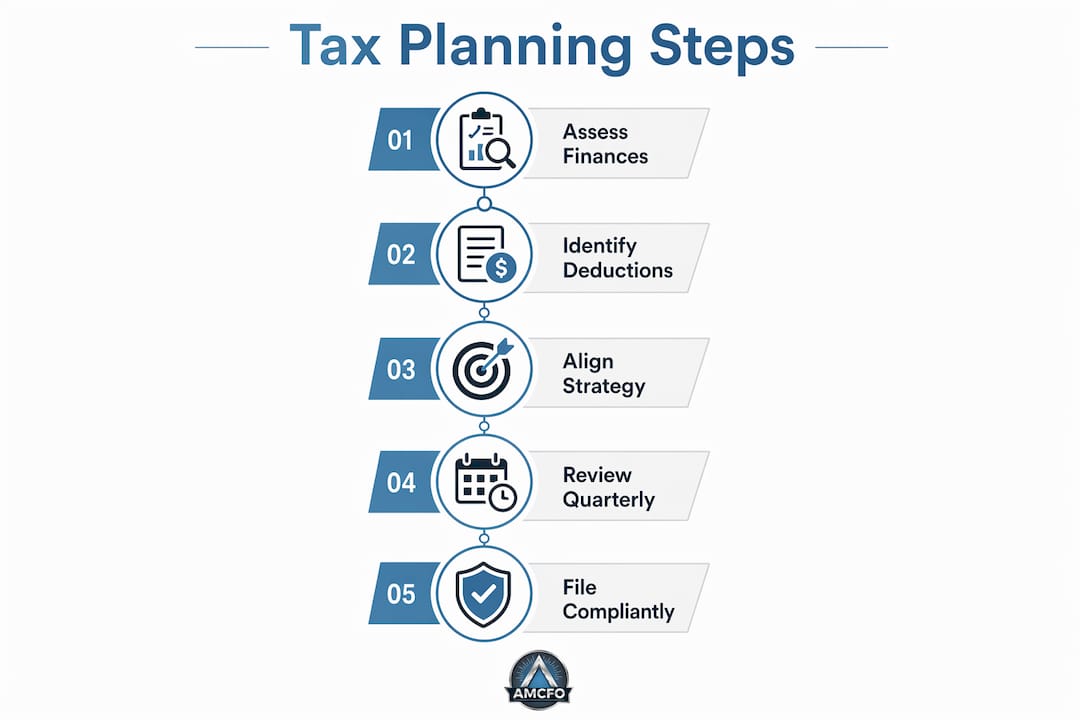
Effective tax planning runs as a continuous process alongside your regular financial management. It involves reviewing your financial position quarterly, forecasting your tax liability, and making decisions with tax consequences already in mind. This includes:
- Timing income and expenses: Accelerating deductible expenses into the current year or deferring income to the next year reduces your taxable income for the period.
- Cash flow forecasting: Knowing your estimated tax liability months in advance lets you reserve cash and avoid liquidity crunches at payment time.
- Loss relief: Carrying forward net operating losses to offset future taxable income reduces your tax bill in profitable years.
- R&D tax credits: Companies investing in qualifying innovation projects can claim significant relief under current IRS rules.
- Retirement plan contributions: Contributing to qualified retirement plans like a SEP-IRA or 401(k) reduces taxable income while building long-term value.
Pro Tip: Review your tax position at the end of each quarter, not just in december. A mid-year review gives you time to act on timing strategies before the window closes.
Tax planning also means aligning your tax decisions with your commercial strategy. A company planning a major equipment upgrade should time that purchase to maximize capital deductions. A company expecting a high-revenue quarter should consider whether deferring certain income is both legal and commercially sensible.
What are effective tax strategies companies commonly use?
The most effective corporate tax strategies share one characteristic: they are built into financial decisions from the start, not added on afterward.
Capital allowances and accelerated depreciation
Capital allowances, including the Full Expensing regime, allow companies to claim 100% first-year deductions on qualifying assets. This accelerates the tax benefit of major purchases, reducing taxable profit in the year the asset is acquired. For a company buying $200,000 in equipment, the difference between standard depreciation and full expensing can represent tens of thousands of dollars in immediate tax savings.
R&D tax credits
R&D tax credits offer valuable relief to companies investing in qualifying innovation. This includes software development, product testing, process improvement, and certain engineering activities. Many business owners underestimate what qualifies. The IRS definition of qualifying research is broader than most people assume, and SMEs with enhanced reliefs can benefit significantly.
Loss relief and income timing
- Carry forward net operating losses to offset taxable income in future profitable years, reducing your effective tax rate over time.
- Defer income recognition where legally permissible, pushing taxable revenue into a lower-income year.
- Accelerate deductible expenses by paying invoices or making purchases before year-end to reduce current-year taxable income.
- Use retirement plans strategically. Retirement plans offer tax credits and advantages that reduce taxable income while building employee benefits.
- Structure profit extraction carefully in owner-managed businesses. The mix of salary, dividends, and pension contributions each carry different tax treatments, and the optimal combination depends on your personal and corporate tax rates.
International tax considerations
Multinational companies face an additional layer of complexity. Complex US tax codes and international rules require continual adaptation, particularly around transfer pricing, foreign tax credits, and entity structure. Getting this wrong creates double taxation or penalties. Getting it right creates significant savings.
| Strategy | Best suited for | Primary benefit |
|---|---|---|
| Capital allowances | Asset-heavy businesses | Reduces taxable profit in purchase year |
| R&D tax credits | Tech, manufacturing, product development | Direct credit against tax owed |
| Loss carryforward | Businesses with variable income | Offsets future taxable income |
| Retirement plan contributions | Owner-managed businesses | Reduces taxable income, builds equity |
| Income timing | Businesses with predictable revenue cycles | Controls which year income is taxed |
What are the benefits and risks of corporate tax planning?
The benefits of tax planning extend well beyond the immediate savings on your tax bill. Tax planning improves clarity and predictability, avoids tax leakage, and supports informed growth decisions. When you know your tax liability months in advance, you can make investment decisions, hiring decisions, and capital allocation decisions with confidence. That predictability is worth as much as the tax savings themselves.
The specific benefits include:
- Cash flow improvement: Reserving the right amount for taxes prevents cash shortfalls at payment deadlines.
- Penalty avoidance: Accurate forecasting and timely estimated payments eliminate avoidable IRS penalties.
- Business alignment: Tax decisions made in context of commercial goals produce better outcomes than tax decisions made in isolation.
- Risk reduction: Proactive planning identifies potential compliance issues before they become audits or penalties.
The risks are real, though. Tax planning requires regular review and bespoke advice because tax laws change. A strategy that was effective in 2023 may be less effective or non-compliant in 2026. Over-reliance on a single technique, ignoring changes to IRS rules, or applying strategies designed for a different business structure are all common mistakes.
"Tax planning is not just about saving money. It is about managing risk, staying compliant with changing laws, and reducing the surprises that disrupt business growth. The companies that treat tax planning as a risk management tool, not just a cost-cutting exercise, consistently outperform those that do not."
The complexity of keeping up with legislative changes is the most underestimated risk. The Tax Cuts and Jobs Act, changes to R&D capitalization rules, and evolving state tax nexus standards have all shifted the tax landscape significantly in recent years. Your tax plan needs to reflect current law, not last year's rules.
How can businesses integrate tax planning into financial management?
Tax planning works best when it is woven into your regular financial management cycle, not treated as a separate annual event. The importance of tax planning shows up most clearly when businesses build it into their quarterly reviews and annual budgeting process.
Pro Tip: Set a recurring calendar reminder for a tax review at the end of each quarter. Use it to compare your actual financial position against your tax forecast and adjust your strategy before the year closes.
The practical steps for integrating tax planning into your financial management process are:
- Build tax forecasting into your budget. Estimate your tax liability as part of your annual financial plan, then update it quarterly as your actual results develop.
- Track deductible expenses in real time. Use accounting software to categorize expenses correctly throughout the year. Reconstructing records at year-end is slower and less accurate.
- Monitor legislative changes. Subscribe to IRS updates and work with a tax advisor who proactively flags changes that affect your business.
- Structure transactions with tax in mind. Before signing a major contract, making an acquisition, or restructuring your entity, model the tax implications first.
- Engage expert guidance. A fractional CFO or tax advisor brings the expertise to identify strategies you would not find on your own, particularly for R&D credits, international structures, and complex transactions.
Good cash flow management and tax planning reinforce each other directly. When your cash flow forecast is accurate, your tax reserve is accurate. When your tax reserve is accurate, you avoid the cash crunches that force businesses to borrow to pay their tax bills.
Key Takeaways
Corporate tax planning is the continuous process of aligning financial decisions with tax law to reduce liabilities, improve cash flow, and support business growth throughout the year.
| Point | Details |
|---|---|
| Tax planning is year-round | Major savings come from decisions made during the year, not at year-end filing. |
| Multiple strategies apply | Capital allowances, R&D credits, loss carryforwards, and retirement plans each reduce taxable income. |
| Benefits go beyond savings | Predictability, penalty avoidance, and better business decisions are equally valuable outcomes. |
| Risks require active management | Tax laws change; strategies need regular review to stay compliant and effective. |
| Integration is the key | Tax planning embedded in quarterly financial reviews produces better results than standalone annual efforts. |
Tax planning as a growth tool, not just a cost line
I have worked with business owners who treat their tax bill as a fixed cost, something that happens to them rather than something they manage. That mindset is expensive. The companies I have seen grow most confidently are the ones that treat tax planning as a core part of their financial strategy, not an afterthought.
The most common mistake I see is ignoring payroll taxes and VAT-equivalent obligations until they become a compliance problem. Business owners focus on income tax and miss the employment tax exposure that builds quietly throughout the year. By the time it surfaces, the penalties are already accumulating.
The second mistake is treating tax planning as a one-time conversation with an accountant in april. Tax law changes constantly. A strategy that worked two years ago may not work today. The businesses that stay ahead are the ones with ongoing advisory relationships, not annual check-ins.
What I find most valuable about proactive tax planning is the confidence it creates. When you know your tax position, you make better decisions about hiring, investment, and growth. You stop avoiding decisions because you are uncertain about the tax consequences. That clarity is worth more than any single deduction.
— Angelica
How Amcfo helps companies build a stronger tax strategy
Tax planning requires accurate financial data, forward-looking forecasts, and expert guidance working together. Amcfo provides fractional CFO services that bring all three to businesses that need senior financial leadership without the cost of a full-time hire.

Amcfo's team handles bookkeeping, financial reporting, budgeting, and tax coordination so your financial records are always ready to support proactive planning. Whether you need help structuring transactions, forecasting your quarterly tax liability, or identifying credits your business qualifies for, Amcfo's accounting and CFO packages are built to deliver that guidance at every stage of your company's growth.
FAQ
What is tax planning for companies in simple terms?
Corporate tax planning is the process of organizing a business's finances to reduce its tax bill legally. It uses strategies like timing income, claiming allowances, and structuring transactions to minimize what the company owes.
How is tax planning different from tax avoidance?
Tax planning uses legal provisions and timing strategies within the rules set by the IRS and applicable law. Tax avoidance typically involves artificial arrangements designed to exploit loopholes, which carries significant legal and reputational risk.
When should a company start tax planning?
Tax planning should run continuously throughout the financial year. Waiting until year-end misses the most valuable opportunities, which arise from decisions made during the year such as asset purchases and income timing.
What are the most common tax strategies for businesses?
The most widely used strategies include capital allowances, R&D tax credits, net operating loss carryforwards, retirement plan contributions, and careful timing of income and deductible expenses.
Do small businesses benefit from corporate tax planning?
Small businesses benefit significantly from tax planning. The IRS requires estimated quarterly payments from most businesses, and proactive planning reduces penalties, improves cash flow, and identifies credits that many small business owners overlook.