

Financial statements are defined as structured reports that summarize a company's financial position, operating results, and cash flows across a specific period. The role of financial statements in decisions is to convert raw accounting data into clear signals that tell you whether to hire, invest, cut costs, or seek financing. Every major business choice, from pricing a product to acquiring a competitor, depends on three core documents: the balance sheet, the income statement, and the cash flow statement. Together, these reports give business owners and financial decision-makers a complete picture of where the company stands and where it can realistically go.
The International Accounting Standards Board (IASB) sets the global framework that governs how these reports are prepared, which means the data inside them is comparable across industries and time periods. That comparability is what makes financial statement analysis so powerful. When you apply ratios like Return on Equity (ROE), Return on Assets (ROA), and the current ratio to your own numbers, you stop guessing and start managing with evidence. Sound decisions depend fundamentally on financial reports that comply with professional standards and help identify feasible strategic alternatives.
What types of decisions rely on financial statements?
Financial statements support every category of business decision, not just year-end tax filings. The range runs from daily operational choices to long-term capital allocation, and each decision type draws on a different part of the reporting package.

Operational decisions use the income statement most heavily. Expense line items reveal where costs are creeping up. Gross margin trends show whether pricing still covers production costs. Revenue breakdowns by product or service help owners decide where to focus sales effort.
Investment and financing decisions depend on the balance sheet. A lender reviewing your debt-to-equity ratio uses that number to decide whether to approve a loan and at what interest rate. Lenders and investors use audited statements and ratios like debt-to-equity to assess creditworthiness directly. Deterioration in those metrics leads to loan rejections or higher borrowing costs, which limits your growth options.
Risk management decisions draw on the cash flow statement. Monitoring operating cash flow tells you whether the business generates enough cash to cover its obligations without relying on debt. Financial statements enable internal decisions by providing verifiable data about operations, cash flow, assets, and liabilities for planning and resource allocation. That framework shifts management from reactive to proactive.
- Pricing reviews: compare gross margin trends on the income statement against cost increases
- Hiring decisions: check operating cash flow before committing to payroll growth
- Capital expenditure approvals: use the balance sheet to confirm debt capacity before financing equipment
- Vendor negotiations: use accounts payable aging to identify leverage points
- Credit applications: prepare clean, current financials before approaching lenders
Pro Tip: Review your cash flow statement before your income statement each month. Cash tells you what is actually happening in the business right now. Profit tells you what happened on paper.
How do financial statements reveal company performance?
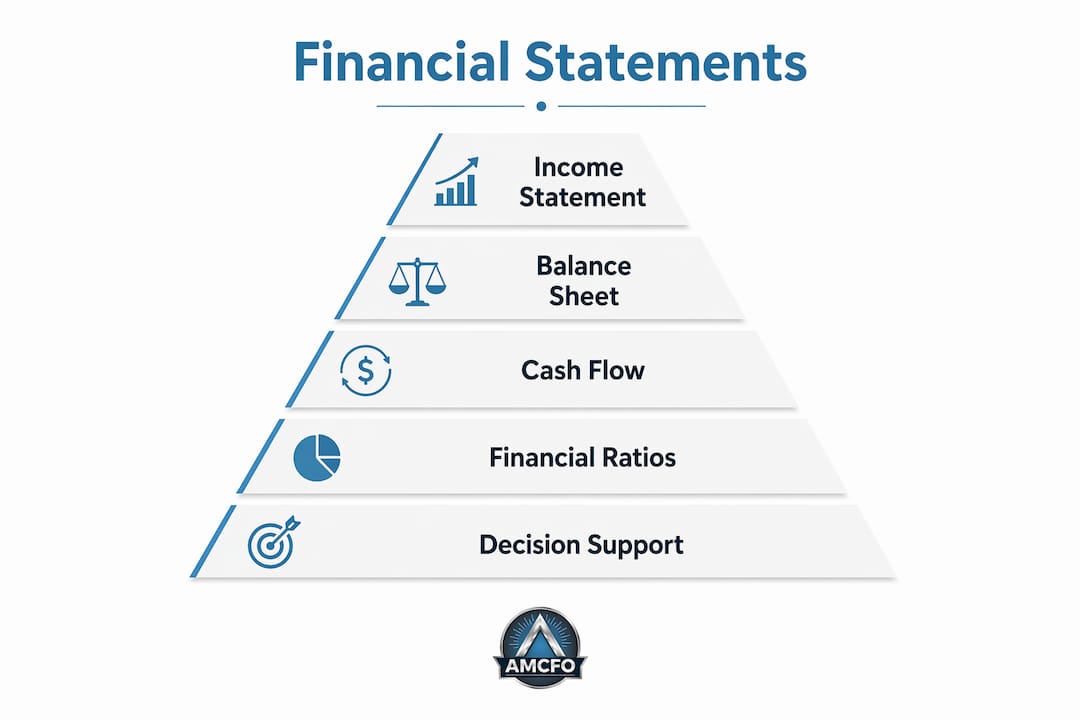
Each of the three core statements answers a different question about your business. Reading them together gives you a complete diagnostic, not just a snapshot.
What the income statement shows
The income statement reveals profitability, expense trends, and sales volume over a defined period. It answers the question: "Did we make money?" But it goes further than a simple yes or no. Gross profit margin shows how efficiently you produce or deliver your product. Operating margin shows how well you control overhead. Net margin shows what actually reaches the bottom line after taxes and interest. Tracking these figures quarter over quarter exposes cost behavior patterns that raw revenue numbers hide.
What the balance sheet shows
The balance sheet answers: "What do we own, what do we owe, and what is left over?" Liquidity ratios derived from the balance sheet, specifically the current ratio (current assets divided by current liabilities), tell you whether the business can meet short-term obligations. The debt-to-equity ratio reveals how much of the company is financed by creditors versus owners. Each statement offers unique insights used for comprehensive financial understanding, and the balance sheet is the anchor for assessing solvency.
What the cash flow statement shows
The cash flow statement tracks real cash movements, not accounting entries. It separates cash from operations, investing, and financing activities. A business can show strong net income on the income statement while running dangerously low on actual cash. Cash flow statement monitoring can detect liquidity problems months before profit issues appear, which gives you time to act rather than react.
| Statement | Primary question answered | Key metrics |
|---|---|---|
| Income statement | Are we profitable? | Gross margin, operating margin, net income |
| Balance sheet | Are we solvent? | Current ratio, debt-to-equity, net worth |
| Cash flow statement | Do we have cash? | Operating cash flow, free cash flow |
Pro Tip: Financial ratios normalize your numbers so you can benchmark against industry peers. A $500,000 net income means very little without knowing your revenue base. ROE and ROA put that number in context.
Financial ratios like ROE, ROA, and the current ratio normalize performance measures, making benchmarking and trend analysis more meaningful than raw figures alone.
Common mistakes business owners make with financial statements
Most financial mistakes do not come from bad intentions. They come from misreading what the statements actually say.
Confusing profit with cash. This is the most dangerous error a business owner can make. Profit on the income statement does not guarantee cash availability because of timing differences between when revenue is recognized and when cash actually arrives. A fast-growing business can show record profits while running out of cash to pay suppliers and employees. That gap has ended otherwise healthy companies.
Treating statements as compliance documents. Viewing financial statements solely as year-end compliance misses ongoing cost, margin, and cash flow trends that are critical to operational health. The statements are most useful when reviewed monthly, not annually.
Relying on raw numbers instead of ratios. A $200,000 increase in revenue sounds good until you realize expenses grew by $250,000. Raw numbers without context mislead. Ratios correct for scale and give you a true read on performance direction.
- Ignoring accounts receivable aging: slow collections destroy cash flow even when sales are strong
- Skipping the notes to financial statements: footnotes often contain material risks and accounting policy changes
- Comparing periods without adjusting for seasonality: a slow january looks worse than it actually is without context
- Making hiring or expansion decisions based on one month of data: trends require at least three periods to be meaningful
Best practices for using financial reports in strategic planning
Consistent, structured use of financial statements separates businesses that grow deliberately from those that react to surprises.
-
Review all three statements monthly. Set a fixed date each month to go through the income statement, balance sheet, and cash flow statement together. One statement alone gives an incomplete picture. The three together reveal whether growth is healthy or strained.
-
Build financial ratios into your review process. Calculate ROE, ROA, gross margin, and the current ratio every period. Track them on a simple spreadsheet. Trends in these ratios tell you more than any single month's absolute numbers. Systematic financial statement analysis using key indicators like ROE, ROA, and liquidity ratios drives cost optimization and better capital management.
-
Integrate statements into budgeting and forecasting. Use last year's income statement as the baseline for next year's budget. Use the cash flow statement to build a 13-week cash forecast. Integrating financial statement review into forecasting and budgeting frameworks encourages proactive, data-driven decisions that support sustainable growth.
-
Use statements to spot early warning signs. A declining gross margin three months in a row signals a pricing or cost problem before it becomes a crisis. Rising accounts receivable relative to revenue signals a collections problem before it hits cash flow. Financial statements are not just historical documents but live decision tools that reveal risks and opportunities when reviewed regularly.
-
Get professional interpretation. Numbers on a page require context to become decisions. Professional financial advice improves interpretation, helping business owners avoid common mistakes and make sense of complex financial data. Experts translate reports into strategies you can act on. For owners without a finance background, a fractional CFO or accounting advisor closes that gap without the cost of a full-time hire. You can learn more about how management accounts support decisions at every level of the organization.
-
Align financial metrics with your growth goals. If your goal is to raise outside capital, focus on improving your debt-to-equity ratio and demonstrating consistent operating cash flow. If your goal is profitability, track gross margin and operating expense ratios weekly. The statements only drive decisions when you connect them to a specific outcome you are managing toward. Explore financial strategies for SMEs to see how this alignment works in practice.
Key Takeaways
Financial statements drive better business decisions only when reviewed consistently, interpreted with ratios, and connected directly to the outcomes you are managing toward.
| Point | Details |
|---|---|
| Three statements work together | Use the income statement, balance sheet, and cash flow statement as a set, not individually. |
| Profit does not equal cash | A profitable business can still run out of cash due to timing gaps between revenue recognition and actual collections. |
| Ratios outperform raw numbers | ROE, ROA, and the current ratio normalize data so you can benchmark performance and spot trends. |
| Monthly review beats annual review | Reviewing statements monthly catches margin erosion and cash pressure months before they become crises. |
| Expert interpretation adds value | Professional advisors translate financial data into decisions, especially for owners without a finance background. |
Why most business owners are using financial statements wrong
I have worked with dozens of business owners who are genuinely smart operators but treat their financial statements like a report card they only look at after the semester ends. That mindset costs them. The income statement is not a verdict. It is a dashboard, and dashboards are only useful if you check them while you are still driving.
The shift I push for is simple: stop asking "how did we do?" and start asking "what does this tell us about next quarter?" A declining gross margin in february is not a problem yet. It is a signal. If you catch it in march and trace it back to a supplier price increase you absorbed without adjusting your own pricing, you fix it in april. If you catch it in december during your annual review, you have lost nine months of margin.
The other thing I see constantly is owners who know their revenue number cold but cannot tell you their current ratio or operating cash flow. Revenue is the most visible number, but it is also the most misleading one in isolation. I have seen businesses with $3 million in revenue that were technically insolvent because their liabilities outpaced their assets. The balance sheet would have told them that story a year earlier if anyone had looked.
My honest recommendation: treat your monthly financial review as a non-negotiable meeting with your business. Bring your accountant or CFO advisor into that conversation. The CFO advisory perspective is not just for large companies. It is exactly what small and mid-size business owners need to stop flying blind.
— Angelica
How Amcfo helps you turn financial reports into real decisions
Accurate financial statements are only half the equation. The other half is knowing what to do with them.

Amcfo provides accounting and bookkeeping services that keep your records current, accurate, and ready for analysis every month, not just at tax time. Beyond clean books, Amcfo's fractional CFO services bring experienced financial leadership to your business without the cost of a full-time hire. That means regular statement reviews, ratio analysis, cash flow forecasting, and direct guidance on the decisions your numbers are pointing toward. Business owners who work with Amcfo stop reacting to financial surprises and start making decisions ahead of them.
FAQ
What is the role of financial statements in decisions?
Financial statements provide verified data on profitability, liquidity, and cash flow that business owners and managers use to make operational, investment, and financing decisions. They convert accounting records into a clear picture of financial health.
Why are financial statements crucial for small business owners?
Small business owners often lack dedicated finance teams, so financial statements serve as the primary tool for tracking performance, managing cash, and planning growth. Regular review catches problems early and supports confident decisions.
What is the difference between profit and cash flow on financial statements?
Profit appears on the income statement and reflects revenue minus expenses under accounting rules. Cash flow appears on the cash flow statement and shows actual cash received and paid, which can differ significantly from profit due to timing differences in collections and payments.
How often should business owners review their financial statements?
Monthly review is the standard best practice. Reviewing all three statements each month allows owners to spot margin trends, cash pressure, and balance sheet changes before they become serious problems.
How does financial statement analysis support strategic planning?
Financial statement analysis uses ratios like ROE, ROA, and gross margin to identify trends and benchmark performance. Integrating this analysis into budgeting and forecasting gives decision-makers a data-driven foundation for setting goals and allocating resources.