

Most business leaders assume that clean books and a solid accountant are enough to make confident financial decisions. That assumption is costing companies real money. Understanding why CFO advisory improves decisions requires separating the function of recording financial history from the discipline of using financial intelligence to shape what happens next. A CFO advisor does not just close the books. They interpret the numbers, model the future, and give executives the specific guidance needed to act with conviction at the moments that matter most.
Table of Contents
- Key takeaways
- Why CFO advisory improves decisions: what the function actually covers
- How CFO advisory sharpens decision quality
- Technology's role in modern CFO advisory
- CFO advisory models: choosing the right engagement
- Practical steps for applying CFO advisory insights
- My take on what executives consistently miss
- See the difference Amcfo advisory makes
- FAQ
Key takeaways
| Point | Details |
|---|---|
| Advisory goes beyond accounting | CFO advisory translates financial data into forward-looking guidance that drives strategic choices. |
| Timing is critical | Engaging advisory before stress points emerge gives leaders far more options and better outcomes. |
| AI is reshaping the function | Modern CFO advisors use AI tools to cut close times and improve forecast accuracy measurably. |
| Fractional models lower the barrier | Growing companies can access expert financial leadership without the cost of a full-time hire. |
| Data quality underpins everything | Strong decisions require clean, reliable financial data as the foundation for any advisory insight. |
Why CFO advisory improves decisions: what the function actually covers
Accounting records what already happened. CFO advisory determines what should happen next. That distinction sounds simple, but it drives entirely different outcomes in boardrooms and executive meetings every week.
CFO advisory services bridge financial excellence and strategic business expertise, enabling organizations to scale, manage risk, and plan resilient growth. In practice, that means advisors are running financial planning and analysis, modeling scenarios for capital allocation, identifying risks before they become emergencies, and translating data into a language that operational leaders can act on.
Here is a clear breakdown of what CFO advisory actually covers in practice:
- Financial planning and forecasting. Building forward-looking models that tie operational assumptions to financial outcomes, so executives can see the consequences of decisions before committing to them.
- Cash flow management. Monitoring working capital, identifying timing gaps, and protecting liquidity so the business never loses strategic flexibility because of a solvable cash problem.
- Risk identification. Spotting concentration risks, margin vulnerabilities, and contract exposures that sit buried in financial data but rarely surface in standard monthly reports.
- Strategic investment analysis. Running rigorous financial analysis on growth initiatives, acquisitions, or pricing changes before the decision is made rather than explaining results afterward.
- Stakeholder and board communications. Translating financial performance into clear narratives that align investors, lenders, and leadership around a shared picture of where the company stands.
A standard bookkeeper or controller handles none of these functions consistently. The role of CFO in decisions is to build the teams, processes, and reporting frameworks that put accurate, real-time financial data directly in front of the people making strategic calls. That is what separates advisory from compliance.
How CFO advisory sharpens decision quality
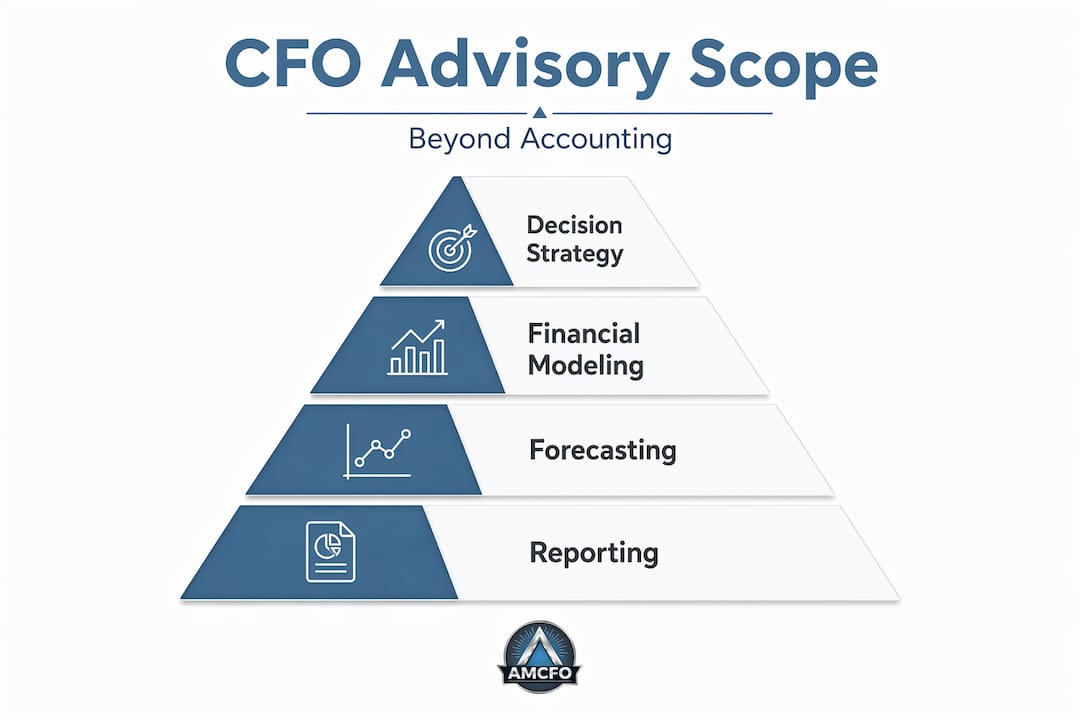
The CFO advisory benefits that matter most are not abstract. They show up in specific decisions that every growing business faces: whether to hire ahead of revenue, which market to enter first, how aggressively to price a new product, and when to raise capital versus when to wait.
Here are the mechanisms through which advisory materially improves those outcomes:
-
Scenario modeling replaces gut instinct. Instead of debating assumptions in a conference room, executives get three fully modeled scenarios: base case, upside, and downside. Each one quantifies the financial consequences of a specific set of choices. Decisions move faster and with far more confidence.
-
Cash flow visibility removes panic decisions. Cash flow consulting now extends into forecasting accuracy and operational visibility, enabling strategic growth decisions rather than reactive firefighting. Leaders who know their cash position 13 weeks forward make fundamentally different choices than those operating on last month's bank balance.
-
Working capital optimization frees growth capital. Many companies have significant cash tied up in receivables, inventory, or vendor payment timing. A CFO advisor identifies and fixes those inefficiencies without requiring new revenue.
-
Financial analysis disciplines growth investment. Before hiring a new sales team, launching a product line, or signing a lease, a CFO advisor runs the numbers. Return thresholds get set. Trade-offs become explicit. The decision does not just feel right. It checks out.
-
Risk mitigation protects the downside. Advisors identify the financial triggers that indicate a strategy is underperforming early enough to adjust course, rather than discovering the problem when it becomes a crisis.
-
Data-driven culture reduces bias. When financial models are built transparently and reviewed regularly, the loudest voice in the room no longer wins by default. Evidence replaces opinion in the most consequential discussions.
Pro Tip: Set a 90-day rolling forecast as a standard agenda item in your executive meetings. If your CFO advisor is not updating this ahead of each session, you are making decisions against stale assumptions.
Financial modeling for smarter decisions is not a one-time exercise. It is an ongoing process that keeps leadership aligned with current reality, not last quarter's plan.

Technology's role in modern CFO advisory
The financial advisory impact has expanded significantly because CFO advisors now operate with tools that did not exist five years ago. AI and advanced analytics are changing what is possible, and advisors who have adopted these tools give the executives they serve a measurable operational edge.
The numbers are concrete. AI-enabled finance workflows can reduce monthly close times by 7.5 days and improve forecast accuracy by 24% by 2027. Those are not incremental improvements. A faster close means executives get current financial data sooner after the month ends. Better forecast accuracy means the scenarios they are planning against are materially more reliable.
Here is where modern advisory practices are applying AI most effectively:
- Automated reconciliations. What used to take a finance team days of manual matching now runs overnight, freeing advisory capacity for interpretation and strategy rather than data cleanup.
- AI-enhanced AR collections. Predictive tools identify at-risk receivables before they age past 60 days, protecting cash flow without requiring constant manual oversight.
- Probabilistic forecasting. Rather than presenting a single forward projection, AI-assisted models generate probability-weighted outcomes that give executives a realistic picture of where the range of results actually sits.
CFO advisory is increasingly essential for navigating AI and analytics adoption, transforming CFOs into decision co-pilots using enhanced insights.
The catch is that technology only works when the underlying data is clean. AI adoption in finance should target core workflows where precision creates enterprise value, and it requires clear metrics, good data quality, and iterative capability building. A CFO advisor who jumps to AI tooling before fixing reporting foundations will produce faster garbage, not better decisions.
CFO advisory models: choosing the right engagement
Not every business needs a full-time CFO. The financial leadership structure that works for a $200 million company is overkill for one doing $8 million. The good news is that outsourced CFO services provide expert financial judgment without full-time costs, producing materially better business outcomes during growth phases.
| Model | Best fit | Cost structure | Decision-making support |
|---|---|---|---|
| Full-time CFO | $50M+ revenue, complex operations | $250K+ annual salary + benefits | Daily, deeply embedded in operations |
| Fractional CFO | $2M to $50M revenue, growth stage | Monthly retainer, typically $3K to $10K | Weekly to biweekly, strategic focus |
| Project-based advisory | Specific events: capital raise, exit, restructure | Engagement fee, defined scope | Intensive during event, then complete |
| Outsourced CFO | Small businesses needing consistent oversight | Lower retainer, shared service model | Monthly reporting and ongoing guidance |
A fractional CFO engagement gives growing companies a level of financial leadership that is proportional to their current stage. The advisor is embedded enough to understand the business deeply but structured as a flexible resource rather than a fixed overhead line.
Pro Tip: When evaluating advisory models, do not anchor on cost per hour. Anchor on the specific decisions coming in the next 12 months. If you have a capital raise, an acquisition, or a market expansion ahead, the cost of suboptimal advisory is far greater than the cost of the right engagement.
Understanding how to structure a CFO advisory engagement for maximum value requires aligning the scope of the relationship to your actual decision calendar, not just your monthly reporting needs.
Practical steps for applying CFO advisory insights
Having a CFO advisor in place does not automatically improve decisions. The relationship has to be structured to create those outcomes deliberately. These steps make the difference between advisory that generates reports and advisory that changes outcomes.
- Align advisory input to your decision calendar. Map out the major decisions you expect in the next 12 months. Capital investments, pricing reviews, new hires, market entries. Schedule advisory work to produce financial analysis ahead of each of those decisions, not after.
- Build a shared reporting framework. Agree on a set of core metrics that the advisory relationship will track and review at each touchpoint. Revenue by segment, gross margin by product line, cash runway, customer acquisition cost, and working capital ratio are a reasonable starting set for most businesses.
- Invest in financial literacy across your leadership team. The best advisory insights land flat if the CFO advisor is the only person in the room who understands them. Executives who read financial statements critically make faster, better use of advisory input.
- Review forecasts iteratively, not annually. Financial advisory ahead of key decisions improves timing and alignment significantly. Waiting until stress emerges limits options. Monthly forecast updates tied to actual results keep the advisory relationship calibrated to reality.
- Create feedback loops. After major decisions, review the financial model that supported them against actual outcomes. That process builds better models over time and catches systematic biases in assumptions before they become expensive patterns.
The benefits of outsourced CFO services compound over time precisely because the advisory relationship develops context. An advisor who has worked through two budget cycles with your business understands your cost structure, your risk tolerance, and your strategic priorities at a depth that produces genuinely different quality guidance.
My take on what executives consistently miss
I have seen a pattern in how business leaders approach CFO advisory, and the most common mistake is treating it as a reporting upgrade rather than a decision-making function. Leaders engage an advisor, get better-looking monthly financials, and declare the problem solved. The decisions keep getting made the same way.
What I have learned is that the financial advisory impact only becomes real when advisory input is deliberately embedded into the decision process. The timing of financial advisory is as critical as the quality. Proactive engagement before stress points gives leaders materially more options and more time to act on them. Reactive engagement after problems emerge is still useful, but you are already negotiating from a weaker position.
The other thing executives underestimate is how much the technology conversation matters right now. CFO advisors who are building fluency with AI-assisted forecasting and analytics are simply giving their clients better intelligence to work with. I think the companies that pair strong financial leadership with modern advisory tools in the next two to three years will build a decision-making advantage that is genuinely hard for competitors to replicate.
The biggest missed opportunity I see consistently is waiting too long. Growing companies delay structured CFO advisory until a crisis forces the conversation. By then, the decisions that were most important for long-term outcomes have already been made on instinct rather than analysis.
— Angelica
See the difference Amcfo advisory makes
Amcfo delivers fractional CFO services built specifically for businesses that need expert financial leadership without the overhead of a full-time executive hire. Whether you are preparing for a capital raise, trying to improve cash visibility, or making growth investment decisions that need rigorous financial backing, Amcfo structures the advisory relationship around your actual decision calendar.

From financial management and planning to ongoing CFO consulting, every Amcfo engagement is built to put better financial intelligence in front of your leadership team at the moments that matter. If you are making significant decisions without that level of insight, the cost is already showing up somewhere in your results. Talk to Amcfo about what a structured advisory relationship looks like for your business.
FAQ
What does a CFO advisor do that an accountant does not?
An accountant records and reports historical financial data. A CFO advisor interprets that data, models future scenarios, identifies risks, and provides strategic guidance that directly informs business decisions before they are made.
How does CFO advisory improve cash flow management?
CFO advisors build forward-looking cash flow forecasts, identify working capital inefficiencies, and create early warning systems so leaders can see liquidity gaps weeks before they become problems rather than reacting after the fact.
When should a growing business engage CFO advisory?
The best time is before major decisions, not after financial stress appears. Proactive advisory ahead of capital raises, market expansions, or significant hiring plans produces materially better outcomes than reactive engagement during a crisis.
What is a fractional CFO and how does it differ from full-time?
A fractional CFO provides the same strategic financial leadership as a full-time hire but on a part-time or retainer basis. This model gives growing businesses expert advisory at a cost that is proportional to their current stage and revenue.
Can small businesses benefit from CFO advisory?
Yes. Outsourced and fractional CFO models are designed specifically to make expert financial judgment accessible to businesses that cannot justify a full-time CFO salary, and they consistently produce better margins, growth discipline, and cash stability.