

Controller services are specialized financial oversight solutions that give businesses accurate reporting, tighter cash management, and stronger internal controls without hiring a full-time employee. The term "controller services" covers what the accounting profession formally calls the financial controller function, which sits between day-to-day bookkeeping and strategic CFO leadership. Firms like Honkamp, BPM, and OD Accountants deliver these services in fractional, outsourced, and virtual formats. Amcfo provides the same layered financial leadership to businesses of all sizes, combining controller-level oversight with bookkeeping, forecasting, and fractional CFO support. The result is a finance function that works in real time, not just at tax season.
What do controller services actually do?
Controller services are the operational backbone of a business's finance function, turning raw transaction data into management-ready reports and forward-looking analysis. Controllers transform raw data into dashboards and rolling forecasts that drive real decisions. That is a fundamentally different output than what a bookkeeper or tax accountant produces.
The core functions covered by financial controller services include:
- Monthly close management: Account reconciliations, journal entries, and variance analysis completed on a fixed schedule so your numbers are always current.
- Management accounts and KPI dashboards: Formatted reports tied to the metrics that matter to your business, not just statutory line items.
- Cash flow forecasting: Rolling cash-flow forecasts linked to live accounting platforms so you see problems before they become crises.
- Internal controls: Documented approval processes, segregation of duties, and fraud prevention protocols that protect your assets.
- Finance team oversight: Controllers supervise bookkeepers and accounting staff, catching errors before they compound.
- Audit and tax support: Preparing schedules, reconciling accounts, and coordinating with external auditors or tax advisors to reduce their billable time.
Key controller tasks include managing monthly closes, financial controls, and operational risk mitigation. That scope explains why businesses that rely on bookkeeping alone consistently face reporting blind spots.
Pro Tip: Ask any prospective controller service provider to show you a sample management accounts pack. If it looks like a standard profit-and-loss printout with no commentary or KPIs, keep looking.

Outsourced vs. full-time controllers: what is the real difference?
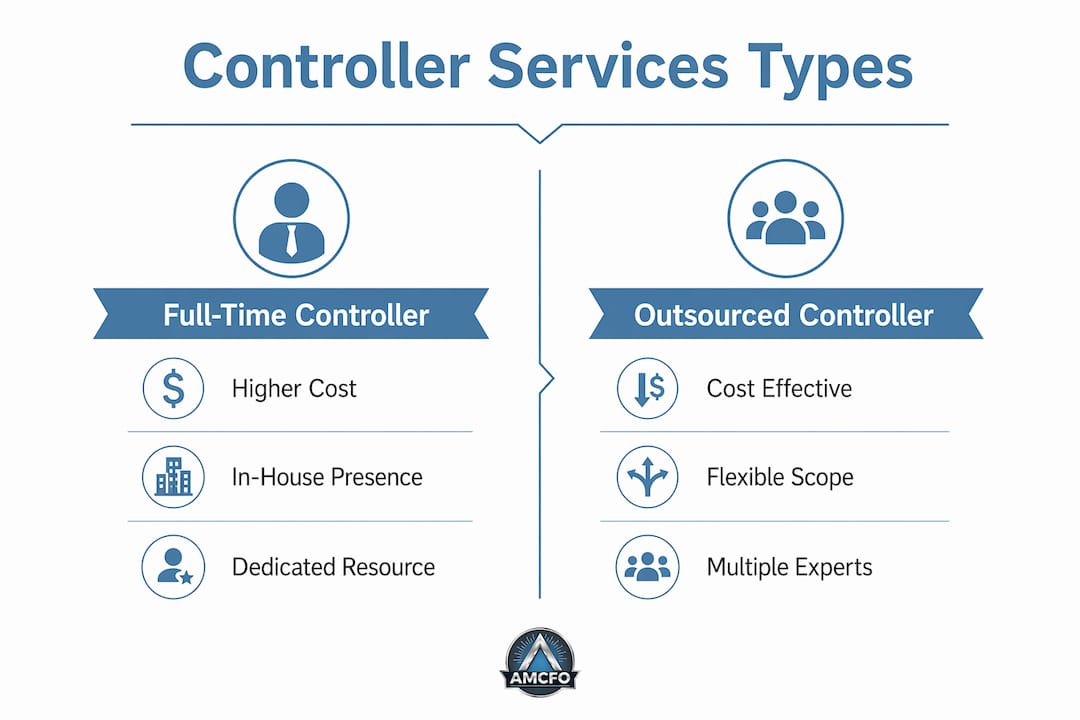
The most practical question business owners ask is whether to hire internally or engage outsourced controller solutions. The answer depends on cost, flexibility, and the depth of expertise you actually need.
| Factor | Full-time controller | Outsourced or fractional controller |
|---|---|---|
| Annual cost | $90,000–$140,000 salary plus benefits and employer taxes | Starting around $1,300/month for fractional engagements |
| Flexibility | Fixed headcount, hard to scale down | Adjustable service levels as needs change |
| Expertise depth | One person's background | Access to a team with cross-industry experience |
| Recruitment risk | 3–6 month hiring process, high turnover cost | No recruitment overhead, faster onboarding |
| Engagement type | Permanent | Project-based, interim, or ongoing retainer |
Fractional and virtual controller services start at roughly $1,300 per month. That figure represents a fraction of the fully loaded cost of an internal hire, and it includes senior-level judgment that most small businesses could not afford to retain full time.
A common misconception is that outsourced providers offer a fixed, one-size-fits-all package. Best providers adapt intensity and scope dynamically based on your growth stage, transaction volume, or a specific project like a fundraising round or acquisition. That flexibility is one of the strongest arguments for the outsourced model.
Controller consulting services also eliminate the risk of a single point of failure. When an internal controller resigns, the finance function can stall for months. An outsourced team absorbs that disruption without missing a close cycle.
How to choose the right controller service provider
Choosing the right provider requires more than comparing price sheets. You need a partner whose capabilities match your current complexity and can grow with you.
-
Define your reporting requirements. How often do you need management accounts? Weekly cash flow updates? Quarterly board packs? Your answer sets the baseline service level and directly affects cost.
-
Assess cash flow complexity. Businesses with multiple revenue streams, foreign currency exposure, or seasonal swings need a provider with forecasting depth, not just reconciliation skills.
-
Check technology compatibility. The best controller service providers work inside your existing stack. Confirm they are proficient in QuickBooks, Xero, or whichever cloud accounting platform you use. Scaling financial operations becomes significantly harder when your controller works in a separate system.
-
Evaluate contract terms. Avoid providers who require long-term lock-ins before demonstrating value. Look for month-to-month or quarterly agreements with clearly defined deliverables.
-
Ask about proactive vs. reactive reporting. A controller who only reports what happened last month is not delivering the full value of the role. You want forward-looking financial management that anticipates cash shortfalls and flags variance trends before they become problems.
-
Request client references in your industry. A controller who has worked with SaaS companies may not understand the working capital cycles of a manufacturing or construction business.
Pro Tip: During your first call with any provider, ask: "What would you flag in our financials in the first 30 days?" A strong answer reveals their analytical instincts. A vague answer reveals their limitations.
The cost of controller services scales with scope, but the right engagement pays for itself quickly. Businesses that catch a single cash flow problem early or avoid one audit adjustment typically recover the annual fee in a single quarter.
Why combine controller services with CFO-level support?
Controller services and CFO leadership are complementary, not interchangeable. Understanding the boundary between them helps you build a finance function that covers both operational accuracy and strategic direction.
The controller function handles the operational layer:
- Accurate, timely financial statements every period
- Internal controls that prevent errors and fraud
- Cash flow visibility through rolling forecasts
- Finance team management and process documentation
- Audit-ready records and tax coordination
The CFO function handles the strategic layer: fundraising, board reporting, M&A analysis, capital allocation, and long-term financial planning. Controller oversight connects day-to-day transactional finance with strategic CFO support for growing companies. Without a solid controller foundation, a CFO is working with unreliable data.
For most growing businesses, the practical path is to engage controller services first. Once your reporting is clean, your cash flow is visible, and your internal controls are documented, you are ready to layer in fractional CFO support for strategic decisions. This sequencing avoids paying CFO rates for work that belongs at the controller level.
Outsourced controller professionals combine technical accounting with practical business insight to build sustainable finance processes. That combination is what makes the controller-to-CFO pathway so cost-effective. You build capability incrementally rather than hiring a senior executive before your finance function is ready to support one.
Amcfo structures its financial management services exactly this way, pairing controller-level oversight with fractional CFO consulting so clients get the right level of expertise at every stage of growth.
Key Takeaways
Controller services deliver the most value when they combine real-time reporting, proactive cash flow oversight, and scalable engagement terms that match your business stage.
| Point | Details |
|---|---|
| Controllers go beyond bookkeeping | They produce management dashboards, KPI reports, and rolling forecasts, not just transaction records. |
| Outsourced models cost far less | Fractional engagements start around $1,300/month versus $90,000+ for a full-time internal hire. |
| Flexibility is a core advantage | Top providers scale service intensity up or down based on growth stage or project needs. |
| Fixed fees drive better outcomes | Fixed-fee engagements encourage proactive oversight; hourly billing discourages frequent contact. |
| Controllers prepare you for CFO support | Clean reporting and strong controls are the foundation that makes fractional CFO work effective. |
What I have learned from watching businesses get this wrong
I have seen businesses spend years with a bookkeeper they called a controller, wondering why their cash flow was always a surprise. The financials were accurate in a technical sense. Every transaction was recorded. But there was no forecast, no variance commentary, no one watching the gap between revenue recognition and actual cash collection.
The most common mistake is treating controller services as a compliance function. You hire someone to close the books and file returns, and you measure success by whether the numbers are clean. That is a low bar. A real controller is watching your receivables aging, modeling your next 13 weeks of cash, and telling you in October that your Q1 payroll will be tight if you do not collect three specific invoices before December.
The second mistake is choosing hourly billing over fixed fees. Fixed fees encourage ongoing oversight and stronger partnerships. When you pay by the hour, you unconsciously limit how often you call. You batch questions. You delay conversations. That delay is exactly where financial problems grow.
The third mistake is waiting too long to layer in strategic support. I have worked with founders who had excellent controller coverage but no one thinking about their capital structure or exit readiness. The controller kept the engine running, but no one was navigating. The fix is not replacing the controller. It is adding a fractional CFO alongside them, which is far cheaper than most founders expect.
Choose a provider who charges a fixed monthly fee, delivers a management pack within five business days of month end, and calls you proactively when something looks off. That is the standard. Hold every provider to it.
— Angelica
How Amcfo can support your financial oversight needs
Amcfo delivers controller-level financial oversight alongside bookkeeping, forecasting, and fractional CFO consulting for businesses at every stage of growth. Whether you need monthly management accounts, cash flow modeling, or a full accounting and bookkeeping foundation, Amcfo builds the finance function around your actual needs, not a generic package.

Every engagement is structured on fixed monthly fees, so you get proactive oversight without watching the clock. Amcfo's service and accounting packages are designed to scale with your business, from early-stage startups needing clean books to established companies ready for fractional CFO support. If you want a finance function that tells you what is coming, not just what already happened, Amcfo is built for that conversation.
FAQ
What are controller services?
Controller services are professional financial oversight solutions covering monthly close management, cash flow forecasting, internal controls, and management reporting. They sit between bookkeeping and CFO-level strategy in the finance function hierarchy.
How much do outsourced controller services cost?
Outsourced and fractional controller services typically start around $1,300 per month, compared to $90,000 or more annually for a full-time internal hire. Pricing scales with reporting complexity and service scope.
What is the difference between a controller and a CFO?
A controller manages operational finance: accurate reporting, internal controls, and cash flow visibility. A CFO handles strategic decisions like fundraising, capital allocation, and board-level planning. Most growing businesses need controller services before they are ready for CFO support.
Are virtual controller services reliable for small businesses?
Virtual controller services are fully reliable for small businesses when the provider uses cloud accounting platforms like QuickBooks or Xero and delivers reports on a fixed schedule. The key is confirming the provider offers proactive communication, not just monthly report delivery.
How do I know if my business needs controller services?
Your business needs controller services if you are making decisions based on bank balance rather than a cash flow forecast, if your books close more than two weeks after month end, or if you have no documented internal controls. These are the clearest signals that bookkeeping alone is not enough.