

Bookkeeping services are professional solutions that record, organize, and manage every financial transaction your business makes, creating the accurate foundation your tax filings, cash flow decisions, and profitability analysis depend on. For small business owners, the difference between clean books and chaotic records often determines whether tax season is manageable or catastrophic. Tools like QuickBooks, Tabby, and Profitbooks have changed how these services are delivered, blending AI automation with expert oversight to give entrepreneurs real-time visibility into their finances. Understanding which type of service fits your business, and how to evaluate your options, is the most practical financial decision you can make this year.
What types of bookkeeping services are available for small businesses?
Small business accounting is not a single product. It exists on a spectrum, and choosing the wrong point on that spectrum costs you either money or accuracy.
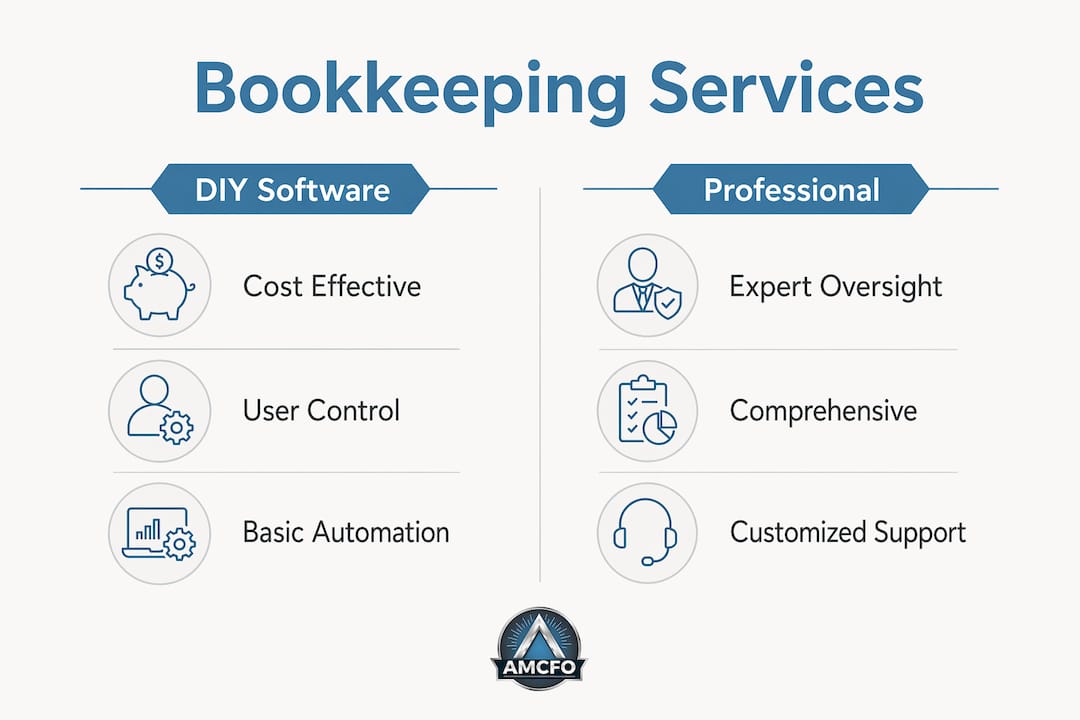
DIY software bookkeeping is the entry point for most early-stage businesses. Platforms like QuickBooks connect directly with bank accounts and credit cards to automatically import and categorize transactions, cutting manual data entry significantly. This works well for sole proprietors and freelancers with straightforward income streams and minimal transaction volume. The risk is that software cannot catch what you do not know to look for, such as misclassified expenses or missed deductions.

Professional bookkeeping means hiring a trained bookkeeper, either locally or through a virtual firm, to manage your records on your behalf. Virtual bookkeeping has grown sharply because it removes geography as a constraint and typically costs less than an in-house hire. This option suits businesses with payroll, inventory, or multiple revenue streams that require judgment calls beyond what software handles automatically.
Hybrid models combine AI-powered automation with periodic expert review. Platforms like Tabby automate expense tracking and produce tax-ready reports, while a human bookkeeper or accountant reviews the output for accuracy and compliance. This is the fastest-growing model in 2026 because it delivers speed and cost efficiency without sacrificing oversight.
- DIY software: Best for freelancers, solopreneurs, and businesses under $250K in annual revenue
- Professional bookkeeping: Best for businesses with payroll, multiple accounts, or complex expense categories
- Hybrid AI plus expert: Best for growing businesses that want automation speed with human accuracy checks
- Full-service accounting firms: Best for businesses approaching $1M in revenue or preparing for investment or acquisition
Pro Tip: If you are a startup with fewer than 50 monthly transactions, start with QuickBooks or a similar platform and schedule a quarterly review with a professional bookkeeper. You get affordable bookkeeping now and expert validation when it matters most.
Does AI replace the need for a professional bookkeeper?
AI bookkeeping tools are genuinely impressive at what they do, and genuinely limited in ways that matter. Profitbooks processes transactions 24/7, matching receipts to bank entries automatically and updating your profit and loss statement in real time. Tabby cleans raw bank statement data and generates tax-ready reports without requiring any accounting background. These capabilities reduce hours of manual work to minutes.
The limitation is structural. AI works best for routine tasks but requires human intervention the moment complexity enters the picture. Entity structure decisions, multi-state tax rules, depreciation schedules, and owner distributions all require judgment that current AI cannot reliably provide. A misclassified transaction that software accepts without question can trigger an IRS audit or distort your profit margins for an entire quarter.
"The best bookkeeping services balance technology automation and human expertise to maintain accuracy, improve efficiency, and ensure compliance." — Tabby
The practical implication: AI tools are not a replacement for expertise. They are a force multiplier for it. When a professional bookkeeper uses Profitbooks or QuickBooks, they process more transactions in less time and focus their attention on the decisions that actually require a trained eye.
| Feature | AI-only bookkeeping | Expert-reviewed hybrid |
|---|---|---|
| Transaction categorization | Automated, fast | Automated, then verified |
| Tax rule application | Limited to common scenarios | Handles entity-specific nuances |
| Real-time reporting | Yes | Yes |
| Complex compliance decisions | Not reliable | Human-reviewed |
| Cost | Lower | Moderate |
| Error risk | Higher without oversight | Significantly reduced |
Pro Tip: Before committing to any AI bookkeeping platform, ask whether a licensed bookkeeper or CPA reviews flagged transactions. If the answer is no, you are accepting compliance risk in exchange for convenience.
How to choose the right bookkeeping service for your business
Selecting the right service is a decision with real financial consequences. Matching your business needs to service offerings across automation, pricing, and service breadth is the framework that prevents costly mismatches. Here is how to evaluate your options systematically.
-
Define your service scope. Determine whether you need transaction recording only, or whether you also need payroll processing, invoicing, tax preparation coordination, or financial reporting. A freelancer needs the former. A business with five employees needs all of it.
-
Assess technology integration. Your bookkeeping service should connect directly with your bank, payment processor, and any platforms you use for sales, such as Shopify or Stripe. Manual data imports create errors and delay your financial picture.
-
Understand the cost structure. Most online bookkeeping services charge a flat monthly subscription based on transaction volume or revenue tier. Verify what is included at each tier. Tax preparation services and payroll are frequently add-ons that significantly change the total cost.
-
Confirm scalability. A service that works for your current volume should also be able to grow with you. Ask specifically whether the pricing and service model can accommodate a doubling of your transaction volume or the addition of payroll within 12 months.
-
Evaluate data security. Your financial records contain sensitive business and personal data. Confirm that any platform or service provider uses bank-level encryption, two-factor authentication, and clear data retention policies.
-
Check accountant collaboration. The best bookkeeping services share data directly with your CPA or tax preparer. Ask whether the platform exports to standard accounting formats and whether the service team will communicate directly with your accountant during tax season.
How bookkeeping connects to accounting and tax preparation
Bookkeeping records and organizes financial data, while accounting uses that data for tax planning, financial statements, and auditing. The distinction matters because many small business owners conflate the two and end up with gaps in their financial management. You can read a detailed breakdown of these roles in this bookkeeping vs. accounting guide for small businesses.
Clean books are the prerequisite for everything that follows. When your bookkeeper maintains accurate, categorized records throughout the year, your accountant or CPA can prepare tax filings faster, identify deductions with confidence, and produce financial statements that actually reflect your business performance. Bookkeeping creates the foundation that accounting builds on for planning, reporting, and tax filing. When that foundation is weak, every downstream process suffers.
The most effective setup for a small business combines ongoing bookkeeping with periodic accounting review. Monthly bookkeeping keeps your records current. Quarterly accounting reviews catch discrepancies before they compound. Annual tax preparation then becomes a data-assembly exercise rather than a crisis.
| Workflow stage | Role | Frequency |
|---|---|---|
| Transaction recording | Bookkeeper | Daily or weekly |
| Bank reconciliation | Bookkeeper | Monthly |
| Financial statement review | Accountant or CPA | Quarterly |
| Tax filing coordination | CPA with bookkeeper data | Annually |
| Strategic financial planning | CFO or fractional CFO | Quarterly or ongoing |
Tips for smooth coordination between your bookkeeper and accountant:
- Use cloud-based platforms like QuickBooks that both parties can access simultaneously
- Establish a shared document folder for receipts, contracts, and tax documents
- Schedule a handoff meeting before tax season to review the year's categorizations
- Confirm that your bookkeeper understands your business entity type, since S-corps, LLCs, and sole proprietors have different reporting requirements
Key Takeaways
Reliable bookkeeping services combine AI-powered automation with professional oversight to keep your records accurate, your taxes compliant, and your business decisions grounded in real financial data.
| Point | Details |
|---|---|
| Choose the right service type | Match DIY, professional, or hybrid bookkeeping to your transaction volume and complexity. |
| AI tools need human review | Platforms like Tabby and Profitbooks automate categorization but cannot handle complex tax or compliance decisions alone. |
| Evaluate six key criteria | Assess scope, technology, cost, scalability, security, and accountant collaboration before selecting a service. |
| Bookkeeping feeds accounting | Clean monthly records make tax preparation faster, more accurate, and less expensive. |
| Integration is non-negotiable | Your bookkeeping platform must connect with your bank, payment tools, and your CPA's workflow. |
What I've learned from watching businesses get bookkeeping wrong
Most small business owners I have worked with do not fail at bookkeeping because they are careless. They fail because they underestimate how quickly financial complexity grows. A business that starts with 30 transactions a month can hit 300 within two years, and the DIY spreadsheet that worked in year one becomes a liability in year three.
The pattern I see repeatedly: an entrepreneur uses a basic software tool, feels confident because the dashboard looks clean, and then discovers at tax time that six months of transactions were miscategorized. The correction costs more in accountant fees than a professional bookkeeping service would have cost for the entire year.
My honest recommendation is to treat bookkeeping as infrastructure, not administration. The businesses that use outsourced accounting services strategically, pairing a reliable platform with periodic expert review, consistently make better financial decisions because they are working from accurate data. The ones that cut corners on record-keeping make decisions based on guesses. That gap compounds over time.
One more thing worth saying directly: real-time financial reporting is not a luxury feature. Knowing your cash position and profit margins on a weekly basis changes how you price, hire, and invest. If your current bookkeeping setup only tells you where you stood three months ago, you are flying blind.
— Angelica
How Amcfo keeps your books accurate and your business moving

Amcfo provides professional bookkeeping and accounting services designed for small businesses and growing companies that need more than a software subscription. From QuickBooks setup and cleanup to monthly transaction management, payroll support, and tax coordination, Amcfo handles the financial record management that keeps your business compliant and your decisions grounded in real numbers. Every client gets expert oversight, not just automated reports. If your books are behind, your categories are a mess, or you simply want a professional managing your financial foundation, explore Amcfo's accounting packages to find the right fit for your business size and goals.
FAQ
What do bookkeeping services typically include?
Bookkeeping services typically include transaction recording, bank reconciliation, expense categorization, invoicing support, and financial report preparation. More comprehensive packages also cover payroll processing and tax preparation coordination.
How much do small business bookkeeping services cost?
Costs vary by transaction volume and service scope, but most online bookkeeping services for small businesses range from $200 to $800 per month. Payroll and tax preparation are frequently priced as separate add-ons.
Is QuickBooks enough for small business bookkeeping?
QuickBooks handles transaction categorization and bank connections effectively, and 79% of QuickBooks Online customers say it helps them run their business more easily. For businesses with complex expenses, payroll, or multiple entities, professional oversight alongside the software produces more reliable results.
What is the difference between a bookkeeper and an accountant?
A bookkeeper records and organizes daily financial transactions, while an accountant analyzes that data for tax planning, financial statements, and strategic decisions. Most small businesses need both, with bookkeeping handled monthly and accounting reviewed quarterly.
When should a startup hire professional bookkeeping services?
Accounting services for startups become necessary as soon as the business has regular revenue, payroll obligations, or investor reporting requirements. Waiting until tax season to organize a full year of records consistently costs more than maintaining clean books throughout the year.