

Outsourcing accounting services is the practice of delegating financial functions such as bookkeeping, payroll, tax coordination, and financial reporting to specialized external providers, freeing your internal team to focus on revenue-generating work. Businesses that outsource bookkeeping and accounting consistently report lower overhead, faster access to qualified talent, and sharper financial visibility. Whether you run a growing startup or a mid-size professional services firm, the decision to outsource finances is no longer a cost-cutting tactic. It is a strategic move that defines how efficiently your business scales in 2026.
Why outsource accounting services: the core business case
The primary reason companies outsource accounting is cost reduction combined with access to expertise they cannot afford to hire full-time. A US-based accountant costs $3,950 or more per month before benefits, office space, and software licenses. Outsourced providers, particularly those with offshore delivery teams, can cut that figure by 70 to 85 percent while still delivering work performed by professionals trained in US GAAP and IRS regulations. That is not a marginal efficiency gain. It is a structural cost advantage.
Beyond price, the benefits of outsourcing accounting extend into talent access and operational agility. The accounting profession faces a well-documented talent shortage, and small to mid-size businesses compete poorly against large corporations for credentialed CPAs and controllers. Outsourcing solves that problem by giving you access to a bench of specialists without the recruiting cost or retention risk. You get the expertise without the employment relationship.
The key benefits businesses report most consistently include:
- Cost savings: Overhead reduction on salaries, benefits, and office infrastructure
- Specialized expertise: Access to professionals credentialed in US GAAP, IRS compliance, and industry-specific regulations
- Scalability: Ability to increase or reduce accounting capacity based on seasonal workload or growth phases
- Technology access: Providers bring enterprise-grade platforms like QuickBooks, Xero, and NetSuite without additional licensing costs
- Faster close cycles: Offshore time zones create near-24-hour productivity windows, accelerating month-end close
- Reduced compliance risk: Dedicated specialists stay current on tax law changes and reporting requirements
Pro Tip: When evaluating providers, ask for documented workflows and sample workpapers before signing any agreement. A provider that cannot show you their process documentation is not ready to handle your books.
Outsourcing vs in-house accounting: which model fits your business?
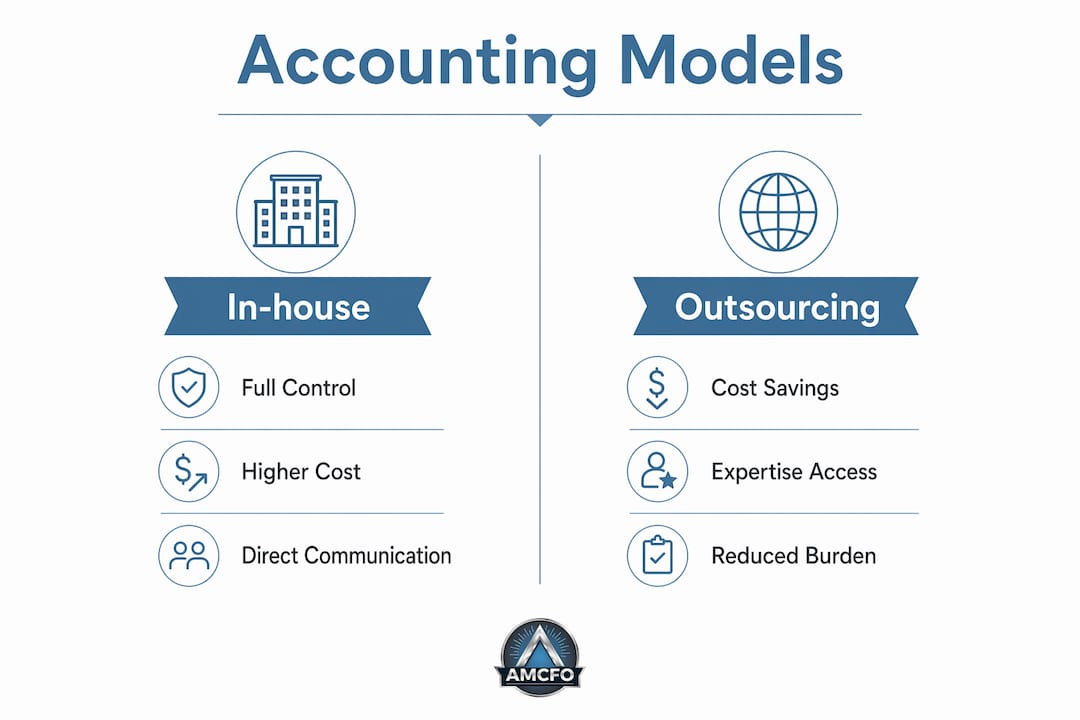
The outsourcing vs in-house accounting decision is not binary. Three distinct models exist, and each carries different cost, control, and quality trade-offs.

In-house accounting gives you the most direct control. Your team sits in your office, understands your culture, and responds immediately to requests. The trade-off is cost and capacity. A full accounting department with a controller, staff accountant, and bookkeeper can easily exceed $200,000 annually in salary alone, before software, benefits, and management overhead. For most small to mid-size businesses, that cost is prohibitive relative to the volume of work generated.
Agency outsourcing places your accounting work with a third-party firm that manages its own staff. You pay a service fee, and the provider handles recruitment, training, and quality control. Agency outsourcing delivers roughly 25% cost savings after a maturation period of two to three years. The trade-off is less direct control over individual staff and slightly higher per-unit cost compared to direct offshoring.
Direct offshoring means you hire accounting staff in a lower-cost country, typically India or the Philippines, and manage them directly. After the same two to three year learning curve, direct offshoring can reach 50% cost savings. You also gain better data security control because you own the hardware and manage access directly. The downside is management complexity. You are effectively running a remote team across time zones and cultural differences.
| Model | Typical cost savings | Control level | Management burden | Best for |
|---|---|---|---|---|
| In-house | None | Highest | Low | Large firms with complex needs |
| Agency outsourcing | ~25% after 2-3 years | Medium | Low to medium | SMBs wanting managed service |
| Direct offshoring | ~50% after 2-3 years | Medium-high | High | Firms with mature processes |
One compliance factor that applies across all three models: ISA 402 requires auditors to obtain evidence about controls within outsourced service organizations. If your business undergoes an audit, your auditor will need documentation of your provider's internal controls. Choose a provider that can supply a SOC 1 or SOC 2 report without hesitation.
What to evaluate before outsourcing your accounting
The businesses that struggle with outsourcing almost always skip the preparation phase. Outsourcing works best as a long-term partnership built on measurable goals and standardized processes, not as a quick fix for a disorganized finance function. Before you sign with any provider, work through this readiness checklist:
- Define measurable success criteria. Specify what "good" looks like: close cycle time, error rate, reporting turnaround, and cost per transaction. Without benchmarks, you cannot evaluate performance.
- Document your current workflows. Map every accounting process from invoice receipt to bank reconciliation. Providers cannot replicate what you have not defined.
- Assess your technology stack. Confirm your accounting software is cloud-based and accessible to external teams. QuickBooks Online, Xero, and NetSuite all support multi-user access with role-based permissions.
- Establish a data security framework. Define who can access what data, how files are transferred, and what encryption standards apply. This protects you under ISA 402 and general data privacy requirements.
- Identify a single internal owner. Outsourcing fails when accountability is diffuse. One person inside your organization must own the provider relationship and performance reviews.
- Plan for a transition period. Budget three to six months for knowledge transfer, process calibration, and quality ramp-up before expecting full productivity.
Effective outsourcing requires integration discipline comparable to a merger or acquisition. Underutilization and misalignment between leadership expectations and day-to-day execution are the two most common reasons outsourcing arrangements fail to deliver projected savings.
Pro Tip: Consider a phased approach. Start with one function, such as accounts payable or bank reconciliation, before transitioning your full accounting operation. This limits risk and builds trust with your provider before the stakes are high.
How AI and cloud technology are reshaping outsourced accounting
Technology has become the primary differentiator among outsourced accounting providers, and the gap between tech-forward firms and traditional service shops is widening fast. Finance and accounting outsourcing providers integrating AI are now evaluated on measurable automation capabilities across invoice processing, tax services, and financial planning workflows. Headcount is no longer the metric. Demonstrable automation is.
AI tools now handle invoice data extraction, three-way matching, anomaly detection in transaction data, and first-pass variance analysis in FP&A. What previously required a staff accountant's full attention for several hours can be processed in minutes with accuracy rates that exceed manual entry. For business owners, this means faster reporting and fewer errors, not just cheaper labor.
Cloud platforms amplify this further. QuickBooks Online, Xero, and NetSuite give you real-time visibility into your financial position regardless of where your accounting team sits. You can review a cash flow report at 8 a.m. that reflects transactions processed overnight by an offshore team. That kind of reporting speed was previously available only to companies with large internal finance departments.
| Technology | Primary function | Business impact |
|---|---|---|
| AI invoice processing | Automated data extraction and matching | Reduces processing time and manual errors |
| Cloud accounting platforms | Real-time multi-user financial data access | Faster close cycles and live reporting |
| AI-driven FP&A tools | Automated variance analysis and forecasting | Faster, more accurate financial planning |
| Automated tax compliance tools | Rule-based tax calculation and filing prep | Lower compliance risk and reduced CPA hours |
When evaluating providers, ask specifically which AI tools they deploy, how they measure accuracy improvement, and what your data rights are if you terminate the relationship. A provider that cannot answer those questions clearly is not yet operating at a competitive technology level.
Which businesses benefit most from outsourcing accounting
Not every business extracts equal value from outsourcing. The highest return on investment comes from specific business profiles where the cost, talent, and scalability advantages align most directly with operational needs.
The businesses that benefit most include:
- Small to mid-size businesses with fluctuating workloads. Seasonal volume spikes in retail, construction, or professional services create accounting demand that does not justify a full-time hire. Outsourcing lets you scale capacity up or down without the HR complexity.
- Professional services firms. Consulting, legal, and marketing agencies generate significant transactional volume in billing and accounts receivable but rarely need a full-time controller. Outsourcing delivers the expertise without the overhead. You can learn more about how scaling financial operations supports this kind of growth.
- Startups and early-stage companies. Founders who spend time on bookkeeping are not spending time on product, sales, or customers. Outsourcing removes that distraction at a fraction of the cost of a full-time hire.
- Businesses in regulated industries. Healthcare, financial services, and government contractors face complex compliance requirements. Outsourced providers who specialize in these sectors bring regulatory knowledge that generalist hires rarely possess.
- Companies experiencing rapid growth. When revenue is scaling faster than your administrative infrastructure, outsourcing provides immediate capacity without the six-month hiring cycle for a qualified accountant.
29% of accounting firms already use offshoring, with top performers using it specifically to free local staff for higher-value advisory work. The pattern is consistent: outsourcing transactional work creates space for strategic thinking. That is the real return on investment for most business owners.
Key takeaways
Outsourcing accounting services delivers maximum value when it is treated as a strategic partnership built on defined processes, measurable goals, and technology-forward providers rather than a simple cost-cutting transaction.
| Point | Details |
|---|---|
| Cost savings are real but not instant | Agency outsourcing yields ~25% savings and direct offshoring ~50%, both after a 2-3 year maturation period. |
| Preparation determines success | Documented workflows, defined success metrics, and a single internal owner are non-negotiable before you outsource. |
| AI is now a vendor differentiator | Evaluate providers on measurable automation capabilities in invoice processing, FP&A, and tax compliance. |
| Compliance requires provider documentation | ISA 402 means your auditor will need evidence of your provider's internal controls. Request a SOC 1 or SOC 2 report upfront. |
| Outsourcing frees your best people | Offloading transactional work lets your internal team focus on advisory, strategy, and client-facing work that drives growth. |
What I have learned from watching businesses outsource their accounting
I have seen business owners approach outsourcing in two very different ways. The first group treats it like ordering a commodity. They find the lowest price, hand over their login credentials, and expect clean financials by month-end. That group almost always ends up frustrated within six months, dealing with errors, miscommunication, and a provider that does not understand their business model.
The second group treats outsourcing like hiring a key employee. They invest time in onboarding, define clear expectations, schedule regular check-ins, and hold the provider accountable to specific metrics. That group consistently reports better outcomes, lower costs over time, and a finance function that actually supports their decision-making.
The uncomfortable truth is that most outsourcing failures are not the provider's fault. They are the result of a business owner who wanted the benefits without doing the integration work. You cannot hand off a disorganized accounting function and expect it to come back organized. The provider will replicate your chaos at a lower hourly rate.
What actually works is treating the first 90 days as a joint project. You document, they learn, you review, they refine. By month four, the relationship starts to generate real efficiency. By month twelve, you have a finance operation that costs significantly less and performs significantly better than what you had before. That is the outcome worth working toward, and it is entirely achievable with the right partner and the right preparation. Exploring outsourced CFO benefits alongside bookkeeping can accelerate that outcome further.
— Angelica
How Amcfo helps businesses build a better finance function

Amcfo provides bookkeeping, accounting, and fractional CFO services built specifically for businesses that want financial clarity without the cost of a full internal team. From QuickBooks setup and cleanup to payroll support, budgeting, forecasting, and tax coordination, Amcfo handles the financial operations that slow most business owners down. Every engagement is tailored to your business size, industry, and growth stage. If you are evaluating whether to outsource your accounting and bookkeeping, Amcfo's team gives you expert-level financial management at a fraction of the cost of in-house hiring. Explore Amcfo's accounting and bookkeeping services to see how the right partner changes what your finance function can do.
FAQ
Why do companies outsource accounting services?
Companies outsource accounting to reduce costs, access specialized expertise, and free internal staff for higher-value work. Cost savings of 25 to 50 percent are achievable after a two to three year maturation period, depending on the outsourcing model chosen.
What accounting functions can be outsourced?
Bookkeeping, accounts payable, accounts receivable, payroll processing, bank reconciliation, tax preparation, and financial reporting are all commonly outsourced. More strategic functions like budgeting, forecasting, and CFO-level analysis can also be outsourced through fractional CFO arrangements.
Should I outsource accounting if my business is small?
Small businesses often benefit most from outsourcing because they cannot justify a full-time accounting hire but still need accurate, timely financials. Outsourcing provides professional-grade financial management at a cost that scales with your actual transaction volume.
How does outsourcing accounting affect my audit?
Under ISA 402, your auditor must obtain evidence about the internal controls of any outsourced service organization handling your financial data. Request a SOC 1 or SOC 2 report from your provider before your audit cycle begins to avoid delays.
What is the difference between outsourcing and offshoring accounting?
Outsourcing means engaging a third-party firm to manage your accounting, while offshoring means directly hiring accounting staff in another country and managing them yourself. Outsourcing offers lower management burden; offshoring offers greater control and higher long-term savings.