

A business financial review is a structured process of gathering, analyzing, and interpreting your company's financial data to assess performance and guide decisions. Done well, it tells you whether your business is growing, stalling, or quietly bleeding cash before a crisis forces the conversation. Most business owners treat financial reviews as a reaction to problems. The ones who build real financial discipline treat them as a scheduled management tool, no different from a sales meeting or a product roadmap session. This guide shows you exactly how to prepare a business financial review, which reports you need, what metrics matter, and how to turn the numbers into decisions.
What documents do you need to prepare a business financial review?
Four reports form the foundation of every financial review: the Profit & Loss statement, the Balance Sheet, the Cash Flow statement, and the Accounts Receivable aging report. Each one answers a different question about your business. Together, they give you a complete picture of financial health.
| Report | Primary Question It Answers | Key Metrics to Review |
|---|---|---|
| Profit & Loss (P&L) | Are we making money? | Revenue, gross margin, net profit margin |
| Balance Sheet | What do we own and owe? | Total assets, liabilities, working capital |
| Cash Flow Statement | Do we have cash to operate? | Operating cash flow, cash burn rate |
| AR Aging Report | Who owes us money, and for how long? | Invoices over 30, 60, and 90 days |

Before you run a single report, reconcile every bank account and credit card account. Unreconciled books produce financial statements that are dangerously misleading. A P&L that includes uncleared transactions or duplicate entries will send you in the wrong direction on every decision that follows.
The Accounts Receivable aging report deserves more attention than most business owners give it. Flag any invoice over 60 days as a collection risk. A business can look profitable on paper while its cash is tied up in unpaid invoices from customers who are 90 days past due.
- Pull reports for the same date range across all four documents.
- Use a consistent accounting method (cash or accrual) every period.
- Export reports to a spreadsheet for trend comparison across three to six months.
- Note any one-time items (asset sales, tax refunds) that could distort the picture.
Pro Tip: Set a recurring calendar reminder the first business day of each month to pull and save all four reports. Consistent file naming (e.g., "P&L_2026_March") makes trend analysis faster and reduces the chance of comparing mismatched periods.
How to build a financial review cadence that actually works
A structured financial review cadence includes four time intervals, each with a specific focus and time commitment. Skipping any one of them creates blind spots.
-
Weekly (15–30 minutes). Check cash on hand, outstanding invoices, and upcoming payables. This is a pulse check, not a deep analysis. The goal is to catch cash shortfalls before they become emergencies.
-
Monthly (60–90 minutes). Review the P&L against budget, check gross margin trends, and reconcile accounts. This is where you spot whether revenue is tracking to plan and whether expenses are creeping up in any category.
-
Quarterly (2–3 hours). Analyze all four core reports together. Compare this quarter to the same quarter last year. Review your working capital ratio, assess your largest customers by revenue contribution, and update your rolling forecast.
-
Annual (half day). Conduct a full financial performance assessment. Review the entire year's P&L, balance sheet changes, and cash flow trends. Set budgets and targets for the coming year. This session feeds directly into tax preparation and strategic planning.
Consistent, scheduled reviews reduce emotional bias and improve decision quality compared to reactive reviews. When you only look at the numbers after something goes wrong, you are already behind. Scheduled reviews keep you ahead of the curve.
Pro Tip: Block these sessions in your calendar at the start of each year and treat them as non-negotiable appointments. Delegate data gathering to a bookkeeper or accounting team so you arrive at the review ready to analyze, not scramble to collect reports.
What financial metrics and ratios should you analyze?
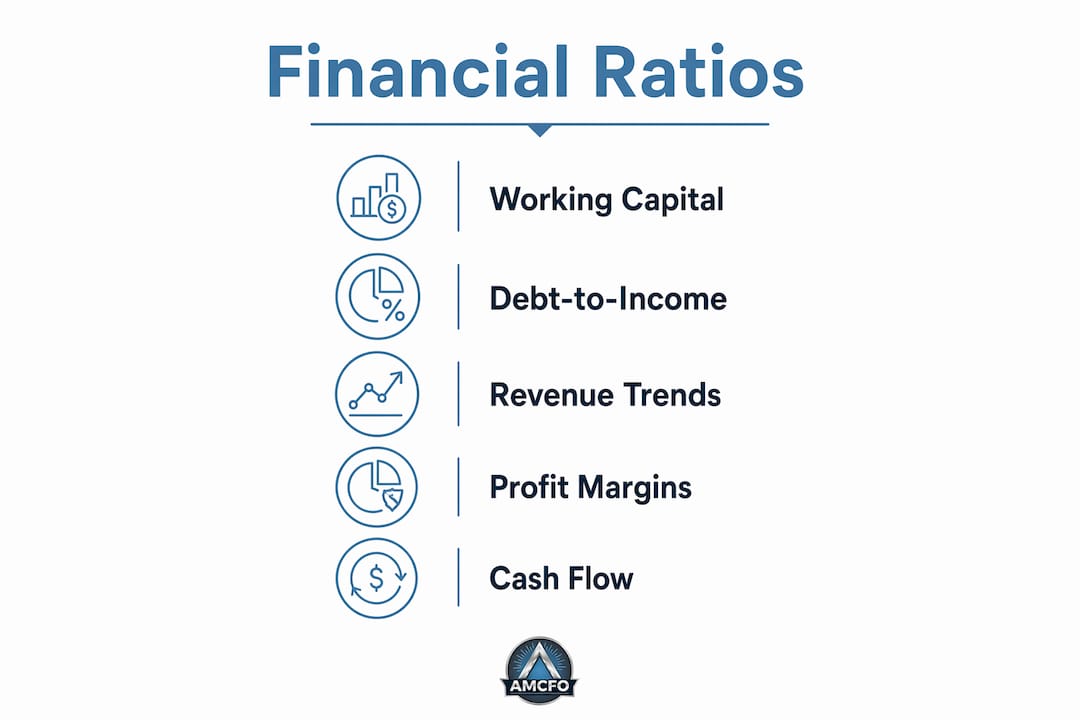
Ratio analysis converts raw financial data into forward-looking insights that drive budgeting, forecasting, and investment decisions. Three categories of ratios matter most: liquidity, profitability, and debt management.
| Ratio | Target Value | What It Tells You |
|---|---|---|
| Working capital ratio | Above 1.2 | Whether you can cover short-term obligations |
| Debt-to-Income (DTI) ratio | 35% or less | Whether debt is manageable relative to income |
| Gross profit margin | Varies by industry | How efficiently you produce revenue |
| Net profit margin | Positive and growing | Whether the business is actually profitable |
| AR over 60 days | Minimize | Collection risk and cash flow exposure |
The working capital ratio is calculated by dividing current assets by current liabilities. A ratio above 1.2 means you have a buffer. A ratio below 1.0 means you owe more in the short term than you can cover with current assets. That is a liquidity warning sign.
The Debt-to-Income ratio should stay at 35% or less of gross income. Exceeding that threshold signals vulnerability to debt-servicing pressure, especially when revenue dips. Businesses that carry high DTI ratios have less room to absorb a slow quarter or an unexpected expense.
Beyond ratios, track revenue trends month over month and year over year. A single strong month means little. A pattern of consistent gross margin growth across six months tells you the business model is working. Declining margins, even with rising revenue, signal a cost problem that needs attention.
How do you turn financial review data into business decisions?
Financial statements are historical records. The analysis you apply to them is what drives future decisions. Raw numbers without interpretation are just data. Ratios and trend comparisons are what make them useful.
Start with cash flow. A business can show profit on the P&L and still run out of cash. Reviewing cash flow alongside the P&L explains the gap between what you earned and what you actually have in the bank. Delayed collections, large capital purchases, or loan repayments all create that disconnect.
Next, assess concentration risk. If one customer accounts for more than 20% of your total revenue, your business carries significant exposure. Identifying that concentration early lets you stress-test the scenario: what happens to your cash flow if that customer reduces orders or leaves? The answer should inform your sales and diversification strategy.
Financial analysis is not about confirming what you already believe about your business. It is about finding the facts that challenge your assumptions and giving you time to act before those assumptions cost you money.
- Compare actual results to your budget every month, not just at year end.
- Identify any expense category that grew faster than revenue.
- Flag any customer or product line with declining margin.
- Use your quarterly review to update your 12-month cash flow forecast.
Pro Tip: Build a one-page financial summary after each quarterly review. List the three biggest variances from budget, the top risk you identified, and the one decision you will make based on the data. This document becomes your management record and keeps reviews from being passive exercises.
For deeper guidance on measuring financial health, the metrics above provide a solid starting framework.
What mistakes do business owners make when preparing a financial review?
The most common mistake is skipping reconciliation before running reports. Unreconciled accounts produce numbers that look real but are not. Every decision you make from those reports compounds the original error.
The second mistake is confusing accounting profit with cash position. A business that invoices $200,000 in a quarter but collects only $140,000 is not operating with $200,000 in cash. Treating P&L profit as available cash leads to overspending and missed payroll obligations.
- Reactive reviews. Reviewing finances only during a crisis is the financial equivalent of going to the doctor only when you are already sick. By the time the numbers look alarming, the underlying problem has been building for months.
- No documentation. Running a review without recording findings and follow-up actions turns the session into a passive exercise. Document what you found, what you decided, and what changed.
- Ignoring stakeholder communication. If you have partners, investors, or a leadership team, the financial review findings need to be shared. Decisions made in isolation from key stakeholders create misalignment.
- Inconsistent periods. Comparing january to march without accounting for seasonality produces misleading conclusions. Always compare like periods.
Pro Tip: Create a one-page review template that includes a reconciliation checkbox, a variance summary, and a follow-up action list. Complete it at every monthly review. After six months, you will have a documented record of your business's financial trajectory.
For a broader view of how financial consulting supports review preparation, the 2026 guide for small business owners covers the full advisory framework.
Key Takeaways
A well-prepared business financial review requires reconciled accounts, four core reports, a consistent cadence, and ratio analysis that converts data into decisions.
| Point | Details |
|---|---|
| Reconcile before you review | Unreconciled accounts produce misleading reports that corrupt every decision downstream. |
| Use four core reports | P&L, Balance Sheet, Cash Flow, and AR Aging together give a complete financial picture. |
| Follow a structured cadence | Weekly, monthly, quarterly, and annual reviews each serve a distinct analytical purpose. |
| Track key ratios | Working capital above 1.2 and DTI at 35% or less are the two most critical benchmarks. |
| Apply insights forward | Use ratio trends and cash flow analysis to update forecasts and drive budget decisions. |
Why I think most financial reviews fail before they start
Most business owners I have worked with do not have a data problem. They have a discipline problem. The reports exist. The numbers are there. What is missing is the habit of sitting down with those numbers on a schedule, without a crisis driving the meeting.
The businesses that grow consistently are the ones where the owner or financial manager treats the monthly review as seriously as a client meeting. They show up prepared, they ask hard questions of the data, and they leave with a decision, not just an observation. The ones that struggle tend to review finances when something feels wrong. By then, the working capital ratio has already slipped below 1.0, the AR aging report is full of 90-day invoices, and the cash flow statement tells a story that the P&L was hiding for months.
The other thing I have seen consistently: business owners who invest in fractional CFO support build better review habits faster than those who go it alone. Not because the CFO does the work for them, but because having a scheduled advisory session creates the external accountability that most owners need to stay consistent. The review cadence becomes a commitment, not an intention.
Financial data is only as useful as the decisions it produces. If your review ends without a documented action item, it was not a review. It was a report-reading session.
— Angelica
How Amcfo supports your financial review process
Preparing accurate, timely financial reviews requires clean books, organized reports, and someone who knows what the numbers mean.

Amcfo provides accounting and bookkeeping services that keep your records reconciled and your reports ready every month. For business owners who want deeper analysis and a structured review cadence, Amcfo's fractional CFO services include ongoing financial performance assessment, ratio analysis, budgeting, and forecasting support. Whether you need clean books to run your own reviews or an experienced CFO to lead the process, Amcfo builds the financial infrastructure your business needs to make confident decisions.
FAQ
What is a business financial review?
A business financial review is a structured analysis of your company's financial statements, ratios, and performance trends to assess health and guide decisions. It typically covers the P&L, Balance Sheet, Cash Flow statement, and AR Aging report.
How often should a business conduct a financial review?
A structured cadence includes weekly cash checks (15–30 minutes), monthly P&L reviews (60–90 minutes), quarterly deep dives (2–3 hours), and an annual full-day assessment. Each interval serves a different analytical purpose.
What is a good working capital ratio for a business?
A working capital ratio above 1.2 indicates the business can cover its short-term obligations with current assets. A ratio below 1.0 signals a liquidity risk that requires immediate attention.
Why does my business show profit but have no cash?
Profit on the P&L reflects earned revenue, not collected cash. Delayed invoice collections, loan repayments, or capital purchases can create a significant gap between accounting profit and actual cash on hand.
What is the biggest mistake in a financial review?
Skipping account reconciliation before running reports is the most damaging mistake. Unreconciled books produce inaccurate financial statements, and every analysis or decision built on those statements will be flawed.