

Bringing a fractional CFO on board can be one of the smartest moves a growing business makes, but without a clearly structured engagement, even the best financial talent can leave you frustrated. Missed deliverables, scope disputes, and vague communication protocols are the most common reasons these relationships break down early. The good news is that a well-built engagement framework prevents nearly all of these problems before they start. This guide walks you through exactly what to define, document, and monitor so your CFO advisory relationship delivers real, measurable value from day one.
Table of Contents
- Key elements to define before structuring a CFO advisory engagement
- Step-by-step process for structuring your CFO advisory engagement
- Common deliverables and reporting protocols in CFO advisory engagements
- Troubleshooting: Avoiding scope creep and disputes
- Our perspective: What truly sets successful CFO advisory contracts apart
- Unlock expert fractional CFO guidance for your business
- Frequently asked questions
Key Takeaways
| Point | Details |
|---|---|
| Clarify included services | Specify exactly what the CFO will deliver to prevent confusion and scope creep. |
| Explicit exclusions matter | Document what is not part of the engagement to avoid disputes and hidden work. |
| Establish communication protocols | Set reporting frequency and response times to streamline collaboration. |
| Address termination and handover | Include clear exit and data transfer terms to protect both parties. |
| Review 'gray areas' early | Discuss software setup, urgent requests, and other ambiguous points before signing. |
Key elements to define before structuring a CFO advisory engagement
Before you write a single line of an engagement letter, you need to get clear on what the relationship actually covers. Vague agreements breed misaligned expectations, and misaligned expectations breed conflict. Defining the scope upfront is not a formality; it is the foundation of a productive working relationship.
Service scope is the first thing to nail down. This means listing specific, tangible outputs rather than broad descriptions like "financial oversight." Think monthly financial reviews, board presentation preparation, KPI dashboard creation, cash flow forecasting, and budget-versus-actual variance analysis. The more concrete the list, the easier it is to measure whether the engagement is delivering value.
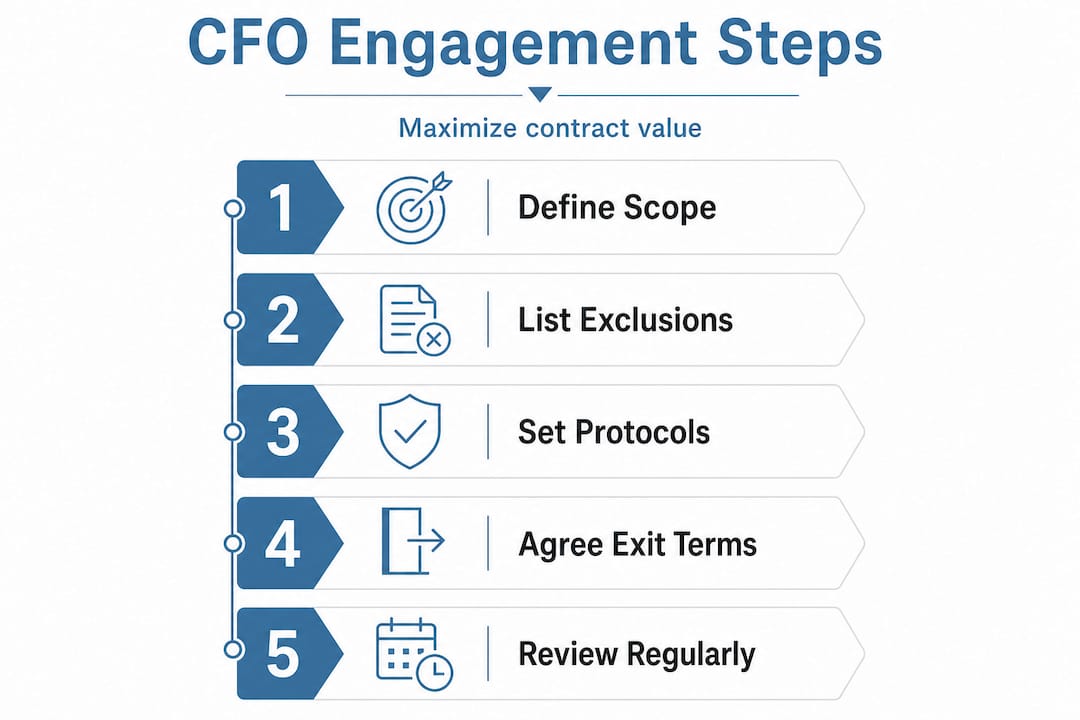
Exclusions matter just as much as inclusions. Fractional CFO contract terms should distinguish services included versus excluded to prevent scope creep and document communication protocols, reporting frequency, response expectations, and exit and termination procedures. Day-to-day bookkeeping, payroll processing, tax preparation, and audit fieldwork are almost always outside the scope of a fractional CFO services engagement. If these are not explicitly excluded, you risk the CFO's strategic time getting consumed by transactional tasks.
Communication protocols deserve their own section in any engagement document. How often will you meet? What is the expected response time for emails or urgent requests? Who is the primary point of contact on both sides? Establishing these norms in writing prevents the frustration of chasing someone down when a critical financial decision needs to be made.
Termination and exit terms are often overlooked until they are urgently needed. Your engagement letter should specify the notice period required by either party, how client data and documents will be handed over, and what happens to any ongoing projects at the time of termination.
Here is a quick comparison of what typically falls inside and outside a fractional CFO advisory engagement:
| Typical inclusions | Typical exclusions |
|---|---|
| Monthly financial review and CFO commentary | Day-to-day bookkeeping |
| Cash flow forecasting and scenario planning | Payroll processing |
| KPI dashboard creation and maintenance | Tax return preparation |
| Budget-versus-actual variance analysis | Audit fieldwork |
| Board and investor presentation support | Accounts payable/receivable management |
| Strategic planning and growth consulting | HR and benefits administration |
| Executive and strategy meeting facilitation | Software implementation (unless specified) |
If your business also needs support with specialized CFO services beyond standard advisory, make sure those are explicitly added to the scope rather than assumed.
Step-by-step process for structuring your CFO advisory engagement
Once you know what belongs in the engagement, it is time to build the actual contract. How fractional CFOs write winning proposals reveals an important distinction: CFO proposals are non-binding documents used to win business, while engagement letters are the binding agreements signed after the client decides to hire. Treating a proposal as a contract is a common and costly mistake.
Here is a practical sequence to follow:
-
Start with a detailed proposal. Use the proposal phase to align on scope, deliverables, fees, and general expectations. This is your opportunity to surface disagreements before money changes hands.
-
Convert the proposal into a binding engagement letter. Once both parties agree, formalize everything in a signed document. The engagement letter should reference the proposal but stand on its own as a complete legal agreement.
-
Define deliverables with specificity. List every output, its format, and its delivery frequency. "Monthly financial report" is vague. "A four-page CFO commentary with variance analysis delivered by the 10th of each month" is not.
-
Document reporting and communication methods. Specify whether meetings are in-person or virtual, how frequently they occur, and what platform is used for ongoing communication. Clarity here prevents a lot of friction.
-
Explicitly list exclusions. Do not assume the client understands what is not included. Write it out. This single step prevents more disputes than almost anything else.
-
Set response time expectations. Agree on standard response times for routine questions versus urgent matters. A 24-hour turnaround for routine emails and a 4-hour turnaround for urgent financial decisions is a reasonable benchmark for many engagements.
-
Establish exit and termination terms. Include notice periods, data handover obligations, and what happens to any deliverables in progress. Thirty days is a common notice period, but this should reflect the complexity of the engagement.
Pro Tip: Address "gray areas" in writing before the engagement begins. Software implementation, vendor negotiations, attendance at board meetings, and responses to investor due diligence requests are common sources of confusion. If there is any chance these might come up, clarify whether they are in scope, out of scope, or billable as add-ons. Getting this in writing protects both parties and keeps the relationship focused on business finance and accounting strategy rather than contract disputes.
Here is a summary of the key contract steps and what each one achieves:
| Contract step | What it achieves |
|---|---|
| Detailed proposal | Aligns expectations before commitment |
| Binding engagement letter | Creates legal clarity and enforceability |
| Specific deliverable list | Enables performance measurement |
| Communication protocols | Reduces friction and delays |
| Explicit exclusions | Prevents scope creep |
| Response time standards | Sets accountability benchmarks |
| Exit and termination terms | Protects both parties at contract end |
For businesses that need support beyond standard financial advisory, consider whether business consulting or strategic growth consulting services should be layered into the engagement from the start.
Common deliverables and reporting protocols in CFO advisory engagements
Knowing what to include in an engagement is one thing. Knowing which deliverables actually move the needle is another. Common deliverables in CFO advisory engagements include planning and forecasting (often using a 13-week rolling cash flow), KPI and dashboard creation and maintenance, budget-versus-actual variance analysis, and recurring executive and strategy touchpoints.
The 13-week rolling cash flow is one of the most valuable tools a fractional CFO brings to the table. It gives leadership a forward-looking view of liquidity, flags potential shortfalls before they become crises, and supports confident decision-making around hiring, capital expenditures, and debt management. For businesses with seasonal revenue or tight margins, this single deliverable can justify the entire cost of the engagement.
Monthly financial reviews with CFO commentary go beyond just presenting numbers. A skilled CFO translates the data into actionable insight, explaining what the variances mean, what risks they signal, and what decisions they should inform. This is the kind of context that a raw financial statement simply cannot provide.

KPI dashboards are another high-value deliverable when built correctly. The key is selecting metrics that are genuinely tied to business performance rather than vanity numbers. Revenue per employee, gross margin by product line, customer acquisition cost, and days sales outstanding are examples of KPIs that drive real decisions.
Here are the most common deliverables and their typical reporting frequencies:
- 13-week rolling cash flow forecast: updated weekly
- Monthly financial review and CFO commentary: delivered monthly
- Budget-versus-actual variance analysis: monthly
- KPI dashboard maintenance: monthly or bi-weekly
- Scenario planning and financial modeling: quarterly or as needed
- Board and investor presentation support: quarterly
- Annual budget and strategic planning: annually
Pro Tip: Use your KPI dashboard as a communication tool with investors and board members, not just an internal management report. A well-maintained dashboard signals financial discipline and strategic clarity, which builds confidence among stakeholders and can directly support fundraising or financing conversations. Explore how financial planning and reporting services can help you build these systems from the ground up.
Troubleshooting: Avoiding scope creep and disputes
Even the best-structured engagement can run into trouble if you do not actively manage the boundaries of the relationship. Scope creep is the gradual expansion of a CFO's responsibilities beyond what was originally agreed, and it is one of the most common sources of frustration on both sides.
The most effective safeguard is a thorough engagement letter that addresses gray areas such as software implementation, vendor negotiations, board meeting attendance, and what happens when urgency increases. These edge cases should be clarified upfront to avoid disputes later.
Here are practical safeguards to build into every engagement:
- Maintain communication logs. Keep a record of all significant requests, decisions, and approvals. This creates a paper trail that protects both the CFO and the client if a dispute arises.
- Use explicit exclusion lists. Every engagement letter should include a clear list of services that are not covered. When a new request falls outside this list, it triggers a conversation about scope adjustment rather than an assumption that it is included.
- Schedule periodic contract reviews. Set a calendar reminder every six months to review the engagement letter and assess whether the scope still reflects the actual work being done. Businesses grow and change, and contracts should evolve with them.
- Document urgent and last-minute requests. When a client asks for something outside the normal scope under time pressure, document the request, the response, and any agreed-upon fee adjustment in writing before the work begins.
"Ambiguity in a CFO advisory contract is not a neutral condition. It always resolves in favor of the party with more leverage, which is rarely the one who needed clarity most. Writing it down is not about distrust; it is about respect for the relationship."
For businesses that also rely on accounting and bookkeeping support alongside CFO advisory, make sure the division of responsibilities between these two functions is spelled out clearly. Overlap between the bookkeeper's role and the CFO's role is a frequent source of confusion and duplicated effort.
Our perspective: What truly sets successful CFO advisory contracts apart
Here is something most articles on this topic will not tell you: the legal language in a CFO advisory contract matters far less than the clarity of the underlying agreement. We have seen beautifully drafted engagement letters fail because the deliverables were still vague, and we have seen simple one-page agreements work beautifully because both parties were completely aligned on expectations.
The contracts that work best treat the engagement letter as a blueprint for collaboration, not a legal weapon. When both parties understand exactly what success looks like, what the boundaries are, and how they will communicate, the contract becomes a reference document rather than a dispute resolution tool.
One lesson we have learned repeatedly is that the most damaging contract mistakes are not the ones involving fees or termination clauses. They are the ones involving undefined deliverables and assumed communication norms. A client who expects weekly check-ins and a CFO who budgeted for monthly meetings will have a rocky relationship no matter how well-written the rest of the contract is.
Think of the engagement letter the way a contractor thinks of architectural blueprints. A contractor who builds without blueprints might produce something functional, but the client will almost certainly be disappointed because what they imagined and what was built are two different things. The engagement letter is your blueprint. It makes the invisible visible before any work begins.
Our strong recommendation is to review the scope of your specialized CFO advisory engagement at least every six months. As your business grows, your financial complexity grows with it. An engagement that was perfectly scoped at $5 million in revenue may be significantly undersized at $15 million. Adjusting the contract proactively keeps the relationship aligned and prevents the resentment that builds when a CFO is quietly doing more than they are being paid for, or a client is quietly paying for more than they are receiving.
Unlock expert fractional CFO guidance for your business
Structuring a CFO advisory engagement correctly from the start saves time, money, and significant frustration down the road. But knowing the framework is just the beginning. Executing it well requires experience, the right tools, and a partner who understands both the strategic and operational sides of business finance.
At AmCFO, we specialize in building CFO advisory relationships that are clear, structured, and genuinely valuable from the first engagement. Whether you need ongoing fractional CFO services tailored to your growth stage or support with strategic management consulting to align your financial strategy with your business goals, our team is ready to help. Reach out today to schedule a consultation and learn how we can structure an engagement that works for your business, not just on paper, but in practice.
Frequently asked questions
What's the difference between a CFO proposal and an engagement letter?
A CFO proposal is a non-binding outline used to win business, while an engagement letter is the binding contract signed after both parties agree to move forward. Confusing the two is a common and avoidable mistake.
Which services are usually excluded from a fractional CFO engagement?
Bookkeeping, payroll, tax preparation, and audit fieldwork are typically excluded from fractional CFO advisory contracts to keep the focus on strategic financial leadership and prevent scope creep.
How often should financial reviews and strategy meetings occur in a typical engagement?
Monthly financial reviews and strategy meetings are the standard cadence for effective CFO advisory contracts, with quarterly board presentations and annual planning sessions layered on top.
What happens when a CFO advisory contract is terminated?
Termination terms should specify the required notice period, outline how client data and documents will be handed over, and clarify the status of any deliverables in progress at the time of exit.
How can I prevent misunderstandings or disputes in my CFO advisory contract?
Address all gray areas and urgent scenarios explicitly in the contract before the engagement begins, and schedule a formal scope review every six months to keep the agreement aligned with your business's evolving needs.