

Financial management is the strategic practice of planning, organizing, directing, and controlling your business's financial resources to maximize profitability, maintain liquidity, and support long-term growth. For small business owners, this means far more than tracking expenses in a spreadsheet. It means making deliberate decisions about cash flow, budgeting, investment, and risk before problems surface. Tools like QuickBooks, Xero, and fractional CFO services from firms like Amcfo give small businesses access to the same financial discipline that large corporations use, at a fraction of the cost.
What are the core functions of financial management?
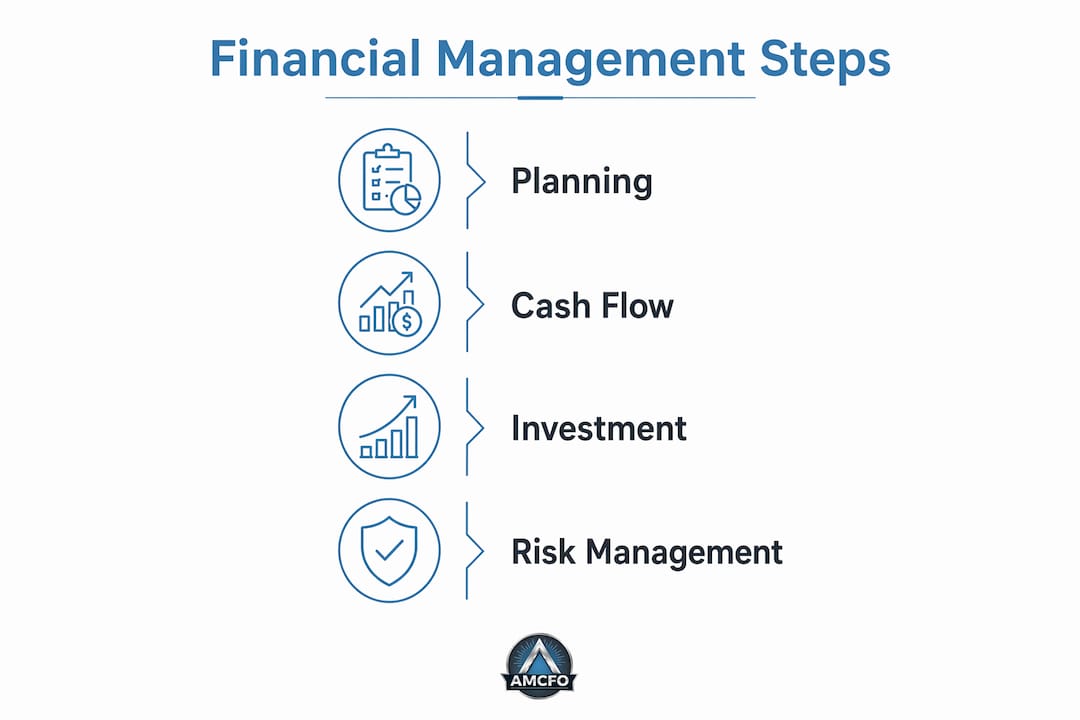
Financial management functions include planning and forecasting, cash flow management, investment analysis, and risk assessment. Each of these functions works together to keep your business financially stable and positioned for growth. Ignoring any one of them creates a gap that compounds over time.
Planning and forecasting sets the financial direction for your business. You create budgets, project revenues, and allocate resources based on realistic assumptions rather than optimism. Without a plan, spending decisions happen reactively, and reactive spending is almost always more expensive.
Cash flow management tracks every dollar moving in and out of your business. Positive cash flow does not automatically mean profitability, and profitable businesses can still run out of cash if timing is mismanaged. This distinction is one of the most misunderstood concepts in small business finance.
Investment and capital budgeting determines when and how to deploy capital for growth. Buying equipment, hiring staff, or expanding a product line all require financial analysis before commitment. Spending without that analysis is how businesses overextend.

Risk management identifies threats before they become losses. Financial risks span market shifts, credit exposure, liquidity crunches, and operational failures. Identifying them early gives you options. Discovering them late gives you problems.
Static vs. flexible budgets: which one fits your business?
| Budget type | How it works | Best for |
|---|---|---|
| Static budget | Fixed figures set at the start of a period, unchanged regardless of actual performance | Stable businesses with predictable revenue |
| Flexible budget | Adjusts based on actual activity levels and changing conditions | Growing businesses or those with seasonal revenue swings |
Flexible budgets offer adaptability that static budgets cannot match, especially when revenue fluctuates month to month. Most small businesses benefit from starting with a static budget for structure, then layering in flexibility as they build financial confidence.
Pro Tip: Review your budget against actual results every month, not every quarter. Monthly variance reviews catch problems early enough to correct them without crisis.
How can small businesses optimize cash flow effectively?
Working capital management means balancing accounts receivable, accounts payable, and inventory to maintain liquidity at all times. Cash flow optimization is not a one-time fix. It is a discipline built through consistent habits and the right tools.
Here are the most effective steps to improve cash flow in your small business:
-
Forecast cash flow weekly or monthly. Rolling forecasts give you a 13-week view of cash in and cash out. This visibility lets you spot shortfalls before they become emergencies. Tools like Float, Pulse, or QuickBooks cash flow reports automate much of this work.
-
Tighten accounts receivable. Invoice immediately after delivery, set clear payment terms of net 15 or net 30, and follow up on overdue invoices within 48 hours. Every day an invoice sits unpaid is a day you are financing your customer's operations.
-
Extend accounts payable strategically. Pay vendors on the last day terms allow, not the first. This keeps cash in your account longer without damaging supplier relationships.
-
Build an emergency cash reserve. Paying off high-interest debt above 10% APR acts as a guaranteed, tax-free return. Once high-cost debt is cleared, redirect those payments into a cash reserve covering three to six months of operating expenses.
-
Automate recurring payments and collections. Manual billing introduces delays and errors. Platforms like Stripe, Bill.com, or QuickBooks Payments automate invoicing, payment reminders, and reconciliation, freeing you to focus on operations.
-
Review inventory levels monthly. Excess inventory ties up cash that could be working elsewhere. Lean inventory practices reduce carrying costs and improve liquidity without sacrificing fulfillment speed.
Pro Tip: A financial forecasting process built on rolling 13-week projections is the single most effective tool for avoiding cash flow surprises in a small business.
What budgeting tips help small businesses stay financially healthy?
Budgeting and forecasting help allocate resources, set performance benchmarks, and enable proactive financial decision-making. A budget is not a constraint. It is a decision-making tool that tells you where your money should go before the month begins.
Effective budgeting for small businesses comes down to a few non-negotiable practices:
- Align your budget with business goals. If your goal is to grow revenue by 20%, your budget should reflect increased marketing spend, staffing, and inventory. A budget disconnected from strategy is just a wish list.
- Use zero-based budgeting for cost control. Instead of rolling last year's numbers forward, justify every expense from zero each period. This forces you to evaluate whether each cost still earns its place.
- Track variances and act on them. Comparing forecasts to actuals is how you detect errors and course-correct. A 10% variance in labor costs might signal a scheduling problem. A 15% variance in materials might signal a supplier issue.
- Review budgets quarterly at minimum. Business conditions change. A budget built in January may be irrelevant by April if a major client leaves or a new opportunity emerges.
- Integrate budgeting with financial forecasting. Budgets set targets. Forecasts project where you will actually land. Using both together gives you a complete picture of financial performance.
Budgeting frequency guide
| Review frequency | What to assess | Why it matters |
|---|---|---|
| Monthly | Revenue vs. budget, expense variances | Catches problems early enough to fix |
| Quarterly | Budget vs. forecast alignment | Adjusts targets to reflect real conditions |
| Annually | Full budget rebuild for next year | Resets strategy based on prior year results |
AI-powered financial tools can highlight data variances automatically, reducing the time you spend hunting for discrepancies. Platforms like Cube, Jirav, and Planful bring this capability to businesses that do not have a full finance team.
Which financial analysis tools and metrics drive profitability?
Using financial KPIs like ROI, profit margins, and liquidity ratios helps small businesses monitor and improve profitability with precision. The challenge is knowing which metrics actually matter for your stage of business, and what to do when the numbers move in the wrong direction.
The metrics every small business owner should track regularly include:
- Gross margin: Revenue minus cost of goods sold, expressed as a percentage. A declining gross margin signals pricing pressure or rising input costs before they hit your bottom line.
- Net profit margin: What remains after all expenses. This is the truest measure of business efficiency.
- Current ratio: Current assets divided by current liabilities. A ratio below 1.0 means you cannot cover short-term obligations, which is a serious liquidity warning.
- Return on investment (ROI): Measures the return generated by a specific investment. Use it to evaluate equipment purchases, marketing campaigns, and hiring decisions.
- Days sales outstanding (DSO): The average number of days it takes to collect payment after a sale. A rising DSO signals a collections problem that will eventually hurt cash flow.
Financial modeling and scenario analysis take these metrics further by projecting how changes in revenue, costs, or pricing affect profitability. A structured 3 to 5 year financial model supports long-term capital allocation and helps you make growth decisions with confidence rather than guesswork.
Pro Tip: Review your three core financial statements together every month: the income statement, balance sheet, and cash flow statement. Each one tells a different part of the story, and reading only one gives you an incomplete picture.
How to integrate risk management and compliance into your financial strategy
Risk management includes identifying market, credit, liquidity, and operational risks, then using insurance, diversification, and contingency planning to reduce exposure. For small businesses, financial risk is often underestimated until a single event, a lost client, a tax penalty, or a supplier failure, creates a crisis.
The most practical risk and compliance practices for small business owners include:
- Maintain strong internal controls. Separate the duties of whoever approves payments from whoever records them. This single step prevents most cases of accidental error and intentional fraud.
- Conduct regular financial reviews and audits. Monthly internal reviews catch discrepancies early. Annual reviews by an external accountant or fractional CFO add an independent layer of oversight.
- Stay current on tax obligations. Quarterly estimated tax payments, payroll tax deadlines, and sales tax filings each carry penalties for late compliance. Use a tax calendar and automate reminders.
- Diversify revenue and supplier relationships. Dependence on one major client or one critical supplier creates concentration risk. Losing either can be catastrophic without a backup plan.
- Build a contingency fund. A cash reserve covering three to six months of fixed costs gives you time to respond to disruptions without making desperate financial decisions.
- Use compliance management tools. Platforms like Gusto for payroll compliance, Avalara for sales tax, and QuickBooks for financial reporting reduce the manual burden of staying compliant across multiple jurisdictions.
Cross-departmental collaboration is equally critical. Financial risk does not live only in the finance department. Sales teams making promises on payment terms, operations teams ordering excess inventory, and HR teams hiring ahead of revenue all create financial exposure. Every manager in your business needs enough financial literacy to understand the implications of their decisions.
Key takeaways
Effective financial management for small businesses requires consistent execution across cash flow, budgeting, analysis, and risk control, not just tracking past results.
| Point | Details |
|---|---|
| Cash flow comes first | Monitor inflows and outflows weekly using rolling forecasts to prevent liquidity gaps. |
| Flexible budgets outperform static ones | Adjust budgets to actual conditions each period rather than locking in figures at year-start. |
| Track the right KPIs | Gross margin, net profit margin, current ratio, and DSO give the clearest picture of financial health. |
| Risk management is proactive | Identify market, credit, and operational risks before they materialize, not after a loss occurs. |
| Technology reduces manual error | Tools like QuickBooks, Cube, and Gusto automate reporting and compliance, freeing time for strategy. |
The financial habit most small businesses skip
Working with small business owners over the years, the pattern I see most often is not a lack of financial knowledge. It is a lack of financial rhythm. Owners understand that cash flow matters. They know they should review their numbers. But without a fixed schedule, financial reviews get pushed to "when things slow down," and things never slow down.
The businesses I have seen thrive financially share one habit: they treat their monthly financial review as a non-negotiable meeting, the same way they treat payroll or a client call. They look at actuals versus budget, check their cash position, and flag any metric that moved more than 10% from the prior month. That review takes 30 minutes. The decisions it enables save thousands.
The other shift that makes a real difference is moving financial responsibility beyond the finance function. When your operations manager understands that overtime hours affect gross margin, and your sales lead understands that extended payment terms affect cash flow, your whole business starts making financially smarter decisions. Financial management success depends on that cross-departmental literacy, not just on having a good accountant.
If you are not yet working with a fractional CFO or financial advisor, the strategic financial guidance available to small businesses today is more accessible than most owners realize. The cost of getting it wrong is always higher than the cost of getting help.
— Angelica
How Amcfo helps small businesses take control of their finances
Small business owners who want better financial outcomes do not always need a full-time CFO. They need the right expertise at the right time.

Amcfo provides fractional CFO services, bookkeeping, QuickBooks setup and cleanup, payroll support, budgeting, forecasting, and tax coordination, all tailored to the size and stage of your business. Whether you need to fix a cash flow problem, build your first real budget, or get a clear picture of your profitability, Amcfo brings the financial structure and strategic guidance to make it happen. Flexible packages mean you get CFO-level thinking without the full-time cost. Reach out to Amcfo for a consultation and start making financial decisions with confidence.
FAQ
What is financial management for a small business?
Financial management is the process of planning, monitoring, and controlling your business's financial resources to maintain profitability, liquidity, and long-term stability. It covers budgeting, cash flow management, investment decisions, and risk mitigation.
How often should a small business review its budget?
Small businesses should review their budget against actual results every month to catch variances early. A full budget rebuild should happen annually, with quarterly adjustments to reflect changing business conditions.
What are the most important cash flow management practices?
The most effective practices include weekly or monthly rolling cash flow forecasts, tightening accounts receivable collection, extending payable terms strategically, and maintaining a cash reserve covering three to six months of operating expenses.
Which financial metrics matter most for small business profitability?
Gross margin, net profit margin, current ratio, return on investment, and days sales outstanding are the core metrics. Tracking all five together gives a complete view of both profitability and liquidity.
When should a small business hire a fractional CFO?
A fractional CFO makes sense when your business is growing faster than your financial systems can handle, when cash flow is unpredictable, or when you need financial strategy beyond what a bookkeeper provides. Firms like Amcfo offer accounting and bookkeeping alongside fractional CFO services, making it easy to scale the level of support as your needs grow.