

Business financial planning is defined as the structured process of setting financial priorities, allocating resources, and creating guardrails that align capital decisions with business strategy. According to Workday, effective planning brings the income statement, balance sheet, and cash flow together with clear targets tied to strategy. The industry term for this discipline is corporate financial planning, though the practice applies equally to small business budgeting and mid-market corporate finance management. A plan that works is not a static document. It is a living decision framework that tells you where to invest, where to cut, and how to respond when conditions shift.
What are the essential components of a business financial plan?
Every solid financial plan is built on the same core building blocks, regardless of company size. Miss one, and the whole structure becomes unreliable.
- Revenue forecasting. Project future income using historical data, signed contracts, pipeline conversion rates, and market assumptions. Separate recurring revenue from one-time sources to understand the true baseline.
- Expense budgeting. Distinguish fixed costs (rent, salaries, insurance) from variable costs (materials, commissions, shipping). Variable costs must be modeled against revenue scenarios, not treated as constants.
- Cash flow management. Profit and cash are not the same thing. A profitable business can still run out of cash if receivables are slow and payables are fast. Business cash flow planning deserves its own dedicated schedule, updated monthly at minimum.
- Profit margin analysis. Break down margins by product line, customer segment, and sales channel. Blended margins hide the truth. A single low-margin product can drag down an otherwise healthy business.
- Capital planning. Identify what investments the business needs over the next 12–36 months, whether that is equipment, technology, headcount, or acquisitions. Map those needs to funding sources.
- Tax planning integration. Tax is a cash expense that arrives on a schedule. Build estimated tax payments, depreciation strategies, and entity-level tax implications into the plan from the start.
- Risk management basics. Every plan needs a section that asks: what could go wrong, and what is the response? This is the foundation of financial risk assessment, covered in depth below.
These components do not operate in isolation. Revenue assumptions feed the cash flow model. Capital decisions affect the balance sheet. Tax planning shapes net income. The plan only works when all seven elements are connected.
How do you build a trustworthy financial baseline?

The most common reason financial plans fail is not bad strategy. It is a bad baseline. A plan built on inaccurate starting data will produce inaccurate forecasts, no matter how sophisticated the model.
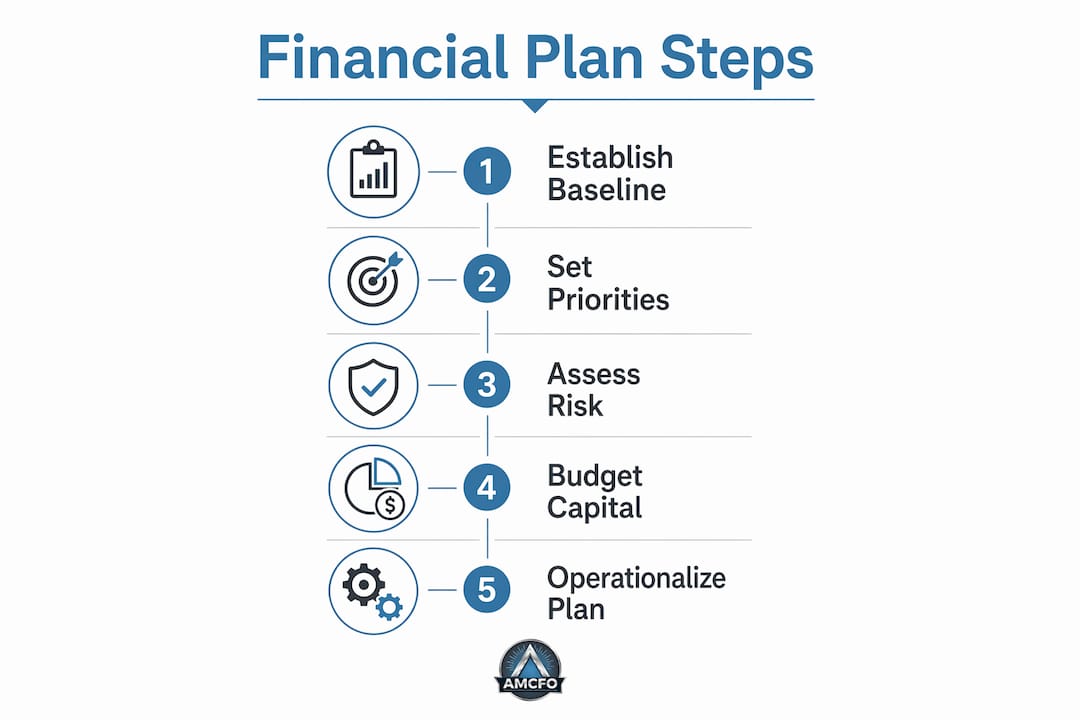
Establishing a reliable baseline means pulling together your income statement, balance sheet, and cash flow statement and then layering in committed spend and signed deals that are not yet reflected in historical numbers. This step separates what has happened from what is already locked in. A company with $2 million in signed annual contracts that have not yet started looks very different on paper than in reality.
The second step is connecting strategy to financial priorities. Translating strategic intent into explicit financial priorities means choosing between growth, margin improvement, cash preservation, and operational resilience before you build a single forecast. These priorities determine how you allocate resources when trade-offs arise. A company prioritizing growth will accept lower margins to fund customer acquisition. A company prioritizing resilience will hold more cash and slow hiring.
Pro Tip: Limit your plan to 3–5 key operating drivers that most influence outcomes. Testing assumptions on those drivers, such as customer acquisition cost, average contract value, or gross margin per unit, delivers more insight than modeling every line item in detail.
Avoiding the disconnect between plans and real operating conditions is the hardest part of this work. Finance teams that skip baseline validation often discover mid-year that their plan assumed costs or revenues that never existed. That discovery forces reactive decisions instead of proactive ones.
What are effective methods for assessing financial risk?
Financial risk assessment is a structured process aligned to ISO 31000:2018 principles that identifies, analyzes, and evaluates financial threats and opportunities before they materialize. The output is not a list of worries. It is a set of decisions about exposure, appetite, and action.
A practical risk assessment for most businesses follows this sequence:
- Identify the threats. List the financial risks specific to your business: customer concentration, currency exposure, interest rate sensitivity, supplier dependency, and regulatory change.
- Analyze the exposure. Use liquidity ratios, credit-loss concepts, and revenue-at-risk calculations to quantify how much each threat could cost. Gut feel is not analysis.
- Evaluate against appetite. Decide how much risk the business can absorb without threatening operations. This is your risk appetite, and it should be explicit, not implied.
- Define the response. Risk assessments must define what actions will be taken if financial conditions tighten. Linking risk to operational responses is what separates useful assessments from compliance exercises.
- Stress test the plan. Simulate adverse conditions, such as a 20% revenue drop or a key customer leaving, and measure the impact on cash and margins.
Stress testing evaluates financial resilience by simulating adverse conditions, informing capital buffers and contingency planning. This practice, once limited to regulated financial institutions, now applies to businesses of every size.
The output of a strong risk assessment feeds directly back into your financial plan. If a stress test reveals that a 15% revenue decline would exhaust your cash reserves in 90 days, that is a capital planning problem that needs to be solved now, not during the crisis. For a deeper look at this process, financial risk management frameworks offer structured approaches for business leaders at every stage.
Which capital budgeting techniques maximize profitability?
Capital budgeting is the process of evaluating long-term investments by modeling projected cash flows and assessing return metrics. Multiple techniques provide a fuller picture than any single method. The right choice depends on your business goals, time horizon, and tolerance for complexity.
| Technique | What It Measures | Best Used When |
|---|---|---|
| Net Present Value (NPV) | Total value created in today's dollars | Comparing investments of different sizes or durations |
| Internal Rate of Return (IRR) | Percentage return on invested capital | Evaluating a single project against a hurdle rate |
| Payback Period | Time to recover the initial investment | Cash-constrained businesses prioritizing liquidity |
| Discounted Payback | Time to recover investment in present-value terms | Combining liquidity focus with time-value accuracy |
| Profitability Index | Value created per dollar invested | Ranking multiple projects when capital is limited |
NPV is the most theoretically sound method because it accounts for the time value of money and the total scale of returns. IRR is the most commonly used in practice because it produces a single percentage that is easy to compare against a cost of capital. Neither method is wrong. Using both together eliminates the blind spots each one carries individually.
Pro Tip: When evaluating a capital investment, run the NPV calculation at three discount rates: your base cost of capital, a rate 3 percentage points higher, and a rate 3 percentage points lower. If the NPV is positive across all three scenarios, the investment is worth serious consideration.
Financial modeling is the practical tool that makes capital budgeting work. A well-built model lets you change one assumption, such as the sales ramp timeline, and instantly see the effect on NPV and payback period. That speed of iteration is what turns capital budgeting from a one-time exercise into an ongoing decision tool.
How do you operationalize a financial plan effectively?
Building a plan is the easy part. Keeping it relevant through the year is where most businesses fall short. Operationalizing the financial plan requires governance, regular updates, and a feedback loop that connects actual results to forward-looking forecasts.
The practical steps that make a plan operational include:
- Maintain baseline data integrity. Connect your planning model to live accounting data. Planning models must reflect current actuals to avoid forecast drift, which quietly destroys plan credibility over time.
- Update forecasts on a rolling basis. Monthly or quarterly rolling forecasts replace the outdated annual budget as the primary planning tool. Each update incorporates new actuals and revised assumptions.
- Focus updates on key drivers. Do not re-forecast every line item. Concentrate on the 3–5 operating drivers that most influence outcomes. This keeps the process fast and focused.
- Embed the plan in decision rhythms. Every major spending decision, hiring decision, or pricing change should be evaluated against the plan. The plan is not a report. It is a filter for decisions.
- Modify priorities as conditions evolve. If a key customer churns or a new market opens, update the financial priorities explicitly. A plan that no longer reflects reality is worse than no plan at all.
Financial planning is a dynamic discipline involving operational rhythms, not static annual documents. Businesses that treat the annual budget as a finished product lose the ability to respond to change. Businesses that treat the plan as a living system gain a real advantage in resource allocation and risk management. For context on how reporting supports this process, financial reporting best practices in 2026 show how accurate data feeds better planning cycles.
Key takeaways
Effective business financial planning requires a connected system of baseline data, explicit priorities, risk assessment, and continuous updates to drive profitable decisions.
| Point | Details |
|---|---|
| Build a reliable baseline | Validate income statement, balance sheet, and cash flow data before forecasting anything. |
| Set explicit financial priorities | Choose between growth, margin, cash, and resilience before allocating resources. |
| Assess risk with structure | Use ISO 31000:2018 aligned steps and stress testing to define exposure and response plans. |
| Apply capital budgeting rigor | Combine NPV and IRR to evaluate investments and rank projects when capital is limited. |
| Operationalize with feedback loops | Connect planning models to live accounting data and update forecasts on a rolling basis. |
Why static budgets are the wrong tool for 2026
I have reviewed financial plans for businesses across a wide range of industries, and the pattern is consistent. The companies that struggle most are not the ones with bad strategies. They are the ones treating their annual budget as a finished product. They build it in October, present it in December, and then spend the next 12 months defending numbers that stopped being relevant by February.
The shift I push every client to make is treating the financial plan as a decision framework, not a document. That means the plan has to answer one question at all times: given what we know right now, where should we put the next dollar? When a plan can answer that question, leadership makes faster, more confident calls on hiring, pricing, and capital allocation.
The piece most businesses underinvest in is assumption testing. The highest leverage in financial planning comes from testing key operating assumptions rather than perfecting the model structure. If your plan assumes a 30-day sales cycle and the actual cycle is 60 days, no amount of modeling sophistication will save your cash flow forecast. Get the assumptions right first.
The other thing I see overlooked constantly is the connection between risk assessment and the operating plan. Most businesses do a risk register as a compliance exercise and then file it away. The ones that actually use it link each identified risk to a specific trigger and a specific response. If receivables aging crosses 45 days, we draw on the credit line. If gross margin drops below 40%, we pause hiring. That kind of pre-committed response is what separates resilient businesses from reactive ones.
— Angelica
How Amcfo helps you build a plan that actually works
Most business owners and financial managers know what a good financial plan should contain. The hard part is building one that stays connected to reality, gets updated consistently, and actually drives decisions. That is where Amcfo comes in.

Amcfo provides fractional CFO services that give your business CFO-level financial strategy without the cost of a full-time hire. From building your financial baseline and rolling forecasts to running risk assessments and capital budgeting analysis, Amcfo's team works inside your business to make the plan operational. Explore the full range of CFO and accounting packages to find the right fit for your growth stage and budget.
FAQ
What is business financial planning?
Business financial planning is the process of setting financial priorities, forecasting revenue and expenses, managing cash flow, and allocating capital to support business strategy. It connects the income statement, balance sheet, and cash flow statement into a single decision framework.
How often should a financial plan be updated?
A financial plan should be updated on a rolling monthly or quarterly basis. Static annual budgets lose accuracy quickly as market conditions, customer behavior, and operating costs shift throughout the year.
What is financial risk assessment in business planning?
Financial risk assessment is a structured process, aligned to ISO 31000:2018, that identifies and quantifies financial threats such as liquidity shortfalls, customer concentration, and market exposure. The output defines the business's risk appetite and the specific actions to take if conditions deteriorate.
Which capital budgeting technique is best for small businesses?
The payback period is the most practical starting point for cash-constrained small businesses because it shows how quickly an investment returns its cost. Pairing it with NPV gives a more complete picture of total value created.
What is the difference between a budget and a financial plan?
A budget is a fixed allocation of resources for a set period. A financial plan is a broader, dynamic framework that includes forecasting, risk assessment, capital planning, and strategic priorities. The budget is one component of the plan, not a substitute for it.