

Financial consulting is the practice of providing expert strategic and operational financial guidance to businesses aiming to improve cash flow, budgeting accuracy, and profitability. For small to mid-sized business owners, this discipline, often delivered through a fractional CFO model or project-based advisory, closes the gap between raw financial data and confident decision-making. Tools like 13-week cash flow forecasts, rolling budget cycles, and profitability analysis frameworks are the working vocabulary of financial consulting. Amcfo delivers these services to businesses that need CFO-level thinking without the overhead of a full-time hire.
What does financial consulting include for small businesses?
Financial consulting covers a wider range of services than most business owners expect when they first engage a consultant. The core deliverables fall into six functional areas, each addressing a distinct pressure point in how a growing company manages money.
- Cash flow management and forecasting. The 13-week cash flow forecast is the gold standard for short-term liquidity visibility. It maps every expected receipt and payment across a rolling 90-day window, giving owners a real-time view of where cash will tighten before it actually does.
- Budgeting and budget review cycles. A consultant builds the annual budget and then runs monthly or quarterly reviews to compare actuals against plan. This turns the budget from a static document into a live management tool.
- Profitability analysis and pricing advisory. Consultants break down gross margin by product line, customer segment, or service type to identify where the business earns and where it bleeds. Pricing strategy recommendations follow directly from this analysis.
- Financial modeling and scenario planning. What happens to cash if revenue drops 20 percent? What does the balance sheet look like after a new equipment purchase? Scenario models answer these questions before the decision is made.
- Strategic advisory. This includes capital raising support, finance team oversight, board meeting preparation, and lender relationship management. At this level, the consultant functions as a part-time CFO.
- Engagement models. Fractional CFO retainers, hourly consulting, and project-based fees each suit different stages of business growth. A startup preparing for a seed round needs different support than a $10M manufacturer optimizing working capital.
Pro Tip: Before signing any consulting agreement, ask the consultant to describe the first 30 days of the engagement. A strong answer will always start with building a reconciled cash baseline, not jumping straight into strategy.
Financial planning differs from budgeting in a critical way: planning is a forward-looking roadmap tied to growth ambitions, while budgeting controls spending against a set target. Financial consulting delivers both, and knowing the difference helps you ask better questions of any consultant you hire.
How is financial consulting different from financial advisory services?
Business owners frequently confuse financial consulting with financial advisory services or investment consulting. The distinction matters because the wrong service type will not solve your problem.

| Dimension | Financial consulting | Financial advisory / investment consulting |
|---|---|---|
| Primary focus | Operational cash flow, budgeting, profitability, and business strategy | Wealth management, portfolio allocation, and investment returns |
| Client type | Business entities, SMB owners in their operator role | Individuals managing personal or investment assets |
| Deliverables | Financial models, forecasts, budget reviews, CFO oversight | Investment recommendations, retirement planning, asset allocation |
| Regulatory framework | General business advisory; not securities-regulated | Governed by SEC rules on fees and fiduciary duty |
| Engagement trigger | Cash flow crisis, growth planning, fundraising, profitability gaps | Wealth accumulation, retirement planning consulting, estate planning |
Performance-based investment advisory fees are regulated by the SEC, a layer of oversight that does not apply to operational financial consulting. This regulatory difference signals the fundamental split between the two fields. Investment consulting is about growing assets. Financial consulting is about running a business better.
Personal finance advice sits in a third category entirely. A personal financial planner helps an individual owner manage their own wealth, retirement accounts, and tax exposure outside the business. Corporate finance consulting, by contrast, focuses on the entity itself: its capital structure, operating costs, and financial reporting. Many SMB owners need both at different times, but they should never expect one service to substitute for the other.
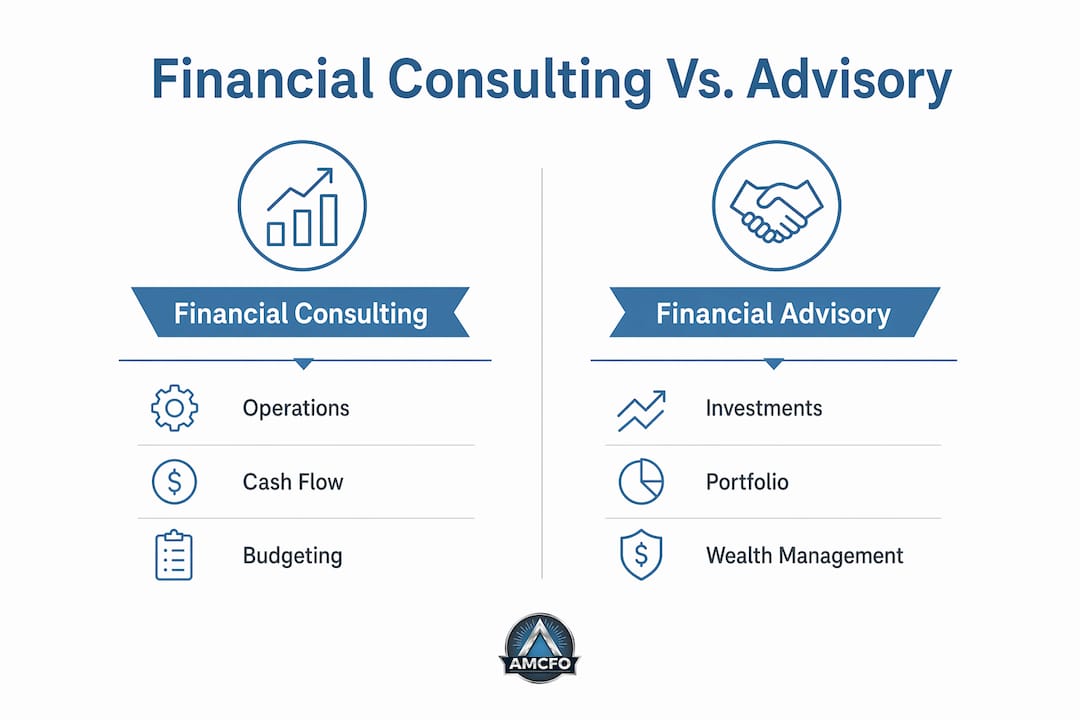
The practical rule: if your problem is inside the business (cash is tight, margins are unclear, the budget is a guess), you need financial consulting. If your problem is outside the business (what to do with a distribution, how to fund retirement), you need a financial advisor or wealth manager.
What does financial consulting actually cost?
Pricing for financial consulting varies by engagement model, consultant experience, and the complexity of your business. Understanding the structure before you negotiate protects your budget and sets realistic expectations.
| Engagement model | Typical cost range | Best fit |
|---|---|---|
| Monthly retainer (fractional CFO) | $3,000 to $12,000/month | Ongoing CFO oversight, reporting, and strategic advisory |
| Hourly consulting | $175 to $450/hour | Defined questions, short-term projects, or ad hoc support |
| Project-based fee | Varies by scope | Fundraising prep, systems implementation, financial model builds |
| Hybrid retainer + project | Base retainer plus project add-ons | Companies with steady needs and periodic intensive work |
Monthly retainers typically cover 10 to 20 hours of work, including financial reporting, cash flow management, budgeting, strategic advisory, and board meeting preparation. Hours beyond the retainer are billed at an agreed overage rate, which is why a written scope document matters before work begins.
The fractional CFO model saves 60 to 80 percent compared to hiring a full-time CFO, making it the dominant choice for companies in the $2M to $20M revenue range. A full-time CFO in the US commands $200,000 to $400,000 in total compensation annually. A fractional engagement at $6,000 per month delivers the same strategic thinking at a fraction of that cost.
Pro Tip: Always ask for a scope document that defines deliverables, monthly hours, overage rates, and communication cadence before signing. Vague agreements are the single biggest source of billing disputes in consulting engagements.
Factors that push pricing higher include industry specialization (healthcare and construction carry more complexity), urgency (crisis engagements cost more than planned ones), and company size. A $3M retail business and a $15M SaaS company both need financial consulting, but the SaaS company's revenue recognition complexity and investor reporting requirements will command a higher retainer.
What planning frameworks maximize the impact of consulting?
The most effective financial consulting engagements are built on structured planning horizons and disciplined review cycles. Without a framework, even the best consultant produces insights that never get acted on.
- Start with a reconciled cash baseline. Before any analysis begins, build a reconciled baseline of the current cash position and map the timing of all receipts and payments. Businesses that skip this step and jump straight to P&L review routinely miss the liquidity decisions that are most urgent.
- Build a 3 to 5 year strategic financial plan. Strategic plans covering three to five years give the business a growth roadmap with financial milestones. This plan becomes the reference point for every budget and investment decision made during the period.
- Run annual, quarterly, and monthly budget reviews. Annual budgets set the target. Quarterly reviews catch structural drift. Monthly reviews catch execution gaps. Each cycle serves a different management purpose, and skipping any one of them creates blind spots.
- Use the 13-week cash flow forecast for short-term decisions. This tool is not a replacement for the annual budget. It is the tactical instrument that tells you whether you can make payroll, pay a vendor early for a discount, or draw on a line of credit this month.
- Build KPI dashboards into the management routine. Gross margin by product, days sales outstanding, operating expense ratio, and cash conversion cycle are the four metrics that most SMB owners do not track consistently but should. A consultant who does not set up dashboards is delivering analysis without accountability.
- Integrate consulting outputs into weekly management meetings. Investors and lenders respond more favorably to businesses with formal strategic financial plans. That credibility is built by making the plan a living document, not a PDF that gets filed after the engagement ends.
How to successfully engage and work with a financial consultant
Choosing the right consultant is only half the work. The other half is structuring the engagement so that the relationship produces results rather than reports.
- Assess your needs before you shop. Are you in a cash crisis, planning for growth, preparing to raise capital, or trying to understand why margins are shrinking? Each scenario calls for a different consultant profile and engagement model. A crisis specialist and a growth strategist are not the same person.
- Prioritize fit over credentials. A consultant with deep experience in your industry will outperform a generalist with a longer resume. Ask for two or three client references from businesses at your revenue stage and in your sector.
- Demand a written scope document. The scope should define deliverables, monthly hours, communication cadence, overage rates, and termination terms. Verbal agreements on consulting engagements almost always end in misaligned expectations.
- Integrate the consultant with your internal team. A fractional CFO who works in isolation from your bookkeeper, operations manager, or sales lead will produce analysis that does not reflect operational reality. Build a communication protocol from day one.
- Use the consultant for fundraising and lender prep. Financial consultants who understand capital markets can translate your financial story into the language that banks and investors respond to. This is one of the highest-value uses of a consulting engagement for a growing SMB.
- Review the engagement quarterly. Ask whether the deliverables are still aligned with your priorities. Businesses change fast, and a consulting scope written six months ago may no longer match what you actually need.
Explore the fractional CFO hiring guide from Amcfo for a detailed walkthrough of how to evaluate candidates and structure your first engagement.
Key takeaways
Effective financial consulting for SMBs requires a reconciled cash baseline, structured planning horizons, and a clearly scoped engagement model to produce measurable results.
| Point | Details |
|---|---|
| Start with cash, not strategy | Build a reconciled cash position before any analysis or planning begins. |
| Match the model to your stage | Fractional CFO retainers suit ongoing needs; project fees suit defined work like fundraising prep. |
| Know the cost range | Monthly retainers run $3,000 to $12,000; fractional models save 60 to 80 percent vs. full-time CFOs. |
| Use structured review cycles | Annual, quarterly, and monthly budget reviews each serve a distinct management purpose. |
| Scope every engagement in writing | Written agreements prevent billing disputes and keep deliverables aligned with business priorities. |
What I have learned from watching SMBs engage financial consultants
I have seen a pattern repeat itself enough times that it no longer surprises me. A business owner hires a consultant, pays the first month's retainer, and then receives a beautifully formatted financial model that has almost no connection to how the business actually operates. The model is built on unreconciled numbers, the cash forecast ignores a $40,000 tax payment due in six weeks, and the strategic plan assumes a revenue growth rate that the sales pipeline cannot support.
The problem is almost never the consultant's technical skill. The problem is scope. Engagements that skip the cash baseline reconciliation step and jump straight to strategy are building on sand. I have watched companies make capital allocation decisions based on P&L analysis that did not account for timing differences in cash receipts. The P&L looked fine. The bank account did not.
The fractional CFO model, when scoped correctly, is the most efficient structure I have seen for SMBs in the $3M to $20M range. It delivers senior-level financial thinking at a cost that fits the budget, and it keeps the consultant accountable to ongoing results rather than a one-time deliverable. The key word is "scoped correctly." A retainer without defined deliverables is just a monthly fee for access to someone's calendar.
My advice: treat financial consulting as a capital investment with an expected return, not an overhead expense. Define what a successful engagement looks like in measurable terms before you sign anything. If a consultant cannot tell you what success looks like in 90 days, that is your answer.
— Angelica
See how Amcfo approaches financial consulting for growing businesses

Amcfo works with small to mid-sized businesses that need more than bookkeeping but are not ready for a full-time CFO. The fractional CFO services from Amcfo cover cash flow management, budgeting, financial reporting, forecasting, and strategic advisory, all structured around your business's specific stage and goals. Transparent service and accounting packages make it straightforward to understand what you are getting and what it costs before you commit. Whether you need ongoing CFO oversight or a defined project like a financial model build or fundraising prep, Amcfo structures the engagement around your priorities. Reach out to discuss your situation and find the right fit.
FAQ
What is financial consulting for small businesses?
Financial consulting is the practice of providing expert operational and strategic financial guidance to businesses, covering cash flow management, budgeting, profitability analysis, and financial planning. For small businesses, it is most commonly delivered through a fractional CFO model or project-based advisory.
How much does a fractional CFO or financial consultant cost?
Monthly retainers for fractional CFO services range from $3,000 to $12,000, with hourly rates between $175 and $450. The fractional model costs 60 to 80 percent less than a full-time CFO hire.
What is the difference between financial consulting and investment consulting?
Financial consulting focuses on business operations: cash flow, budgeting, and profitability. Investment consulting and financial advisory services focus on portfolio management, wealth building, and retirement planning consulting for individuals.
When should a small business hire a financial consultant?
Hire a financial consultant when cash flow is unpredictable, margins are unclear, you are preparing to raise capital, or you need a structured budget and financial plan. Companies in the $2M to $20M revenue range benefit most from a fractional CFO engagement.
What should a financial consulting agreement include?
Every agreement should define deliverables, monthly hours, overage rates, communication cadence, and termination terms. A written scope document prevents misaligned expectations and protects both parties throughout the engagement.