

Hospitality accounting is the specialized practice of managing financial records, reporting, and analysis for hotels, restaurants, and other service-driven businesses. The industry standard for this work is the Uniform System of Accounts for the Lodging Industry, known as USALI, now in its 12th edition effective January 1, 2026. Unlike general business accounting, hospitality finance tracks revenue and costs at the department level, runs daily financial closes, and measures performance through KPIs like RevPAR and GOPPAR. Tools like cloud-based accounting platforms, property management systems, and AI-driven dashboards have made real-time financial visibility the new baseline for competitive hotel and restaurant operations.
What are the core components of hospitality accounting?
Hospitality financial management combines accounting, budgeting, forecasting, and reporting into one continuous process. The goal is to balance guest experience with profitability, using real-time data to make decisions across departments. USALI provides the chart of accounts and reporting framework that makes this possible at scale.
The USALI framework
USALI has been the guiding standard for hotel accounting since 1926, maintained by HFTP and the American Hotel & Lodging Association. The 12th edition standardizes departmental profit and loss statements and the categorization of undistributed expenses. Every hotel that follows USALI reports financials the same way, which makes benchmarking across properties and ownership groups straightforward.
The structure of a hotel income statement under USALI breaks revenue and expenses into operated departments, such as rooms, food and beverage, and spa, followed by undistributed operating expenses like sales and marketing, utilities, and property maintenance. This layered view shows exactly where each dollar is earned and spent. A restaurant income statement follows a simpler structure but still tracks cost of goods sold, labor, and overhead by category.
Key hospitality KPIs
RevPAR, ADR, and GOPPAR are the three KPIs every hotel finance team tracks. RevPAR measures revenue per available room, ADR tracks the average rate charged per occupied room, and GOPPAR captures gross operating profit per available room. These metrics translate financial statements into signals that guide pricing, staffing, and capital decisions.
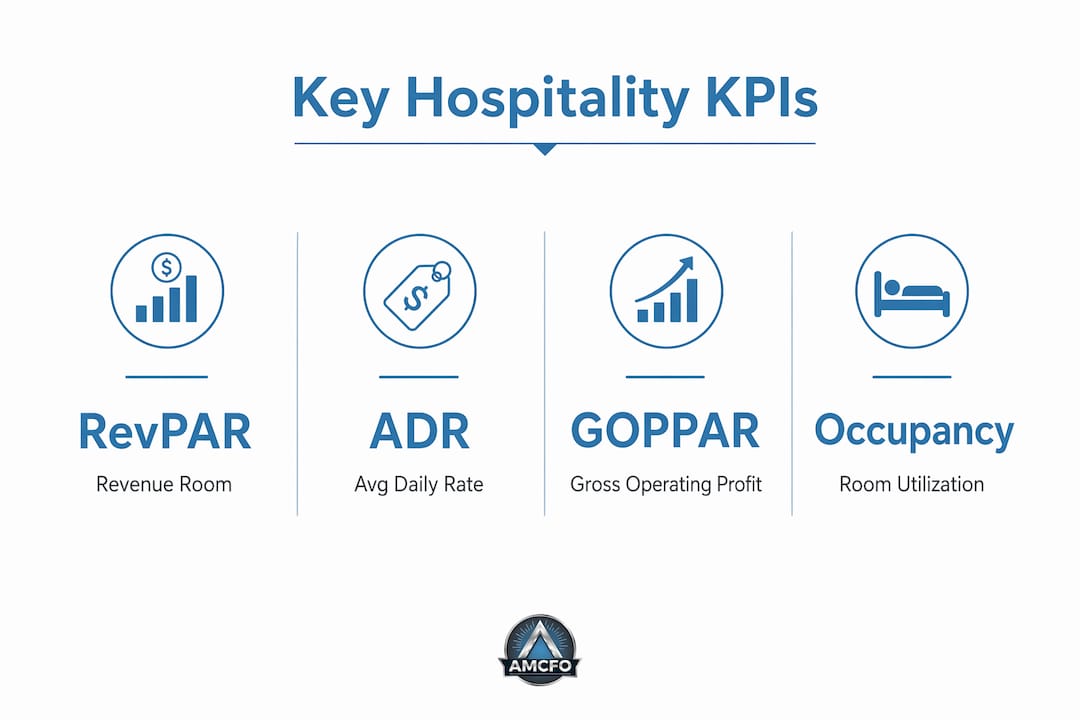
| KPI | What it measures | Why it matters |
|---|---|---|
| RevPAR | Revenue per available room | Shows overall room revenue efficiency |
| ADR | Average daily rate | Tracks pricing strength per occupied room |
| GOPPAR | Gross operating profit per available room | Measures true profitability after operating costs |
| Occupancy rate | Percentage of rooms sold | Indicates demand and sales performance |
Pro Tip: Track GOPPAR alongside RevPAR. RevPAR tells you how much you earned. GOPPAR tells you how much you kept. A property can have strong RevPAR and still lose money if labor or energy costs are out of control.
The night audit
Hotels perform a daily book closing called the night audit to capture and reconcile all guest transactions across every service point. This daily financial close is a defining feature of hotel accounting. Restaurants typically close books monthly, which means hotels generate far more frequent financial data and require tighter daily controls.
How does hospitality accounting differ between hotels and restaurants?
Hotels and restaurants share the same industry but operate with very different financial rhythms. Hotels focus on daily closings and multi-entity ownership reporting, while restaurants manage higher transaction volumes and tighter inventory cycles. Understanding these differences helps managers apply the right controls in the right place.
Revenue streams and transaction types
A hotel earns revenue from rooms, food and beverage outlets, event spaces, parking, and ancillary services. Each stream requires its own revenue recognition rules and cost tracking. A restaurant earns revenue almost entirely from food and beverage sales, with catering or private dining as secondary sources.

Restaurant transactions are faster and more frequent. A busy restaurant may process hundreds of table turns in a single evening, each with its own check, tip, and payment type. Hotels process fewer but larger transactions, often with deferred billing through city ledgers and corporate accounts.
Operational expenses and reporting cadence
Labor is the largest controllable expense in both settings, but the scheduling complexity differs. Hotels staff across 24-hour operations with multiple departments. Restaurants concentrate labor into service windows, making food cost and labor cost percentage the two most watched metrics.
| Factor | Hotels | Restaurants |
|---|---|---|
| Revenue streams | Rooms, F&B, events, parking | Food, beverage, catering |
| Financial close | Daily (night audit) | Monthly |
| Key cost driver | Labor across departments | Food cost and labor percentage |
| Reporting framework | USALI 12th edition | No single universal standard |
| Inventory complexity | FF&E, linens, F&B | Perishable food and beverage |
Seasonality hits both sectors hard, but in different ways. A ski resort hotel may see 80% of its annual revenue in three months. A restaurant near a convention center may spike during events and go quiet in between. Both require seasonal budgeting and forecasting to protect cash flow through the slow periods.
What technology tools improve hospitality accounting accuracy?
Technology is the difference between reactive and proactive financial management in hospitality. Cloud-based platforms unify PMS and POS data with budgets and reconciliations, giving managers a live view of financial performance. Without that integration, finance teams spend hours manually entering data that software should handle automatically.
PMS, POS, and accounting integration
Integration failures between PMS and POS systems and accounting software lead to manual data errors that compound over time. API-level connections between systems are the standard for accurate, automated data flow into the general ledger. Prioritizing systems with 200 or more integrations reduces this risk significantly.
Data Plus GEN 9 Finance AI Cloud is one example of hospitality accounting software built specifically for this environment. It offers native USALI 12th edition support and over 267 integrations for multi-property portfolios, covering accounts payable, capital project tracking, and full departmental reporting. That level of native support removes the need for workarounds that create errors.
Automation and real-time visibility
Automation tools like Dext use OCR technology with 99% accuracy to scan and categorize receipts and invoices automatically. This real-time expense visibility helps managers align spending with the financial realities of each season. The time saved on manual data entry translates directly into faster decision-making.
Automation software reduces manual data entry by hours monthly. That time compounds across a year, freeing finance staff to focus on analysis rather than data cleanup. For a hotel or restaurant running on thin margins, that shift in focus can change outcomes.
- Connect your PMS, POS, and accounting platform at the API level, not through manual exports.
- Use cloud-based accounting software that updates in real time, not end-of-month batch uploads.
- Choose platforms with native USALI support to avoid manual chart-of-accounts mapping.
- Automate receipt and invoice capture with tools like Dext to eliminate paper-based bottlenecks.
- Build financial dashboards that surface RevPAR, GOPPAR, and labor cost percentage daily.
Pro Tip: Before selecting hospitality accounting software, ask the vendor for a list of native integrations with your specific PMS and POS systems. A system with 267 integrations is only useful if your stack is on that list.
How can accounting data improve profitability and operational efficiency?
Accounting data is most valuable when it drives a specific decision. Departmental P&Ls show exactly where costs are running above budget, which points managers toward the right corrective action. The key is reviewing financial data frequently enough to act before a problem becomes a loss.
Here are four ways hospitality managers use accounting data to improve results:
-
Identify labor inefficiencies by department. Compare labor cost as a percentage of departmental revenue each week. If the housekeeping department runs above its target percentage during low-occupancy periods, that signals overscheduling. Adjusting shift counts in response to occupancy forecasts brings the ratio back in line.
-
Adjust menu pricing based on food cost trends. Restaurant managers who review food cost percentage monthly can catch ingredient price increases before they erode margins. Repricing two or three high-cost menu items or substituting ingredients can recover several margin points without reducing guest satisfaction.
-
Use forecasting to manage cash flow through slow seasons. Real-time expense tracking combined with forecasting enables adaptive pricing and labor scheduling to protect margins. A hotel that forecasts a 30% occupancy drop in february can reduce staffing levels and defer non-critical maintenance spending before the revenue shortfall arrives.
-
Shorten the financial close cycle. Real-time financial dashboards and automated monthly closes shorten feedback loops, allowing managers to act quickly on cost overruns or revenue shifts. A 10-day close cycle gives you three weeks to respond to a problem. A 30-day close cycle gives you none.
"The hospitality businesses that protect their margins through slow seasons are the ones that review financial data weekly, not monthly. Frequency of review is the single biggest driver of financial discipline in this industry."
Budgeting in hospitality requires a different approach than in most industries. You are not budgeting for a flat year. You are budgeting for a year with peaks, valleys, and unpredictable external events. Building a rolling 12-month forecast that updates monthly gives managers a tool that reflects current reality rather than last year's assumptions.
Connecting your financial management and planning process to your accounting data closes the loop between what you planned and what actually happened. That gap, reviewed regularly, is where the most useful financial insights live.
Key Takeaways
Effective hospitality accounting requires daily financial discipline, the right technology integrations, and a consistent framework like USALI to turn raw data into decisions that protect profitability.
| Point | Details |
|---|---|
| USALI 12th edition is the standard | Adopt the 2026 framework to standardize departmental P&Ls and undistributed expense reporting. |
| Night audits define hotel accounting | Hotels close books daily, requiring tighter controls than the monthly cycles common in restaurants. |
| Integration prevents costly errors | Connect PMS, POS, and accounting software at the API level to eliminate manual data entry mistakes. |
| KPIs drive operational decisions | Track RevPAR, ADR, and GOPPAR daily to catch revenue and cost problems before they compound. |
| Forecasting protects slow-season cash flow | Build rolling 12-month forecasts that update monthly to manage labor and expenses through demand shifts. |
What I've learned from working with hospitality finances
The biggest mistake I see hospitality managers make is treating accounting as a compliance task rather than a management tool. They close the books, file the reports, and move on. The financial data sits in a system that nobody looks at until something goes wrong.
The properties that consistently outperform their competitors do the opposite. They review departmental P&Ls weekly. They track GOPPAR alongside RevPAR. They use their accounting data to make staffing decisions on tuesday, not to explain what went wrong in the prior month.
USALI 12th edition compliance in 2026 is not optional for any hotel that wants to benchmark against peers or attract institutional investment. The standardization it provides is the foundation for every meaningful financial comparison you will make. If your chart of accounts does not align with USALI, your data is not comparable to anything outside your own walls.
Automation is not a luxury at this point. A finance team spending hours each week on manual data entry is a team that cannot do analysis. The outsourcing accounting services model has matured to the point where hospitality businesses of any size can access expert bookkeeping and fractional CFO support without hiring a full-time team. For independent hotels and restaurant groups, that is often the most cost-effective path to financial discipline.
The future of hospitality finance is real-time. AI-driven forecasting tools are already moving from enterprise-only to accessible for mid-market operators. The managers who build financial literacy now, and who invest in the right integrations today, will have a significant advantage as those tools become standard.
— Angelica
How Amcfo helps hospitality businesses manage their finances
Hospitality finance is complex enough without managing it with the wrong tools or without expert support. Amcfo provides accounting and bookkeeping services built for businesses that need accurate, timely financial reporting to make real decisions. From QuickBooks setup and cleanup to payroll support and tax coordination, the team handles the daily financial operations so you can focus on running your property or restaurant.
For hospitality managers who need more than bookkeeping, Amcfo's fractional CFO packages include budgeting, forecasting, financial analysis, and ongoing CFO consulting tailored to your operation. Whether you run a single restaurant or a multi-property hotel group, Amcfo brings the financial expertise and technology-driven approach your business needs to stay profitable through every season.
FAQ
What is hospitality accounting?
Hospitality accounting is the specialized management of financial records, reporting, and analysis for hotels, restaurants, and related businesses. It uses industry-specific frameworks like USALI to track departmental revenue and costs, measure KPIs, and support operational decisions.
What is USALI and why does it matter?
USALI is the Uniform System of Accounts for the Lodging Industry, the standard chart of accounts and reporting framework for hotel finance. The 12th edition became effective january 1, 2026, and standardizes departmental P&Ls and undistributed expense categories across the industry.
What are the most important KPIs in hotel financial management?
RevPAR, ADR, and GOPPAR are the three core KPIs in hotel financial management. RevPAR measures revenue per available room, ADR tracks average rate per occupied room, and GOPPAR captures gross operating profit per available room.
How does restaurant accounting differ from hotel accounting?
Restaurants close books monthly and focus on food cost percentage and labor cost as primary metrics. Hotels perform a daily night audit, track revenue across multiple departments, and follow the USALI framework for standardized reporting.
What software is used for hospitality accounting?
Data Plus GEN 9 Finance AI Cloud is a purpose-built hospitality accounting platform with native USALI 12th edition support and over 267 integrations. Dext is widely used for automated receipt and invoice capture, integrating directly into leading accounting software platforms.