

The debt service coverage ratio (DSCR) measures whether a property or business generates enough operating cash to cover its required debt payments. The formula is straightforward: DSCR = Net Operating Income ÷ Total Debt Service. A ratio above 1.0 means income exceeds debt obligations; below 1.0 means it does not. Chase notes that commercial lenders commonly look for a DSCR of at least 1.25, though thresholds vary by loan type and sector.
- DSCR > 1.25: Strong coverage; most commercial lenders will proceed.
- DSCR 1.0–1.25: Marginal; lenders may require reserves, a co-borrower, or additional collateral.
- DSCR < 1.0: Negative coverage; the property or business cannot service its debt from operating income alone.
Key Takeaways
The debt service coverage ratio equals Net Operating Income divided by Total Debt Service, and most commercial lenders require a minimum of 1.25 before approving a loan.
| Point | Details |
|---|---|
| Core formula | DSCR = NOI ÷ Total Debt Service; both figures must cover the same 12-month period. |
| Lender benchmarks | Most commercial lenders require a minimum DSCR near 1.25; SBA programs set a slightly lower threshold; retail and hospitality sectors often require higher coverage ratios. |
| Calculate NOI correctly | Deduct vacancy allowance, replacement reserves, and normalized owner compensation before dividing. |
| Fix a low DSCR early | Raise rents, cut discretionary expenses, or refinance to a longer amortization before submitting your application. |
| Amcfo for borderline cases | Amcfo's fractional CFO team restates NOI to lender standards, builds stress-tested models, and prepares global DSCR packages. |
Table of Contents
- What is the debt service coverage ratio formula?
- How to calculate Net Operating Income step by step
- How to calculate total debt service accurately
- Worked examples: CRE property and small business
- What lenders look for: DSCR thresholds by sector
- Practical steps to improve your DSCR before applying
- Common DSCR mistakes that cause loan denials
- Other ratios lenders use alongside DSCR
- When should you hire a fractional CFO for DSCR work?
- DSCR is a lens, not a verdict
- Amcfo helps you calculate, improve, and present your DSCR
- Sources
What is the debt service coverage ratio formula?
The primary formula every lender uses is:
DSCR = Net Operating Income (NOI) ÷ Total Debt Service
Both figures must cover the same period. Annual is the standard. If you are working from monthly statements, multiply each figure by 12 before dividing. Mixing a monthly NOI against an annual debt service figure is a common error that cuts your apparent DSCR by a factor of 12.
Numerator choices: NOI, EBIT, and EBITDA
Lenders do not always agree on what goes in the numerator. Three versions appear regularly:
- NOI (Net Operating Income): Revenue minus operating expenses, before interest, taxes, depreciation, and amortization. Standard for commercial real estate.
- EBIT (Earnings Before Interest and Taxes): Used in corporate lending; includes depreciation and amortization as a cost, so it is more conservative than EBITDA.
- EBITDA (Earnings Before Interest, Taxes, Depreciation, and Amortization): Common in business lending and leveraged finance; adds back non-cash charges to approximate operating cash flow.
Investopedia defines DSCR as operating income divided by required debt payments, which aligns with the EBIT approach. For real estate, NOI is the accepted standard. For a manufacturing company or service business, lenders often substitute EBITDA. Ask your lender which numerator they use before you run the numbers yourself.
What to include and exclude from NOI
Include:
- Gross rental income or gross operating revenue
- Other recurring income (parking, laundry, storage fees)
- Less: vacancy and credit loss allowance (typically 5–10% for stabilized properties)
- Less: all operating expenses (insurance, property taxes, management fees, utilities, maintenance)
Exclude:
- Mortgage interest and principal payments
- Income taxes
- Depreciation and amortization
- One-time or non-recurring income (insurance proceeds, asset sales)
- Capital expenditures
Pro Tip: Annualize consistently. If your rent roll shows a lease that started mid-year, prorate it. Lenders will catch a full-year income figure that includes only six months of a new tenant, and it damages your credibility in underwriting.
How to calculate Net Operating Income step by step
Getting NOI right is where most borrowers lose points in underwriting. Follow this sequence:
- Start with effective gross income (EGI). Take scheduled gross revenue, subtract a vacancy and credit loss allowance, and add any other recurring income. For a stabilized multifamily property, a 5% vacancy factor is typical; for retail or hospitality, use the actual trailing 12-month figure.
- List all operating expenses. Include property taxes, insurance, property management fees, utilities paid by the owner, landscaping, repairs and maintenance, and administrative costs. Use actual trailing 12-month figures, not budget projections, unless the lender specifically requests a forward-looking underwrite.
- Subtract operating expenses from EGI. The result is NOI.
- Adjust for replacement reserves. Many lenders require you to deduct a replacement reserve line (often $250–$500 per unit per year for multifamily) even if you have not funded it yet. Skipping this step overstates NOI.
- Normalize owner compensation. If the owner manages the property personally and takes no management fee, add a market-rate management fee (typically 8–10% of EGI) as an expense. Lenders underwrite to what it would cost to replace the owner's labor.
Common adjustments lenders require
- Non-recurring income: Strip out one-time lease termination fees, insurance settlements, or tenant improvement reimbursements.
- Below-market leases: Some lenders will underwrite to market rents rather than in-place rents if leases expire within 12 months.
- Recurring CapEx: For older properties, lenders may add a capital reserve line beyond standard replacement reserves.
Documents to prepare for underwriting
- Trailing 12-month profit and loss statement
- Current rent roll with lease expiration dates
- All lease agreements
- Prior two years of tax returns (property-level and entity-level)
- Capital expenditure history and upcoming CapEx plans
For portfolio loans, lenders will often want a global NOI that aggregates income and expenses across all properties and related entities. Property-level DSCR and global DSCR can differ significantly if one asset carries most of the debt.
How to calculate total debt service accurately
Total debt service is the denominator, and under-reporting it is just as damaging as overstating NOI. J.P. Morgan explains that total debt service must include all required debt payments due in the next 12 months.
Standard components:
- Scheduled principal amortization
- Scheduled interest payments
- Current maturities of long-term debt (balloon payments due within 12 months)
- Capital lease payments
- Sinking fund contributions where required by the loan agreement
Debt items borrowers commonly miss
- Lines of credit: If you carry a balance on a revolving credit line, the minimum required payments belong in total debt service.
- Short-term notes payable: A 90-day note from a supplier or related party counts.
- SBA loan payments: If you have an existing SBA loan, include it. SBA program guidance often references a minimum DSCR near 1.15 for small-business programs, but the calculation still requires all existing obligations in the denominator.
- Personal guarantees on business debt: For global DSCR, a lender may include personally guaranteed debt even if it sits in a different entity.
Pro Tip: Pull the amortization schedule from every active loan and sum the next 12 months of principal and interest. Do not rely on your bank statement payment amounts alone — those figures may exclude escrow, fees, or balloon components that the lender will include.
Worked examples: CRE property and small business
Example 1: Commercial real estate property
A small office building generates $320,000 in gross rental income.
- Effective Gross Income: $320,000 − $22,400 = $297,600
- Less operating expenses: $297,600 − $115,000 = NOI of $182,600
- Annual debt service: $148,000 (principal + interest on a $1.8M loan at 6.5%, 25-year amortization)
- DSCR = $182,600 ÷ $148,000 = 1.23
A 1.23 DSCR is below the 1.25 threshold most commercial lenders prefer. The lender might approve the loan with a debt service reserve account (DSRA) funded to cover three to six months of payments, or they may require the borrower to pay down the loan balance to reduce annual debt service.
| Item | Amount |
|---|---|
| Gross rental income | $320,000 |
| Vacancy allowance (7%) | ($22,400) |
| Operating expenses + reserves | ($115,000) |
| Net Operating Income | $182,600 |
| Annual debt service | $148,000 |
| DSCR | 1.23 |
Example 2: Small business loan
A manufacturing company reports $850,000 in revenue. After cost of goods sold and operating expenses (excluding interest, taxes, depreciation, and amortization), EBITDA is $210,000. The business has two loans: an existing equipment loan requiring $60,000 per year and a proposed new term loan requiring $90,000 per year.
- EBITDA (numerator): $210,000
- Total annual debt service: $60,000 + $90,000 = $150,000
- DSCR = $210,000 ÷ $150,000 = 1.40
A 1.40 DSCR is comfortably above the 1.25 benchmark. WallStreetPrep's calculation guidance confirms that commercial lenders routinely size loans to maintain a target DSCR under stress scenarios, not just at current income levels.
What lenders look for: DSCR thresholds by sector
DSCR minimums are not universal. They shift based on property type, loan program, and borrower profile.
| Loan / Property Type | Typical Minimum DSCR |
|---|---|
| Stabilized multifamily (conventional) | 1.20–1.25 |
| Commercial real estate (office, industrial) | 1.25 |
| Retail / hospitality | 1.30–1.40 |
| SBA 7(a) and 504 loans | ~1.15 |
| Owner-occupied commercial real estate | 1.20–1.25 |
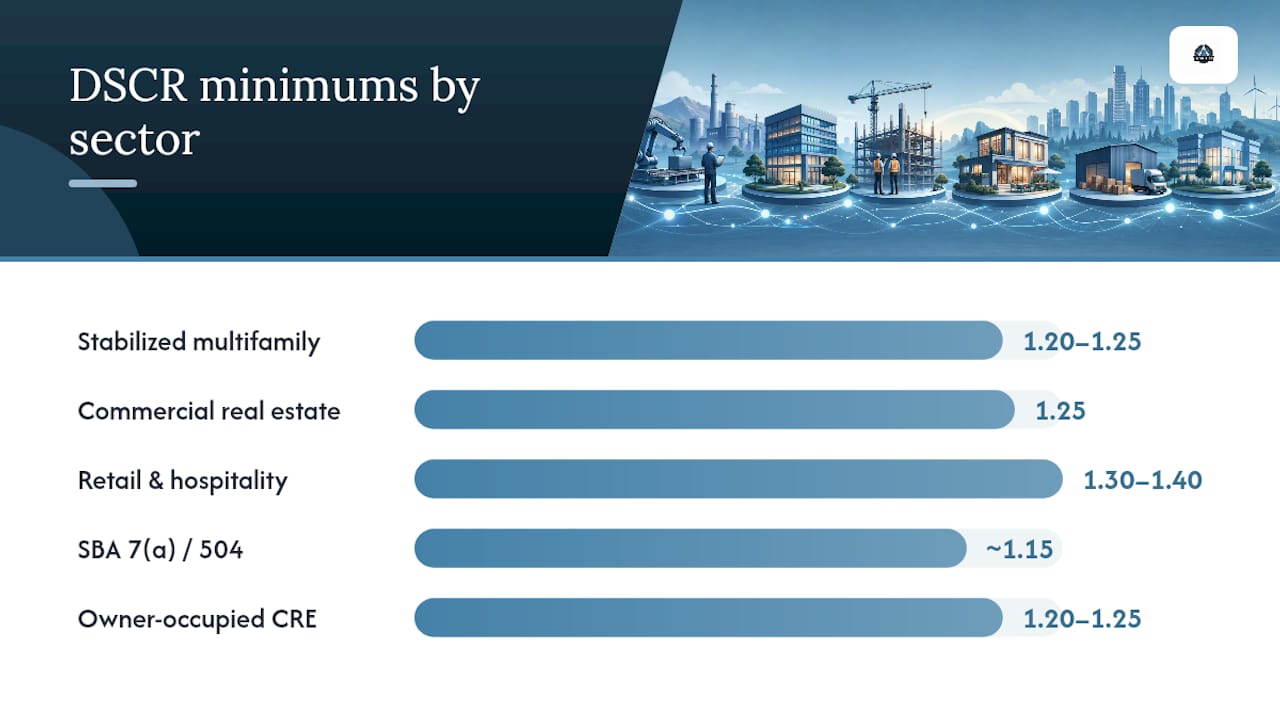
Stabilized multifamily tends to get the most favorable thresholds because cash flows are predictable. Retail and hospitality carry more volatility, so lenders demand a larger cushion. J.P. Morgan notes that acceptable thresholds vary by sector, and practitioners recommend asking your specific lender for their stress-test DSCR requirement before submitting an application.
A DSCR above the typical range signals very strong cash flow and low borrower risk. Some lenders, however, may view an unusually high ratio as a sign the borrower is under-leveraged or holding excess cash rather than deploying it productively. The sweet spot for most commercial borrowers is a moderate to somewhat higher range.
How lenders use DSCR beyond the initial approval
- Loan sizing: Lenders back-calculate the maximum loan amount that keeps DSCR at or above their minimum. If your NOI is $182,600 and the lender requires 1.25, the maximum annual debt service they will underwrite is $146,080.
- Ongoing covenants: Many commercial loans include a maintenance covenant requiring DSCR to stay above a floor (often 1.10–1.20) throughout the loan term. Falling below triggers a cure period or technical default.
- Debt Service Reserve Account (DSRA): HUD guidance and many commercial lenders require a funded reserve account when DSCR is borderline. A DSRA typically covers three to six months of debt service and provides a lender backstop if income dips.
Practical steps to improve your DSCR before applying
A borderline DSCR is not a dead end. Most of the levers are on the NOI side, and some can move the number meaningfully within 60–90 days.
Revenue-side moves:
- Raise rents to market rate on expiring leases before the underwriting date.
- Reduce vacancy by accelerating lease-up or converting month-to-month tenants to longer terms.
- Add ancillary income streams (storage units, parking fees, vending) that lenders will credit as recurring income.
Cost-side moves:
- Cut discretionary operating expenses that are not contractually required.
- Renegotiate vendor and service contracts; even a 10% reduction in management or maintenance costs can shift DSCR by several hundredths.
- Normalize owner compensation to market rate. If you are paying yourself above-market, lenders will recast it anyway — do it yourself first.
Capital-side moves:
- Refinance existing debt to a longer amortization period. Extending from 20 to 25 years reduces annual principal payments and lowers total debt service.
- Add subordinated capital (mezzanine debt or preferred equity) to reduce senior debt service, though this adds complexity.
- Fund a DSRA voluntarily before the lender requires it; some lenders will approve a borderline DSCR if a reserve is already in place.
Pro Tip: Refinancing to lower your denominator is effective, but it extends total interest costs over the life of the loan. Run a side-by-side model showing DSCR improvement versus total interest paid before committing. Cash flow modeling makes this comparison straightforward.
Common DSCR mistakes that cause loan denials
The errors below show up repeatedly in underwriting reviews, and each one can flip a borderline approval into a denial.
- Using net income after tax as the numerator. Post-tax net income understates cash available for debt service because it deducts interest (which is part of debt service) and taxes (which are not an operating obligation in the DSCR framework). Use NOI, EBIT, or EBITDA as your lender specifies.
- Omitting existing debt obligations. Leaving out a line of credit balance, a related-party note, or a capital lease inflates DSCR artificially. Lenders pull credit reports and loan schedules; they will find it.
- Overstating NOI with non-recurring income. A one-time lease termination fee or an insurance payout makes trailing 12-month income look better than it is. Lenders strip these out, and so should you.
- Ignoring vacancy. Underwriting a fully occupied building at 100% occupancy when actual occupancy is 88% overstates NOI by the full vacancy gap.
- Mismatching time periods. Annual NOI divided by monthly debt service produces a ratio 12 times too high. Always confirm both figures are on the same annualized basis.
Watch for covenant definitions that differ from your calculation. Many loan agreements define DSCR using "Adjusted NOI" or a trailing four-quarter average rather than the trailing 12-month figure you used to qualify. A loan that closes at 1.28 can breach a 1.20 maintenance covenant within 18 months if the covenant uses a different NOI definition. Read the covenant language before signing, not after.
Other ratios lenders use alongside DSCR
DSCR tells lenders whether cash flow covers payments. It does not tell them how much debt the borrower carries relative to assets or equity. Lenders use several complementary metrics.
- Interest Coverage Ratio (ICR): EBIT ÷ Interest Expense. This measures only interest coverage, not principal repayment. A company can have a strong ICR but a weak DSCR if it carries heavy amortization. ICR is common in corporate bond covenants and revolving credit facilities.
- Debt-to-Equity (D/E): Total debt divided by total equity. Measures leverage, not cash flow. A lender may approve a DSCR of 1.30 but still decline a loan if D/E exceeds their policy limit (often 3:1 or 4:1 for commercial real estate).
- Debt-to-Assets: Total liabilities divided by total assets. Provides a balance-sheet view of solvency. Useful for lenders assessing liquidation risk if the borrower defaults.
- Global DSCR: Aggregates NOI and total debt service across all properties and related entities owned by the borrower. When a single asset has a borderline ratio, lenders often require a global DSCR statement to confirm the borrower's overall cash position supports the new obligation. WallStreetPrep notes that preparing a global DSCR is standard practice when individual assets are borderline.
For SBA loans, expect the lender to run both a business-level DSCR and a global DSCR that includes the owner's personal income and obligations. For large CRE portfolios, the global DSCR often carries more weight than any single property's ratio.
When should you hire a fractional CFO for DSCR work?
Some DSCR situations are straightforward enough to handle with a spreadsheet. Others are not.
Hire a fractional CFO or accounting professional when:
- Your DSCR is borderline (1.10–1.25) and you need to restate NOI to lender standards before submitting.
- You are refinancing a portfolio of properties and need a global DSCR statement that aggregates across entities.
- You are in a growth or roll-up phase and need pro forma DSCR projections for acquisitions.
- Your loan agreement has a maintenance covenant and you are approaching the trigger level.
- A lender has declined your application citing DSCR and you need to understand what adjustments would change the outcome.
What a fractional CFO will do
- Restate NOI using lender-standard adjustments (vacancy, reserves, normalized compensation).
- Build a stress-tested cash flow model showing DSCR at 5%, 10%, and 15% revenue declines.
- Prepare a global DSCR package across all entities and properties.
- Model refinancing scenarios (different amortization periods, rate assumptions) to find the structure that clears the lender's threshold.
- Negotiate directly with lenders on amortization assumptions and covenant definitions.
Onboarding checklist: what to bring
- Trailing 24-month profit and loss statements (property-level and entity-level)
- All current loan amortization schedules
- Current rent rolls with lease expiration dates
- All lease agreements
- Prior two years of federal tax returns
- Capital expenditure history and upcoming CapEx plans
- Any existing loan covenant compliance certificates
DSCR is a lens, not a verdict
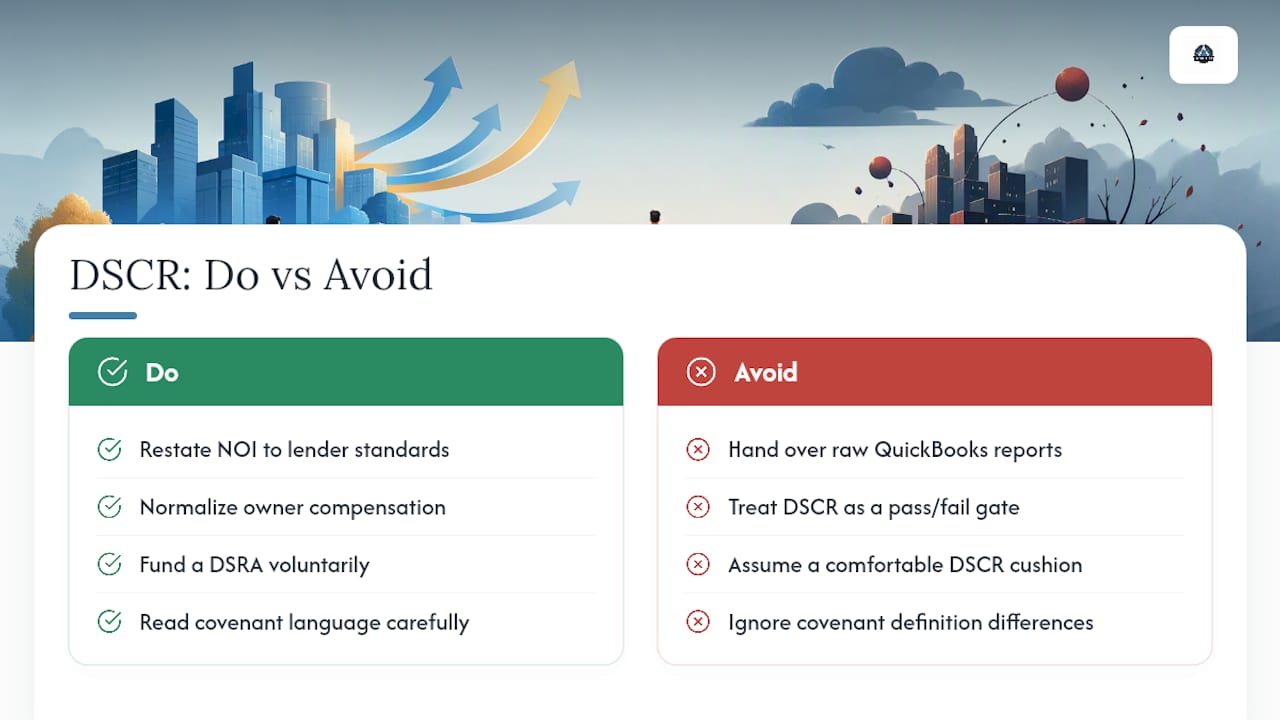
Most articles treat DSCR as a pass/fail gate. That framing misses the more useful insight: DSCR is a diagnostic. A ratio of 1.18 on a stabilized multifamily property tells a very different story than 1.18 on a single-tenant retail building with a lease expiring in 14 months. The number is the same; the risk is not.
The most consequential DSCR work happens before the loan application, not during it. Borrowers who restate NOI to lender standards, normalize owner compensation, and fund a DSRA voluntarily arrive at underwriting with a credible package. Borrowers who hand over raw QuickBooks reports and hope for the best spend weeks in back-and-forth that often ends in a lower loan amount or a denial.
There is also a subtler point about covenant definitions. The DSCR that gets you approved and the DSCR your loan agreement requires you to maintain are often calculated differently. Approvals use trailing 12-month actuals; covenants often use trailing four-quarter averages or forward-looking projections. A borrower who closes at 1.28 and assumes they have a comfortable cushion can breach a 1.20 maintenance covenant within two years if income softens and the covenant definition is less forgiving than the approval definition. Read the covenant language with the same care you give the rate and term.
Amcfo helps you calculate, improve, and present your DSCR
Getting DSCR right before a lender sees it is exactly the kind of work Amcfo's fractional CFO services are built for. Clean books, lender-standard NOI restatements, stress-tested cash flow models, and global DSCR packages across multiple entities — these are not tasks that belong in a spreadsheet the night before your loan submission.

Amcfo's team handles the full preparation cycle: QuickBooks cleanup and accounting to produce audit-ready financials, NOI restatement to lender standards, refinancing scenario modeling, and covenant review so you know exactly where your cushion sits. Whether you are a real estate investor preparing a portfolio refinance or a business owner applying for an SBA loan, the engagement starts with a document review and a clear DSCR restatement — so you walk into underwriting knowing your number before the lender calculates it for you. Reach out to Amcfo to schedule an initial review.
Sources
These U.S.-focused sources back the benchmarks, formulas, and underwriting notes in this article:
- What is the debt-service coverage ratio (DSCR)? | Business
- What is debt service coverage ratio (DSCR) in real estate?
- Debt Service Coverage Ratio (DSCR) | Formula + Calculator
- Sba
This article is general information, not a substitute for advice from a qualified financial advisor. Consult a qualified financial professional about your own circumstances before acting on anything here.