

When you try to scale financial operations growth without a solid foundation in place, you don't just slow down. You multiply every existing problem. Manual reconciliations that barely worked at $5M in revenue become genuine audit risks at $20M. Fragmented systems that once produced delayed reports now block board decisions entirely. This guide walks through the four pillars that separate finance teams successfully scaling for growth from those perpetually fighting fires: readiness assessment, technology deployment, team structure, and execution discipline.
Table of Contents
- Key takeaways
- Assessing your readiness to scale financial operations
- Leveraging technology to optimize financial processes
- Building a finance team that scales with growth
- Execution discipline and governance that sustain gains
- My honest take on scaling finance in 2026
- Scale smarter with Amcfo
- FAQ
Key takeaways
| Point | Details |
|---|---|
| Fix data before automating | Clean, harmonized data is the prerequisite that determines whether automation helps or compounds existing errors. |
| Redesign processes, don't just automate | Automating a broken process scales inefficiency. Map and fix workflows before deploying any technology. |
| Build for adaptability, not headcount | Generalist finance professionals with AI fluency outperform larger, rigid teams at nearly every growth stage. |
| Govern continuously, not periodically | Sustaining efficiency gains requires recurring accountability reviews and a small set of tracked performance outcomes. |
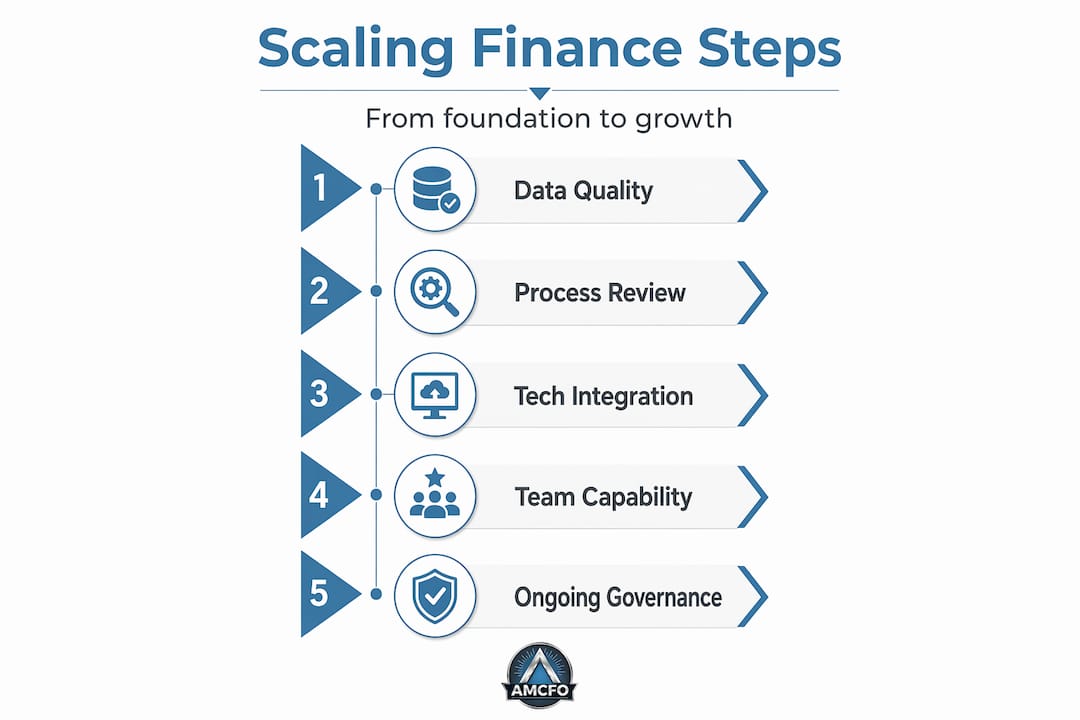
| Sequence your scaling investments | Technology, process, people, and governance each depend on the previous layer. Skipping steps creates compounding risk. |
Assessing your readiness to scale financial operations
Before any growth initiative gains traction, your finance function needs a frank diagnosis. The companies that struggle most when scaling aren't the ones lacking ambition. They're the ones that deployed expensive technology on top of messy, undocumented processes and then wondered why the numbers didn't improve.
The starting point is data quality. AI only creates value on a trusted foundation with harmonized data and standardized, integrated processes. That means a unified chart of accounts, consistent entity naming conventions, and reconciled historical data before a single automation tool goes live. If your balance sheet closes with unexplained variances every month, no software will fix that for you.
Process documentation comes next, and it's where most finance leaders discover uncomfortable truths. Research shows that only 31% of workflows actually follow documented procedures. The other 69% involve undocumented variants and workarounds that hide in spreadsheets and tribal knowledge. You cannot standardize what you haven't mapped.
Your technology stack also deserves honest scrutiny. Can your current systems integrate with a modern ERP or planning tool? Do your reporting tools produce real-time outputs or weekly batch files? These questions determine whether you're building on a scalable base or patching a system that will need replacement mid-growth.
- Data layer: Unified chart of accounts, normalized entity data, reconciled historical records
- Process layer: Documented workflows with identified exceptions and shadow processes removed
- Technology layer: Assessed integration capability, API availability, and upgrade path
- People layer: Identified skill gaps, particularly in data analysis, systems fluency, and AI literacy
Pro Tip: Run a formal operational efficiency assessment before committing any scaling budget. An efficiency audit will surface the specific bottlenecks costing you the most time and money right now.
Leveraging technology to optimize financial processes
Technology is where scaling businesses usually want to start. It's also where many of them waste the most money. The pattern is familiar: a company purchases a new financial planning platform, struggles with data migration for six months, and ends up running the new system in parallel with the old spreadsheets indefinitely.
The firms that achieve real results follow a tighter sequence.
- Define the outcome first. Are you trying to close faster, reduce reconciliation errors, or improve forecast accuracy? Each objective points to a different category of technology.
- Audit integration requirements. Any new system must connect cleanly with your CRM, ERP, and payroll platforms. Siloed tools create new manual work, they don't eliminate it.
- Pilot before deploying broadly. Run a controlled test on one process or one business unit before scaling the technology across the organization.
- Measure against a baseline. Document current cycle times, error rates, and labor hours before go-live so you can quantify actual improvement.
The ROI evidence for aligned technology investments is strong. Businesses that align tech with process improvements achieve 200 to 300% ROI and up to 75% operational efficiency gains within three to nine months. The qualifier is that word "aligned." Technology deployed without process redesign doesn't come close to those numbers.
AI agents for the financial close are one of the most concrete current examples. AI-enabled close agents compress the month-end cycle from five to ten days down to three days or fewer, with $127,000 to $212,000 in annual savings for mid-sized finance teams. That's not theoretical. That's achievable when the underlying reconciliation data is clean and the process is standardized first.

| Technology area | Primary benefit | Key prerequisite |
|---|---|---|
| AI financial close agents | 50–70% cycle time reduction | Standardized reconciliation data |
| Process mining tools | Uncovers undocumented workflow variants | Access to system transaction logs |
| Integrated FP&A platforms | Real-time forecasting and scenario planning | Clean ERP and CRM data feeds |
| Automated AP/AR workflows | Reduced manual intervention from 67% to 21% | Consistent vendor and customer master data |
Pro Tip: Don't buy technology to solve a process problem. Use financial modeling tools to quantify the cost of your current inefficiencies first, then select technology that directly addresses those specific gaps.
Building a finance team that scales with growth
There's a common misconception that scaling business finances means scaling headcount proportionally. It doesn't. The most effective finance teams at growth-stage companies are built around adaptable generalists, not narrowly specialized roles added one at a time.
Modern finance team scaling favors professionals focused on analytics and system integration over rigid headcount increases. This matters because the work itself is changing faster than most hiring plans account for. A finance manager hired today primarily for accounts payable execution will need to pivot toward oversight, exception handling, and process governance within two to three years as automation absorbs the transactional volume.
The skills that genuinely differentiate finance hires right now are:
- Systems fluency: Can they set up, configure, and troubleshoot the tools the team uses, not just input data into them?
- Analytics orientation: Do they default to asking "what does the data tell us?" rather than "what does the report say?"
- AI literacy: Can they validate AI outputs, recognize when a model is producing nonsense, and exercise independent judgment on flagged anomalies?
- Cross-functional range: Can they work credibly with operations, sales, and product teams rather than staying siloed in finance?
Effective scaling is not linear by revenue. It's shaped by business model complexity and team capabilities, which means your hiring sequence should flex with your actual operational needs rather than following a generic headcount chart.
The reactive alternative, which is hiring in response to capacity crunches rather than anticipating capability needs, consistently produces teams with redundant skills and coverage gaps in the areas that matter most. If you're a CFO or finance leader reading this, the hire you make when you're already overwhelmed is almost never the right one. Plan the capability roadmap six to twelve months ahead.
Execution discipline and governance that sustain gains
Getting the right technology in place and hiring well are visible accomplishments. What kills scaling initiatives isn't usually the setup. It's the lack of ongoing discipline to sustain the improvements after the initial energy fades.
Sustainable operational efficiency is an ongoing discipline focused on a few critical outcomes with strong accountability, not a one-time project with a launch date and a ribbon-cutting ceremony. That means identifying three to five key performance outcomes for your finance function, such as close cycle time, forecast accuracy, or reconciliation error rate, and reviewing them on a recurring cadence with clear owners.
Governance for scaling finance also means embedding AI oversight into daily operations, not treating it as a separate IT concern. Only 10% of AI success comes from the models themselves. Seventy percent depends on organization, workforce, and governance. Your team needs defined protocols for when to trust an AI output, when to escalate a flagged transaction, and when to override a model recommendation.
Resilience deserves attention alongside efficiency. Predictive analytics enable maintaining both efficiency and resilience by allocating system buffers intelligently, protecting against disruptions without sacrificing speed. Finance leaders who think only about efficiency often build brittle systems that fail when volumes spike or a key team member leaves.
- Track three to five outcome metrics, not twenty activity metrics
- Assign named owners for each financial process area with defined response thresholds
- Schedule monthly or quarterly operational reviews that go beyond financial results to cover process performance
- Build a change log for all workflow modifications so you can trace the source of new inefficiencies quickly
Pro Tip: After any major technology deployment or process change, run a follow-up audit 90 days later. The gaps between intended and actual behavior show up clearly at that window, before they calcify into new shadow processes.
Finance operations must evolve from reactive accounting to a proactive, integrated function to support scaling complexity. The teams that get there fastest are the ones that treat governance as a core competency, not an afterthought.
My honest take on scaling finance in 2026
In my experience working with finance leaders across industries, the single most expensive mistake I've watched companies make is rushing to automate before their data house is in order. Everyone wants the AI story. Nobody wants to spend three months cleaning up their chart of accounts. But those three months of cleanup are the difference between automation that actually works and automation that produces wrong answers faster.
The second thing I've seen consistently underestimated is what process automation actually does to a broken workflow. It doesn't fix it. It makes it faster and more consistent, which means the errors compound instead of occasionally catching themselves through human review. If you automate a flawed reconciliation process, you don't save time. You accelerate the creation of problems that are now harder to trace.
What actually works, and what I'd recommend to any finance leader planning a scaling initiative, is this sequence: clean your data, map your real processes (not the ones on paper), hire or develop one or two people who are genuinely systems-literate, then deploy technology. After that, build governance into the calendar rather than treating it as optional.
The teams I've seen win at scaling finance aren't the ones with the biggest budgets. They're the ones who checked their CFO responsibilities against their actual organizational readiness, moved deliberately through the preparation phase, and then executed with discipline. That combination is hard to beat.
— Angelica
Scale smarter with Amcfo

Scaling financial operations is one of the most high-stakes challenges a growing business faces, and it's rarely solved with technology alone. Amcfo works with businesses at every growth stage to build the financial foundation that makes scaling possible. From accounting and bookkeeping that keeps your data clean and audit-ready, to fractional CFO services that bring strategic oversight without the cost of a full-time executive, Amcfo provides the structure your finance function needs to grow without breaking. If you're ready to move from reactive financial management to a proactive function that supports confident decisions, connect with Amcfo to discuss where your operations stand and what the path forward looks like.
FAQ
What does it mean to scale financial operations?
Scaling financial operations means building finance systems, processes, and team capabilities that grow in capacity and sophistication alongside the business without requiring proportional increases in cost or headcount.
What should come first when scaling: technology or process redesign?
Process redesign should come first. Automating a poorly designed process scales the inefficiency. Documenting and fixing workflows before deploying technology produces significantly better outcomes.
How does AI help finance teams scale more efficiently?
AI tools can compress the month-end close cycle from up to ten days down to three or fewer, reduce reconciliation labor costs by 15 to 25%, and flag anomalies that manual review would miss, but only when the underlying data is clean and standardized.
How do you measure financial scalability?
Track a small set of outcome metrics including close cycle time, forecast accuracy variance, reconciliation error rate, and cost per financial transaction. Progress on these four indicators tells you whether your scaling investments are actually working.
When should a growing business consider fractional CFO support?
A business typically benefits from fractional CFO services when revenue growth is outpacing the finance team's capacity, when board or investor reporting is becoming more complex, or when strategic decisions require financial modeling the current team isn't equipped to provide.