

Business consulting is the practice of hiring independent experts to diagnose organizational problems, define solutions, and drive measurable improvements in efficiency, profitability, and operations. The right engagement delivers more than a slide deck. It produces a working execution system with clear ownership, defined KPIs, and governance that outlasts the consultant's involvement. This guide covers how engagements are structured, what they cost, how to hire well, and what separates consulting that creates lasting change from consulting that produces reports no one reads.
What is business consulting and why does it matter?
Business consulting, also called management consulting services, is a professional discipline where outside experts work inside your organization to solve specific problems or accelerate specific outcomes. The scope can range from a focused process improvement project to a full strategic growth consulting engagement spanning multiple business units. What distinguishes consulting from coaching or advisory work is the emphasis on deliverables: defined outputs, measurable results, and a structured handoff.
The value proposition is straightforward. You bring in people who have solved your problem before, in other organizations, and you compress the learning curve. A company that would take 18 months to redesign its sales operations through internal trial and error can accomplish the same outcome in 90 days with the right consulting partner. The catch is that the quality of the outcome depends heavily on how the engagement is scoped, governed, and executed.

Frameworks like McKinsey's 7-S Model, the Balanced Scorecard, and OKR-based planning are common tools consultants deploy. Amcfo uses financial modeling, KPI structuring, and operational cadence design as core delivery mechanisms when working with business owners on growth and efficiency challenges.
How do business consulting engagements typically run?
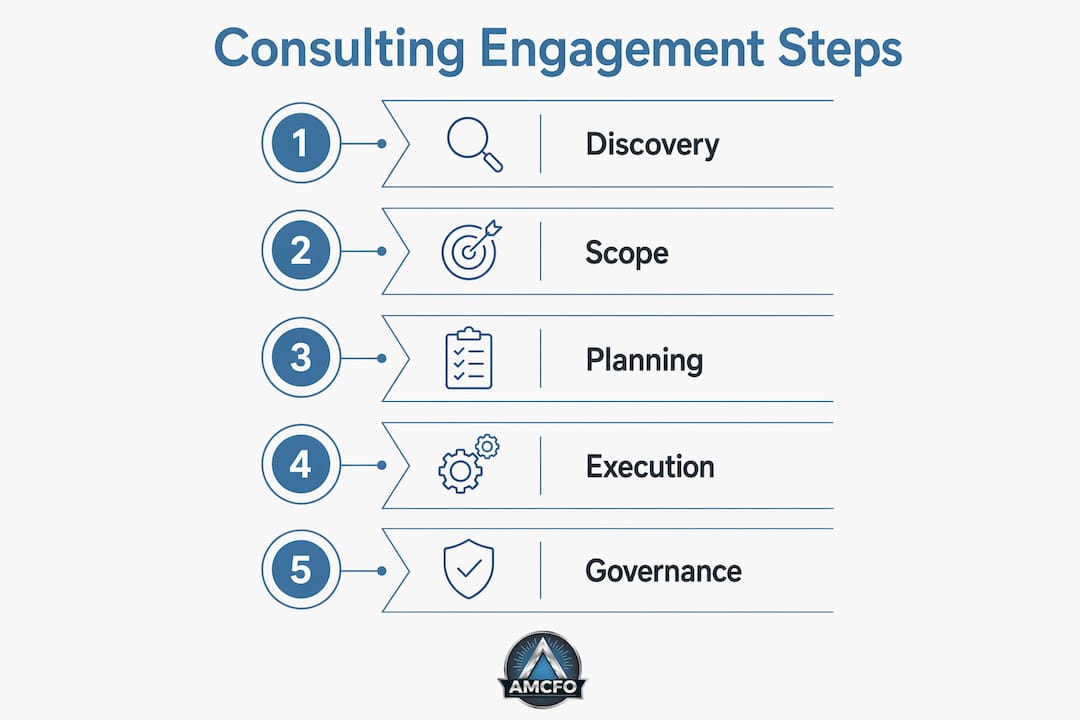
A well-run engagement follows a predictable structure. Defining outcomes with metrics and scope boundaries early, combined with a weekly governance cadence, reduces risk and improves clarity for both sides. Most engagements break into two phases.
-
Discovery phase (2 to 6 weeks). The consultant interviews stakeholders, audits data and systems, maps current-state workflows, and produces a scoping document. This document defines the problem statement, proposed workstreams, KPIs, timeline, and pricing. Discovery is not optional. Any consultant who skips it and jumps straight to recommendations is guessing.
-
Delivery phase. This is where the actual work happens. Workstreams are assigned owners, a 90-day roadmap is set, and the team operates on a weekly review cadence. Governance artifacts include KPI dictionaries, decision logs, RAID logs (risks, assumptions, issues, dependencies), and change control records.
The delivery phase runs as an execution system, not a research project. Meetings focus on KPI variance, blockers, and decisions. Every meeting ends with owner and due-date assignments. Status updates without decisions are removed from the agenda.
Pro Tip: Start with one workflow or function as your scope boundary and expand only after a successful pilot. Broad initial scope is the single most common cause of unfocused, overrun engagements.
Scope drift is a structural risk in every engagement. The antidote is a formal change-control mechanism written into the statement of work before the engagement begins. Any request that falls outside the original scope triggers a written change order with revised pricing and timeline. Without this, costs and timelines expand silently.
What pricing models and fee structures are used in business consulting?
Consulting fees vary widely based on seniority, firm size, and engagement complexity. Independent consultant hourly rates range from $75 to $350 per hour on average, with senior specialists and niche experts charging $300 to $500 or more per hour. Large firm rates run higher. This range matters because it tells you that a $150/hour generalist and a $450/hour industry specialist are not interchangeable, even if both call themselves business consultants.
The four most common pricing models are compared below.
| Pricing model | Best for | Risk to watch |
|---|---|---|
| Fixed fee | Defined scope with clear deliverables | Scope creep erodes consultant margin and quality |
| Time and materials | Exploratory or evolving work | Costs can escalate without a budget ceiling |
| Monthly retainer | Ongoing advisory or fractional roles | Scope tends to expand without formal reviews |
| Staged payments | Multi-phase projects with exit criteria | Requires clear acceptance criteria at each gate |
Fixed-fee engagements give you cost certainty, but only if the scope is airtight. Time-and-materials arrangements give the consultant flexibility, but you carry the budget risk. Retainers work well for ongoing strategic business advice but require quarterly scope reviews to stay focused.
Pro Tip: When reviewing a pricing proposal, ask the consultant to itemize what changes the price. Named scope items, change-order thresholds, and out-of-scope examples tell you more about pricing discipline than the headline number.
For consulting fee benchmarks and how they apply to financial advisory engagements specifically, the structure of the engagement matters as much as the rate.
What questions should you ask when hiring a business consultant?
Effective hiring checklists highlight the need for named delivery teams, stakeholder access, and defined pricing effects of scope changes. Before signing any agreement, work through these questions with every candidate.
- On process: Walk me through your engagement phases from discovery to delivery. What does your governance cadence look like week to week?
- On team: Who specifically will lead this project? Will a senior partner be involved in delivery, or only in the sale?
- On results: Can you show me a case study with before-and-after KPIs from a similar engagement? Can I speak to that client directly?
- On industry fit: Have you worked with companies in our industry and at our revenue scale? How did you customize your approach?
- On pricing: What triggers a change order? What is explicitly out of scope in your proposal?
- On communication: How often will we meet? What format do your status reports take? What happens at the end of the engagement in terms of handoff?
- On post-engagement support: Do you offer a stabilization period after the main engagement closes? What does that cost?
The answer to the senior partner question is particularly revealing. Many consulting firms sell with partners and deliver with junior staff. If the person who convinced you to hire them will not be in the weekly operating review, that is a structural problem worth addressing before you sign.
For a deeper look at evaluating consulting partners and what to look for in process clarity and pricing transparency, Amcfo's consultant evaluation framework covers the key criteria.
What makes a successful consulting engagement?
The most reliable predictor of consulting success is not the quality of the consultant's analysis. Insufficient client-side leadership time and limited access to data and approvals cause more engagement failures than weak consulting work. Before you hire, assess your own readiness honestly.
- Leadership availability: Can your senior decision-makers commit 4 to 6 hours per week to the engagement? If not, the consultant will stall waiting for approvals.
- Data access: Are your financial, operational, and customer data systems accessible and reasonably clean? Consultants who spend the first month cleaning data are not delivering value.
- Decision authority: Is there a named executive sponsor with authority to approve recommendations without a six-week committee process?
Beyond readiness, the engagement itself must be run as an execution system. Governance artifacts like KPI dictionaries, decision logs, and RAID logs are not bureaucratic overhead. They are the mechanism by which consulting work converts into real organizational change.
Common pitfalls that derail otherwise well-scoped engagements include:
- Unclear acceptance criteria for deliverables, which creates disagreement at review gates
- Scope creep that is tolerated rather than managed through change control
- Decision bottlenecks where one executive's unavailability halts the entire workstream
- Dependency on the consultant to run processes that should be owned by internal staff
"The best consulting engagements I have seen are the ones where the client team is running the operating rhythm by week six, and the consultant is coaching rather than executing."
Clear acceptance criteria for each deliverable, with named approvers and defined review windows, prevent the most common source of end-of-engagement disputes.
How to measure and govern success during a consulting engagement?
Measurement is not a post-engagement activity. It starts in week one. Operational governance hinges on a small set of KPIs, a 90-day roadmap, and consistent weekly operating reviews with defined decision rights. Here is how to set it up.
-
Define outcome KPIs with baselines and targets. Each KPI needs a baseline value, a target value, a measurement owner, and a data source. "Improve gross margin" is not a KPI. "Increase gross margin from 38% to 44% by Q3, measured from QuickBooks P&L, owned by the CFO" is a KPI.
-
Establish a weekly operating review. The weekly cadence meeting focuses on KPI variance, blockers, decisions, and risks. It does not recap completed tasks. Every agenda item ends with an owner and a due date.
-
Maintain a decision log and RAID log. Every decision made in the engagement is recorded with the date, the decision, and the approver. Every risk and issue is tracked with an owner and a resolution date.
-
Define exit criteria after initial sprints. After the first 30 to 45 days, the engagement should have a formal checkpoint. The options are continuation, rescope, or stop. Having this checkpoint written into the statement of work prevents both parties from continuing an engagement that has lost direction.
-
Transfer the operating system before exit. Experienced consultants transfer the entire operating rhythm, including definitions, cadence, owners, and templates, to the client team before the engagement closes. If the improvements disappear within 90 days of the consultant leaving, the transfer did not happen.
For KPI-structured consulting methods including baseline and target setting, Amcfo's financial management practice applies the same governance logic to ongoing CFO advisory work.
Key takeaways
Effective business consulting requires clear scope, defined KPIs, weekly governance, and a formal operating system transfer to the client team before the engagement ends.
| Point | Details |
|---|---|
| Scope before you start | Use a 2 to 6 week discovery phase to define outcomes, boundaries, and pricing before delivery begins. |
| Governance drives results | Weekly operating reviews with KPI variance, blockers, and decision logs convert analysis into execution. |
| Pricing requires transparency | Ask consultants to name what changes the price and document scope boundaries in a formal change-control mechanism. |
| Client readiness is a success factor | Leadership time, data access, and decision authority on the client side predict engagement success more than consultant quality alone. |
| Transfer the operating system | Sustainable improvements require handing off definitions, cadence, owners, and templates to internal teams before the engagement closes. |
Why governance separates good consulting from great consulting
I have reviewed dozens of consulting engagements over the years, and the pattern is consistent. The ones that produce lasting results are not the ones with the most sophisticated analysis or the most polished deliverables. They are the ones where the client's team is running a real operating rhythm by the midpoint of the engagement.
Most business owners hire consultants expecting the consultant to carry the work. That is a reasonable expectation for the analysis phase. But when it comes to execution, the consultant's job is to build the system and then step back. If your team cannot run the weekly operating review without the consultant in the room, you have not bought a capability. You have rented one.
The other thing I see consistently is that pricing conversations happen too late. Business owners focus on the headline rate and miss the scope assumptions buried in the proposal. A $50,000 fixed-fee engagement with a narrow scope and a formal change-control mechanism is almost always a better deal than a $35,000 time-and-materials engagement with no ceiling. Ask the hard questions before you sign, not after the first invoice arrives.
For business owners considering strategic growth consulting or process improvement consulting, the governance structure you agree to upfront determines whether the work sticks. Insist on it.
— Angelica
How Amcfo supports your business consulting goals
Amcfo works with business owners and leadership teams to scope, govern, and execute consulting engagements that produce measurable financial and operational results. Whether you need a focused efficiency and cost analysis or a full business consulting engagement covering strategic growth, process redesign, and fractional CFO support, Amcfo brings the governance structure and financial expertise to make the work stick.

Every engagement starts with a scoped discovery phase, defined KPIs, and a governance cadence built before delivery begins. If you are ready to move from analysis to execution, Amcfo is the partner that stays accountable to the numbers.
FAQ
What is business consulting?
Business consulting is a professional service where independent experts help organizations improve performance through defined problem-solving, execution frameworks, and measurable deliverables. Engagements typically cover strategy, operations, finance, or process improvement.
How much does a business consultant cost?
Independent consultant rates average $75 to $350 per hour, with senior specialists charging $300 to $500 or more. Pricing models include fixed fee, time and materials, retainer, and staged payments depending on scope complexity.
How do I choose the right business consultant?
Ask for named delivery team members, phase-by-phase timelines, past case studies with measurable results, and a written explanation of what triggers a change order. Vague answers to any of these questions are a reliable signal to keep looking.
How long does a consulting engagement typically last?
Most engagements run 90 to 180 days for a defined delivery phase, preceded by a 2 to 6 week discovery phase. Ongoing retainer arrangements extend beyond that for advisory or fractional roles.
What is the biggest reason consulting engagements fail?
The most common cause of failure is insufficient client-side leadership time and limited access to data and approvals, not poor consultant quality. Before hiring, assess whether your team can commit the time and authority the engagement requires.