

Forecasting is the practice of using historical and current data to generate reliable predictions that guide strategic business decisions and financial planning. Unlike a budget, which locks in a fixed resource allocation for a set period, forecasts are dynamic estimates updated regularly to reflect changing market conditions. That distinction matters more than most finance teams realize. A business that treats its annual budget as a forecast will be caught flat-footed every time the market moves. The organizations that outperform their peers treat forecasting as a living process, not a calendar event.
What are the primary forecasting methods?
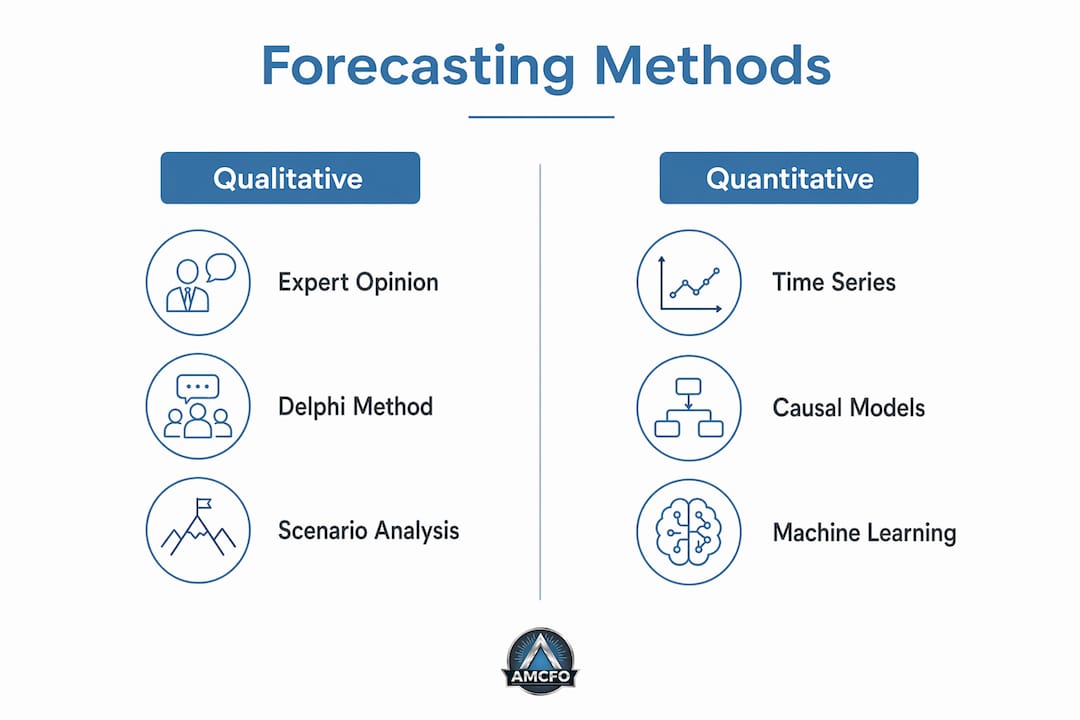
Forecasting methods fall into two broad categories: qualitative and quantitative. Knowing which to use depends on how much historical data you have and how stable your market environment is.
Qualitative methods rely on expert judgment rather than numerical data. The Delphi method, for example, collects anonymous opinions from a panel of experts across multiple rounds until consensus emerges. Market research surveys and structured executive interviews fall into this category as well. These approaches work best for new product launches, entry into unfamiliar markets, or any situation where historical data is thin or irrelevant.
Quantitative methods use mathematical models applied to historical data. Time series analysis examines patterns in past data, such as trends, cycles, and seasonal fluctuations, to project future values. Causal models go further by linking your outcome variable to external drivers. A retailer might model revenue as a function of foot traffic, local employment rates, and promotional spend. Predictive analytics provides risk ratings and probabilities, while predictive forecasting yields quantifiable numerical projections for direct financial strategies. That distinction shapes which tool you reach for when building a financial model.

| Method | Data needed | Accuracy | Complexity | Best use case |
|---|---|---|---|---|
| Delphi / expert opinion | None required | Moderate | Low | New markets, no historical data |
| Time series analysis | 2+ years of history | High | Moderate | Revenue, demand, cash flow |
| Causal / regression models | Historical + external data | Very high | High | Pricing, marketing ROI |
| AI-driven forecasting | Large datasets | Very high | High | Real-time trend detection |
Pro Tip: Start with a simple time series model before adding complexity. A well-calibrated moving average often outperforms a poorly specified machine learning model.
How do AI and time series models improve prediction accuracy?
AI-driven forecasting has changed the speed at which finance teams can act on market signals. AI-detected trends typically surface 4–12 weeks ahead of traditional research cycles. That lead time is the difference between setting a price before a competitor does and reacting after the fact.
Modern open-source time series libraries have also raised the performance bar dramatically. Processing benchmarks show that current engines can fit three years of daily historical data in under 100 milliseconds, a 10–100x improvement over older tools like Prophet. Speed at that scale means finance teams can run scenario updates daily instead of monthly.
Three model families dominate the current landscape:
- Chronos uses a probabilistic transformer architecture trained on large public datasets, making it effective even when your own historical data is limited.
- TimesFM (developed by Google Research) applies a decoder-only foundation model to time series, producing accurate zero-shot forecasts across industries.
- Prophet remains widely used for business time series with strong seasonality and known holiday effects, though it has been largely surpassed in raw accuracy by newer models.
One technical risk that trips up even experienced analysts is data leakage. Causal dependency in time series requires models to respect temporal order. If a model is trained on data that includes future information, its accuracy in testing looks excellent but collapses in production. The fix is strict train-test splitting by date, never by random sampling.
AI visibility data also captures buyer research behavior weeks before it appears in traditional market research. The strongest forecasts combine AI signals with sales data and structured expert input, not one source alone.
Pro Tip: When using any automated forecasting engine, always include exogenous variables such as marketing spend, holidays, and macroeconomic indicators. Ignoring external factors skews performance projections and inflates apparent model accuracy.
What common pitfalls should business leaders avoid?
The most damaging forecasting errors are not technical. They are organizational and behavioral.
Confusing forecasts with budgets is the most common mistake. A budget is a commitment. A forecast is a best current estimate. When leaders treat a forecast revision as a sign of failure, teams stop updating their models honestly. The result is a forecast that looks stable on paper while the business drifts off course.
The clairvoyance trap is equally dangerous. Business leaders often fixate on predicting a single outcome rather than preparing for a range of scenarios. The more useful question is not "what will happen?" but "what moves create value across multiple futures?" Identifying no-regret moves, actions that pay off regardless of which scenario materializes, is the practical output of good scenario planning.
Ignoring seasonality and external drivers produces forecasts that look reasonable in aggregate but fail at the line level. High-precision forecasting requires including exogenous regressors like marketing spend or holidays to correct seasonal noise. A consumer goods company that models revenue without accounting for back-to-school or holiday cycles will consistently miss its quarterly targets.
Effective forecasting requires scenario planning and regularly revisiting assumptions to adjust as evidence emerges. Revisiting scenarios quarterly helps update strategic positions before they become irrelevant.
The fix for all three pitfalls is the same: build a process, not a model. A model is a tool. A process is what keeps the tool calibrated over time.
How to implement an effective forecasting process
A reliable forecasting process follows four stages: data collection, model selection, validation, and scheduled updates. Skipping any stage produces a forecast that looks credible but fails under pressure.
-
Collect and clean your data. Pull at least two years of historical financials, broken down by revenue stream, cost center, and time period. Identify gaps, outliers, and any periods distorted by one-time events. Clean data is the single largest driver of forecast accuracy.
-
Select the right model for your data profile. Use time series analysis for stable, recurring revenue streams. Use causal models when you have reliable external data, such as industry indices or marketing spend history. Use qualitative methods when entering new markets or launching new products. Match the model to the data, not the other way around.
-
Validate before you deploy. Split your historical data into a training set and a holdout test set. Run the model on the training data, then measure its accuracy against the holdout period. Metrics like Mean Absolute Percentage Error (MAPE) and Root Mean Squared Error (RMSE) give you an objective read on model performance before any real money depends on it.
-
Schedule regular updates and assumption reviews. Structured foresight methodologies produce significantly higher organizational adaptability during market disruptions. Quarterly assumption reviews are the minimum. High-growth businesses benefit from monthly rolling forecasts tied directly to corporate financial planning cycles.
Cross-functional collaboration is not optional. Finance owns the model, but sales, operations, and marketing own the inputs. A revenue forecast built without sales pipeline data is a guess dressed up as analysis. Build a standing cadence where each function reviews and signs off on its assumptions before the forecast is finalized.
Weak signal detection adds another layer of foresight. Monitoring signals through a tri-filter approach, looking for convergence, persistence, and amplification across multiple data sources, can surface emerging trends 18–24 months before mass adoption. That kind of lead time shapes capital allocation decisions, not just quarterly targets.
Pro Tip: Tie your forecasting process directly to your strategic planning calendar. When forecasts and strategy reviews happen in separate silos, neither one improves the other.
Key takeaways
Accurate forecasting is the foundation of confident financial decision-making, and it requires the right methods, clean data, and a disciplined update process to deliver real value.
| Point | Details |
|---|---|
| Forecasts are not budgets | Update forecasts regularly as conditions change; treat revisions as accuracy, not failure. |
| Match method to data | Use time series for recurring revenue, causal models for driver-based planning, and qualitative methods for new markets. |
| AI accelerates trend detection | AI-driven models surface market shifts 4–12 weeks earlier than traditional research cycles. |
| Avoid data leakage | Always split time series data by date, not randomly, to prevent overly optimistic model results. |
| Process beats model | A disciplined quarterly review cycle with cross-functional input outperforms any single forecasting tool. |
The forecasting mistake I see most often
After working with finance teams across industries, the pattern I keep seeing is not a technical failure. It is a cultural one. Organizations invest in a forecasting model, get a clean output, and then treat that output as settled fact for the next 12 months. The model becomes a document, not a decision tool.
The teams that actually improve their financial performance use forecasts differently. They treat every forecast as a hypothesis. They ask what would have to be true for this projection to be wrong, and they monitor for exactly those signals. That mindset shift, from prediction to hypothesis testing, is what separates finance teams that lead strategy from those that report on it after the fact.
I also think the industry undersells scenario planning. Most articles describe it as a risk management exercise. It is actually a growth tool. When you map out three or four plausible futures and identify the moves that create value across all of them, you stop waiting for certainty before committing capital. You act earlier, with more confidence, because you have already thought through the downside.
The honest advice for senior leaders is this: your forecasting culture is set at the top. If you punish a team for revising a forecast, you will get a team that stops revising forecasts. If you reward accuracy and intellectual honesty, you will get a process that actually helps you run the business.
— Angelica
How Amcfo supports better financial forecasting
Accurate forecasting depends on clean books, reliable data, and financial leadership that knows how to build and maintain a planning process. Amcfo provides fractional CFO services that give growing businesses access to senior financial expertise without the cost of a full-time hire.
Amcfo's team handles the full stack: accounting and bookkeeping to keep your financial data accurate, budgeting and forecasting support to build forward-looking models, and ongoing CFO consulting to connect those models to your strategic decisions. Whether you are building your first rolling forecast or overhauling a process that has stopped working, Amcfo brings the structure and expertise to make it reliable.
FAQ
What is the difference between forecasting and budgeting?
A budget is a fixed resource allocation plan for a set period. A forecast is a regularly updated estimate of future outcomes based on current data and market conditions.
What forecasting method works best for small businesses?
Time series analysis works well for businesses with at least two years of consistent revenue history. Qualitative methods like expert judgment are better when historical data is limited or a new product is involved.
How does AI improve business forecasting accuracy?
AI-driven models detect emerging market trends 4–12 weeks earlier than traditional research methods. They also process large historical datasets far faster, enabling more frequent forecast updates.
What is data leakage in time series forecasting?
Data leakage occurs when a model is trained on information that includes future data points. It produces misleadingly high accuracy in testing but fails in real-world use. Always split training and test data by date.
How often should a business update its forecasts?
Most businesses benefit from monthly rolling forecasts with a full assumption review each quarter. High-growth or high-volatility businesses may need more frequent updates tied to key operational metrics.