

Corporate financial planning is the strategic discipline that defines how an enterprise funds its growth, manages financial risk, and sustains long-term performance through integrated goals, forecasts, budgets, capital allocation, and cash flow management. Most executives conflate this with Financial Planning and Analysis (FP&A), but the two serve entirely different altitudes of decision-making. Corporate financial planning operates at the CEO, CFO, and board level across multi-year strategic horizons of one to ten years, while FP&A handles the operational detail work within an 18-month window. Understanding the difference, and mastering the discipline itself, is what separates companies that grow deliberately from those that react to every market shift.
What is corporate financial planning, and why does it matter?
Corporate financial planning is defined as the governance framework that sets financial guardrails clarifying capital deployment, balancing short- and long-term tradeoffs, and connecting growth priorities to realistic execution. That definition matters because it positions the discipline as something far more consequential than a spreadsheet exercise. It is the mechanism by which leadership translates ambition into a financially defensible path forward.
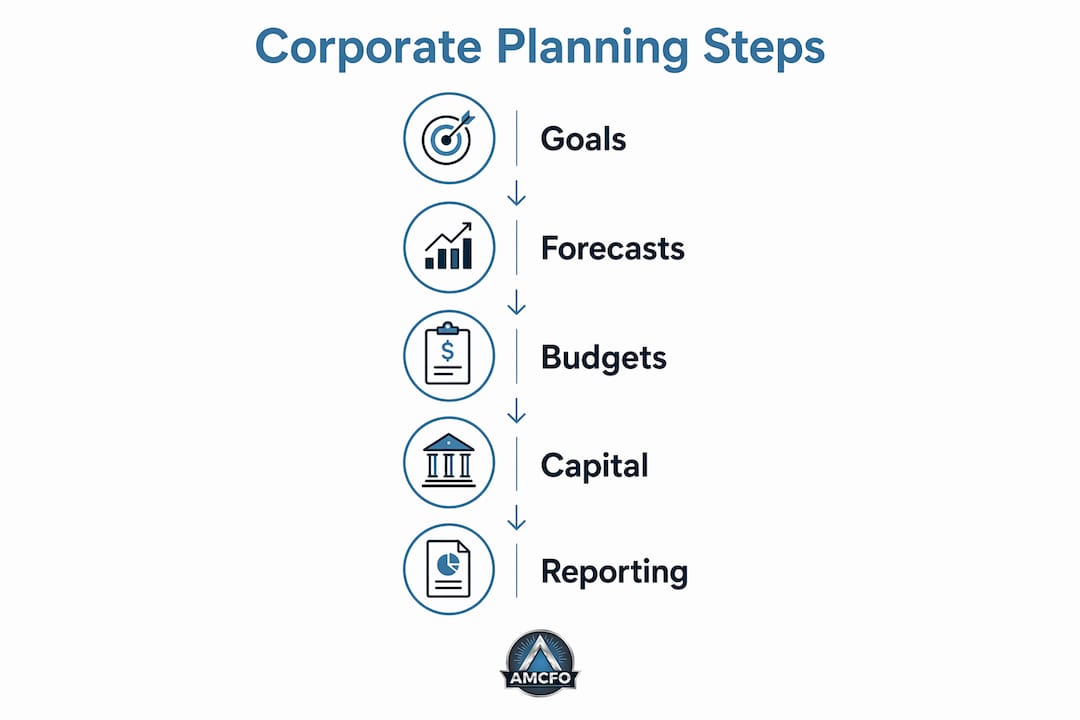
The framework integrates five core elements: financial goals, forward-looking forecasts, operating budgets, capital planning, and cash flow management. Each element feeds the others. A company that sets aggressive revenue targets without modeling the capital required to achieve them will discover the gap at the worst possible moment. Organizations that treat these five elements as a connected system, rather than separate departmental tasks, consistently make faster and more confident decisions.

Tools like Workday and Oracle have built entire product lines around this integration challenge, offering predictive modeling and rolling cash forecasts that give finance teams real-time visibility across planning horizons. The technology matters less than the discipline, but the right tools remove friction from a process that already demands significant executive attention.
For corporate managers and business owners, the practical implication is straightforward. A company without a formal corporate financial planning process is making capital allocation decisions based on intuition rather than structured analysis. That approach works until it doesn't, and the failure is rarely gradual.
What are the key components of corporate financial planning?
The five components of corporate financial planning are not equally weighted, but all five are required for the framework to function. Removing any one of them creates a blind spot that compounds over time.
-
Financial goals are specific, measurable targets aligned to company strategy. They answer the question: what does financial success look like in three years? Goals might include a target EBITDA margin, a debt-to-equity ratio ceiling, or a minimum cash reserve. Without defined goals, every budget discussion becomes a negotiation without a reference point.
-
Financial forecasts are forward-looking models built on historical data, market assumptions, and operational inputs. A credible forecast is not a wish list. It is a structured estimate of where the business is heading given current trajectory and planned actions. Forecasts are updated regularly, not once a year.
-
Budgets translate strategy into resource allocation. The budget is where strategic intent meets operational reality. A company that funds departments inconsistently with its stated priorities has a strategy problem disguised as a budget problem.
-
Capital planning covers the full range of investment decisions, including M&A activity, share buybacks, dividends, and debt management decisions. This is where the largest financial commitments are made, and where the consequences of poor planning are most severe.
-
Cash flow management is the tactical layer that keeps the entire framework operational. A company can be profitable on paper and still face a liquidity crisis if cash timing is mismanaged.
Pro Tip: Link your financial goals directly to your capital planning decisions before you finalize any budget. If the capital plan cannot support the stated goals, the goals need to change, not the budget.
These five components work as a system. The goals define the destination. The forecasts map the route. The budget allocates the fuel. Capital planning manages the vehicle. Cash flow management keeps the engine running. Treat them as a system, and the plan becomes a genuine management tool rather than an annual compliance exercise.
How does corporate financial planning differ from FP&A?
The distinction between corporate financial planning and FP&A is one of altitude and deliverables. Corporate planning targets executives at the CEO, CFO, and board level, producing multi-year strategic plans that set direction and guardrails. FP&A supports department managers and operational executives with budgets, variance reports, and short-cycle forecasts.
| Dimension | Corporate financial planning | FP&A |
|---|---|---|
| Time horizon | 1 to 10+ years | 1 to 18 months |
| Primary audience | CEO, CFO, board of directors | Department heads, operational managers |
| Key deliverables | Strategic plans, capital structure decisions | Budgets, forecasts, variance analysis |
| Focus | Direction, risk, capital allocation | Execution, performance tracking |
| Decision type | Where are we going? | Are we on track? |
Corporate financial planning acts as a governance layer, establishing the limits and guiding principles within which FP&A operates. FP&A then tests operational budgets and forecasts against those guardrails to confirm feasibility. The two functions are complementary, not competing. A company that runs one without the other either lacks strategic direction or lacks operational accountability.
A common organizational mistake is assigning both functions to the same team without distinguishing their outputs. When the same analysts who build monthly variance reports are also responsible for five-year capital structure decisions, neither gets the attention it deserves. Separating the audiences and deliverables, even within a small finance team, produces better outcomes for both.
Pro Tip: Schedule a quarterly alignment meeting between your corporate planning lead and your FP&A team. Use it specifically to reconcile strategic assumptions with operational actuals. This single habit prevents the drift that causes strategic plans to become irrelevant by Q3.
For a deeper look at how CFO-level leadership manages this distinction in practice, the CFO responsibilities guide from Amcfo covers the structural decisions growing companies face.
What planning horizons are essential in corporate financial planning?
Corporate financial planning operates across three distinct time horizons, each serving a different decision-making purpose. Conflating them produces plans that are neither strategic nor operational. Keeping them separate, while ensuring they connect logically, is the structural discipline that makes planning useful.
| Horizon | Timeframe | Primary focus |
|---|---|---|
| Annual operating plan | ~1 year | Detailed budgets, performance targets, resource allocation |
| Mid-term strategic plan | 3 years | Strategic initiatives, capital allocation, growth investments |
| Long-range strategic plan | 5 to 10 years | Market positioning, capital structure, major investment decisions |
The annual operating plan is the most detailed and the most immediately actionable. It drives quarterly performance reviews, departmental budgets, and hiring decisions. Most managers live in this horizon by default, which is why the longer-term plans often receive insufficient attention.
The three-year plan is where strategic intent becomes financially concrete. It answers questions like: which markets will we enter, what capital will we commit to product development, and how will our debt profile change? This horizon requires assumptions that are less certain than the annual plan, but it forces leadership to make explicit choices rather than leaving them implicit.
The long-range strategic plan, covering five to ten years, is the least precise but the most consequential. Decisions about capital structure, major acquisitions, and market positioning made at this horizon shape the company's trajectory for a decade. The goal is not precision. The goal is directional clarity that prevents short-term decisions from foreclosing long-term options.
Each horizon informs the others. The long-range plan sets the destination. The three-year plan maps the route. The annual plan executes the next leg of the journey. When these three documents are disconnected, the annual budget becomes an isolated exercise with no strategic anchor.
How can organizations implement adaptive corporate financial planning?
The most common failure in corporate financial planning is treating the plan as a finished document rather than a living management tool. An effective planning discipline sequences decisions from reliable starting points, translates strategy into priorities, and adapts dynamically as conditions change. That last part is where most organizations fall short.
Adaptive planning requires three structural changes to how most companies currently operate:
-
Embed triggers in the plan. Define in advance the specific conditions that will prompt a plan revision. Triggers might include a liquidity ratio falling below a defined threshold, a demand shift exceeding a set percentage, or a key input cost moving outside a modeled range. Without pre-defined triggers, plan updates happen reactively and too late.
-
Replace static annual forecasts with rolling forecasts. A rolling forecast extends the planning window forward continuously, rather than anchoring to a fixed year-end. This approach keeps the forecast current and reduces the distortion that comes from protecting annual budget commitments that no longer reflect reality.
-
Integrate tactical cash forecasting. Oracle's predictive cash forecasting tools support tactical 10-day forecasts alongside mid-term three-to-six month rolling views. This dual-horizon cash visibility prevents the scenario where a company is profitable on paper but faces a cash crisis because timing was not managed. Strategic plans fail operationally when cash timing is ignored.
Pro Tip: Build your rolling forecast in the same model as your strategic plan, not in a separate file. When assumptions change in the rolling forecast, the impact on the three-year plan should be visible immediately. Disconnected models create disconnected decisions.
The planning process also benefits from financial modeling that stress-tests assumptions before they are embedded in the plan. Scenario analysis, sensitivity testing, and Monte Carlo simulations are not reserved for large enterprises. Any company making capital commitments above its operating cash flow should model the downside before committing.
Key takeaways
Corporate financial planning is the governance framework that connects strategic ambition to financial reality through goals, forecasts, budgets, capital allocation, and cash management across multi-year horizons.
| Point | Details |
|---|---|
| Definition and scope | Corporate financial planning sets financial guardrails that guide capital deployment and balance growth with risk across one-to-ten-year horizons. |
| Five core components | Goals, forecasts, budgets, capital planning, and cash flow management must function as a connected system, not separate tasks. |
| Distinction from FP&A | Corporate planning serves the CEO and board with strategic direction; FP&A serves operational managers with budgets and variance analysis. |
| Three planning horizons | Annual, three-year, and long-range plans each serve distinct purposes and must connect logically to remain useful. |
| Adaptive planning discipline | Embed triggers, use rolling forecasts, and integrate tactical cash forecasting to keep the plan current and decision-ready. |
What I've learned from watching companies plan well and plan poorly
After working with companies across a wide range of industries, the pattern I see most consistently is this: organizations that struggle financially almost always have a planning process that is either absent or disconnected from how decisions actually get made. The plan exists as a document. The decisions happen in meetings where nobody references it.
The companies that plan well do something different. They treat the financial plan as the decision-making framework, not the output of a planning season. When a capital request comes in, the first question is whether it fits within the guardrails already established. When a market opportunity appears, the first question is whether the cash position supports pursuing it. The plan is the filter, not the filing cabinet.
I've also seen the damage that comes from confusing corporate financial planning with FP&A. When executives expect their FP&A team to produce strategic direction, and the FP&A team expects executives to provide it, the result is a planning vacuum. Nobody owns the long-range view. The annual budget becomes the de facto strategy, which means the company is optimizing for the next twelve months at the expense of the next ten years.
The other mistake I see repeatedly is underestimating cash timing. A company can show strong profitability and still run out of operating cash because receivables are slow and payables are fast. Integrating tactical cash forecasting into the planning process is not optional for any company managing real capital commitments. It is the difference between a plan that works on paper and one that works in practice.
Executive involvement is non-negotiable. When the CFO delegates the planning process entirely to the finance team, the resulting plan reflects what finance thinks leadership wants rather than what leadership actually intends. The best planning processes I've observed involve the CEO and CFO in the assumption-setting phase, not just the approval phase.
— Angelica
How Amcfo helps companies build financial plans that actually work

Most companies have the ambition to plan strategically. What they lack is the financial leadership infrastructure to do it consistently. Amcfo provides fractional CFO services that give businesses access to senior financial leadership without the cost of a full-time executive hire. That means you get a CFO-level perspective on capital allocation, forecasting, and financial guardrail-setting, applied directly to your business's specific situation.
Amcfo's team works with companies to build planning processes that connect annual budgets to multi-year strategic goals, integrate cash flow monitoring, and produce financial analysis that supports confident decisions at the executive level. If your current planning process produces documents rather than decisions, that is exactly the gap Amcfo is built to close. Reach out to learn how financial management planning support can be structured for your organization.
FAQ
What is corporate financial planning in simple terms?
Corporate financial planning is the process by which a company defines its financial goals, allocates capital, and manages cash flow across a multi-year horizon to fund growth and manage risk. It is the strategic framework that connects where a company wants to go with the financial resources required to get there.
How is corporate financial planning different from budgeting?
Budgeting is one component of corporate financial planning, focused on allocating resources for a specific period, typically one year. Corporate financial planning is the broader discipline that includes multi-year forecasts, capital structure decisions, and strategic goal-setting that the annual budget is designed to support.
Why do strategic plans fail operationally?
Strategic plans most often fail operationally because cash timing is not managed alongside profit projections. A company can be profitable on paper and still face a liquidity crisis if receivables lag and payables accelerate. Integrating rolling cash forecasts with the strategic plan prevents this mismatch.
Who is responsible for corporate financial planning?
Corporate financial planning is the responsibility of the CEO, CFO, and board of directors, who set the strategic direction and financial guardrails. FP&A teams and department managers then execute within those guardrails through operational budgets and short-cycle forecasts.
How often should a corporate financial plan be updated?
A corporate financial plan should be reviewed at least annually, with rolling forecasts updated quarterly or monthly. Embedding pre-defined triggers, such as liquidity thresholds or demand shifts, into the plan allows for structured updates when conditions change rather than waiting for a scheduled review cycle.