

Most business leaders know financial risk management exists. Far fewer treat it as the forward-looking strategic function it actually is. When most people hear the phrase, they picture loss prevention: hedging against a bad quarter, setting credit limits, maybe buying insurance. But financial risk management, known formally as enterprise risk management (ERM) when applied at the organizational level, is far more expansive. It covers identification, analysis, and control of every financial threat that could undermine your company's health, from market swings to liquidity crunches to operational failures. This guide breaks down the concepts, frameworks, and practical strategies you need to put it to work.
Table of Contents
- Key takeaways
- What financial risk management really means
- Types of financial risks every organization faces
- Frameworks that structure risk programs
- Practical techniques for managing financial risk
- Embedding risk management into business strategy
- My take on where most businesses go wrong
- How Amcfo helps you manage financial risk
- FAQ
Key takeaways
| Point | Details |
|---|---|
| Risk management is strategic | Financial risk management protects business value and supports growth, not just loss prevention. |
| Five core risk types matter | Market, credit, liquidity, operational, and legal risks each require distinct identification and mitigation tactics. |
| Frameworks provide structure | ISO 31000 and COSO ERM give organizations proven processes for managing risk consistently and systematically. |
| Techniques must be actionable | Scenario analysis, hedging, diversification, and stress testing only add value when tied to real business decisions. |
| Integration is non-negotiable | Risk management embedded in strategy and governance produces better outcomes than a standalone compliance program. |
What financial risk management really means
At its core, financial risk management is the discipline of identifying, measuring, and responding to financial exposures before they damage your organization. The goal is not to eliminate risk entirely. That would mean eliminating opportunity. The goal is to understand which risks you can absorb, which you need to transfer, and which you must actively reduce.
The primary objectives break down into four areas:
- Safeguarding assets: Protecting the balance sheet from impairment caused by market volatility, counterparty defaults, or catastrophic operational events.
- Ensuring liquidity: Maintaining enough cash or readily convertible assets to meet short-term obligations without fire-selling long-term investments.
- Managing capital: Allocating resources in proportion to the risks being taken so that you are not over-exposed in any single area.
- Supporting strategic goals: Aligning risk tolerance with growth ambitions so that risk management informs, rather than blocks, decision-making.
Financial risk management sits within the broader discipline of enterprise risk management. ERM takes a portfolio view, connecting financial exposures to operational, strategic, and reputational risks across the whole organization. Effective risk management leads to cost savings, better decisions, and improved returns even when markets are volatile. That is the business case, spelled out plainly.
Pro Tip: When building your risk management function, start by mapping how each major financial risk connects to a specific balance sheet line or cash flow statement. This makes abstract risks concrete and immediately usable for your leadership team.
Types of financial risks every organization faces
Understanding the specific types of financial risks your company faces is the foundation of any risk program. Grouping them into a risk register or taxonomy helps your team track, assign ownership, and prioritize mitigation efforts.
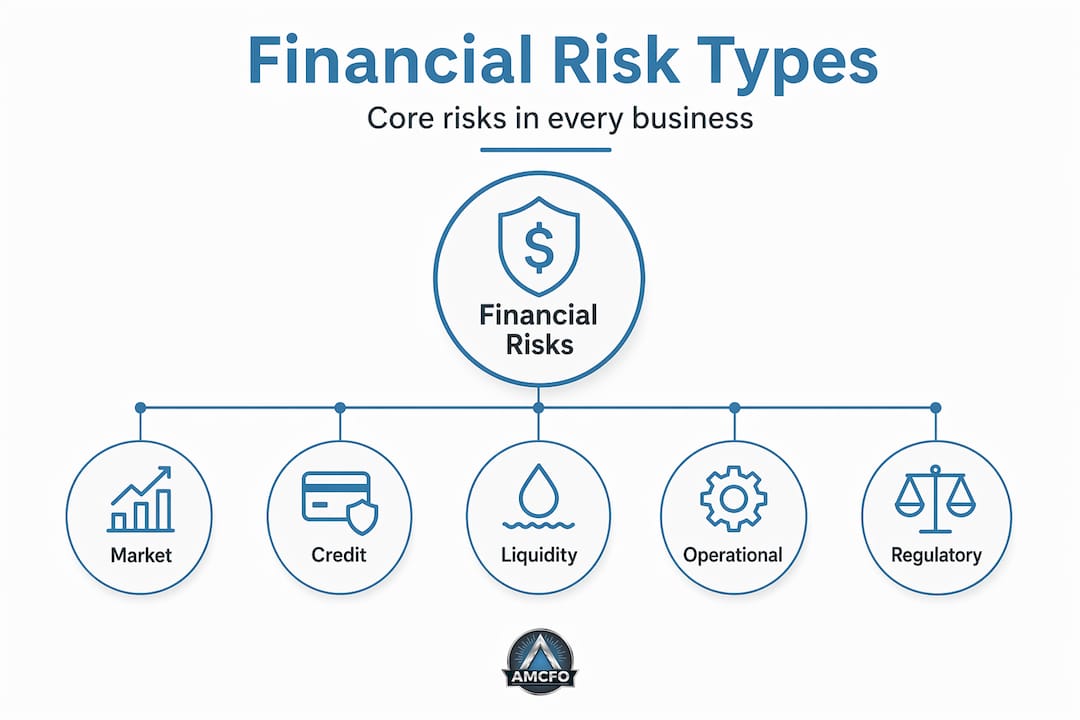
The five categories most organizations work with are:
- Market risk: Exposure to changes in interest rates, equity prices, foreign currency exchange rates, and commodity prices. A manufacturer importing materials priced in euros faces currency risk every time the dollar weakens.
- Credit risk: The possibility that a customer, borrower, or counterparty will default or fail to pay. This affects not just lenders but any business extending payment terms.
- Liquidity risk: The risk of being unable to meet financial obligations when they come due. Even profitable companies can collapse if cash is tied up in slow-moving receivables.
- Operational risk: Losses from failed processes, systems, or external events, including fraud, technology failures, and supply chain disruptions.
- Legal and regulatory risk: Exposure to fines, litigation, or operational restrictions resulting from non-compliance with laws and regulations in your industry.
The table below compares these five types by their primary source and most common mitigation approach:
| Risk type | Primary source | Common mitigation |
|---|---|---|
| Market risk | Price and rate volatility | Hedging, diversification |
| Credit risk | Counterparty default | Credit limits, due diligence |
| Liquidity risk | Cash flow timing gaps | Cash reserves, credit facilities |
| Operational risk | Internal failures, external events | Controls, insurance, redundancy |
| Legal/regulatory risk | Compliance gaps, litigation | Legal review, compliance programs |
No single risk type operates in isolation. A credit default can trigger a liquidity problem. An operational failure can expose you to regulatory risk. The real skill in understanding financial risks is seeing how they compound.

Frameworks that structure risk programs
Two frameworks dominate how organizations structure their approach: ISO 31000 and COSO ERM. Both are valuable. They solve slightly different problems.
ISO 31000 provides a structured process covering identification, analysis, evaluation, and treatment of risks, with strong emphasis on embedding that process throughout all organizational levels. It is principles-based, meaning it can be adapted to almost any industry or company size. The value of ISO 31000 is its universality. It gives you a common language and process without being prescriptive about what tools to use.
COSO ERM organizes risk management into five components: governance and culture, strategy and objective-setting, performance, review and revision, and information and communication. The 2017 update placed particular emphasis on connecting risk management directly to strategy execution. Unlike ISO 31000, COSO is more explicit about integrating risk appetite into executive decision-making. It treats risk management as iterative and integral to strategy, not a one-time compliance exercise.
| Framework | Best for | Key strength |
|---|---|---|
| ISO 31000 | Organizations of any size or sector | Flexible, principles-based process |
| COSO ERM | Larger organizations with governance structures | Strategy alignment and performance monitoring |
| Basel III | Banks and regulated financial institutions | Capital and liquidity ratio requirements |
For regulated financial institutions, Basel III adds another layer. It requires banks to maintain specific capital and liquidity metrics, including the Liquidity Coverage Ratio and Net Stable Funding Ratio, as direct measures of financial risk management effectiveness. The key lesson from Basel III applies beyond banking: capital strength alone is insufficient when liquidity controls are weak.
Pro Tip: You do not have to choose between ISO 31000 and COSO. Many mature programs use ISO 31000 as the process spine and COSO ERM for strategic integration. They are complementary, not competing.
Practical techniques for managing financial risk
Knowing the risk categories and frameworks is the map. These techniques are how you actually navigate.
-
Run scenario analysis and stress tests. Model specific adverse conditions: a 20% revenue drop, a key customer defaulting, a rate spike. Quantify what each scenario does to your cash flow and capital position. This converts theoretical risk into concrete numbers your leadership team can act on.
-
Use hedging where exposure is measurable. Hedging, diversification, insurance, and risk limits are the standard toolkit for reducing the adverse effects of financial risks. A business with significant foreign revenue can use currency forwards to lock in exchange rates. The cost of the hedge is the price of predictability.
-
Set formal risk limits. Define the maximum acceptable exposure for each risk category before a decision is made, not after a loss has occurred. Risk limits give your team decision-making authority within a defined boundary, which speeds up operations without removing oversight.
-
Monitor capital and liquidity metrics continuously. For businesses with access to credit facilities or investor reporting obligations, tracking metrics like debt service coverage ratios and operating cash flow gives early warning before a liquidity problem becomes a crisis. Regulated institutions use model-to-metrics pipelines that link risk identification to governance decisions through quantitative internal metrics.
-
Translate risk into business impact. This is where most programs fail. Risk professionals who can frame impacts in cash flow and capital terms get board-level attention and funding. Those who report in technical jargon get ignored. Every risk report should answer: what does this mean for our cash position, earnings, or balance sheet?
One persistent challenge is siloed data. When finance, operations, and legal each manage risk in separate systems with separate definitions, you cannot see how risks interact. Siloed risk definitions across departments undermine enterprise-level risk management and create blind spots. Addressing that silo problem is often the single highest-value step a business can take. You can read more about connecting risk to financial modeling in this piece on smarter business decisions.
Embedding risk management into business strategy
Risk management that lives only in a compliance document does not protect your business. The organizations that get the most value from it treat it as a living, embedded function.
The key practices that separate mature risk programs from checkbox exercises include:
- Governance integration: Board-level risk oversight with clear accountability at the executive layer. Your CFO or a fractional CFO should be able to summarize your risk exposure in one page.
- Continuous review cycles: Risk environments change. Quarterly reviews of your risk register, combined with annual deep-dives tied to strategic planning, keep the program relevant.
- Risk-informed growth decisions: Before entering a new market, launching a product, or acquiring a business, run a formal risk assessment. The output should inform the decision, not just document it afterward.
- Transparent communication: Translating risk metrics into board-ready language means describing timing and financial impact, not statistical probability distributions. A board needs to know: "If this risk materializes, we face a $2M cash shortfall in Q3," not "our VaR at the 95th percentile is elevated."
"The value of financial risk management goes beyond loss avoidance to creating defensible strategies that safeguard business performance amid uncertainty." — Thomson Reuters Legal Solutions
When risk management connects directly to your strategic planning cycle, it stops being a cost center and starts generating real value. Better decisions, fewer expensive surprises, and a clearer picture of where your capital is actually working.
My take on where most businesses go wrong
I've seen financial risk management treated as a once-a-year audit prep exercise more times than I can count. Leaders approve a risk policy, file it somewhere, and move on. Then a customer concentrates into 40% of revenue, a key vendor fails, or a rate move squeezes margins, and suddenly the risk function that was supposed to protect the business was never actually running.
In my experience, the biggest gap is not knowledge of frameworks. Most leaders have heard of COSO and ISO 31000. The gap is translation. Risk outputs that stay in technical formats never reach the people with authority to act on them. What I've learned from working with business owners and decision-makers is that the moment you connect a risk to a specific dollar impact on cash flow or earnings, the conversation completely changes. Executives engage. Boards ask follow-up questions. Budgets get approved.
My other hard-won lesson: do not try to build a perfect, enterprise-wide risk program from day one. Start with your top three financial exposures. Build the habit of reviewing them regularly, reporting on them clearly, and making documented decisions. The iteration matters more than the initial framework you choose. Complexity can come later. Discipline has to come first.
— Angelica
How Amcfo helps you manage financial risk
Managing financial risk without the right financial expertise in your corner is genuinely hard. Most growing businesses do not have a full-time CFO, but they face the same financial exposures that require CFO-level thinking.

Amcfo's fractional CFO services give your business access to senior financial leadership without the full-time overhead. From building a risk register tied to your cash flow model, to stress-testing your budget against adverse scenarios, to presenting clean risk summaries to your board or investors, Amcfo handles the work that protects your business. For a deeper look at how financial risk connects to everyday business decisions, explore Amcfo's financial management and planning services, or read our detailed breakdown on risk management for business owners.
FAQ
What is financial risk management in simple terms?
Financial risk management is the process of identifying, analyzing, and controlling the financial threats that could harm your organization's cash flow, earnings, or balance sheet. The goal is to make informed decisions about which risks to absorb, transfer, or reduce.
What are the main types of financial risks?
The five primary types are market risk, credit risk, liquidity risk, operational risk, and legal or regulatory risk. Each has distinct causes and requires specific mitigation strategies tailored to your business model and industry.
What is the difference between ISO 31000 and COSO ERM?
ISO 31000 is a flexible, principles-based framework adaptable to any organization, while COSO ERM is more structured around governance, strategy alignment, and performance monitoring. Many organizations use both together for a more complete program.
How do you manage financial risk in a small or mid-sized business?
Start by identifying your top three financial exposures, quantify their potential cash flow impact, and set limits or controls for each. Regular review cycles and clear reporting to leadership matter more than the sophistication of your initial framework.
Why does financial risk management matter beyond compliance?
Because it directly affects decision quality. Organizations that translate risk into business impact terms make faster, more defensible decisions about funding, hiring, and growth, and they avoid the expensive surprises that derail otherwise sound strategies.