

A workers' compensation payroll audit is an insurer's review that reconciles your estimated premium to actual payroll, then adjusts what you owe. The single best immediate action is to appoint one point person and pull your payroll register and Form 941s for the policy period. The outcome cuts both ways: you could owe additional premium or get a refund, depending on how close your estimate was to reality.
TL;DR:
- Payroll classification errors, such as lumping employees into one code or misclassifying split-duty workers, can significantly inflate premiums during an audit.
- Inaccurate or missing subcontractor certificates of insurance allow auditors to include subcontractor payments in your payroll, increasing your premium exposure.
- Keeping detailed, up-to-date records, including time logs and supporting documentation, is crucial to easily dispute incorrect audit findings or adjustments.
- Regular reconciliation of payroll records against IRS filings and internal books minimizes discrepancies that trigger additional scrutiny or premium increases.
- Using online portals or working with a bookkeeping service like Amcfo ensures your payroll data remains audit-ready, reducing surprises and supporting accurate classification.
Table of Contents
- What a Workers Comp Payroll Audit Actually Reviews
- Audit Formats: Mail, Phone, Onsite, and Online
- How Auditors Examine Your Payroll Records
- Your Workers Comp Audit Checklist
- Common Payroll Errors That Inflate Your Premium
- How to Dispute a Workers Comp Audit Finding
- How Amcfo Helps Clients Avoid Surprise Audit Bills
- Audits Reward Preparation, Not Panic
- Let Amcfo Handle the Payroll Side Before the Auditor Calls
- Where to Verify Audit Requirements Directly
- Sources
- FAQ
What a Workers Comp Payroll Audit Actually Reviews
Every workers' compensation policy starts as a guess. Your carrier quotes a premium based on estimated payroll, then checks that estimate against what you actually paid employees once the policy term ends. That reconciliation is the entire point of the audit.
The math behind your premium comes down to three inputs: actual payroll by classification code, the rate assigned to each class code, and any experience modifier applied to your account. Multiply payroll by the class rate, apply the modifier, and you get the adjusted premium. Get the payroll numbers wrong, or misclassify employees into the wrong code, and the math shifts in the insurer's favor.
Most carriers run this process annually, and outreach typically starts fast. Insurers commonly contact policyholders within 30 to 60 days after the policy term ends to schedule the review. A few things drive what happens next:
- Your payroll size and industry risk class
- Whether you've had prior audit discrepancies
- How complex your workforce is (multiple states, mixed job duties, subcontractors)
Audit Formats: Mail, Phone, Onsite, and Online
How your audit gets conducted depends on your policy size, claims history, and carrier preference. Each format has its own rhythm and its own risks if you're unprepared.
- Mail audits ask you to fill out a payroll summary form and return it with supporting documents. These are common for smaller accounts, but they're also easy to rush through and get wrong.
- Phone audits put an auditor on the line walking through your numbers in real time. You'll want your records open before you pick up.
- Onsite audits send a live auditor to your office to review original records, ask about job duties, and sometimes tour your facility. These happen more often for larger payrolls or complex operations.
- Online/portal audits let you upload documents through a secure system, which is increasingly the default for mid-size accounts.
Whatever the format, verify the auditor's identity against your carrier's contact information before sharing anything, and confirm your submission deadline in writing. The typical flow runs the same regardless of method: initial notice, document request, reconciliation, a draft finding, then a final premium statement.
How Auditors Examine Your Payroll Records
Auditors work through your numbers in a fairly predictable sequence, and knowing that sequence helps you anticipate their questions instead of scrambling to answer them.
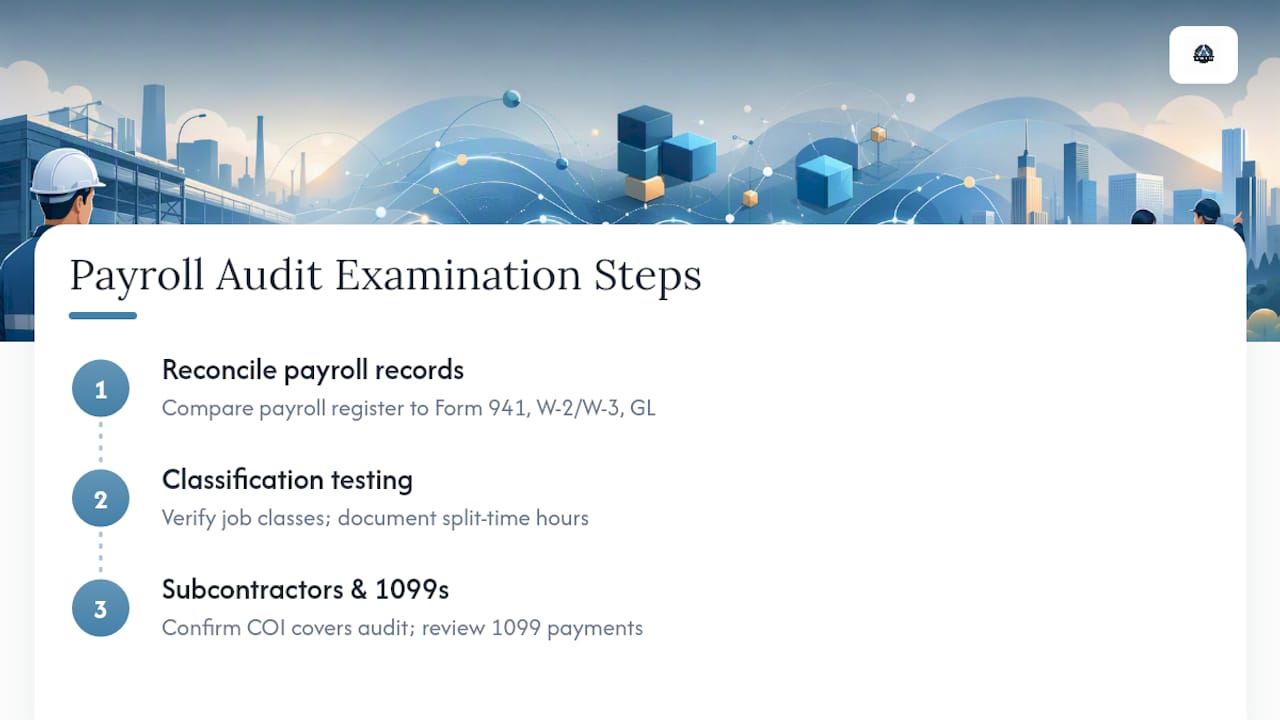
They start by reconciling your internal payroll register against your quarterly Form 941 filings, your W-2 and W-3 totals, and your general ledger payroll entries. Any gap between what you reported to the IRS and what you told the insurer at policy inception gets flagged immediately.
From there, they move to classification testing. This means checking whether employees are coded to the class that matches their actual duties, not just their job title. Someone who splits time between office work and warehouse labor needs documentation showing the split, because auditors default undocumented split-time payroll to the highest-risk classification that applies to any part of the job.
Finally, they test subcontractor and 1099 payments. If a contractor's certificate of insurance doesn't cover the audit period, the auditor can pull those gross payments into your payroll exposure.
Pro Tip: Keep a simple time-allocation log for any employee who works more than one job classification. A one-page spreadsheet showing hours by task beats trying to reconstruct the split from memory during the audit.
Your Workers Comp Audit Checklist
Auditors reconcile payroll registers against federal filings and internal records, and mismatches between those documents invite closer scrutiny and possible premium adjustments. Having the right paperwork organized before the auditor calls is the difference between a routine review and a drawn-out dispute.
Start with the core financial documents:
- Payroll register broken out by pay date, for the full policy period
- All quarterly Form 941 filings for that period
- W-2 and W-3 forms
- 1099 forms for any independent contractors paid during the period
Then layer in the supporting records that explain the numbers:
- Written job descriptions for every role, especially split-duty positions
- Timecards showing overtime hours separated from regular hours
- Owner or officer exclusion election forms, if applicable in your state
- General ledger tie-outs matching payroll expense to your books
Finally, gather your subcontractor documentation: valid certificates of insurance (COIs) covering the exact audit dates, signed contracts, invoices, and any records showing which states the work was performed in. Construction and contracting firms face the highest audit scrutiny precisely because subcontractor payments and mixed job duties are hardest to document cleanly, and COI management tends to be the single highest-impact prevention step available to those businesses.
Common Payroll Errors That Inflate Your Premium
Most premium surprises trace back to a handful of recurring mistakes, and nearly all of them are avoidable with better recordkeeping habits.
- Lumping everyone into one class code. Office staff coded under a trade classification because "that's how it's always been done" inflates payroll exposure unnecessarily.
- Not separating overtime. Overtime premium pay (the extra portion above straight time) is often excludable from payroll calculations, but only if your records clearly break it out.
- Letting subcontractor COIs lapse. A subcontractor without a valid COI for the audit period turns their entire invoice into your payroll, which can swing your premium significantly.
- Skipping owner exclusion paperwork. Many states let owners or officers exclude themselves from coverage, but only with the correct election form on file.
- Disorganized records generally. When documentation is missing or inconsistent, auditors' default assumptions favor the insurer, not you.
How to Dispute a Workers Comp Audit Finding
Disagreeing with an audit result isn't unusual, and carriers expect a certain volume of pushback. The process rewards employers who move fast and stay organized.
- Request the audit worksheet. Ask your carrier for the itemized worksheet showing exactly how they calculated each classification and dollar figure. You cannot dispute what you can't see.
- Review every line against your own records. Compare the worksheet's payroll allocations, class codes, and subcontractor treatment against your payroll register, job descriptions, and COIs.
- Assemble targeted documentation. For each disputed line, attach the specific document that supports your position: a time log for a misclassified split-duty employee, a COI for a contractor the auditor treated as payroll.
- File within the window. Most carriers give you 30 to 60 days to formally dispute a finding. Miss that window and the audit result typically stands.
Resolutions usually land in one of three places: the carrier corrects the error and adjusts your bill, they partially agree and split the difference, or they uphold the original finding and you pay the additional premium.
How Amcfo Helps Clients Avoid Surprise Audit Bills
Audit surprises almost always trace back to messy books, not bad luck. Amcfo builds monthly reconciliation into ongoing bookkeeping work specifically so payroll numbers match your filings before an auditor ever asks.
That means matching payroll registers against Form 941 filings every quarter, not just at year-end.
Practical steps Amcfo brings to audit preparation include:
- Tracking subcontractor COI expiration dates so none lapse mid-project
- Mapping job duties to the correct classification codes before payroll runs, not after
- Reconciling payroll journal entries to the general ledger monthly
When your payroll situation involves multiple states, mixed job duties, or a growing subcontractor base, that's usually the point to bring in fractional CFO support or a bookkeeping cleanup rather than waiting for the audit notice to force the issue.
Audits Reward Preparation, Not Panic
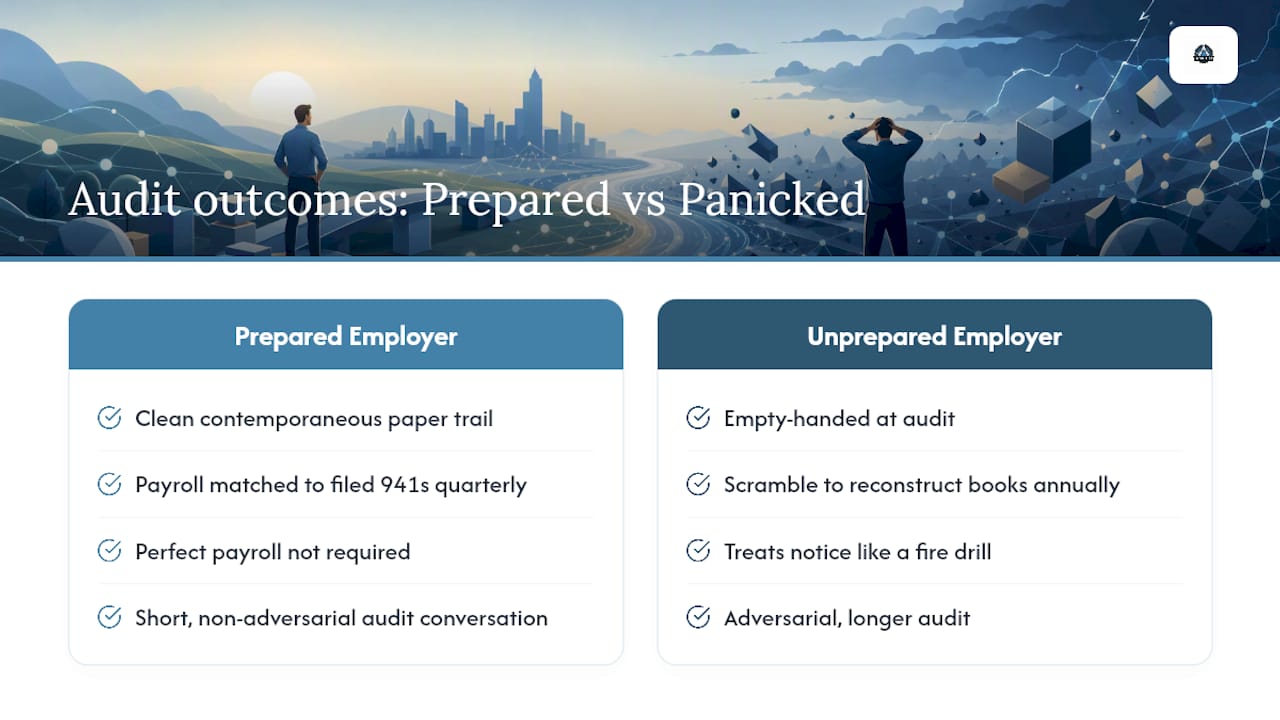
Most business owners treat the audit notice like a fire drill. It shouldn't be. An audit is just a reconciliation exercise, and reconciliation is something your books should already be doing every month, not something you scramble to reconstruct once a year.
The employers who come out ahead aren't the ones with perfect payroll. They're the ones who kept a clean, contemporaneous paper trail as they went, because good habits like matching payroll to filed 941s quarterly make the audit conversation short instead of adversarial. Estimated audits and surcharges almost always hit the businesses that showed up empty-handed, not the ones that made an honest mistake.
— Angelica
Let Amcfo Handle the Payroll Side Before the Auditor Calls
If your payroll records live in three different spreadsheets and your 941s never quite matched your general ledger, an audit notice turns into a scramble instead of a formality. This service is an alternative to hiring a full-time controller when you need clean books, correct classifications, and audit-ready payroll without adding headcount.

Amcfo's bookkeeping and payroll cleanup services handle the monthly reconciliation work that keeps your payroll register matched to your filings year-round, so an audit notice doesn't require weeks of reconstruction. For businesses with multiple job classifications, subcontractor exposure, or multistate payroll, Amcfo's fractional CFO services can map job duties to the right class codes and build the reconciliation habits that prevent estimated audits in the first place. If your records need a deeper look before the next audit cycle, Amcfo's forensic accounting review can trace discrepancies back to their source. Reach out for a no-obligation review of where your payroll records stand today.
Where to Verify Audit Requirements Directly
- IRS Form 941 instructions for reconciling quarterly payroll tax filings
- The Hartford's workers' compensation audit guide for carrier-side audit procedures
- Florida Statutes § 440.381 as an example of state-specific audit rules
- SBA quality-of-earnings documentation standards for what auditors consider reliable records
Sources
- Workers’ Compensation Audit | The Hartford
- Workers Comp Payroll Audit Checklist | Aegivra
- About Form 941 | IRS
- Workers' Comp Audit Guide: How to Prepare, What to Expect & How to Avoid Overpaying | BlueWave HR
FAQ
What Is a Workers' Comp Payroll Audit?
It's an insurer's year-end review comparing your estimated payroll (used to set your premium) against your actual payroll, with the premium adjusted up or down based on the difference.
Do Workers' Comp Audits Happen Every Year?
Most policies are audited annually, with carriers typically reaching out 30 to 60 days after the policy term ends to begin the process.
What Are the Audit Procedures for Payroll?
Auditors reconcile your payroll register against Form 941 filings, W-2/W-3 forms, and general ledger entries, then test employee classifications and subcontractor payments for accuracy.
What Happens if I Can't Provide a Subcontractor's Certificate of Insurance?
If a subcontractor's COI doesn't cover the audit period, the auditor can add that contractor's gross payments to your payroll exposure, often raising your premium.
Can I Get Help Preparing for a Payroll Audit?
Yes. Amcfo works with business owners on payroll reconciliation, classification mapping, and recordkeeping so audit season doesn't turn into a scramble for missing documents.