

Winery accounting is the practice of tracking, managing, and analyzing the financial aspects of wine production and vineyard operations to support profitability and growth. Unlike general business accounting, it requires managing multi-year production cycles, bulk wine inventory, grape purchase contracts, and tax incentives specific to the wine industry. Tools like QuickBooks, Xero, and specialized platforms such as InnoVint give winery owners the data they need to make confident decisions. This guide covers the financial records, cost tracking methods, software options, and tax strategies that matter most for running a financially sound winery.
What financial records and reports are essential for winery accounting?
The income statement is the most critical financial document a winery produces. Also called the profit and loss statement, it shows winery revenue, expenses, and profit over a given period. For wineries, this means breaking out revenue by sales channel, separating tasting room sales from wholesale, and detailing cost of goods sold by wine type or vintage.
The balance sheet tells you what your winery owns, owes, and is worth at a specific point in time. Vineyard land, equipment, aging inventory, and barrel stock all appear as assets. Grape purchase contracts and equipment loans show up as liabilities. A winery's balance sheet looks different from a typical manufacturer's because aging wine in barrels is a long-term asset that changes value over time.
The cash flow statement answers a question the income statement cannot: do you actually have money available right now? Wineries often show strong paper profits while running tight on cash because revenue from a vintage may not arrive for 18 months after harvest. Tracking cash flow monthly prevents the surprise of a profitable winery that cannot pay its vendors.
Beyond the standard three statements, wineries need specialized records that general businesses do not.
- Batch costing records: Track all costs tied to a specific production lot from harvest through bottling.
- Inventory ledgers: Maintain separate accounts for bulk wine, case goods, and raw materials like barrels and corks.
- Grape purchase and lease contracts: Document terms, payment schedules, and delivery obligations.
- Excise tax records: Federal and state excise taxes apply to wine production and require precise volume tracking.
| Standard financial report | Winery-specific adjustment |
|---|---|
| Income statement | Separate revenue by tasting room, wholesale, and DTC channels |
| Balance sheet | Include aging inventory and vineyard land as long-term assets |
| Cash flow statement | Account for 12–24 month lag between production costs and revenue |
| Inventory report | Track bulk wine and case goods separately with batch identifiers |
| Cost report | Allocate costs by vintage, varietal, and production stage |
How does cost accounting work in wine production?
Cost accounting in wineries requires tracking bulk wine and case goods separately because each has a different production cycle and cost structure. Bulk wine accumulates costs from harvest through fermentation and aging. Case goods add bottling, labeling, and packaging costs on top of the bulk wine cost. Mixing these two cost pools together produces inaccurate pricing and misleading profitability data.

The core cost categories in wine production are raw materials, direct labor, overhead, and aging and storage costs. Raw materials include grapes, yeast, barrels, and packaging. Direct labor covers harvest crews, cellar workers, and bottling line staff. Overhead includes utilities, equipment depreciation, and facility costs allocated across production batches. Aging and storage costs are unique to wine and can span multiple fiscal years, which complicates standard accounting methods.
Here is how cost tracking flows from harvest to sale:
- Record harvest costs. Capture all grape costs, whether purchased or estate-grown, along with harvest labor and equipment use.
- Track fermentation and cellar costs. Log yeast, additives, barrel purchases or rentals, and cellar labor by batch.
- Allocate overhead. Assign facility and equipment costs to each production batch based on volume or time in production.
- Capture aging costs. Record ongoing storage, barrel depreciation, and any blending or racking labor for each vintage.
- Add packaging costs. When wine moves to bottling, add bottle, cork, label, capsule, and bottling line costs to the batch total.
- Calculate cost per case. Divide total batch costs by the number of cases produced to get your true cost per case.
- Compare cost to selling price. This final step reveals your actual margin by channel and product.
Pro Tip: Document the date, volume, and all associated costs for every production batch at the time they occur. Reconstructing batch costs months later from memory or partial records is one of the most common and costly mistakes in vineyard bookkeeping.
Accurate cost accounting directly affects your pricing decisions. If your cost per case of Pinot Noir is $28 but you are selling it to a distributor at $36, your margin is thinner than it looks once you factor in sales commissions and shipping. Knowing your true cost by varietal and vintage lets you price confidently and cut underperforming products.
What is the best accounting software for wineries?
The best accounting software for wineries combines general ledger capabilities with inventory tracking, production batch management, and sales channel reporting. QuickBooks remains the most widely used platform for small and mid-sized wineries because of its broad integration ecosystem and accountant familiarity. Xero offers a strong cloud-based alternative with multi-currency support, which matters for wineries that export. Cloud-based solutions with custom integrations improve accuracy and reduce manual data entry across financial processes.
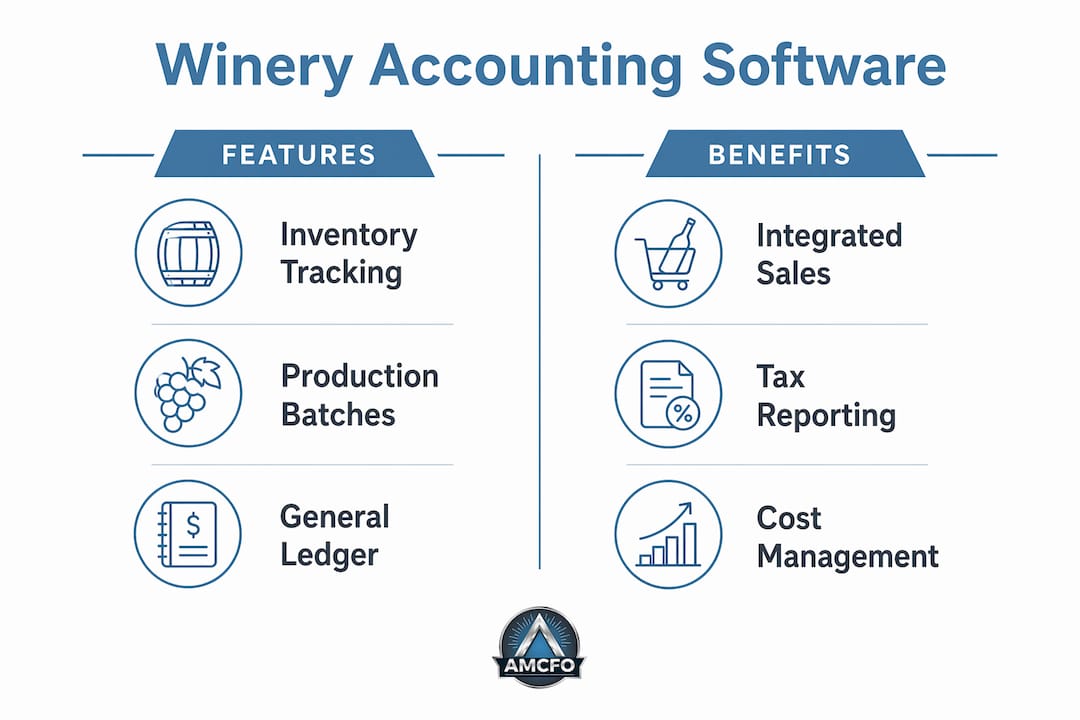
Specialized wine industry platforms like InnoVint focus on production management and connect winery operations data directly to financial records. This kind of integration eliminates the manual step of transferring batch costs from a winemaking log into your accounting system. The fewer manual transfers, the fewer errors.
Essential bookkeeping practices for wineries include:
- Daily transaction recording: Post sales, vendor payments, and payroll entries the same day they occur.
- Separate bank accounts: Keep tasting room, wholesale, and wine club revenue in separate accounts for clean reporting.
- Monthly reconciliation: Match every bank and credit card statement to your accounting records before the month closes.
- Vendor management: Track grape grower invoices, barrel supplier terms, and distributor payment schedules in one system.
- Excise tax tracking: Record production volumes and calculate federal and state excise tax obligations monthly, not quarterly.
Pro Tip: Connect your point-of-sale system directly to your accounting software. Tasting room sales, wine club shipments, and online orders should post automatically to your general ledger. Manual entry of daily sales is a time drain and a common source of reconciliation errors.
How can wineries use accounting for strategic tax planning?
Winery financial reporting is evolving beyond compliance into a planning tool that informs tax strategy, R&D eligibility, and capital investment decisions. Most wineries complete their month-end close on time and file accurate returns, but compliance-focused reporting stops there. It does not answer questions like: should we buy the new bottling line this year or next? Does our R&D spending on new varietals qualify for a federal credit?
The One Big Beautiful Bill Act (OBBBA) introduced tax changes that affect wineries directly. OBBBA tax changes create new opportunities around R&D credits, depreciation schedules, and energy incentives. Wineries that do not align their financial reporting with these provisions will miss deductions they have already earned.
| Compliance reporting | Strategic reporting |
|---|---|
| Meets filing deadlines | Informs timing of capital purchases |
| Satisfies audit requirements | Identifies R&D credit eligibility |
| Records historical transactions | Projects cash flow for next vintage |
| Tracks basic revenue and expenses | Evaluates return on new equipment |
| Confirms tax liability | Reduces tax liability through planning |
Strategic financial management for wineries means using your financial data to answer forward-looking questions. For example, if your cost accounting shows that your estate Chardonnay carries a 42% gross margin while your Rosé runs at 28%, you have a data-driven reason to shift production capacity. That kind of decision requires accurate, timely financial data, not just year-end tax returns.
Common pitfalls include misaligned depreciation schedules on vineyard equipment, missed energy credits on solar installations, and failing to document winemaking experiments as R&D activities. Each of these errors is preventable with the right accounting setup.
What are the benefits of outsourcing winery accounting?
Outsourcing winery accounting frees owners to focus on production and sales while specialists handle the financial complexity. BPM's Wine Industry Group is one example of a firm that provides outsourced accounting with deep roots in the wine community, offering tax, assurance, and consulting services tailored to wineries. The key advantage is not just cost savings. It is access to specialists who already understand batch costing, excise tax, and grape contract accounting.
Contract database management is a specific service outsourced accounting groups provide that many winery owners underestimate. Lease agreements, grape purchase contracts, and custom crush arrangements all carry financial obligations that need to be tracked and reported accurately. Missing a contract renewal or misrecording a payment can create both tax and legal problems.
When evaluating an outsourced accounting provider for your winery, check for these qualifications:
- Direct experience with wine production accounting and excise tax compliance
- Familiarity with vineyard bookkeeping, including crop year accounting and capitalization rules
- Knowledge of federal and state tax incentives specific to agriculture and wine production
- Use of cloud-based tools that integrate with your existing winery management software
- References from other winery or vineyard clients at a similar scale to your operation
The cost savings from outsourcing come from avoiding full-time accounting staff salaries, benefits, and training costs. The risk reduction comes from having specialists who stay current on tax law changes, including provisions like the OBBBA, without you having to track those changes yourself.
Key Takeaways
Winery accounting requires specialized cost tracking, strategic financial reporting, and tax planning that goes well beyond standard business bookkeeping.
| Point | Details |
|---|---|
| Separate cost pools | Track bulk wine and case goods separately to get accurate cost per case. |
| Strategic reporting matters | Use financial data to plan capital purchases and identify tax credits, not just file returns. |
| Software integration saves time | Connect POS and winery management systems to your accounting platform to reduce manual entry. |
| Outsourcing adds expertise | Specialized providers handle excise tax, contract management, and tax incentives you might miss. |
| OBBBA creates new opportunities | Align financial reporting with current tax law to capture R&D, depreciation, and energy credits. |
What I have learned from working with winery finances
The wineries that struggle most financially are not the ones with bad products. They are the ones treating accounting as a compliance task rather than a management tool. I have seen profitable wineries run out of cash in october because nobody modeled the gap between harvest costs and holiday sales revenue. That is a cash flow planning failure, not a winemaking failure.
The shift from compliance accounting to strategic financial management is the single biggest upgrade a winery can make. It does not require a larger team. It requires better data and someone who knows how to read it. When you know your true cost per case by varietal, your margin by sales channel, and your cash position three months out, you make completely different decisions about pricing, production volume, and capital spending.
Technology adoption accelerates this shift. Wineries that connect their production software to their accounting platform get real-time cost data instead of month-old estimates. That timeliness changes what questions you can ask and answer. The wineries I see growing confidently are the ones using their numbers to plan, not just to report.
The uncomfortable truth is that most winery owners are excellent at making wine and underinvested in understanding their financials. That gap is fixable. The tools exist, the expertise is available, and the payoff in better decisions is real.
— Angelica
Winery accounting support from Amcfo
Running a winery means managing production costs, multi-year inventory, excise taxes, and capital investments all at once. Amcfo provides accounting and bookkeeping services built for exactly this kind of complexity, from QuickBooks setup and monthly reconciliation to full fractional CFO support.

Amcfo's team works with winery owners to build financial reporting that goes beyond compliance, covering tax strategy alignment, cash flow forecasting, and production cost analysis. Whether you need ongoing bookkeeping, a one-time financial cleanup, or a fractional CFO package to guide investment decisions, Amcfo has the winery-specific expertise to support your operation. Contact Amcfo to schedule a consultation.
FAQ
What is winery accounting?
Winery accounting is a specialized branch of accounting focused on tracking wine production costs, vineyard operations, inventory, excise taxes, and financial reporting specific to the wine industry.
How does cost accounting differ in a winery?
Wineries must track bulk wine and case goods as separate cost pools because each has a different production cycle, cost structure, and pricing implication.
What accounting software do wineries use?
QuickBooks and Xero are the most common platforms, often integrated with wine-specific tools like InnoVint for production batch tracking and cost allocation.
Why does strategic financial reporting matter for wineries?
Compliance reporting meets filing requirements, but strategic reporting uses financial data to identify tax credits, plan capital purchases, and evaluate production profitability by varietal and channel.
When should a winery outsource its accounting?
A winery should outsource accounting when the owner lacks time for financial management, when excise tax or contract complexity increases, or when tax planning requires specialist knowledge of wine industry incentives.