

Why businesses need financial reports: the core case
Financial reports are not optional paperwork. They are the clearest window into whether a business is actually healthy, growing, or quietly bleeding cash. Every owner, manager, and stakeholder who wants to make a confident decision needs them.
The three documents at the center of any reporting system are the balance sheet, income statement, and cash flow statement. Together, they answer three questions no business can afford to ignore: What do we own and owe? Are we profitable? Can we pay our bills?
Here is what financial reports deliver across the business:
- Decision support: Reports give managers real numbers to back hiring, spending, and growth calls, not gut feelings.
- Compliance: Public companies must meet SEC disclosure rules; private firms answer to lenders, the IRS, and state regulators.
- Transparency: Stakeholders, from investors to board members, use reports to hold leadership accountable.
- Capital access: Lenders and investors require audited or reviewed statements before committing funds.
- Performance tracking: Reports let you measure KPIs, spot cost overruns, and catch problems before they compound.
The businesses that treat reporting as a strategic tool, rather than a filing obligation, consistently make faster and better decisions.
Table of Contents
- What financial reporting actually is and why it exists
- The three financial statements every business relies on
- Why financial reporting matters: the real benefits
- How managers use financial reports to run better businesses
- Modern perspectives: financial reporting as a strategic tool
- What happens when financial reporting goes wrong
- Amcfo gives you financial reports you can actually act on
- Key Takeaways
What financial reporting actually is and why it exists
Financial reporting is the process of communicating a company's financial position and performance to people who need that information. It serves two distinct audiences, and confusing them leads to reports that serve neither well.
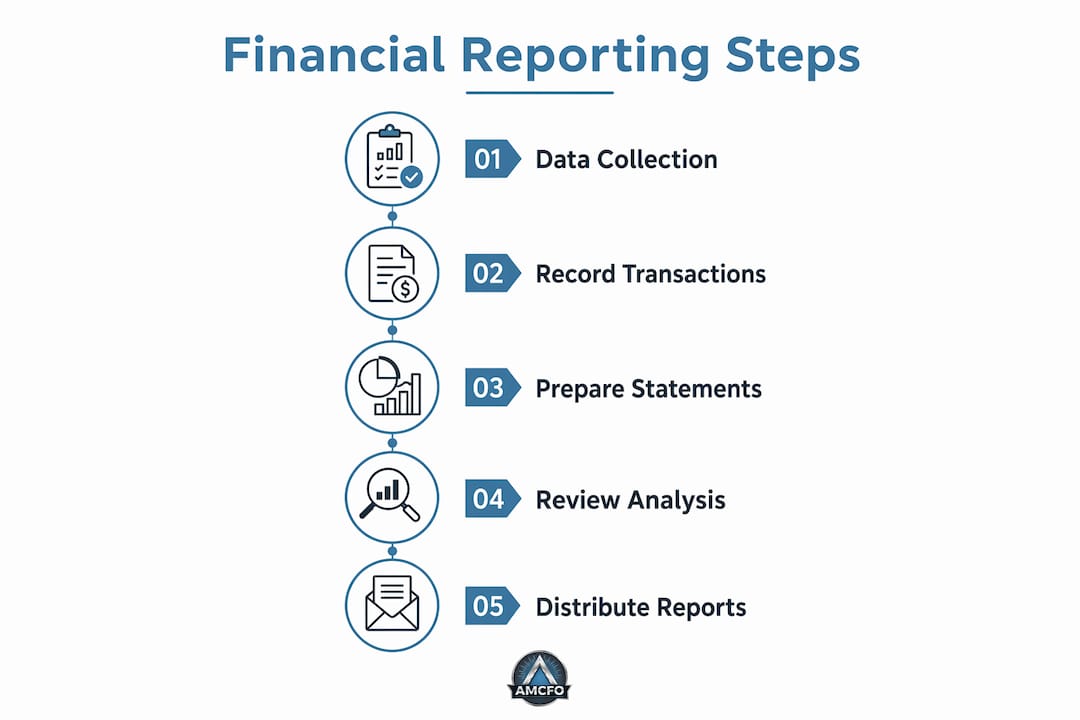
External reporting follows standardized rules. Public companies file with the SEC; all companies report income to the IRS; lenders require statements that conform to Generally Accepted Accounting Principles (GAAP). These reports are designed to be comparable across companies and periods, which is exactly why the standards are non-negotiable.
Internal reporting is different. It is customized for management, often more frequent than annual filings, and focused on the specific metrics a leadership team needs to run the business day to day. A weekly cash burn report, a monthly departmental P&L, a rolling 13-week cash forecast: none of these go to the SEC, but all of them drive real decisions.
The objectives overlap in one critical area: both forms of reporting exist to give decision-makers an accurate picture of financial performance. Without that accuracy, every plan built on top of it is suspect.
The three financial statements every business relies on
Understanding financial statements starts with knowing what each one actually measures and why that matters for your specific role.
The balance sheet is a snapshot of financial position at a single point in time. It lists assets (what the business owns), liabilities (what it owes), and equity (the residual value belonging to owners). A balance sheet taken at December 31 tells you nothing about how the year went, but it tells you exactly where the business stands at that moment.
The income statement (also called the Profit and Loss statement, or P&L) covers a period of time, typically a month, quarter, or year. It shows revenue, subtracts the cost of goods sold and operating expenses, and lands on net income. This is the statement most managers check first, because it answers the most basic question: did we make money?
The cash flow statement tracks actual cash moving in and out across three categories:
- Operating activities: cash generated from core business operations
- Investing activities: cash spent on or received from assets like equipment or acquisitions
- Financing activities: cash from loans, equity raises, or debt repayments
A business can show a profit on the income statement while running out of cash, and the cash flow statement is what reveals that gap. Discrepancies between cash flows and reported income can signal revenue recognition problems or, in serious cases, fraud. Analyzing all three statements together gives you the full picture that no single document can provide on its own.
Why financial reporting matters: the real benefits
The importance of financial reporting goes well beyond keeping regulators satisfied. Here is where it creates concrete value:
Strategic planning and budgeting. Reports give leadership a factual baseline for setting targets. Without historical data on revenue trends, expense patterns, and margin performance, a budget is just a wish list. Accurate statements let you build forecasts grounded in what the business has actually demonstrated it can do.
Regulatory compliance. Companies must comply with GAAP, SEC rules, and IRS requirements, and the penalties for getting this wrong range from fines to criminal liability. Consistent, well-documented reporting is the only reliable defense.
Investor and lender confidence. Financial reports support attracting capital by demonstrating creditworthiness and operational strength. A bank evaluating a loan application will scrutinize your statements. A venture investor will do the same. Clean, auditable records close deals that sloppy books kill.
Operational efficiency and risk management. Internal reports let managers track KPIs by department, catch cost overruns early, and identify segments that are dragging down overall profitability. A well-integrated reporting system also acts as an early warning system that flags discrepancies before they become crises.
Stakeholder trust. Comprehensive reporting enhances transparency and accountability, which builds the kind of long-term trust that keeps investors patient and partners loyal. Businesses that go dark on financials tend to find that trust evaporates fast when they need it most.
Poor reporting, by contrast, creates real damage: mispriced products, missed tax deadlines, failed audits, and investors who walk away because the numbers do not add up.
How managers use financial reports to run better businesses
Managers who actually read their financial statements make different decisions than those who rely on memory and instinct. The gap shows up in results.
Internal management uses financial reports to analyze profitability at multiple levels, manage cash flow, and assess how individual segments are performing. A regional manager comparing her division's gross margin to the company average can see immediately whether her team is carrying its weight or dragging on overall performance.

Budget management is another direct application. Because the financial environment shifts constantly, using last year's budget as a template without checking current statements is a common and costly mistake. The income statement and cash flow statement together show where spending has drifted from plan and where there is room to reallocate.
Cost control becomes much easier when expenses are visible line by line. Seeing a monthly subscription you forgot to cancel, or realizing that a particular vendor relationship costs twice what a comparable one does, is the kind of discovery that only happens when someone is actually reading the statements.
Financial statements also help managers motivate teams by connecting individual project results to revenue and profitability. When employees can see that their work moved the needle on a specific line item, the abstract goal of "growing the business" becomes something tangible. That connection tends to drive performance more reliably than any incentive program that floats free of real numbers.
Pro Tip: Use your income statement to set team goals, then show employees the specific line items their work affects. Connecting effort to a real financial outcome is one of the most effective ways to build a performance culture without adding overhead.
Cross-departmental alignment is the final, often underrated benefit. When every department head has reviewed the same financial statements, conversations about budget priorities start from shared facts rather than competing assumptions.
Modern perspectives: financial reporting as a strategic tool
The most forward-thinking businesses in 2026 no longer treat financial reporting as a backward-looking compliance exercise. They use it as a live management system.

Successful businesses use financial reports as live dashboards for weekly operational insights, monitoring leading indicators like days sales outstanding (DSO) to manage cash proactively rather than reactively. A rising DSO, for example, signals that customers are taking longer to pay, which will compress cash flow weeks before the bank account reflects it.
AI-powered financial analysis now enables predictive insights that go beyond historical data, helping businesses anticipate market shifts and manage risk before problems materialize. Scenario planning tools built on top of financial statements let leadership stress-test assumptions: what happens to cash if revenue drops 15%? What does the balance sheet look like if we add a line of credit?
Consistent application of GAAP across periods and business units is what makes these comparisons meaningful. Without that consistency, trend analysis becomes unreliable, and the insights you draw from it can be actively misleading.
Expert CFO services add a layer that most internal teams cannot replicate on their own. A fractional CFO brings the analytical framework to interpret what the numbers mean in context, not just what they say on the page. Amcfo's financial reporting guidance helps business owners move from reading reports to acting on them with confidence.
Businesses that integrate operations consulting with their financial reporting practices tend to close the gap between what the numbers reveal and what the organization actually does about it.
- Use weekly or bi-weekly cash flow reviews, not just monthly closes.
- Track DSO, inventory turnover, and gross margin by product line, not just total revenue.
- Apply consistent accounting policies so year-over-year comparisons are actually valid.
- Bring in expert analysis when internal capacity to interpret reports is limited.
What happens when financial reporting goes wrong
Poor financial reporting is not just an accounting problem. It has real operational and legal consequences that can end a business.
The most common internal failure is misclassifying expenses, which distorts the income statement and leads management to believe margins are healthier than they are. A company that thinks it is running a 30% gross margin when the real number is 18% will underprice products, overspend on growth, and run out of cash before leadership understands why.
Cash flow mismanagement is closely related. A business that reports strong net income but does not track actual cash timing can find itself unable to make payroll, even in a profitable month. This is exactly the scenario the cash flow statement exists to prevent, but only if someone is reading it.
On the external side, inaccurate or incomplete reporting creates serious legal exposure. The SEC has brought enforcement actions against public companies for misstatements that began as internal accounting shortcuts. For private companies, lenders who discover that reported financials do not match actual performance can accelerate loan repayment or call the debt entirely.
Fraud is the extreme case, but it is worth naming directly. Discrepancies between cash flows and reported income are one of the earliest detectable signs of revenue manipulation. Businesses that review their statements regularly, and compare them against each other, catch these problems early. Those that treat reporting as a once-a-year tax exercise often discover problems only after the damage is done.
The pattern across all these failures is the same: reporting was treated as a formality rather than a management tool. The role of financial statements in decisions is not passive. They only protect you if you actually use them.
Amcfo gives you financial reports you can actually act on
Most business owners know they need better financial reporting. The gap is usually not awareness; it is capacity. Building an internal finance function that produces accurate, timely, and useful reports takes people, systems, and expertise that most growing businesses do not have on staff.

Amcfo fills that gap without the cost of a full-time CFO. The fractional CFO services Amcfo provides go beyond bookkeeping: you get financial statements prepared to GAAP standards, cash flow analysis, budgeting and forecasting support, and a CFO-level perspective on what the numbers mean for your next decision. Whether you need QuickBooks cleanup, payroll support, or ongoing strategic guidance, the work is tailored to your business's actual situation, not a generic template.
The concrete payoff is confidence. When your balance sheet, income statement, and cash flow statement are accurate and current, you can walk into a lender meeting, a board conversation, or a pricing decision with real data behind you. Explore Amcfo's accounting and bookkeeping services or reach out directly to discuss what your business needs.
Key Takeaways
Accurate, consistent financial reporting is the single most reliable foundation for business decisions, compliance, and capital access in 2026.
| Point | Details |
|---|---|
| Three core statements | The balance sheet, income statement, and cash flow statement each answer a distinct question about financial health. |
| Compliance is non-negotiable | Businesses must meet GAAP, SEC, and IRS requirements; inaccurate reporting creates legal and financial exposure. |
| Capital depends on clean books | Lenders and investors evaluate financial statements before committing funds; poor records kill deals. |
| Reports are management tools | Managers use statements to control costs, track KPIs, align departments, and motivate teams with real data. |
| Amcfo bridges the capacity gap | Amcfo's fractional CFO and accounting services deliver GAAP-standard reports and CFO-level analysis for businesses without a full-time finance team. |