

Multi-entity bookkeeping is the practice of maintaining separate, complete financial records for each legal entity in a company structure, then consolidating those records into one group-level view with intercompany transactions eliminated. The outcome you're after is simple to state and hard to execute: clean, audit-ready books for every entity, plus a single consolidated report leadership can actually trust.
You need this the moment you're operating more than one legal entity that touches the same business, whether that's a holding company with subsidiaries, separate LLCs for each rental property, or a parent company after an acquisition. The trigger is rarely dramatic. It's usually one of these:
- Forming a second legal entity for liability protection or tax purposes
- Acquiring or merging with another company
- Setting up separate LLCs for individual properties, projects, or brands
- Expanding into a new state or country that requires local registration
Growth events like these are the most common reason companies adopt multi-entity accounting in the first place, and the coordination problems can show up with as few as two entities. If you're still tracking two companies in one QuickBooks file or reconciling intercompany loans on a spreadsheet, you're already feeling the strain this discipline is built to solve.
Key Takeaways
Multi-entity bookkeeping succeeds when standardized charts of accounts, automated intercompany reconciliation, and a shared close calendar replace manual, entity-by-entity spreadsheet work.
| Point | Details |
|---|---|
| Definition | Separate entity-level books plus consolidated reporting with intercompany eliminations. |
| Common trigger | A second legal entity, an acquisition, or separate LLCs for properties or projects. |
| Biggest failure point | Intercompany reconciliation mismatches and unmatched aging balances. |
| Core benefit | Faster close, consolidated visibility, and stronger audit readiness for leadership. |
| Implementation priority | Standardize the chart of accounts and automate intercompany matching before buying software. |
Table of Contents
- What Is Entity-Level Accounting? Key Concepts to Know
- How Does Multi-Entity Bookkeeping Work Month to Month?
- What Challenges Come With Managing Multiple Entities?
- What Are the Business Benefits of Multi-Entity Bookkeeping?
- How Do You Implement Multi-Entity Bookkeeping the Right Way?
- What Tools Support Multi-Entity Financial Reporting?
- How Does a Fractional CFO Help With Multi-Entity Books?
- The Operating-Model Shift Most Companies Miss
- Frequently Asked Questions
- Sources
What Is Entity-Level Accounting? Key Concepts to Know
Before you can manage multiple entities well, you need a shared vocabulary. Finance teams often use "entity," "subsidiary," and "division" loosely, but they mean different things, and the difference determines how you book transactions.
- Legal entity. A separately incorporated business with its own tax ID, bank accounts, and legal obligations. The IRS treats each business structure differently for tax purposes, which is exactly why entity-level books exist in the first place.
- Division or branch. An internal operating unit without separate legal or tax status. It might have its own budget or profit-and-loss statement, but it files taxes and holds assets under the parent entity.
- Subsidiary. A legal entity owned, partly or wholly, by a parent company. Ownership percentage determines which consolidation method applies, whether that's full consolidation, proportional combination, or the equity method under IFRS 10 principles.
- Chart of accounts (COA). The list of every account used to categorize transactions. When entities use inconsistent account structures, one calling it "software expense" and another "SaaS subscriptions," consolidation becomes a mapping exercise instead of a simple roll-up.
- Intercompany transactions. Any transfer of money, goods, or services between entities under common ownership. A parent company loaning cash to a subsidiary, or one LLC paying another for shared staff, both count.
- Consolidation and eliminations. Producing one set of financial statements for the whole group requires stripping out intercompany activity so revenue and expenses aren't counted twice. Multi-entity accounting means keeping separate books per entity while still producing consolidated statements that eliminate intercompany activity.
Entity-level reports and consolidated reports serve different audiences. The entity report tells you whether that specific LLC, subsidiary, or branch is profitable on its own. The consolidated report tells your board, lenders, or investors how the whole organization performs. You need both, and they should never be the same document.
How Does Multi-Entity Bookkeeping Work Month to Month?
Day-to-day bookkeeping in a multi-entity structure still looks a lot like single-entity bookkeeping at the transaction level. Someone codes an invoice, records a payroll run, reconciles a bank account. The complexity shows up at the seams, where entities interact with each other and where individual ledgers have to be pulled into one picture.
Here's the typical flow from a single journal entry to a finished consolidated statement:
- Each entity closes its own books first, recording all transactions against its own chart of accounts.
- Bookkeeping teams flag and record intercompany transactions separately, tagging them so they're identifiable at consolidation time.
- A mapping layer translates each entity's COA into a standardized group structure, since not every entity uses identical account names or numbering.
- Intercompany balances get matched between the two entities involved. If Entity A shows a $40,000 receivable from Entity B, Entity B needs a matching $40,000 payable.
- Eliminating entries remove intercompany revenue, expense, and balance-sheet activity so the group total isn't inflated by transactions the company had with itself.
- The consolidated statement is produced, currency-converted where needed, and reviewed against prior periods for anomalies.
Intercompany invoicing is where most of the manual pain lives. If Entity A bills Entity B for management fees or shared services, someone has to invoice it, record the payment, and confirm both sides agree on the amount and the period. Do this across five or six entities on a spreadsheet, and you're inviting mismatches that take days to untangle.
Timing matters as much as accuracy. If Entity A closes its books on the 3rd business day and Entity B doesn't close until the 10th, you can't consolidate cleanly. A shared close calendar, with hard cutoffs for every entity, keeps the whole group moving at the same pace. Companies operating internationally add another layer: currency conversion at the right exchange rate and on the right date, plus alignment of fiscal periods if one entity reports on a different year-end than the parent.
Pro Tip: When you're transitioning to a new consolidation process, run parallel closes for at least two cycles. Keep the old entity-level books untouched, but produce a second consolidated output using your new mapping and elimination rules. Comparing the two before you fully switch over catches errors while they're still cheap to fix.
What Challenges Come With Managing Multiple Entities?
The mechanics above sound orderly on paper. In practice, most companies I've seen struggle with the same handful of failure points, and they tend to compound rather than stay isolated.

Intercompany reconciliation is the most common breaking point. Balances that don't match between entities pile up as "aging" items nobody has time to investigate, and missing offsetting entries, unmatched currency conversions, or misaligned timing windows are the usual root causes of persistent reconciliation aging. Six months later, nobody remembers what the discrepancy was for.
Chart of accounts drift is the quieter problem. One entity adds a new expense category without telling anyone. Another books the same type of cost under a completely different account. Consolidation then requires manual remapping every single period, which is slow and error-prone.
- Manual spreadsheet consolidation that takes days instead of hours
- Delayed close cycles because one entity's books lag behind the others
- Tax filing complexity, since each entity may face different rates, deadlines, or jurisdictions
- Risk of commingling assets between entities, which can undermine the liability protection the separate structure was meant to provide
That last point deserves emphasis. Clear entity separation isn't just an accounting preference, it's a governance control that limits legal and tax exposure by keeping assets and liabilities from blurring across entities. When a court or auditor sees co-mingled funds, the separate legal protection you set the entity up for can start to look like a formality rather than a real boundary.
Companies relying on manual spreadsheet consolidation often watch their close timeline stretch by weeks as they add entities, since each additional entity adds mapping and reconciliation work that spreadsheets handle poorly at scale. Audit readiness suffers most directly here. When reviewers ask for supporting documentation on an intercompany balance and nobody can produce a clean trail, that's not a paperwork issue. It's a sign the underlying process was never built to hold up under scrutiny.
What Are the Business Benefits of Multi-Entity Bookkeeping?
Done well, multi-entity bookkeeping pays for itself fast, and not just in avoided headaches.
- Faster close. Standardized charts of accounts and automated consolidation cut out the manual reconciliation work that used to eat up days or weeks of a finance team's time each month.
- Consolidated visibility. Leadership and investors get one accurate view of group performance instead of stitching together five separate spreadsheets before a board meeting.
- Stronger audit posture. Clean entity-level records with a documented elimination trail mean fewer surprises and fewer follow-up requests during an audit.
- Better capital allocation. A centralized but flexible consolidation model lets you compare entity performance side by side while still respecting each entity's local reporting needs.
- Freed-up capacity for real analysis. When bookkeepers aren't buried in manual reconciliation, your finance function can actually forecast, model scenarios, and support decisions instead of just closing books.
That last point is the one growing companies underestimate most. The real prize isn't cleaner spreadsheets. It's a finance team that has time to tell you what the numbers mean instead of just producing them.
How Do You Implement Multi-Entity Bookkeeping the Right Way?
Getting this right is a sequencing problem more than a technology problem. Here's the order that tends to work.
- Identify your trigger point. If you're adding a second entity, closing an acquisition, or expanding into a new jurisdiction, that's your signal to formalize the process rather than patch it together informally.
- Standardize the chart of accounts wherever possible. Give every entity the same core account structure. Where local tax rules or industry norms require differences, document the exceptions explicitly instead of letting them accumulate unnoticed.
- Define intercompany accounting rules up front. Decide how intercompany loans, management fees, and shared expenses get invoiced, priced, and recorded, before the first transaction happens, not after the first reconciliation headache.
- Automate intercompany reconciliation. Manual matching doesn't scale past two or three entities. Automated matching against a single source of truth for intercompany invoices is the single biggest lever for reducing aging balances and audit exceptions.
- Centralize consolidation logic and set a shared close calendar. Every entity should work against the same cutoff dates, with one team or system owning the final consolidated output.
- Build governance around it. Assign clear roles for who owns entity-level books, who owns consolidation, and who signs off. Keep a documented audit trail and run test reconciliations before every close, not just at year-end.
This is fundamentally an operating-model change, not a software purchase. A centralized but flexible model that standardizes what needs to be standardized while allowing legitimate local variation is what actually holds up as you add entities. Companies that skip straight to buying a consolidation tool without fixing the underlying process just end up with an expensive way to produce the same messy numbers faster.
Pro Tip: Before rolling out new consolidation rules company-wide, pick your two most complex entities, the ones with the most intercompany activity, and pilot the new process on them first. If it survives your hardest case, it'll handle the simpler entities easily.
If you want a deeper primer on why companies formalize this process in the first place, this breakdown of why companies consolidate financial statements is worth a read alongside your rollout planning.
What Tools Support Multi-Entity Financial Reporting?
You don't need to evaluate specific vendors to know what category of tool you're shopping for. Four broad categories cover most needs:
- ERP systems with multi-entity modules. These handle entity-level ledgers and consolidation within one platform, useful once you're managing four or more entities with meaningful transaction volume.
- Standalone consolidation engines. Built specifically to pull data from multiple accounting systems and apply mapping, elimination, and currency conversion rules.
- Intercompany reconciliation tools. Focused narrowly on matching intercompany balances automatically instead of relying on manual spreadsheet comparison.
- ETL and connector tools. Move data between separate entity-level accounting files and a central consolidation or reporting layer without manual export and re-import.
Whatever category fits your scale, look for automated elimination entries, native multi-currency support, entity-level user permissions so one entity's team can't see another's sensitive data, and a clear audit trail on every consolidating adjustment. The scale trigger for investing in dedicated tooling is usually somewhere between three and five entities, or the point where your close calendar starts slipping by more than a few days each cycle.
How Does a Fractional CFO Help With Multi-Entity Books?
Multi-entity bookkeeping stretches most internal teams thin, especially once you're juggling more than two or three entities alongside everything else finance already owns. That's usually the point where bringing in outside support makes more sense than hiring another full-time bookkeeper for each entity.
Amcfo works with growing companies on exactly this problem: standardizing charts of accounts across entities, setting up intercompany reconciliation processes, and building consolidated reporting that holds up to audit scrutiny. Our bookkeeping and fractional CFO teams handle both the entity-level detail work and the group-level analysis leadership actually needs.
If you're evaluating outside help, whether that's Amcfo or anyone else, ask these questions before signing on:
- Can you show me a sample consolidated report with eliminations clearly documented?
- How do you handle intercompany reconciliation, manually or with automated matching?
- What's your process for onboarding a new entity into an existing structure?
- Who owns the audit trail if a regulator or lender asks for supporting documentation?
A provider who can't answer those specifically isn't ready to take on multi-entity work.
The Operating-Model Shift Most Companies Miss
The conventional advice on multi-entity bookkeeping treats it as a software decision: pick the right platform, and consolidation problems resolve themselves. That's backward. The research consistently points to process and governance as the real fix, with tooling as the amplifier, not the solution.
Where I think growing companies get this wrong is timing. They wait until the close is already painful, three, four entities in, before standardizing anything. By then you're not implementing a clean process, you're untangling years of chart-of-accounts drift and unreconciled intercompany balances at the same time.
Start with the boring part first: one chart of accounts structure, one set of intercompany rules, one close calendar. Do that before you shop for a consolidation engine. Companies that get the operating model right first find the software choice becomes almost incidental. The ones that buy first and standardize later just end up with an expensive tool amplifying the same inconsistent numbers.
Frequently Asked Questions
What is multi-entity bookkeeping in simple terms?
Multi-entity bookkeeping means keeping separate, complete financial records for each legal entity a company owns or operates, then combining those records into one consolidated report with intercompany transactions removed so the totals aren't double-counted.
How is multi-entity bookkeeping different from regular bookkeeping?
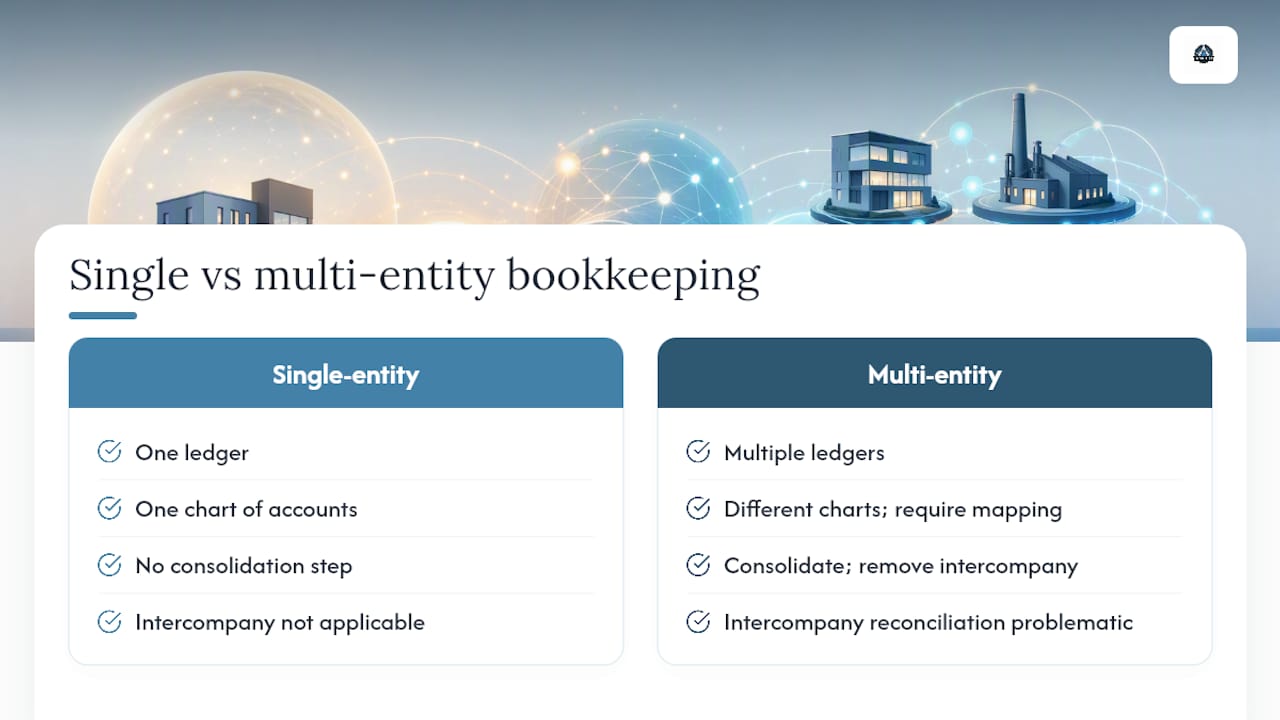
Single-entity bookkeeping manages one ledger and one chart of accounts. Multi-entity bookkeeping manages several ledgers at once, requires mapping between different account structures, and adds a consolidation step that eliminates intercompany activity before producing group-level reports.
When should a business move to multi-entity bookkeeping?
The right time is usually when you form a second legal entity, complete an acquisition, or expand into a new state or country. Coordination problems tend to surface even with just two entities if the accounting processes weren't built for it.
What's the biggest challenge in multi-entity bookkeeping?
Intercompany reconciliation causes the most persistent problems. Mismatched balances between entities, often from timing differences or currency conversion errors, pile up as aging items that slow down every close until someone automates the matching process.
Do all entities need the same chart of accounts?
Not necessarily, but they should share a common core structure wherever possible. Where local tax rules or industry requirements force differences, document those exceptions clearly so the mapping to your consolidated report stays consistent every period.
Sources
- Multi-Entity Accounting: Benefits, Challenges & Best Practices — TechnologyAdvice
- What is multi-entity accounting? How to use it, benefits, and tips — Intuit ERP
- Multi-Entity Accounting — Expensify blog
- What Is Multi-Entity Accounting? — NetSuite
- Business structures — IRS