

A bookkeeper is the person who makes sure every dollar your business earns or spends gets recorded, categorized, and reconciled correctly. Without that foundation, financial statements are guesswork, tax filings become a scramble, and cash flow surprises hit you sideways. The role of bookkeeper in business is not glamorous, but it is the single most direct line between your daily transactions and the financial clarity you need to run a company confidently.
According to the Bureau of Labor Statistics, core bookkeeper duties cover transaction recording, ledger maintenance, bank reconciliation, accounts payable and receivable, and payroll. That list sounds straightforward until you realize that one miscategorized expense or a missed reconciliation can distort your profit picture for an entire quarter.
What does a bookkeeper actually do in your business?
A bookkeeper manages the daily financial record-keeping that keeps your business running on solid numbers. Their work sits at the front end of the accounting process, capturing raw financial data before any analysis or reporting happens. Eric J. Weitner, a CPA and business adjunct at Southern New Hampshire University, put it plainly: "Bookkeeping is like a business' version of a personal checkbook. It involves recording and organizing financial transactions to maintain accurate and up-to-date financial records for a business."
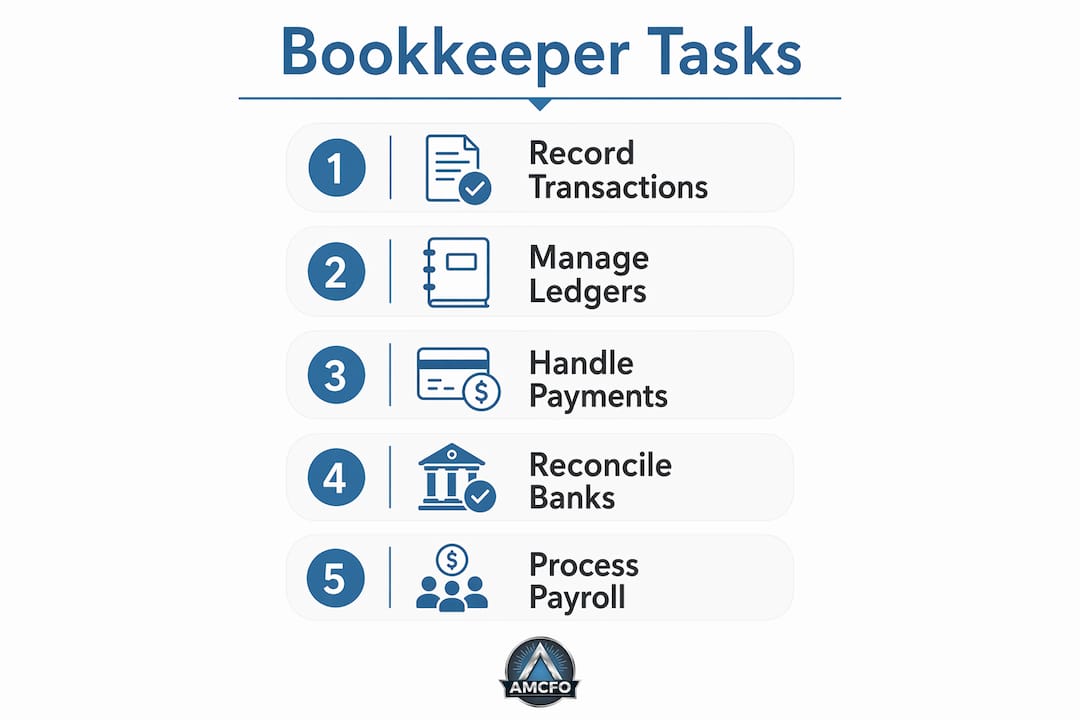
The core responsibilities break down like this:
- Transaction recording: Every sale, purchase, payment, and receipt gets logged daily.
- Ledger maintenance: The general ledger stays current and organized by account category.
- Bank reconciliation: Bank statements get matched against internal records to catch discrepancies.
- Accounts payable and receivable: Invoices go out on time, bills get paid, and outstanding balances get tracked.
- Payroll processing: Employee wages, deductions, and tax withholdings are calculated and recorded.
- Compliance support: Records stay organized and accessible for IRS review at any time.
Bookkeeping also manages the first six steps of the accounting cycle, focusing on data collection and input. That structured approach is what gives accountants clean material to work with when producing financial statements.
1. Daily transaction recording and ledger management
Every financial event in your business, from a client payment to a vendor invoice, needs a home in your records. A bookkeeper logs these transactions in real time, assigning each one to the correct account category: assets, liabilities, revenue, or expenses. That categorization is not just organizational tidiness. It determines whether your income statement reflects reality or a distorted version of it.

The general ledger is the master record where all of this lives. Bookkeepers keep it current, check for posting errors, and make sure account balances add up correctly at the end of each period. Tools like QuickBooks, Xero, and FreshBooks are standard in this workflow, automating much of the data entry while the bookkeeper handles classification and review.
Pro Tip: Set up your Chart of Accounts before you record a single transaction. A well-structured chart makes every report you pull later actually useful. A poorly structured one means your data is technically recorded but practically unreadable.
2. Accounts payable and receivable management
Cash flow problems in small businesses usually trace back to one of two places: money owed to you that hasn't come in, or money you owe that's overdue. A bookkeeper tracks both sides of that equation with discipline.
On the receivable side, they generate invoices, monitor due dates, and flag overdue accounts so you can follow up before a small delay becomes a bad debt. On the payable side, they track vendor bills, schedule payments to avoid late fees, and make sure nothing slips through. For businesses with contractors or multiple vendors, this coordination alone saves real money.
Organized accounts payable and receivable records also feed directly into cash flow projections. When your bookkeeper keeps these current, you can see weeks ahead whether you'll have enough cash on hand to cover payroll or a large purchase.
3. Bank reconciliation and financial accuracy
Bank reconciliation is the process of matching your internal records against your bank statements, line by line, every month. It sounds tedious, and it is. It also catches fraud, duplicate charges, bank errors, and data entry mistakes before they compound.
A bookkeeper who reconciles accounts monthly gives you a clean, verified picture of your actual cash position. Skip reconciliation for a few months and you're flying on assumptions. By the time you discover a discrepancy, it may take hours of forensic work to untangle. Staying audit-ready requires exactly this kind of consistent, monthly discipline.
The IRS requires that business records be available for inspection at any time, and bank reconciliation is one of the clearest ways to demonstrate that your records are accurate and complete.
4. Invoice management and bill payment
Managing invoices goes beyond sending them out. A bookkeeper tracks the full lifecycle: invoice creation, delivery, receipt confirmation, and payment. For businesses that deal with a high volume of transactions, this process needs a system, not just a spreadsheet.

On the expense side, bookkeepers review incoming bills for accuracy, match them against purchase orders when applicable, and process payments on schedule. They also maintain records of every transaction, which matters when a vendor disputes a payment or an auditor asks for documentation.
Good invoice management directly affects your Days Sales Outstanding (DSO), the average number of days it takes to collect payment after a sale. Keeping that number low is one of the fastest ways to improve cash flow without changing your pricing.
5. Payroll processing and tax compliance
Payroll is one of the highest-stakes tasks a bookkeeper handles. Employees expect accurate, on-time paychecks. The IRS expects accurate, on-time tax deposits. Getting either wrong has real consequences.
A bookkeeper's payroll responsibilities typically include:
- Calculating gross wages for hourly and salaried employees
- Applying federal, state, and local tax withholdings correctly
- Deducting benefits contributions such as health insurance and retirement plans
- Processing direct deposits or paper checks on schedule
- Maintaining payroll records for each pay period
- Supporting quarterly and annual payroll tax filings (Forms 941, W-2, and 1099)
For businesses that also work with contractors, bookkeepers track those payments and prepare 1099 forms at year-end. Payroll accuracy isn't just about compliance. It's a direct signal to your team that the business is well-managed.
6. What skills and education does a good bookkeeper need?
Hiring a bookkeeper without knowing what to look for is a common mistake. The technical skills matter, but so does the judgment to apply them correctly.
Hard skills every bookkeeper needs:
- Proficiency with accounting software (QuickBooks is the most widely used in the U.S., followed by Xero and Sage)
- Double-entry bookkeeping knowledge
- Understanding of GAAP (Generally Accepted Accounting Principles) at a foundational level
- Payroll processing experience
- Bank reconciliation and accounts payable/receivable management
Soft skills that separate good bookkeepers from great ones:
- Attention to detail, the ability to catch a $0.01 discrepancy that signals a larger error
- Discretion with sensitive financial data
- Clear written and verbal communication, especially when flagging issues to owners or accountants
- Organization and the ability to manage multiple deadlines simultaneously
On the education side, bookkeepers typically hold an associate's degree in accounting or a related field, though many enter the profession through on-the-job training. Certifications like the Certified Bookkeeper (CB) designation from the American Institute of Professional Bookkeepers (AIPB) or the National Association of Certified Public Bookkeepers (NACPB) credential add credibility. These are not required, but they signal that a candidate has met a tested standard.
Professional bookkeepers prevent errors that business owners doing their own books often miss, particularly when transactions become more complex as a company grows.
7. How bookkeeping differs from accounting
Bookkeeping and accounting are related but not interchangeable. Confusing them leads to either overpaying for services you don't need yet or underpaying for ones you do.
| Factor | Bookkeeper | Accountant |
|---|---|---|
| Primary focus | Recording and organizing transactions | Analyzing data and producing financial reports |
| Accounting cycle | Manages steps 1–6 (data collection and input) | Manages steps 7–9 (analysis, reporting, closing) |
| Education | Associate's degree or vocational training | Bachelor's degree; CPA license for advanced work |
| Typical tasks | Ledger entries, reconciliation, payroll, invoicing | Financial statements, tax strategy, audits, forecasting |
| Cost | Generally lower | Generally higher |
| Output | Clean, organized financial data | Interpreted financial insights and strategic advice |
The distinction between the two roles matters most when you're deciding what kind of help to hire. Bookkeeping handles the administrative side of your financial past and present. Accounting takes that data and turns it into forward-looking analysis. A bookkeeper delivers the clean records an accountant needs to do their job well. Without one, the other's work becomes slower and more expensive.
The Small Business Association notes that a bookkeeper can provide basic day-to-day functions at a lower cost, but won't possess the formal education of a CPA. That's not a knock on bookkeepers. It's a description of two different jobs that work best together.
8. Types of bookkeeping and how they affect your business
Not all bookkeeping is set up the same way, and the method you use shapes how useful your financial data actually is.
Single-entry bookkeeping records each transaction once, either as income or an expense. It's simple and works for very small businesses or sole proprietors with minimal transactions. The downside is that it doesn't track assets and liabilities, so your financial picture stays incomplete.
Double-entry bookkeeping records every transaction in two accounts: a debit in one and a credit in another. This method is the standard for any business that needs accurate financial statements. It also makes errors easier to catch because the books must always balance.
Computerized bookkeeping uses software like QuickBooks, Xero, or Wave to automate data entry, generate reports, and flag inconsistencies. Most professional bookkeepers work this way. The software handles repetitive tasks; the bookkeeper handles judgment calls.
Manual bookkeeping uses physical ledgers or spreadsheets. It's rare in 2026 outside of very small operations, and it carries a higher risk of human error with no automated checks.
The benefits of organized bookkeeping extend well beyond keeping records clean:
- Cash flow visibility: You can see exactly where money is coming from and where it's going, week by week.
- Tax preparation: Clean monthly records mean year-end filing is a matter of review, not reconstruction.
- Audit readiness: Organized books with supporting documentation satisfy IRS requirements without scrambling.
- Loan and investor confidence: Lenders and investors read your books before they commit. Organized records signal a well-run business.
- Compliance: Proper bookkeeping for small businesses helps avoid IRS penalties and keeps you current with federal and state tax obligations.
9. Why bookkeeping is a strategic asset in 2026
Most business owners think of bookkeeping as a back-office chore. The ones who grow fastest treat it as a management tool.
Clean books give you real-time visibility into cash flow, profitability by product or service line, and expense trends before they become problems. That visibility is what lets you make a confident decision about hiring, pricing, or taking on debt, rather than guessing based on your bank balance.
Skilled bookkeepers also implement internal controls such as segregation of duties and approval workflows that prevent fraud and unauthorized spending. Most small business owners don't think about fraud until it happens. A bookkeeper who enforces these controls is your first line of defense, not your accountant, not your bank.
There's also a direct ROI argument. Monthly reconciliation by a bookkeeper means your accountant spends their time on analysis and strategy, not rebuilding records from scratch at tax time. That difference shows up in your accounting bill every year.
The Chart of Accounts setup is one of the most underrated bookkeeper responsibilities. Get it wrong at the start and every report you pull for the next five years will be harder to read and less useful for decisions. A bookkeeper who structures it correctly from day one makes every downstream financial tool, from QuickBooks dashboards to CFO-level forecasting, work the way it's supposed to.
Pro Tip: Ask any bookkeeper you're considering hiring to walk you through how they would set up your Chart of Accounts for your specific business model. Their answer tells you more about their competence than any certification.
Bookkeeping also signals financial maturity to outside parties. Lenders reviewing a loan application and investors evaluating a business both look at the quality of your financial records. Disorganized books don't just slow down the process. They raise questions about how the business is actually being run. Consistent, professional bookkeeping, as Weitner noted, is "the backbone of every business" and a direct input into business growth over time.
Key Takeaways
A bookkeeper's core value is accuracy at the transaction level, and that accuracy compounds into better decisions, lower tax costs, and stronger credibility with lenders and investors.
| Point | Details |
|---|---|
| Core bookkeeper duties | Transaction recording, ledger maintenance, bank reconciliation, payroll, and accounts payable/receivable. |
| Bookkeeper vs. accountant | Bookkeepers handle steps 1–6 of the accounting cycle; accountants analyze data and produce financial reports. |
| Strategic value | Internal controls set by bookkeepers prevent fraud and reduce year-end accountant fees through clean monthly records. |
| Chart of Accounts setup | Correct initial setup by a bookkeeper directly determines how useful your accounting software and financial reports will be. |
| Amcfo's role | Amcfo provides bookkeeping, accounting, and fractional CFO services that give small businesses accurate records and financial clarity. |
Amcfo gives your business the financial foundation it needs
Running a business without a professional bookkeeper is like navigating without a map. You might get somewhere, but you'll waste time, miss turns, and pay for mistakes that were entirely avoidable.

Amcfo provides bookkeeping and accounting services built for businesses that want more than just compliant records. The team handles daily transaction recording, QuickBooks setup and cleanup, payroll support, bank reconciliation, and tax coordination, all structured to give you a clear picture of your finances every month. For businesses ready to go further, fractional CFO services layer in budgeting, forecasting, and financial analysis without the cost of a full-time hire.
If your books are behind, your Chart of Accounts is a mess, or you're not sure what your numbers actually mean, that's exactly the situation Amcfo is built for. Schedule a consultation to see what clean, professionally managed books can do for your business.