

Bookkeeping is the systematic process of recording, organizing, and maintaining every financial transaction a business makes. Think of it as the daily scorekeeping that tells you exactly where your money came from and where it went. A bookkeeper logs daily transactions, manages invoices, categorizes expenses, reconciles bank statements, and handles payroll records. Without that foundation, no financial report, tax return, or business decision rests on solid ground.
At its core, bookkeeping covers:
- Recording sales, purchases, payments, and receipts
- Categorizing transactions into the correct accounts
- Reconciling bank and credit card statements monthly
- Maintaining payroll records
- Generating source documents like invoices and receipts
- Preparing the data that accountants use for analysis and reporting
Bookkeeping is foundational to accurate financial reporting in a way that accounting alone cannot replace. Accounting interprets and analyzes the numbers. Bookkeeping creates them.
Table of Contents
- Why bookkeeping matters for your business
- Single-entry vs. double-entry: which system fits your business?
- Cash basis vs. accrual basis: how you record transactions
- The core components of a bookkeeping system
- How bookkeeping keeps you IRS-compliant and financially healthy
- What bookkeeping software do most businesses use?
- What does a bookkeeper actually do day to day?
- How bookkeeping fits within the broader accounting picture
- What do real bookkeeping entries look like?
- Common bookkeeping mistakes and how to avoid them
- Amcfo handles your books so you can focus on your business
- Key Takeaways
Why bookkeeping matters for your business
Accurate books give you a real-time picture of your financial health. You know whether you are profitable, whether a client owes you money, and whether you can afford to hire. That visibility is not a luxury for large companies. It is the baseline every business needs to survive.
The IRS requires businesses to maintain organized financial records for tax return evidence and audit purposes. Disorganized books do not just slow down an audit. They invite penalties. Proper bookkeeping reduces that risk and speeds up the entire examination process.
Beyond compliance, bookkeeping supports:
- Cash flow tracking: Know exactly when money arrives and when bills are due
- Expense management: Spot overspending before it becomes a crisis
- Tax readiness: Identify every deductible expense and reduce your tax liability
- Investor and lender confidence: Clean books are often required to secure growth capital
- Profitability analysis: Understand which products, services, or clients actually make you money
The bottom line on compliance: Organized bookkeeping expedites tax examinations and minimizes cash flow mismanagement — two of the most common reasons small businesses run into financial trouble.
Financial visibility is vital for obtaining growth capital and managing profitability. That point matters most when you are trying to scale.
Single-entry vs. double-entry: which system fits your business?
There are two primary bookkeeping methods used in the U.S., and choosing the right one depends on your business size and complexity.
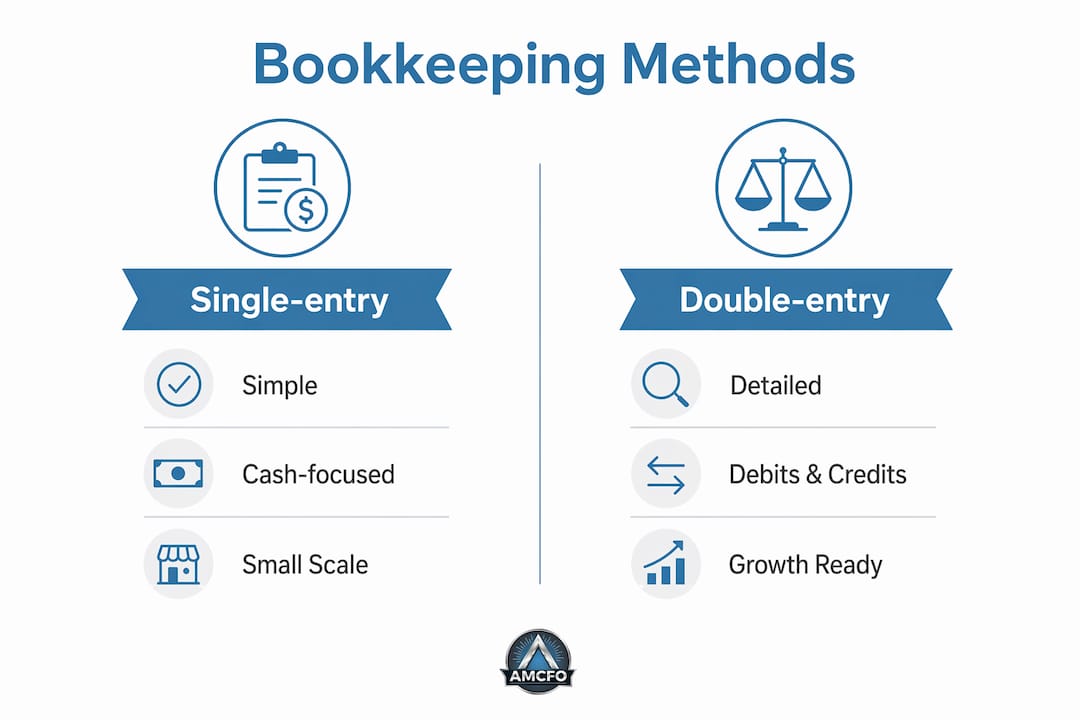
Single-entry bookkeeping records each transaction once, typically as a positive or negative cash entry. It works like a personal checkbook register. Very small businesses and sole proprietors with straightforward finances often start here.
Double-entry bookkeeping records every transaction twice: once as a debit and once as a credit. Every entry must balance. That built-in check makes errors far easier to catch and gives you a complete picture of assets, liabilities, and equity.

| Feature | Single-Entry | Double-Entry |
|---|---|---|
| Transactions recorded | Once | Twice (debit + credit) |
| Error detection | Limited | Strong |
| Best for | Very small businesses | Growing or complex businesses |
| Financial statements | Basic cash flow | Full balance sheet and income statement |
| Complexity | Low | Moderate to high |
Single-entry pros and cons:
- ✓ Simple to maintain with minimal training
- ✓ Low cost to implement
- ✗ Prone to undetected errors
- ✗ Cannot produce a complete balance sheet
Double-entry pros and cons:
- ✓ Built-in accuracy checks through balanced debits and credits
- ✓ Supports full financial reporting
- ✗ More time-consuming to set up
- ✗ Requires a stronger understanding of accounting principles
Most businesses that plan to grow, seek financing, or have employees should use double-entry from the start.
Cash basis vs. accrual basis: how you record transactions
Beyond the recording system, every business must choose an accounting basis. This determines when a transaction hits your books.
Cash-basis accounting records income when cash is received and expenses when cash is paid. A freelancer who invoices in March but gets paid in April records that income in April. It is simple and gives an accurate picture of cash on hand.
Accrual-basis accounting records income when it is earned and expenses when they are incurred, regardless of when cash moves. That same freelancer records the income in March. The accrual basis reports economic events when they occur rather than when cash changes hands, which provides more complete reporting of assets, liabilities, revenues, and expenses.
Key differences for your bookkeeping practice:
- Cash basis is simpler but can distort profitability in months with timing gaps between work and payment
- Accrual basis is required by GAAP for most larger businesses and preferred by lenders and investors
- The IRS generally allows small businesses with annual gross receipts under a certain threshold to use cash basis, but check current IRS guidance for your specific situation
- Switching from cash to accrual requires careful adjustment entries and often professional help
For a small business that plans to grow, starting with accrual basis saves a painful transition later.
The core components of a bookkeeping system
Every bookkeeping system, whether paper-based or digital, relies on the same set of building blocks. Transactions flow from source documents into daybooks, then journals, and finally into ledgers that summarize each account.
- Source documents: Invoices, receipts, bank statements, and contracts. These are the raw evidence of every transaction.
- Daybooks (books of original entry): Where transactions are first recorded, organized by type. Common daybooks include the sales daybook, purchases daybook, and cash receipts daybook.
- Journals: Transactions are organized chronologically here, with debits and credits assigned. The general journal captures entries that do not fit a specialized daybook.
- Ledgers: Each account gets its own ledger page. The general ledger compiles all account totals and forms the basis for financial statements.
- Petty cash book: Tracks small, routine cash payments like office supplies or parking. Keeping this separate prevents minor expenses from cluttering the main ledger.
- Chart of Accounts: The master list of every account category your business uses, from cash and accounts receivable to payroll expenses and owner equity. A well-structured Chart of Accounts is the backbone of scalable bookkeeping.
On the Chart of Accounts: Setting up a proper Chart of Accounts and performing frequent reconciliations are the two practices most strongly linked to long-term bookkeeping accuracy.
These components do not operate in isolation. A sale generates a source document, gets entered in the sales daybook, flows into the journal as a debit to accounts receivable and a credit to revenue, and posts to the general ledger. That chain is what makes your books auditable and your financial statements trustworthy.
How bookkeeping keeps you IRS-compliant and financially healthy
The IRS does not require perfection. It requires documentation. Businesses that cannot produce organized records during a tax examination face delays, additional scrutiny, and potential penalties. Proper bookkeeping is your first line of defense.

Maintaining current, organized records minimizes penalties and aids in tax examinations. That means keeping receipts, reconciling accounts monthly, and ensuring every deductible expense is categorized correctly before year-end.
Bookkeeping also protects your cash flow. When you know exactly what is owed to you and what you owe, you can plan payments, avoid overdrafts, and time major purchases strategically.
Pro Tip: Schedule a monthly 30-minute financial review with your bookkeeper or accountant. Catching a miscategorized expense or a missed invoice in month two costs far less than discovering it in month twelve during tax prep.
Automation helps, but it is not foolproof. Experienced bookkeepers provide a sanity check on automated processes to avoid costly errors. Software can misclassify a loan repayment as income or miss a duplicate transaction entirely. Human oversight catches what algorithms miss.
What bookkeeping software do most businesses use?
Most small businesses in the U.S. run their books on one of a handful of platforms. QuickBooks Online is the most widely used, offering invoicing, expense tracking, payroll integration, and bank reconciliation in one place. It scales from sole proprietors to mid-sized companies and integrates with hundreds of third-party apps.
FreshBooks suits service-based businesses and freelancers who prioritize invoicing and time tracking over complex accounting features. Wave is a free option that covers the basics for very small businesses with simple finances. Xero is popular with businesses that have international transactions or need strong multi-user access controls.
For nonprofits and organizations that need financial visibility across programs, business management consulting resources often recommend purpose-built tools alongside standard bookkeeping platforms to maintain clean fund accounting.
The right software depends on your transaction volume, whether you have employees, and how much you rely on financial reports for decisions. What matters more than the platform is using it consistently.
What does a bookkeeper actually do day to day?
The daily work of bookkeeping is more specific than most people expect. It is not just "handling the finances." A bookkeeper's responsibilities typically include:
- Recording every sale, purchase, and payment as it occurs
- Matching bank and credit card transactions to recorded entries
- Sending and tracking invoices to clients
- Processing vendor bills and scheduling payments
- Running payroll and recording payroll tax liabilities
- Reconciling accounts at month-end to catch discrepancies
- Generating basic financial reports: profit and loss, balance sheet, cash flow statement
- Flagging unusual transactions or potential errors for review
In a small business, one person often handles all of these. In larger organizations, these tasks split across a bookkeeping team, with an accountant or CFO reviewing the output. Either way, the work requires attention to detail, consistency, and a solid understanding of the Chart of Accounts.
How bookkeeping fits within the broader accounting picture
Bookkeeping and accounting are not the same thing, though people use the terms interchangeably. Bookkeeping is the technical recording of transactions — the what and when. Accounting takes that data and interprets it: analyzing trends, preparing tax returns, advising on financial strategy, and producing audited statements.
Think of it this way: bookkeeping is the data entry, accounting is the analysis. Without consistent bookkeeping, accounting cannot yield accurate financial reports. An accountant working from sloppy books is guessing, not analyzing.
For a deeper look at how these two functions divide and overlap, the bookkeeping vs. accounting breakdown for small businesses is worth reading before you decide how to staff your finance function.
What do real bookkeeping entries look like?
A bookkeeping entry is simpler than it sounds. Here are three common examples using double-entry:
Example 1: A sale on credit A business invoices a client $1,500 for consulting services.
- Debit: Accounts Receivable $1,500
- Credit: Revenue $1,500
Example 2: Paying a vendor The business pays a $400 software subscription.
- Debit: Software Expense $400
- Credit: Cash $400
Example 3: Receiving a client payment The client pays the $1,500 invoice.
- Debit: Cash $1,500
- Credit: Accounts Receivable $1,500
Each entry keeps the accounting equation balanced: Assets = Liabilities + Equity. That balance is what makes the general ledger reliable and what lets an accountant produce a trustworthy balance sheet at year-end.
Common bookkeeping mistakes and how to avoid them
Most bookkeeping errors are not complicated. They are the result of inconsistency, procrastination, or skipping the basics.
Mixing personal and business finances is the most common mistake small business owners make. Running personal expenses through a business account makes reconciliation a nightmare and raises red flags during an IRS audit. Open a dedicated business checking account on day one.
Falling behind on data entry compounds quickly. A week of unrecorded transactions becomes a month, then a quarter. Catching up under deadline pressure means more errors. Daily or weekly entry habits prevent this.
Neglecting reconciliations is another frequent problem. Failing to reconcile accounts regularly causes discrepancies between your records and bank statements that are hard to trace after the fact. Monthly reconciliation is the minimum.
Miscategorizing expenses distorts your financial reports and can cost you deductions. A meal with a client is a business expense. A meal with your family is not. The distinction matters at tax time.
Relying entirely on software automation without review is a growing issue. Automated bank feeds are convenient, but they misclassify transactions regularly. A loan deposit can look like income. A transfer between accounts can appear as revenue. Review every auto-categorized entry before closing the month.
For a practical walkthrough of how bookkeeping works in a real business context, including how to set up your Chart of Accounts and establish a monthly close process, that guide covers the mechanics step by step.
Amcfo handles your books so you can focus on your business

Knowing what bookkeeping is and actually keeping clean books are two different challenges. Amcfo provides professional bookkeeping and accounting services for businesses of all sizes, handling everything from daily transaction recording and bank reconciliation to QuickBooks setup, payroll support, and tax coordination. You get accurate, IRS-ready financials without spending your evenings in a spreadsheet.
What sets Amcfo apart from hiring a part-time bookkeeper or relying on software alone is the combination of hands-on accuracy and strategic oversight. Every account gets reviewed by an experienced professional, not just auto-categorized and filed. When something looks off, you hear about it before it becomes a problem.
If you are a small business owner who has been managing your own books, falling behind, or working from records you do not fully trust, Amcfo's fractional CFO and accounting packages give you a clear path to clean, current financials. Schedule a consultation to see which service level fits your business.
Key Takeaways
Bookkeeping is the systematic recording of financial transactions that makes accurate accounting, tax compliance, and sound business decisions possible.
| Point | Details |
|---|---|
| Core definition | Bookkeeping records every financial transaction systematically, forming the basis for all financial reporting. |
| IRS compliance | Organized books are required by the IRS for tax returns and audits, reducing penalty risk. |
| Two main systems | Single-entry suits very small businesses; double-entry provides accuracy checks for growing companies. |
| Accrual vs. cash basis | Accrual basis records transactions when earned or incurred, giving a more complete financial picture than cash basis. |
| Amcfo's role | Amcfo provides hands-on bookkeeping, QuickBooks setup, and fractional CFO oversight so your records stay accurate and audit-ready. |