

Many business owners assume that having a CFO means hiring a full-time executive with a six-figure salary and a corner office. That assumption is costing them. A fractional CFO is a senior financial executive who works part-time, typically supporting multiple companies at once, providing the same strategic financial leadership at a fraction of the cost. If you run a growing business and feel like your finances are always one bad month away from a crisis, this model was built for you.
Table of Contents
- Understanding the core responsibilities of a fractional CFO
- How fractional CFOs add strategic value beyond bookkeeping
- Practical applications: When and why to hire a fractional CFO
- Key deliverables and financial tools used by fractional CFOs
- Common challenges and how fractional CFOs address them
- Why fractional CFOs are the strategic game-changers for growing businesses
- How AmCFO can support your fractional CFO needs
- Frequently asked questions
Key Takeaways
| Point | Details |
|---|---|
| Fractional CFO role | A fractional CFO provides part-time, senior financial leadership tailored to growing small and mid-sized businesses. |
| Strategic focus | They focus on forward-looking financial planning, cash management, and decision support rather than day-to-day bookkeeping. |
| When to hire | Ideal hires for businesses needing expert financial advice but not ready or able to afford full-time CFOs. |
| Deliverables | Typical outputs include cash flow forecasts, budgets, KPI dashboards, and investor reporting packages. |
| Data importance | Clean and reliable financial data is essential for fractional CFOs to deliver accurate forecasts and advice. |
Understanding the core responsibilities of a fractional CFO
The confusion about what a fractional CFO actually does runs deep. Most people assume finance means accounting. Bookkeeping, tax prep, reconciliations. That is transactional work, and while it matters, it is not what a fractional CFO focuses on.
A fractional CFO lives in the future. Their job is to look at where your business is heading, not just where it has been. They build and maintain the financial infrastructure that lets you make confident decisions about hiring, pricing, expansion, and cash reserves before a crisis forces your hand.
Here is what fractional CFO responsibilities typically look like in practice:
- Cash flow forecasting: Building 13-week rolling forecasts that show you exactly where your cash position is headed
- Financial modeling: Creating scenario models so you can test the financial impact of decisions before making them
- KPI and dashboard design: Identifying the five to eight numbers that actually drive your business, then making them visible
- Budgeting and reforecasting: Building an annual budget and updating it quarterly when reality diverges from the plan
- Investor and board reporting: Preparing financial packages that tell your story clearly to stakeholders
Understanding financial modeling for decisions is one area where fractional CFOs add immediate, tangible value. They do not just build spreadsheets. They translate those models into plain English so you know exactly what the numbers mean for your next move. Pair that with solid cash flow management best practices and you start running your business with a lot more clarity.
How fractional CFOs add strategic value beyond bookkeeping
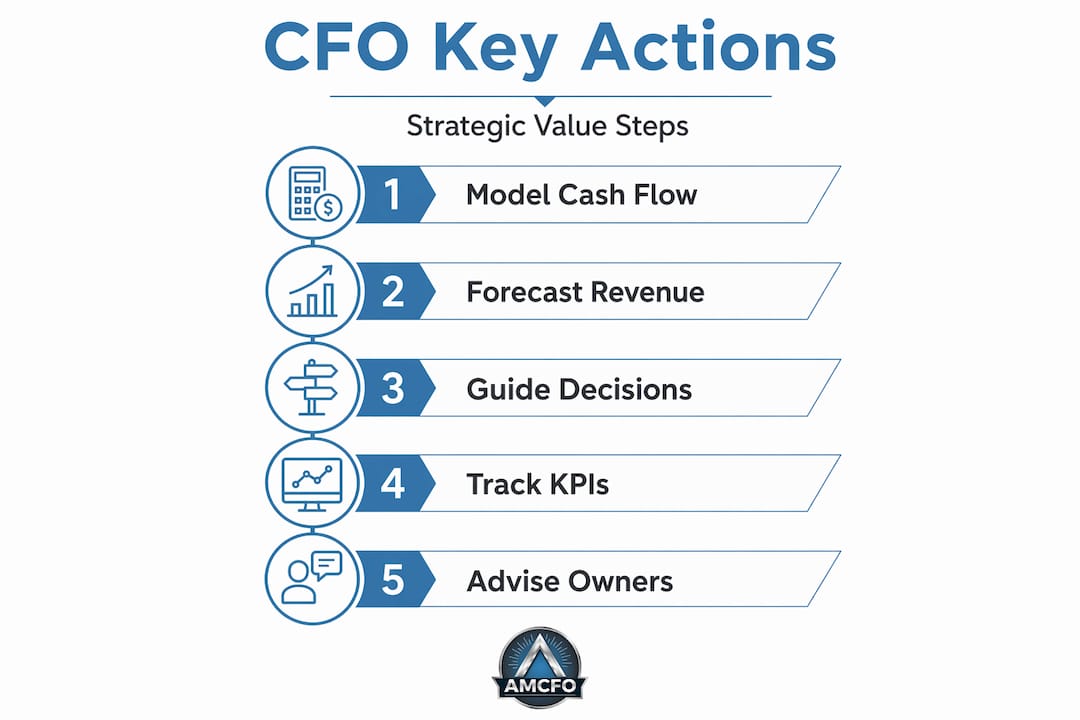
Here is the clearest way to think about the difference. Your bookkeeper records what already happened. Your accountant makes sure those records are accurate and compliant. Your fractional CFO takes those records and asks, "What does this mean, and what should we do about it?"
That distinction sounds simple, but in practice it is enormous. Most business owners make major decisions on gut instinct backed by a glance at their bank balance. A fractional CFO replaces guesswork with forward-looking financial models and structured analysis.
"Fractional CFOs create forecasts, shape strategy, and advise leadership, while traditional finance and accounting focuses on historical reporting and compliance." — Wise
The practical difference shows up in conversations like these. When you are thinking about hiring two new salespeople, a bookkeeper tells you what you spent on payroll last year. A fractional CFO models what your revenue needs to look like in six months to cover that increased overhead, then helps you decide whether the timing makes sense. When a big client goes 60 days past due, a fractional CFO runs the cash flow impact and tells you whether you need a line of credit or can hold.
Understanding the financial forecasting process is a big part of what separates reactive businesses from ones that grow with intention. Fractional CFOs build that process from scratch if it does not exist, or fix it if it is broken.

Practical applications: When and why to hire a fractional CFO
Not every business needs a fractional CFO on day one. But there is a common inflection point where the need becomes obvious. Revenue is growing, complexity is increasing, and the owner realizes they are making six-figure decisions based on month-old reports they barely understand. That is the moment.
Fractional CFOs often start by cleaning and standardizing your financial data before producing any forecasts. They cannot build reliable models on messy books, so the first few weeks often involve fixing the foundation.
Here is a typical engagement sequence when bringing in a fractional CFO:
- Financial data audit: Review existing books, identify inconsistencies, and standardize the chart of accounts
- Process setup: Establish a consistent monthly close process and reporting calendar
- Baseline modeling: Build a realistic view of current financial performance and cash position
- Forecasting and planning: Develop rolling forecasts, a budget, and scenario plans
- Ongoing advisory: Hold regular reviews with leadership to interpret results and adjust strategy
The scenarios where fractional CFOs deliver the most value include: businesses between $1M and $30M in revenue, companies raising outside capital, businesses going through acquisitions or major contracts, and owners who want to exit in the next few years and need clean financials.
Understanding how to structure a CFO advisory engagement upfront saves a lot of wasted time and money. The best engagements have clear goals, defined deliverables, and a shared understanding of what success looks like.
Pro Tip: Before hiring a fractional CFO, write down the top three financial questions you cannot currently answer about your business. If you cannot answer "How much cash will I have 90 days from now?" or "What happens to my margins if I add another employee?", those become the first deliverables you ask for.
Key deliverables and financial tools used by fractional CFOs
Knowing what you will actually receive from a fractional CFO engagement helps you evaluate whether it is worth the investment. This is not abstract consulting. The work produces concrete deliverables you can act on.
Here is a comparison of the most common deliverables and what they help you do:
| Deliverable | What it is | What it helps you decide |
|---|---|---|
| 13-week cash flow forecast | Rolling weekly cash in and out | Whether you can afford near-term expenses |
| Annual budget | Revenue and expense plan for the year | Hiring, spending, and investment timing |
| Financial model | Scenario-based projections | Impact of pricing, growth, or cost changes |
| KPI dashboard | Visual summary of key metrics | Whether the business is on track week to week |
| Quarterly reforecast | Updated budget based on actuals | Course corrections before problems compound |
| Investor/board package | Financial story for stakeholders | Fundraising, board meetings, partner updates |
Beyond the table, the real value is in how these tools change your behavior as an owner. Most people who receive a KPI dashboard for the first time say the same thing: "I had no idea this number was moving in the wrong direction."
A few additional tools fractional CFOs regularly use:
- Scenario planning models that test three versions of the future (base case, upside, downside)
- Working capital analysis that pinpoints where cash is trapped in receivables or inventory
- Profitability analysis by product, client, or channel to show you where your real margins live
Reading a solid financial modeling guide can help you understand what to expect from these tools before your first engagement. If you want to explore what ongoing advisory looks like in practice, business consulting services can give you a clearer picture of the engagement structure.
Pro Tip: Ask your fractional CFO to walk you through each deliverable verbally the first time. Reading a financial model alone is rarely enough. The real value comes from the conversation about what the numbers mean for your specific situation.
Common challenges and how fractional CFOs address them
The most common obstacle fractional CFOs run into is not lack of expertise. It is bad data. If your books have not been consistently maintained, if revenue is recorded in different ways across months, or if expenses are miscategorized, every forecast built on top of that data is unreliable.
Fractional CFOs build models even with messy data, but they are upfront that accuracy depends on what goes in. Improving the underlying data quality is part of the job, not a precondition for starting.
Here is what that cleanup process typically involves:
- Chart of accounts standardization: Making sure every dollar is categorized consistently so reports are comparable month over month
- Revenue recognition cleanup: Ensuring revenue is recorded when it is earned, not just when cash arrives
- Close process cadence: Building a repeatable monthly routine so books are done within five to seven days of month end
- Historical reconciliation: Going back through prior months to fix categorizations that skew trend analysis
One area that trips up many small businesses is inconsistent revenue reporting. A client paying in advance gets recorded differently than a client paying on delivery, and suddenly your month-to-month comparisons look erratic even when the business is stable. Fixing this is unglamorous work, but it is what makes everything else possible.
Strong cash flow management practices depend entirely on clean inputs. A fractional CFO who skips the data cleanup phase and goes straight to forecasting is setting you up for decisions based on flawed numbers.
Why fractional CFOs are the strategic game-changers for growing businesses
Here is an opinion most finance content will not say directly: the majority of small business owners do not have a money problem. They have a visibility problem. They are making decisions without a clear picture of where their finances actually stand, and that blindness is expensive.
The traditional assumption is that CFO-level thinking is reserved for companies large enough to justify a full-time hire. That assumption has held back countless businesses that were growing fast enough to benefit from strategic financial guidance but were not ready to spend $200,000 or more per year on a full-time executive. The fractional model breaks that constraint completely.
What makes fractional CFOs uniquely valuable is not just the cost savings. It is the fresh perspective they bring. Because they work across multiple businesses, they have seen your exact problem before, in a different industry, at a different scale, and they know which solutions actually work. That pattern recognition is not something you can develop internally until it is too late to matter.
The key distinction, as Wise notes, is that fractional CFOs produce forward-looking work: creating forecasts, shaping strategy, and advising leadership on decisions. This is exactly what growing businesses need and rarely have access to.
The businesses that benefit most are the ones that stop treating CFO work as a luxury and start treating it as infrastructure. You would not run a $5M business without accounting software. You should not run one without someone whose job is to tell you where you are headed. Exploring fractional CFO strategic roles can help you see what that looks like as an actual engagement, not just a concept.
How AmCFO can support your fractional CFO needs
If reading this made you realize your business is making decisions without the financial clarity it deserves, you are not alone. Most businesses at the $1M to $15M range are flying without instruments. That changes when you bring in the right support.

At AmCFO, our fractional CFO services are designed for business owners who need real strategic guidance, not just another report. We combine accounting and bookkeeping services with ongoing CFO advisory so your financial data is clean, current, and actually useful. From cash flow forecasting and budgeting to fundraising support and profitability analysis, we tailor every engagement to your specific goals. And because we handle the books too, there is no gap between your data and your strategy. If you are ready to run your business with clarity, our business consulting team is ready to help.
Frequently asked questions
What is a fractional CFO and how is it different from a full-time CFO?
A fractional CFO works part-time across several companies, delivering the same strategic financial leadership as a full-time CFO without the full-time salary, benefits, or long-term commitment that typically comes with an executive hire.
What are the main responsibilities of a fractional CFO?
They focus on forward-looking financial work including cash flow forecasting, financial modeling, KPI dashboard design, budgeting, scenario analysis, and preparing investor and board reporting packages.
When should a small business consider hiring a fractional CFO?
When your business outgrows basic bookkeeping, struggles with cash flow visibility, plans to raise outside capital, or needs strategic financial guidance that your current team cannot provide without the cost of a full-time CFO hire.
Can a fractional CFO help prepare my business for fundraising or investment?
Yes. Fractional CFOs are often the people who build your financial models, prepare investor-facing materials, and manage financial due diligence throughout the fundraising process.
How do fractional CFOs handle messy or inconsistent financial data?
They treat data cleanup as part of the engagement itself. Improving management reporting and audit readiness is a standard early deliverable, because reliable forecasting requires reliable inputs.