

Financial due diligence (FDD) is the investigative process a buyer, investor, or seller uses to verify a target company's historical financial performance, normalize earnings, and surface hidden liabilities before a transaction closes. Three concrete outcomes follow every well-run FDD engagement:
- An adjusted EBITDA figure that strips out one-time items and owner perks, giving both sides a defensible earnings baseline
- A net working capital target that anchors the post-close cash settlement in the purchase agreement
- A risk register that maps contingent liabilities, tax exposures, and operational gaps into negotiation levers
Buyers typically commission FDD, though sellers increasingly run their own vendor due diligence to speed the process and control the narrative. Either way, the financial due diligence process is distinct from an audit: it is forward-looking, commercially oriented, and designed to answer one question — are these earnings real, sustainable, and worth the proposed price?
Table of Contents
- What does financial due diligence typically examine?
- Why financial due diligence matters more than most buyers expect
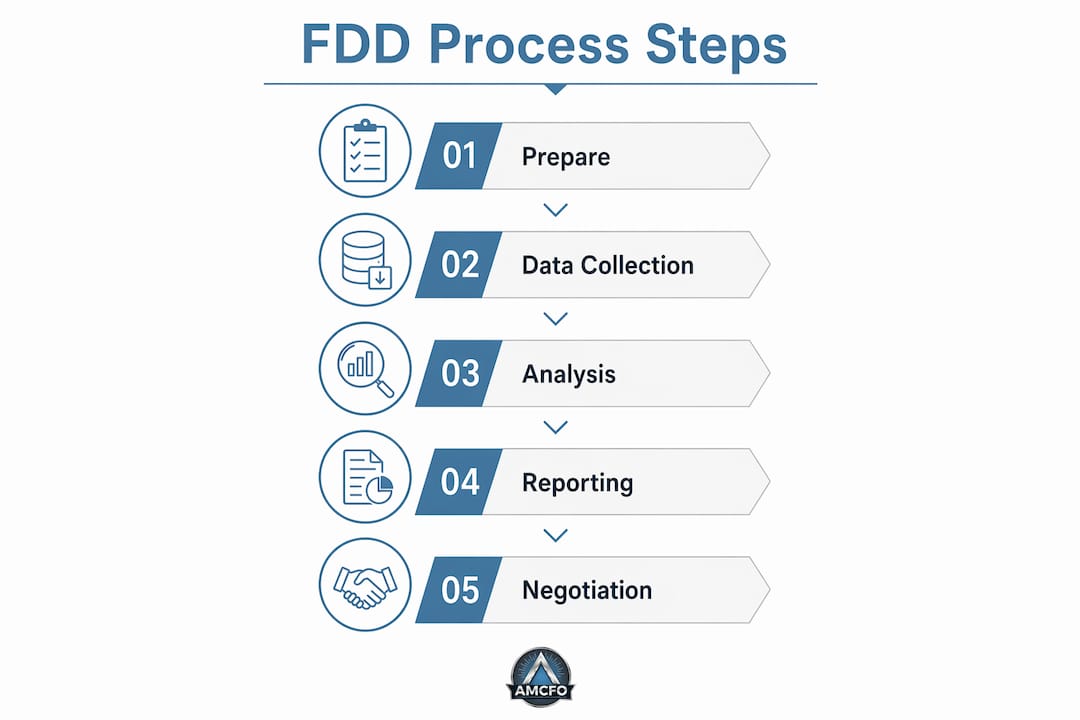
- How the FDD process works, step by step
- The financial due diligence checklist every buyer should request
- Common FDD findings and red flags that kill deals or cut price
- How FDD scope and pricing are set
- How sellers should prepare for FDD
- How a fractional CFO supports FDD — and where Amcfo fits
- What FDD deliverables look like and how to use them
- Key Takeaways
- The part of FDD most advisers won't tell you upfront
- Amcfo's fractional CFO services for FDD-ready businesses
- Useful sources and further reading
What does financial due diligence typically examine?
FDD covers several interlocking scope areas, each tied directly to valuation or deal structure:
- Quality of Earnings (QoE): Normalizes EBITDA by removing non-recurring items, owner compensation adjustments, and accounting policy differences. This is the most resource-intensive workstream in most middle-market deals.
- Revenue and customer analysis: Tests revenue concentration, contract terms, churn rates, and the sustainability of the top-line.
- Working capital: Establishes a normalized working capital baseline for SPA negotiation and flags seasonal or structural cash traps.
- Cash flow: Reconciles reported earnings to actual cash generation and identifies capex patterns.
- Balance sheet: Verifies asset quality, confirms ownership, and checks for off-balance-sheet obligations.
- Debt and contingent liabilities: Captures all funded debt, leases, earn-outs, and guarantees that affect net debt at close.
- Tax exposures: Reviews filed returns, open audits, transfer pricing, and state nexus issues.
- Internal controls: Assesses whether the financial reporting infrastructure is reliable enough to trust the numbers.
Pro Tip: Tailor scope to your deal hypothesis. A buyer acquiring a SaaS business should weight customer cohort analysis and deferred revenue heavily; a buyer acquiring a manufacturer should prioritize inventory valuation and capex normalization. ICAEW guidance confirms that FDD scope is not rigidly prescribed — it should reflect the specific risks the commissioning client cares most about.
Why financial due diligence matters more than most buyers expect
FDD is the primary mechanism for catching value-eroding surprises before they become your problem. Skipping it, or scoping it too narrowly, routinely costs buyers far more than the advisory fee they saved.
Common risks FDD surfaces:
- Customer concentration (one client representing 40%+ of revenue is a pricing and retention risk)
- Working capital gaps that trigger post-close cash calls the buyer did not model
- Undisclosed tax liabilities from prior-year nexus exposure or aggressive deductions
- Litigation reserves that belong on the balance sheet but never appeared there
- Revenue recognized ahead of delivery, inflating the earnings multiple the buyer paid
A single missed working capital adjustment of $500,000 on a 5x EBITDA deal translates to a $2.5 million overpayment — before accounting for the cash drain of fixing the underlying issue post-close.
The importance of financial due diligence is not just risk avoidance. Findings become negotiation currency: price chips, escrow holdbacks, indemnity carve-outs, and earn-out structures all flow directly from what FDD uncovers.
How the FDD process works, step by step
A typical middle-market FDD runs four to six weeks from engagement kick-off to final report. Early-stage or smaller deals can compress to two to four weeks when the data room is well-organized.
The standard process:
- Engagement kick-off: Buyer and adviser align on scope, deal hypothesis, and key risk areas.
- Data room population: Seller uploads documents; adviser issues a formal data request list.
- QoE and workstream analysis: Advisers run parallel workstreams (earnings, working capital, tax, debt, controls).
- Management Q&A: Written questions and follow-up calls clarify gaps and test explanations.
- Draft findings: Preliminary report shared with buyer for review and prioritization.
- Final report delivery: Adjusted EBITDA bridge, working capital schedule, debt schedule, and risk register issued.
- SPA negotiation support: Findings feed directly into price adjustment mechanisms and reps and warranties.
Typical deal timelines vary with size and complexity: smaller deals may complete in a few weeks focusing on core analyses, whereas larger, complex transactions can extend for several months covering all workstreams and multiple legal entities.
The financial due diligence checklist every buyer should request

This document list is the core of any FDD data request. Buyers should issue it at kick-off; sellers should start assembling it the moment a deal process begins.
Financial statements and accounting records:
- Audited or reviewed financial statements for the past three or more years
- Monthly management accounts for the trailing 12–24 months
- General ledger detail and trial balances
- Bank statements (all accounts, 24 months minimum)
- Accounts receivable aging and collections history
- Accounts payable aging and vendor terms
Debt, equity, and legal:
- All loan and credit agreements, including revolving facilities and equipment notes
- Cap table and equity ownership documentation
- Lease agreements (real estate and equipment)
- Contingent liability schedules and litigation files
- Insurance certificates and claims history
Tax and compliance:
- Federal and state tax returns (three or more years)
- Open audit correspondence and notices
- Sales tax filings and nexus analysis
Commercial and operational:
- Top customer contracts and revenue breakdowns by customer
- Payroll records and employee benefit plans
- Inventory detail and obsolescence schedules
- Management projections and supporting assumptions
Documents that consistently cause delays: reconciled trial balances, auditor correspondence, and organized QuickBooks files. A financial review preparation done before the process starts cuts response time dramatically.
Pro Tip: In the first 48–72 hours of a data room opening, prioritize pulling the QoE-critical documents: monthly P&Ls, the general ledger, and the top-customer revenue file. Those three items drive the most questions and the longest back-and-forth.
Common FDD findings and red flags that kill deals or cut price
Practitioners sometimes call these "financial tumors" — issues that look minor on the surface but metastasize into valuation adjustments or deal-breakers under scrutiny.
- Inflated EBITDA add-backs: Owner discretionary expenses buried in cost of goods or SG&A. Buyer response: require a detailed add-back schedule with supporting invoices; challenge any item that recurs annually.
- Customer concentration: Revenue from one or two clients exceeds 30–40% of total. Buyer response: negotiate an earn-out tied to retention, or request an escrow holdback.
- Slow collections: AR aging shows 60+ day balances growing as a percentage of revenue. Buyer response: adjust working capital target downward and scrutinize credit policies.
- Inventory obsolescence: Finished goods or raw materials not moved in 12+ months. Buyer response: require a write-down before close or reduce purchase price accordingly.
- Aggressive revenue recognition: Revenue booked at contract signing rather than delivery. Buyer response: restate revenue on a delivery basis and recalculate the EBITDA multiple.
- Related-party transactions: Rent paid to an owner-affiliated entity at above-market rates. Buyer response: normalize to market rate in the QoE; flag for reps and warranties coverage.
Findings that typically drive price adjustments: QoE reductions, working capital shortfalls, and net debt additions. Findings that typically drive escrow or indemnity structures: tax exposures, litigation contingencies, and undisclosed liabilities.
Pro Tip: A revenue audit of the top 10 customers before entering a formal process can surface concentration and recognition issues early — giving sellers time to address them rather than defend them.
How FDD scope and pricing are set
ICAEW guidance is clear: the commissioning client sets scope, with adviser input. The buyer's deal hypothesis — what they believe they are buying and why — should drive which workstreams get the most attention and budget.
Common fee structures:
- Fixed-fee arrangements are often used for well-defined, smaller deals.
- Time-and-materials contracts are common for larger or more complex transactions where scope is uncertain.
- Phased retainers may be employed, starting with a red-flag assessment before proceeding fully.
Fees vary widely depending on deal size, complexity, and engagement scope.
Pro Tip: Build stage-gates into your engagement letter. If the red-flag phase surfaces a material issue, you want the right to pause before committing to full-scope fees.
How sellers should prepare for FDD
Sellers who prepare proactively close faster and at better valuations. The goal is a data room that answers questions before they are asked.
- Reconcile your books through the most recent month-end and resolve any open items in QuickBooks or your accounting system
- Document every non-recurring item in the P&L with a one-paragraph explanation and supporting backup
- Assemble a contract summary for your top 10 customers, including term, renewal date, and revenue by year
- Prepare a clean cap table and confirm all equity agreements are executed and filed
- Organize three or more years of tax returns with any audit correspondence
- Compile a contingent liability schedule covering all pending or threatened claims
Consider preparing a vendor assistance pack — a structured data room factbook presenting your financials in the format buyers expect. ICAEW guidance supports this approach as a way to reduce duplication and speed buyer review.
Pro Tip: Assign a fractional CFO or controller to own the data room. Management distraction during FDD is one of the most underestimated deal risks — having a dedicated point person keeps the business running while the process unfolds.
How a fractional CFO supports FDD — and where Amcfo fits
A fractional CFO adds the most value in FDD at three points: before the process (getting the books clean), during (managing the data room and responding to adviser questions), and after (integrating findings into post-close planning).
Specific services that matter:
- QuickBooks cleanup and reconciliation to produce reliable trial balances
- Normalized EBITDA calculation and add-back documentation
- Working capital analysis and target-setting support
- Interim financial reporting that gives buyers confidence in the numbers
- Transaction modeling to stress-test purchase price assumptions
A fractional CFO who has sat on both sides of an FDD process knows exactly which questions are coming — and can prepare answers before the buyer's adviser even asks them. That preparation compresses timelines and reduces the back-and-forth that stalls deals.
Amcfo's forensic accounting and fractional CFO services cover all of these workstreams. For sellers, that means entering a process with clean, defensible financials. For buyers, it means having an experienced adviser who can challenge the seller's numbers and translate findings into negotiation strategy. Learn more about structuring that engagement at amcfo.com.
What FDD deliverables look like and how to use them
The standard FDD outputs are a package of schedules and memos, not a single document:
- Quality of Earnings report: The adjusted EBITDA bridge showing each normalization adjustment with supporting detail. This is the primary pricing document.
- Net working capital schedule: Historical monthly working capital calculation and a proposed target for the SPA. Deviations from target at close trigger dollar-for-dollar price adjustments.
- Debt and cash schedule: All funded debt, lease obligations, and cash items that adjust the equity purchase price.
- Red-flag risk register: A prioritized list of findings with estimated financial impact and recommended deal structure responses (escrow, indemnity, price chip).
- Supporting appendices: Customer revenue schedules, AR aging analysis, tax exposure summaries, and management account reconciliations.
Each deliverable maps to a specific negotiation lever. The QoE drives the EBITDA multiple applied to price; the working capital schedule sets the post-close true-up; the debt schedule adjusts enterprise value to equity value; and the risk register feeds directly into reps, warranties, and indemnity carve-outs.
Key Takeaways
Financial due diligence is the investigative backbone of every well-structured acquisition, and skipping or under-scoping it routinely costs buyers more than the advisory fee they avoided.
| Point | Details |
|---|---|
| FDD is not an audit | It is forward-looking and investigative, focused on EBITDA normalization and deal risk, not historical compliance. |
| QoE drives valuation | The Quality of Earnings workstream is the most resource-intensive and directly sets the purchase price baseline. |
| Sellers benefit too | Preparing a clean data room and vendor assistance pack speeds closing and supports a higher, more defensible valuation. |
| Timeline and cost vary | Middle-market FDD typically runs 4–6 weeks; fees vary widely depending on deal size, complexity, and engagement scope. |
| Amcfo supports both sides | Amcfo's fractional CFO and forensic accounting services cover data room preparation, QoE analysis, and post-close integration. |
The part of FDD most advisers won't tell you upfront
The conventional wisdom is that FDD is a buyer's tool. Run it, find the problems, negotiate the price down. That framing misses something important.
The sellers who get the best outcomes are the ones who treat FDD as a mirror before it becomes a weapon. A business that has reconciled its books, documented its add-backs, and assembled a clean data room is not just easier to buy — it is genuinely worth more. Buyers pay a premium for certainty, and a well-prepared seller removes the uncertainty discount that buyers build into every offer when they are not sure what they will find.
The other thing practitioners rarely say out loud: the QoE negotiation is where most deals actually get made or broken, not in the legal room. An EBITDA adjustment of $200,000 at a 6x multiple is a $1.2 million swing in purchase price. Buyers and sellers who understand that going in — and who have advisers who have run this analysis dozens of times — negotiate from a fundamentally stronger position than those who treat the financial report as a formality.
For business owners considering a sale or acquisition in the next 12–24 months, the single highest-return investment is getting your financial house in order now, before a buyer's adviser starts asking questions you cannot answer cleanly.
Amcfo's fractional CFO services for FDD-ready businesses

Amcfo (Amplify Consults) gives business owners and executives a done-for-you alternative to scrambling through FDD unprepared. Instead of spending the first two weeks of a deal process cleaning up your books under buyer scrutiny, you enter with reconciled financials, a documented EBITDA bridge, and a fractional CFO who already knows your numbers.
Relevant services include fractional CFO support, accounting and bookkeeping, QuickBooks cleanup, forensic accounting, and transaction modeling. An initial scoping call covers your current financial state, the timeline of your deal or investment process, and which workstreams need the most attention. From there, Amcfo builds a scoped engagement that fits your transaction, not a generic retainer.
Contact Amcfo at amcfo.com to schedule a scoping call and find out exactly what your financials need before a buyer's adviser does.
Useful sources and further reading
The following authoritative sources informed this guide and are worth bookmarking for deeper reference:
- ICAEW Financial Due Diligence Guideline: The definitive professional standard for FDD scope, process, and best practice, authored by PricewaterhouseCoopers specialists for the ICAEW Corporate Finance Faculty.
- Dealroom: How to Conduct Financial Due Diligence: Practical walkthrough of workstreams, timelines, and QoE methodology for middle-market transactions.
- Dealroom: Due Diligence Checklist (98 Documents): Comprehensive document checklist covering financial statements, legal agreements, tax files, and commercial contracts used in U.S. deals.
- Corporate Finance Institute: Financial Due Diligence: Explains the distinction between FDD and an audit, and describes standard report outputs and their transaction uses.
- OGScapital: Financial Due Diligence Checklist for USA: U.S.-focused guide covering FDD purpose, buyer and seller perspectives, and checklist structure for M&A transactions.