

Depreciation is the accounting method that spreads the cost of a tangible business asset over the years it actually gets used, instead of dumping the whole expense on the day you buy it. That single shift changes three things at once for your business.
- Net income: your profit looks steadier year to year instead of cratering the month you buy a $40,000 delivery van.
- Balance sheet: the asset's value drops over time through accumulated depreciation, so your books reflect what the equipment is actually worth now, not what you paid for it five years ago.
- Tax timing and cash flow: how fast you depreciate an asset for tax purposes can shift real dollars in or out of this year's tax bill, even though no cash actually moves when the depreciation entry hits the books.
The concept rests on the matching principle, a core rule in U.S. GAAP that FASB sets and enforces, and it intersects with IRS rules the moment tax season rolls around. Get comfortable with both sides early, because they rarely produce the same number.
Key Takeaways
Depreciation allocates a tangible asset's cost over its useful life to match expense with revenue, and the method you choose changes the timing of that expense, not the total amount.
| Point | Details |
|---|---|
| Depreciation is non-cash | It reduces net income on the income statement but doesn't affect cash in the period recorded. |
| Land never depreciates | Only tangible assets with a finite useful life qualify; intangibles use amortization instead. |
| Financial statement impact | Depreciation expense hits the income statement, accumulated depreciation reduces the balance sheet, and it's added back on the cash flow statement. |
| Book and tax rules differ | GAAP methods aim for fair presentation, while IRS rules like MACRS and Section 179 follow separate timing, so consult a tax advisor. |
| Get help for complex assets | Amcfo builds depreciation schedules and coordinates tax treatment as part of its bookkeeping and fractional CFO services. |
Table of Contents
- What Is Depreciation in Accounting, and Which Assets Qualify?
- Why Does Depreciation Matter for Your Business?
- What Are the Key Depreciation Terms You Need to Know?
- What Are the Main Depreciation Methods in Accounting?
- How Do You Calculate Depreciation Step by Step?
- How Do You Record Depreciation in Your Books?
- Book Depreciation vs. Tax Depreciation: What's the Difference?
- What Should Small Businesses Do to Manage Depreciation Well?
- When Should You Get Professional Help With Depreciation?
- A Fractional CFO's View on Getting Depreciation Right
- How Amcfo Helps You Get Depreciation Right
- Sources
What Is Depreciation in Accounting, and Which Assets Qualify?
Not everything you buy for your business gets depreciated, and mixing this up is one of the most common bookkeeping errors small business owners make. Depreciation applies specifically to tangible fixed assets, meaning things you can touch that will last more than a year and lose value through use, age, or obsolescence.
Common depreciable asset classes include:
- Machinery and production equipment
- Vehicles, including delivery trucks and company cars
- Office equipment, computers, and furniture
- Buildings and structures you own
- Leasehold improvements you make to a rented space
Whatever you paid to get the asset ready for use counts toward its cost basis, not just the sticker price. That means freight charges, installation labor, and testing costs all get rolled into the depreciable amount rather than expensed separately.
Two categories fall outside depreciation entirely. Land is never depreciated because it doesn't wear out or become obsolete, per the Federal Reserve's guidance on property and equipment. And intangible assets like patents, trademarks, and purchased goodwill don't depreciate either. They amortize instead, a related but distinct process, while natural resources like timber or oil reserves use a third method called depletion, according to AccountingCoach.
Why Does Depreciation Matter for Your Business?
Depreciation exists to match expenses with the revenue they help generate, which is exactly what accountants mean by the matching principle. If you buy a $60,000 piece of manufacturing equipment that will run for ten years, expensing the full cost in year one would make your business look like it lost money that year, even though the machine is going to generate revenue for a decade.
Spreading that cost across the equipment's useful life gives a more honest picture of profitability in each period. This matters more than most new business owners expect:
- A single large purchase, expensed all at once, can turn a genuinely profitable year into an apparent loss on paper.
- Lenders and investors reading your financials year over year will see wild, meaningless swings instead of a clear profit trend.
- Depreciation is a non-cash expense. It reduces net income on your income statement, but no actual dollars leave your bank account when the entry is recorded, which is why analysts add depreciation back when calculating EBITDA and evaluating cash flow.
Picture a small print shop that spends $50,000 on a new industrial printer. Expensed in full immediately, that single purchase could wipe out an entire year of otherwise solid earnings on the income statement, even though the printer will produce revenue for the next eight years. Spread the cost with depreciation, and the income statement tells the truth: steady profit, with a predictable expense showing up every year the machine is in service.
What Are the Key Depreciation Terms You Need to Know?
Before you touch a formula, get these terms straight. Confusing them is the fastest way to build a depreciation schedule that's wrong from day one.
- Cost basis: the total amount paid to acquire and prepare the asset for use, including purchase price, freight, and installation.
- Useful life: the estimated number of years or units the asset will remain productive for your business.
- Salvage (residual) value: what you expect to sell or scrap the asset for once you're done using it.
- Depreciable base: cost basis minus salvage value, which is the actual amount you'll spread across the useful life.
- Accumulated depreciation: the running total of depreciation expense recorded against an asset since you put it in service.
- Book (net) value: what the asset is worth on your books right now, calculated as cost minus accumulated depreciation.
Useful life estimates aren't set in stone. If a machine you expected to last ten years starts showing serious wear at year six, accounting standards allow you to revise the remaining depreciation schedule going forward rather than restating prior years. Small businesses that never revisit these estimates often end up depreciating assets that are already worthless, or worse, still expensing equipment that's fully paid for and sitting idle.
What Are the Main Depreciation Methods in Accounting?
Four methods dominate small business accounting, and each answers a different question about how an asset loses value. The method you pick doesn't change the total amount you'll eventually depreciate. It changes when that expense hits your books.
Straight-line depreciation spreads cost evenly across every year of useful life. The formula is (Cost minus Salvage Value) divided by Useful Life. A $20,000 vehicle with a $5,000 salvage value and a 5-year life depreciates $3,000 a year, every year, no surprises. It's the most common method for financial reporting because it's simple and predictable, which is exactly what lenders and investors want to see.
Declining balance and double-declining balance front-load the expense, recognizing that many assets lose more value early on. The formula multiplies book value by a fixed rate, doubled for double-declining. A $20,000 asset depreciated at a 40% double-declining rate loses $8,000 in year one alone, then a shrinking amount each year after. Businesses often use this for tax purposes since it accelerates deductions when cash flow benefits most.
Sum-of-the-years-digits also accelerates depreciation but on a gentler curve. You add up the digits of the useful life (a 5-year asset gives you 1+2+3+4+5=15), then apply a fraction each year with the largest number in the numerator first. Year one of that 5-year asset gets 5/15 of the depreciable base; year five gets just 1/15.
Units-of-production ignores time and ties expense directly to usage, measured in hours, miles, or units made. A delivery truck expected to run 100,000 miles before it's worthless depreciates based on miles driven each year, not the calendar. A manufacturer running seasonal production often prefers this because it matches expense to actual wear rather than an arbitrary yearly clock.
| Method | Formula | Best For | Trade-off |
|---|---|---|---|
| Straight-line | (Cost − Salvage) ÷ Useful Life | Financial reporting, predictable expense | Doesn't reflect front-loaded wear on some assets |
| Double-declining balance | Book Value × (2 ÷ Useful Life) | Tax deductions, assets that lose value fast | Expense drops sharply in later years |
| Sum-of-the-years-digits | Depreciable Base × Remaining Life ÷ Sum of Years | Moderate acceleration without double-declining's swing | More complex to calculate and explain |
| Units-of-production | (Cost − Salvage) ÷ Total Units × Units Used | Equipment with usage-based wear | Requires accurate usage tracking |
How Do You Calculate Depreciation Step by Step?
Every method follows the same setup process before the formulas diverge. Working through these steps in order keeps you from having to redo the schedule later.
- Determine the asset's full cost basis, including purchase price, freight, and installation.
- Estimate the salvage value, what the asset will realistically be worth at the end of its useful life.
- Estimate useful life in years or units, based on how the asset is actually used in your business.
- Choose a depreciation method that fits your reporting goals and the asset's usage pattern.
- Calculate the depreciable base by subtracting salvage value from cost basis.
- Apply the method's formula to get the annual (or periodic) depreciation expense.
- Record the expense on a depreciation schedule and repeat each period until the asset is fully depreciated or disposed of.
Worked example 1: Straight-line depreciation. You buy office furniture for $12,000 with an estimated $2,000 salvage value and a 5-year useful life. Depreciable base is $10,000, so annual expense is $2,000 every year.
Worked example 2: Double-declining balance. A $20,000 piece of equipment with a $2,000 salvage value and a 5-year life gets a 40% rate (double the straight-line rate of 20%). Notice how the expense front-loads hard, then tapers.
- Year 1: $20,000 × 40% = $8,000 expense; book value drops to $12,000.
- Year 2: $12,000 × 40% = $4,800 expense; book value drops to $7,200.
- Year 3: $7,200 × 40% = $2,880 expense; book value drops to $4,320.
- Years 4 and 5 taper further, and you stop reducing once book value reaches the $2,000 salvage floor.
How Do You Record Depreciation in Your Books?
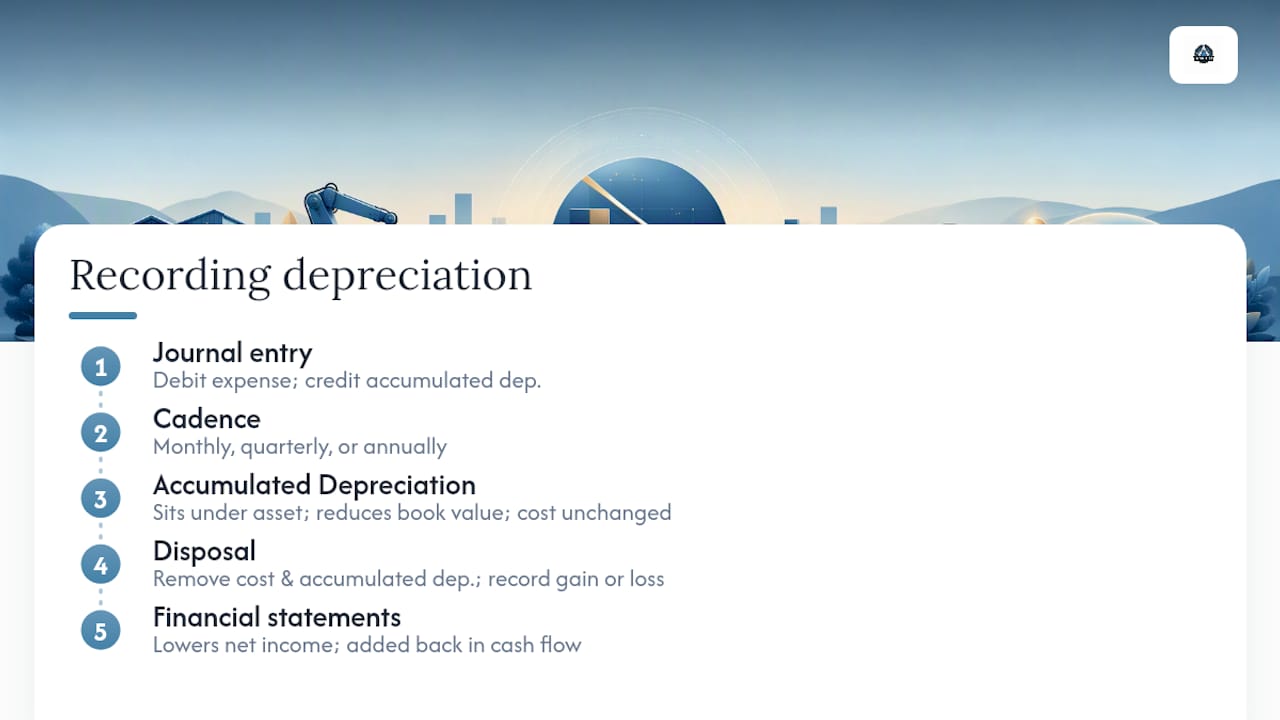
The basic journal entry for depreciation is always the same: debit Depreciation Expense, credit Accumulated Depreciation. This entry typically runs monthly, quarterly, or annually depending on your bookkeeping cadence, and it continues until the asset is either fully depreciated or disposed of, per AccountingVerse.
Sample journal entry (monthly, for the furniture example above):
Accumulated Depreciation is a contra-asset account. It sits on the balance sheet directly under the related asset and reduces its reported value without ever touching the original cost figure, which stays fixed at what you paid.
When you eventually sell or scrap the asset, you record a disposal entry that removes both the original cost and the accumulated depreciation, then calculates any gain or loss against what you received. Sell that furniture for $1,500 after it's fully depreciated to $2,000 book value, and you'd record a $500 loss on disposal.
On the income statement, depreciation expense reduces net income for the period. On the balance sheet, accumulated depreciation reduces the asset's carrying value. And on the cash flow statement, because depreciation never touched actual cash, it gets added back to net income in the operating activities section, which is why a profitable-looking company can still show weaker cash flow than its income statement suggests, and vice versa.
Book Depreciation vs. Tax Depreciation: What's the Difference?
Book depreciation aims for an honest, GAAP-compliant picture of your business's financial health under FASB standards. Tax depreciation follows IRS rules designed to influence business investment and revenue collection, and the two frequently produce different numbers for the exact same asset.
- MACRS (Modified Accelerated Cost Recovery System) assigns IRS-prescribed recovery periods and accelerated depreciation patterns that often move faster than straight-line, per IRS Publication 946.
- Section 179 allows businesses to immediately expense the full cost of qualifying equipment in the year it's placed in service, up to annual limits set by the IRS.
- Bonus depreciation permits an additional first-year deduction percentage on qualifying assets, on top of or instead of Section 179 in some cases.
The IRS also maintains tangible property regulations that govern what you can expense immediately versus what must be capitalized and depreciated, and these rules shift periodically. This is a high-level summary, not tax advice. Section 179 limits, bonus depreciation percentages, and MACRS recovery periods change based on current law, so confirm the specifics with a qualified tax advisor before filing.
What Should Small Businesses Do to Manage Depreciation Well?
Getting depreciation right isn't about mastering every formula. It's about setting a few sensible policies once and sticking to them.
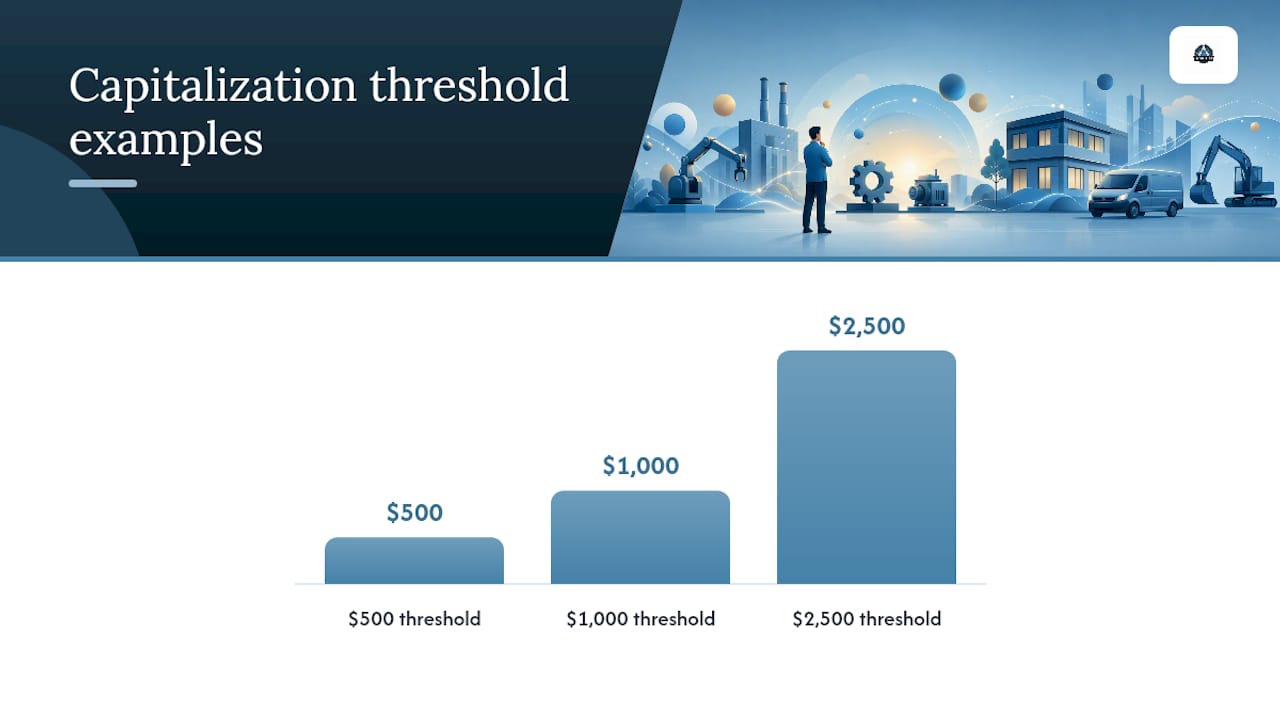
- Set a capitalization threshold (commonly $500 to $2,500) below which purchases are expensed immediately rather than depreciated.
- Document every cost component when you acquire an asset: purchase price, freight, installation, and testing.
- Standardize useful-life assumptions by asset category so you're not guessing differently for every new laptop or vehicle.
- Review depreciation estimates annually, especially for equipment that's aging faster or slower than expected.
- Maintain a fixed-asset register that tracks every depreciable item, its cost basis, and its remaining schedule.
- Run depreciation schedules monthly so your financials stay current instead of getting a rough estimate slapped in at year-end.
Pro Tip: Set your capitalization threshold too low and you'll spend hours tracking depreciation schedules on a $150 office chair. Choose a level like $1,000 or $2,500 that keeps your books clean without burying you in bookkeeping noise over items too small to matter.
Most accounting software, including QuickBooks, can automate depreciation schedules and generate the reporting you need for both book and tax purposes. If your books have gotten messy or you're not confident your existing schedules are accurate, a QuickBooks setup and cleanup engagement is usually faster and cheaper than untangling years of guesswork later.
When Should You Get Professional Help With Depreciation?
Bring in an accountant or fractional CFO when you're facing a complex capital project, trying to optimize tax timing, dealing with a potential impairment, preparing for an audit, or switching accounting systems entirely. These situations carry real financial consequences if handled incorrectly, and DIY mistakes here tend to compound over multiple tax years.
Common services an accountant or fractional CFO provides around depreciation include:
- Setting up or cleaning up QuickBooks to properly track fixed assets
- Building a full depreciation schedule across your entire asset base
- Coordinating book versus tax treatment so your financials and tax return align without surprises
- Reviewing useful-life and salvage-value assumptions for accuracy
- Handling asset disposals, write-offs, and impairment calculations correctly
The math itself is simple. The judgment calls, choosing the right method, defending a useful-life estimate to a lender, or untangling a disposal that's been recorded wrong for two years, are where professional help earns back its cost quickly. A few hours of review upfront is almost always cheaper than an amended tax return or a bank loan denied over financials that don't add up.
A Fractional CFO's View on Getting Depreciation Right
Depreciation choices look small until you're three years into a growing business with a dozen assets on the books, each using a slightly different useful-life assumption because nobody wrote down a policy. I've seen the checklist approach work precisely because it removes the guesswork: set a capitalization threshold, standardize your assumptions by asset category, and review them once a year instead of never.
What surprises most owners is how often the fix isn't a complicated tax strategy. It's just consistency. Businesses across manufacturing, service, and retail sectors all hit the same wall: nobody revisited an estimate after year one, and by year four the schedule bears no resemblance to reality. A fractional CFO's job in these moments is less about finding a clever deduction and more about making sure the numbers you're already tracking actually tell the truth.
How Amcfo Helps You Get Depreciation Right
Depreciation errors compound quietly. A misjudged useful life or a missed Section 179 election doesn't blow up your business overnight, but it distorts your financials and your tax bill for years until someone catches it. Amcfo builds accurate depreciation schedules into the bookkeeping work it already does for clients, so the numbers on your books and your tax return actually match.
Amcfo's accounting and bookkeeping services include QuickBooks setup and cleanup, fixed-asset schedule creation, payroll support, and tax coordination, all handled by people who catch these details before they become a problem at tax time. For businesses juggling bigger capital decisions, like whether to buy equipment outright or finance it, Amcfo's fractional CFO services add the strategic layer: forecasting the tax impact, reviewing useful-life assumptions against your actual usage, and making sure depreciation decisions support your broader financial plan instead of working against it. If your books need a second look or you're not confident your current schedules are right, reach out to Amcfo and get a clear read on where things stand.
Sources
- Federal Reserve — Chapter 3: Property and Equipment
- AccountingTools — Overview of depreciation
- IRS Publication 946 — How To Depreciate Property
- FASB — Financial Accounting Standards Board
This article is general information, not a substitute for advice from a qualified financial advisor. Consult a qualified financial professional about your own circumstances before acting on anything here.