

In accounting, a debit is a left-side ledger entry and a credit is a right-side ledger entry. Every transaction you record must include at least one debit and one credit, and the two sides must always equal each other. For small business owners, that rule is not just bookkeeping formality. It is the mechanism that keeps your financial statements accurate, your taxes defensible, and your cash picture honest.
Table of Contents
- What do debit and credit mean in accounting?
- How debits and credits affect each account type
- Worked examples: journal entries for common transactions
- Why debits must equal credits — and what happens when they don't
- Common confusions about debits and credits — and how to avoid them
- Practical bookkeeping tips you can start using today
- When should you hire a bookkeeper, accountant, or fractional CFO?
- Key Takeaways
- A practitioner's perspective on why this matters more than most guides admit
- Amcfo keeps your books balanced so your decisions aren't
- Useful sources for further reading
What do debit and credit mean in accounting?
The words come from Latin: debere (to owe) and credere (to entrust). In modern double-entry bookkeeping, they simply describe which column of a ledger account gets the entry.
- Debit (Dr.): recorded in the left column of an account.
- Credit (Cr.): recorded in the right column of an account.
- T-account: the visual tool that shows these two columns side by side, shaped like the letter "T."
- Balancing rule: total debits across all accounts must equal total credits for every transaction.
Neither word means "good" or "bad." Whether a debit increases or decreases an account depends entirely on the account type, not on the direction of cash flow.

How debits and credits affect each account type
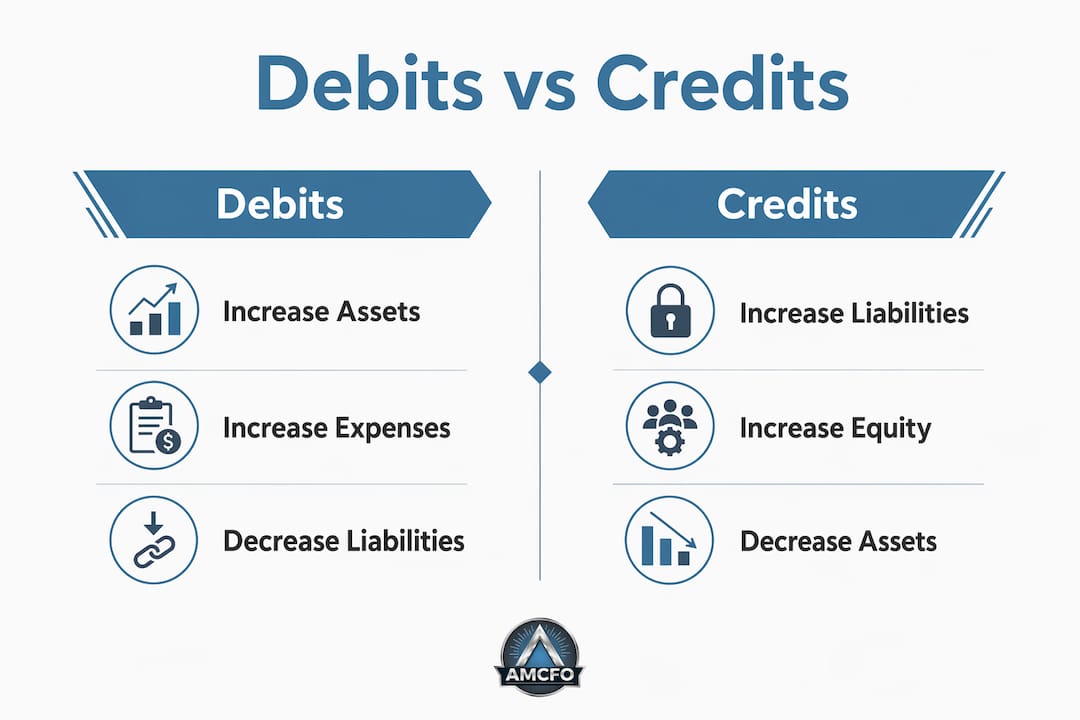
This is the table every beginner needs to memorize. Debits increase assets and expenses; credits increase liabilities, equity, and revenue — and each does the opposite to the other side.
| Account type | A debit does… | A credit does… | Quick example |
|---|---|---|---|
| Assets | Increases the balance | Decreases the balance | Cash received → debit Cash |
| Liabilities | Decreases the balance | Increases the balance | Loan taken → credit Loan Payable |
| Equity | Decreases the balance | Increases the balance | Owner invests cash → credit Owner's Equity |
| Revenue | Decreases the balance | Increases the balance | Service sold → credit Revenue |
| Expenses | Increases the balance | Decreases the balance | Rent paid → debit Rent Expense |
Two mnemonics that stick:
- EA = Expenses and Assets have natural debit balances (they live on the left side of the accounting equation).
- LER = Liabilities, Equity, and Revenue have natural credit balances.
Think of it this way: assets sit on the left side of the equation Assets = Liabilities + Equity, so they naturally carry debit balances. Everything on the right side of that equation carries a credit balance.

Worked examples: journal entries for common transactions
In a general journal, debits are always listed first, credits are indented below. Here are five transactions every small business encounters.
-
Cash sale ($500): You deliver a service and the client pays on the spot.
- Debit Cash $500
- Credit Revenue $500 (Cash, an asset, increases. Revenue increases.)
-
Credit sale ($800): You invoice a client who will pay in 30 days.
- Debit Accounts Receivable $800
- Credit Revenue $800 (You now hold a receivable — an asset — instead of cash.)
-
Expense payment — rent ($1,200): You write a check for office rent.
- Debit Rent Expense $1,200
- Credit Cash $1,200 (Expense increases; cash, an asset, decreases.)
-
Loan received ($10,000): The bank deposits funds in your account.
- Debit Cash $10,000
- Credit Loan Payable $10,000 (Cash rises; so does your liability.) A business line of credit works the same way — the draw hits your Cash account as a debit, and the obligation lands in a liability account as a credit.
-
Equipment purchase on credit ($3,000): You buy a laptop and will pay later.
- Debit Equipment $3,000
- Credit Accounts Payable $3,000 (One asset rises; a liability rises to match it.)
T-account visual for the cash sale (Example 1):
        Cash                    Revenue
  ┌────────┬────────┐     ┌────────┬────────┐
  │  Dr.   │  Cr.   │     │  Dr.   │  Cr.   │
  │  $500  │        │     │        │  $500  │
  └────────┴────────┘     └────────┴────────┘
Value moves from the Revenue account to the Cash account. The left side of Cash grows; the right side of Revenue grows. Both sides of the ledger stay in balance.
Why debits must equal credits — and what happens when they don't
The balancing requirement enforces the accounting equation: Assets = Liabilities + Equity. Every transaction either shifts value within the equation or adds equal amounts to both sides. When the books do not balance, something went wrong.
An unbalanced trial balance is often the first practical sign of a recording problem, and catching it early prevents decisions based on faulty numbers.
Common issues an imbalance exposes:
- A missing transaction (only one side was posted)
- A miscategorized entry (debit posted to the wrong account type)
- A math or data-entry error (amounts do not match)
- A duplicate posting on one side
Example: You pay a $400 vendor invoice. You debit Accounts Payable $400 but forget to credit Cash. Your trial balance is now off by $400. The fix is straightforward: find the missing credit, post it, and re-run the trial balance. Left uncorrected, that gap distorts your cash balance and your expense totals on the income statement.
Common confusions about debits and credits — and how to avoid them
The biggest source of confusion is the word "debit" itself. Your bank statement shows a debit when money leaves your checking account, which feels like a decrease. But in your own accounting books, that same checking account is an asset, so a debit actually increases it. Debits and credits do not universally mean money in or money out — the effect depends entirely on the account type.
The bank is recording the transaction from its own perspective. From the bank's view, your deposit is a liability it owes you, so the bank credits your account. In your books, the same deposit is an asset, so you debit it. Same cash, opposite entries. That is why beginners confuse debit-card withdrawals with accounting debits and end up with recording errors.
A short checklist for reading any journal entry:
- Identify every account affected.
- Determine each account's type (Asset, Liability, Equity, Revenue, or Expense).
- Apply EA/LER: does this transaction increase or decrease that account?
- Confirm debits are on the left, credits on the right.
- Verify the total debit amount equals the total credit amount.
Rule of thumb: when in doubt, ask "what is receiving value, and what is giving it?" The account receiving value gets the debit; the account giving value gets the credit. This framing, used by NetSuite's accounting guides, works for non-cash items like depreciation and accruals too.
Practical bookkeeping tips you can start using today
Knowing the rules is step one. Keeping your books clean week after week is where most small business owners struggle.
- Use cloud accounting software. Platforms that force every journal entry to net to zero before posting prevent unbalanced entries from ever hitting your ledger.
- Reconcile your bank account monthly. Match every transaction in your books to your bank statement. Gaps reveal missing entries before they compound.
- Review your trial balance regularly. A quick scan shows whether total debits equal total credits and flags any account with an unexpected balance.
- Separate owner draws from business expenses. Mixing them distorts both your equity account and your profit figures.
- Keep a chart of accounts current. Posting to the wrong account is as damaging as posting to the wrong side.
Pro Tip: Reconcile within the first five business days of the following month, while transactions are still fresh. Waiting until quarter-end turns a 30-minute task into a multi-hour cleanup. Businesses that reconcile monthly catch errors when the paper trail is easy to follow; those that wait often need a full bookkeeping cleanup to untangle months of compounded mistakes.
Understanding how these entries connect to your overall cash position also matters for growth planning. Free cash flow starts with accurate ledger entries — if your debits and credits are wrong, your cash flow picture is wrong too.
When should you hire a bookkeeper, accountant, or fractional CFO?
DIY bookkeeping works until it doesn't. These are the signals that you have crossed the line.
- Transactions regularly go unreconciled for more than 30 days
- Your trial balance does not balance and you cannot find why
- Payroll has grown beyond a handful of employees
- Revenue is growing fast and your books cannot keep pace
- Tax prep requires significant cleanup before your accountant can start
- You are making pricing or hiring decisions without reliable financial data
When those signals appear, the question shifts from whether to get help to who to hire. Here is what to ask any bookkeeper or fractional CFO before you engage them.
- What accounting software do you work in, and can you handle our current setup?
- How do you handle month-end close and what is your turnaround time?
- Can you provide references from businesses in our industry or at our revenue stage?
- How do you communicate findings — reports, calls, dashboards?
- What does your onboarding process look like, and how long until our books are current?
Pro Tip: A bookkeeper who cannot explain a trial balance discrepancy in plain language is a red flag. You do not need to understand every entry, but your provider should be able to walk you through any number on your financial statements without hesitation. See 7 signs your business needs a bookkeeper for a fuller checklist.
Key Takeaways
Debits and credits are the two-sided recording system that keeps every business's financial statements accurate and trustworthy.
| Point | Details |
|---|---|
| Left = debit, right = credit | Every ledger entry goes in one of two columns; position never changes regardless of account type. |
| EA/LER mnemonic | Expenses and Assets increase with debits; Liabilities, Equity, and Revenue increase with credits. |
| Every transaction must balance | Total debits must equal total credits — an imbalance signals a missing entry, miscategorization, or math error. |
| Reconcile monthly | Matching your books to your bank statement monthly catches errors before they compound into costly cleanups. |
| Amcfo handles it for you | Amcfo's bookkeeping and fractional CFO services keep your ledger balanced, your reconciliations current, and your financials decision-ready. |
A practitioner's perspective on why this matters more than most guides admit
Most explainers treat debits and credits as a memorization exercise. Learn the table, apply the rule, done. That framing misses the real point.
The double-entry system is not just a recording convention. It is a built-in error-detection mechanism. Every time you post a transaction, you are running a silent audit. If the books balance, the transaction was recorded consistently. If they do not, something is wrong and the system tells you immediately. No other part of your financial process gives you that kind of instant feedback.
What small business owners underestimate is how quickly small recording errors compound. A single miscategorized expense does not just affect one line on your income statement. It distorts your gross margin, your expense ratios, and potentially your tax liability. By the time you notice, you may be looking at months of decisions made on bad data.
The owners who get the most value from understanding debits and credits are not the ones who memorize the rules and do their own books forever. They are the ones who understand the system well enough to review their financials critically, ask sharp questions of their bookkeeper, and catch problems early. That oversight function is worth far more than the time spent on data entry.
Amcfo keeps your books balanced so your decisions aren't
Knowing what debit and credit mean is the foundation. Keeping every entry accurate, every account reconciled, and every report ready when you need it is a different job entirely.

Amcfo provides bookkeeping and accounting services built for businesses that need clean, reliable financials without hiring a full-time finance team. From QuickBooks setup and monthly reconciliations to full fractional CFO support, the team handles the ledger work so you can focus on running the business. If your books are behind, your trial balance is off, or you simply want a second set of expert eyes on your financials, reach out to Amcfo for a bookkeeping review.
This article is general educational information, not professional accounting or tax advice. Confirm the specifics of your situation with a qualified accounting professional.
Useful sources for further reading
- AccountingCoach — Debits and Credits Explanation: Worked examples and T-account visuals that reinforce the journal-entry mechanics covered here.
- AccountingTools — Debits and Credits Definition: Concise, practitioner-level definitions with clear rules for each account type.
- Investopedia — Debit: Accessible overview of natural balances and how debits function across account categories.
- NetSuite — Debits and Credits: Broader context on value-based recording, including non-cash items like depreciation and accruals.
- Xero — Debits and Credits Guide: Software-focused guidance on applying the EA/LER rules inside cloud accounting tools, with reconciliation best practices.