

Real estate accounting is the specialized practice of recording, tracking, and reporting all financial transactions tied to property investments, rentals, and real estate operations. Unlike general business accounting, it demands property-level tracking, trust account management, and compliance with state-specific fiduciary rules. Tools like DoorLoop, Sage, NetSuite, and Xero have become standard in the industry because the complexity of managing multiple properties, leases, and owner distributions goes far beyond what a basic spreadsheet can handle. Whether you manage a single rental or a commercial portfolio, getting this right is the foundation of real estate finance.
What is real estate accounting and how does it work?
Real estate accounting is a distinct financial discipline built around property transactions, not just business income and expenses. It tracks revenue and costs at the property level, the unit level, and the lease level. That granularity is what separates it from standard bookkeeping and makes it both more demanding and more revealing.
The core components include rent rolls, tenant ledgers, trust accounts, owner distributions, depreciation schedules, and monthly financial reports. Each property functions almost like its own business entity within your books. A 10-unit apartment building, for example, requires separate income tracking per unit, expense allocation by property, and a trust account for security deposits held on behalf of tenants.

Real estate tax accounting adds another layer. Depreciation deductions, 1031 exchanges, passive activity rules, and cost segregation studies all require precise records to execute correctly. Errors in this area translate directly into overpaid taxes or IRS exposure.
How does real estate accounting differ from property management accounting?
Real estate accounting and property management accounting are related but not identical. Real estate accounting covers the full financial picture of owning property assets, including acquisition costs, financing, depreciation, and portfolio-level reporting. Property management accounting zooms in on the day-to-day operational finances of managing those properties on behalf of owners.
The most important distinction is fiduciary responsibility. Property managers hold funds that belong to tenants and owners. Trust accounts hold security deposits and owner funds separately from operating funds, as mandated by state laws. Commingling those funds is a legal violation in most states, not just a bookkeeping error.
General business accounting tracks revenue and expenses at the company level. Property management accounting tracks financial activity by property, unit, and lease, which requires a segmented ledger structure that most standard accounting systems are not built to handle natively.
| Feature | General Business Accounting | Property Management Accounting |
|---|---|---|
| Tracking level | Company-wide | Per property, unit, and lease |
| Trust accounts | Not required | Legally required in most states |
| Reporting frequency | Quarterly or annual | Monthly per owner |
| Fiduciary duty | Minimal | High, legally enforced |
| Software fit | QuickBooks, general ERP | DoorLoop, Yardi, AppFolio |
Pro Tip: If you manage properties for third-party owners, treat trust accounting as a non-negotiable legal obligation, not an optional best practice. A single commingling violation can cost you your property management license.
What accounting methods are used in real estate, and when should you use each?
Two accounting methods govern how real estate investors and managers record their finances: cash basis and accrual basis. Choosing the wrong one for your situation produces misleading financial statements and tax complications.
Cash basis accounting is simpler and records income when cash is received and expenses when cash is paid. A small landlord with two or three single-family rentals can manage effectively on cash basis. The records are easy to maintain, and the tax picture is straightforward.
Accrual accounting records income when earned and expenses when incurred, regardless of when cash changes hands. This method suits larger portfolios, commercial properties, and any situation involving long-term leases. If a tenant owes January rent but pays in february, accrual accounting shows that income in January where it belongs.
Here is when each method makes the most sense:
- Cash basis: Fewer than five properties, no commercial leases, simple tax situation, owner-operated with no outside investors
- Accrual basis: Five or more properties, commercial tenants, investor reporting requirements, complex lease structures, or plans to scale
- Hybrid approach: Some investors use cash basis for tax filing but maintain accrual records internally for management decisions
Pro Tip: Even if you file taxes on cash basis, maintain accrual-based internal reports. Lenders and investors will ask for accrual financials when you apply for financing or bring on equity partners.
What are the essential elements of effective real estate accounting?
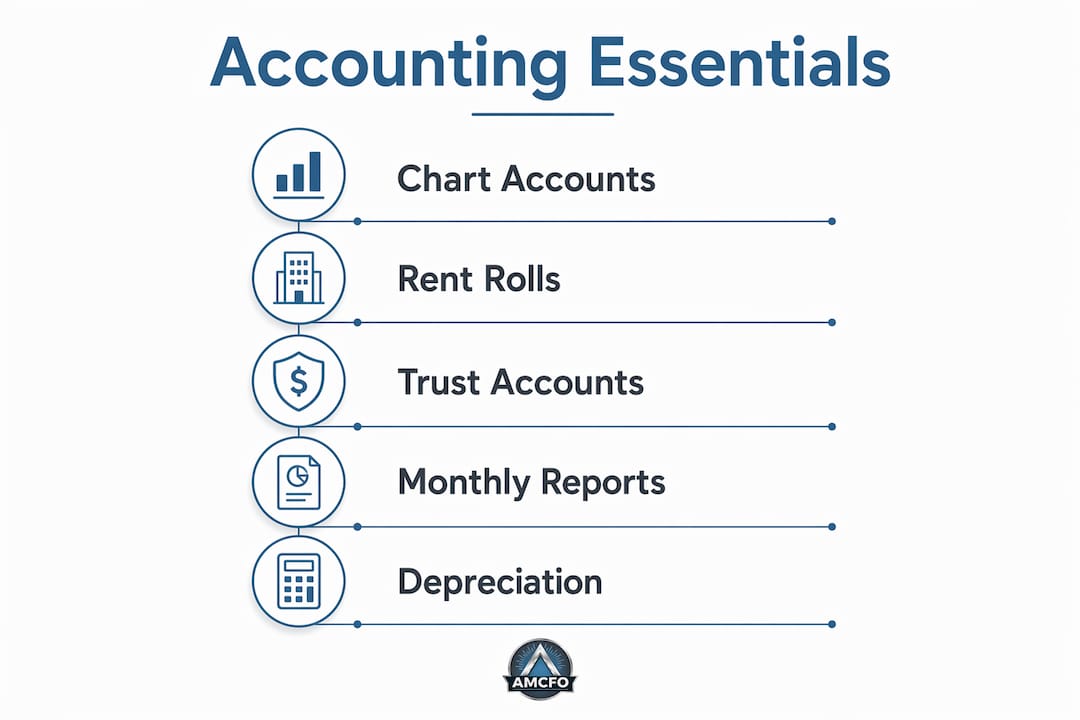
A well-built real estate accounting system has five core components. Each one serves a specific function, and skipping any of them creates gaps that compound over time.
1. Chart of accounts organized by property
A chart of accounts organized by property entity and transaction type simplifies analysis and regulatory reporting. Each property should have its own income, expense, asset, and liability categories. This structure makes it possible to pull a profit and loss statement for a single building in minutes.
2. Rent rolls and tenant ledgers
A rent roll is a snapshot of all current leases, monthly rent amounts, and payment status. Tenant ledgers track every charge, payment, and balance for each tenant over time. Together, they give you a real-time view of rental income and delinquency.
3. Trust account management
Security deposits and owner reserve funds must sit in separate trust accounts. Maintaining separate bank accounts for operating funds and trust funds avoids commingling and satisfies fiduciary obligations. Most states require annual reconciliation of trust accounts, and some require monthly.
4. Monthly financial reporting
Property management accounting produces monthly financial reports for owners and investors, unlike general business accounting which often produces annual summaries. Monthly reporting lets owners catch underperforming properties early and make decisions before small problems become large ones. A standard monthly package includes a profit and loss statement, balance sheet, rent roll, and owner distribution summary.
5. Expense allocation and depreciation tracking
Every expense must be allocated to the correct property. Repairs, insurance, property taxes, and management fees all need to land in the right ledger. Depreciation tracking is equally critical for real estate tax accounting, since residential properties depreciate over 27.5 years and commercial properties over 39 years under IRS rules.
Pro Tip: Use financial reporting best practices from 2026 guidance to structure your monthly owner reports. Consistent formatting across all properties makes portfolio-level analysis far faster.
Which software tools simplify real estate accounting tasks?
Specialized software like DoorLoop, Sage, NetSuite, and Xero automates rent tracking, expense allocation, financial reporting, and compliance tasks. Each platform targets a different segment of the market, so the right choice depends on your portfolio size and complexity.
- DoorLoop: Built specifically for property managers. It handles tenant ledgers, trust accounting, online rent collection, and owner reporting in one platform. Best for residential portfolios of any size.
- Sage: Strong general accounting with property management modules. Sage suits operators who want deep financial reporting and integration with payroll or tax tools. It is a common choice for mid-size commercial operators.
- NetSuite: An enterprise-grade ERP used by large real estate companies and REITs. NetSuite handles multi-entity consolidation, complex lease accounting under ASC 842, and advanced financial analysis.
- Xero: A cloud accounting platform that works well for smaller real estate investors and agents who need clean bookkeeping without the overhead of a full property management system. Xero integrates with tools like Gusto for payroll and Hubdoc for document management.
- QuickBooks Online: Widely used by real estate agents and small investors. It lacks native property management features but works well when combined with a well-structured chart of accounts and manual rent tracking.
The key feature to evaluate in any platform is automated rent tracking and ledger management. Manual entry at scale creates errors. Software that pulls bank feeds, matches transactions, and flags discrepancies saves hours each month and reduces audit risk.
How do you set up real estate accounting and avoid common mistakes?
Setting up a real estate accounting system correctly from the start prevents the most common and costly errors. Follow these steps to build a system that holds up under growth and scrutiny.
- Separate personal and business finances immediately. Open a dedicated business checking account for each property entity. Mixing personal and business transactions is the single most common mistake among new investors, and it creates tax and legal exposure.
- Build a property-specific chart of accounts. Use a structure that mirrors your portfolio. Each property gets its own income and expense categories. If you use QuickBooks, set up classes or locations to segment transactions by property.
- Open trust accounts before collecting deposits. Do not collect security deposits into your operating account. Open a separate trust account first. This is a legal requirement in most states, not a preference.
- Establish a monthly close process. Reconcile all bank accounts, review the rent roll for delinquencies, allocate expenses to the correct properties, and generate owner reports by the 15th of each month. Consistency here prevents year-end chaos.
- Consult a real estate accounting professional before tax season. Real estate tax accounting involves depreciation recapture, passive activity loss rules, and entity structure decisions that have significant dollar impacts. A specialist pays for themselves many times over.
Common mistakes to avoid include incorrect trust account reconciliation, failing to track lease start and end dates, misclassifying capital improvements as repairs, and skipping monthly owner reports. Effective property management accounting requires detailed tracking that goes well beyond standard bookkeeping, including trust fund management and monthly owner reporting.
Pro Tip: Schedule a quarterly review with an outside accountant or fractional CFO. Fresh eyes catch allocation errors and compliance gaps that internal teams miss. Consider outsourcing accounting services if your portfolio grows faster than your internal capacity.
Key Takeaways
Effective real estate accounting requires property-level tracking, trust account compliance, monthly reporting, and the right accounting method for your portfolio size.
| Point | Details |
|---|---|
| Property-level tracking | Organize your chart of accounts by property to enable accurate reporting and fast analysis. |
| Trust account compliance | Keep security deposits and owner funds in separate accounts to meet state legal requirements. |
| Accounting method choice | Use cash basis for small portfolios and accrual basis for larger or commercial properties. |
| Monthly financial reports | Produce owner reports monthly, not annually, to catch performance issues early. |
| Software selection | Match your platform to your portfolio size: DoorLoop for residential, NetSuite for enterprise scale. |
What I have learned after years of watching real estate books go wrong
The most expensive mistake I see real estate investors make is treating accounting as a year-end tax exercise rather than a monthly management tool. By the time they sit down with a CPA in march, they have already made a dozen decisions based on incomplete financial data. A property that looked profitable on paper was actually losing money once expenses were allocated correctly.
The shift toward accrual accounting is real and necessary. Accrual accounting is increasingly favored by property management professionals for larger portfolios because it aligns income and expenses with the periods they relate to. I have seen investors refinance based on cash basis financials, only to discover their actual net operating income was lower than reported once deferred expenses were recognized.
Technology has changed what is possible for smaller operators. Five years ago, a 10-unit landlord had no realistic alternative to a spreadsheet or a basic QuickBooks setup. Today, platforms like DoorLoop put enterprise-grade property accounting within reach of individual investors at a fraction of the cost. The barrier is not the software anymore. It is the discipline to use it consistently.
My honest advice: do not wait until you have 20 properties to build a real accounting system. Build it at property one. The habits you form early determine whether your portfolio scales cleanly or collapses under its own complexity.
— Angelica
How Amcfo supports real estate accounting and financial management
Real estate accounting is complex enough without trying to manage it alone. Amcfo provides accounting and bookkeeping services built for businesses that need accurate, property-level financial reporting without hiring a full-time CFO.

From QuickBooks setup and cleanup to monthly financial reporting, trust account reconciliation, and tax coordination, Amcfo handles the details that keep your portfolio financially sound. The fractional CFO services add strategic oversight for investors managing multiple entities or preparing for acquisitions. If your books are behind, your reports are inconsistent, or you are not sure which accounting method fits your portfolio, Amcfo is the right call.
FAQ
What is real estate accounting?
Real estate accounting is the specialized practice of tracking income, expenses, assets, and liabilities tied to property investments and operations. It includes property-level reporting, trust account management, and real estate tax accounting.
How is property management accounting different from real estate accounting?
Property management accounting focuses on day-to-day operational finances for managed properties, including tenant ledgers and trust accounts. Real estate accounting covers the broader financial picture of owning and investing in property assets.
Should I use cash or accrual accounting for my rental properties?
Cash basis works for small landlords with simple portfolios. Accrual basis is the better choice for larger portfolios, commercial leases, or any situation requiring investor-grade financial reporting.
What software is best for real estate bookkeeping?
DoorLoop is the top choice for residential property managers. Xero suits smaller investors, while NetSuite handles large commercial portfolios. The right platform depends on your portfolio size and reporting needs.
What are the most common real estate accounting mistakes?
The most common mistakes include commingling trust funds with operating accounts, misclassifying repairs as capital improvements, skipping monthly reconciliations, and failing to track lease terms accurately in tenant ledgers.