

A capital expenditure (CapEx) is money a business spends to acquire, improve, or extend the useful life of a long-term asset — one that delivers economic benefits for more than one year. Under U.S. GAAP, that cost gets recorded as an asset on the balance sheet and then allocated to expense gradually through depreciation or amortization, not written off all at once. That single accounting decision ripples through your income statement, cash flow statement, and tax return in ways that a misclassified expense never would.
The practical bottom line:
- CapEx shows up on the balance sheet as a long-term asset, not immediately on the income statement.
- Cash paid for CapEx flows through the investing activities section of the cash flow statement.
- The IRS offers accelerated options (Section 179, bonus depreciation) that can change the tax timing dramatically.
- Misclassifying a CapEx as an operating expense, or vice versa, distorts both profit and taxable income.
Table of Contents
- What counts as a capital expenditure?
- How CapEx is recorded in your financial statements
- How do you decide whether to capitalize a cost?
- CapEx vs. OpEx: what's the real difference?
- U.S. tax rules that change the CapEx calculation
- How to plan and budget CapEx the right way
- Common CapEx mistakes and how to fix them
- Key Takeaways
- Why most businesses get CapEx wrong until it costs them
- Amcfo handles CapEx accounting so you can focus on the decision
- Authoritative sources for further reading
What counts as a capital expenditure?
Capital expenditures span two broad categories: tangible assets you can touch and intangible assets you cannot.
Tangible CapEx examples:
- Land and land improvements (grading, paving)
- Commercial buildings and major renovations
- Manufacturing machinery and heavy equipment
- Company vehicles and fleet additions
- Computer hardware and data-center infrastructure
- Furniture and fixtures above your capitalization threshold
Intangible CapEx examples:
- Purchased software licenses with multi-year useful lives
- Patents, trademarks, and other acquired intellectual property
- Internally developed software costs that meet GAAP capitalization criteria under ASC 350-40
- Customer lists or non-compete agreements acquired in a business purchase
The contrast with routine purchases is sharp. Office supplies, printer paper, and monthly software subscriptions are not CapEx. Neither is a $300 repair that simply keeps a machine running at its current level. The moment a purchase extends useful life or adds new capacity, the classification shifts.
Borderline case worth knowing: A software subscription (SaaS) is almost always OpEx because you never own the underlying asset. But if your team builds a custom internal platform, the development-phase coding costs can be capitalized under ASC 350-40 once technological feasibility is established. The delivery model, not the dollar amount, drives the call.
Pro Tip: Keep a running log of borderline purchases throughout the year. Reviewing them quarterly with your accountant is far easier than reconstructing intent at year-end when the invoices are buried.
How CapEx is recorded in your financial statements
The capitalization mechanic
When you buy a long-term asset, you do not expense it immediately. You record it as an asset and then spread the cost over its useful life. This is the matching principle at work: the expense hits the income statement in the same periods the asset generates revenue. The total cost capitalized includes the purchase price plus shipping, taxes, installation, and any other cost necessary to bring the asset into service.

Depreciation vs. amortization
Depreciation applies to tangible assets (machinery, vehicles, buildings). Amortization applies to intangible assets (patents, capitalized software). Both spread the cost; the terminology differs by asset type. Straight-line depreciation is the most common method for book purposes:
Annual depreciation = (Cost − Salvage value) ÷ Useful life in years
A $50,000 machine with a $5,000 salvage value and a 10-year life generates $4,500 of depreciation expense per year.
Sample journal entries
1. Initial purchase (cash):
| Account | Debit | Credit |
|---|---|---|
| Machinery (asset) | $50,000 | |
| Cash | $50,000 |
2. Annual depreciation recognition:
| Account | Debit | Credit |
|---|---|---|
| Depreciation Expense | $4,500 | |
| Accumulated Depreciation | $4,500 |
Accumulated Depreciation is a contra-asset account. It sits on the balance sheet directly below the asset and reduces its carrying value each year.
Cash flow statement impact
CapEx appears in the investing activities section of the cash flow statement, not in operating activities. This matters because a company can show strong operating cash flow while simultaneously spending heavily on growth assets. CapEx can be approximated as the change in gross PP&E plus depreciation for the period. Analysts watch this figure closely because it signals whether a business is investing in future capacity or coasting on existing infrastructure.
Key accounting principle: Capitalizing a cost does not reduce net income in the current year the way expensing does. It reduces it gradually. That timing difference is exactly why misclassification matters so much to lenders, investors, and the IRS.
| Asset type | Balance-sheet account | Contra account | Expense account |
|---|---|---|---|
| Building | Property, Plant & Equipment | Accumulated Depreciation | Depreciation Expense |
| Vehicle | Property, Plant & Equipment | Accumulated Depreciation | Depreciation Expense |
| Patent | Intangible Assets | Accumulated Amortization | Amortization Expense |
| Capitalized software | Intangible Assets | Accumulated Amortization | Amortization Expense |
How do you decide whether to capitalize a cost?
Three questions settle most classification decisions:
- Does the asset have a useful life longer than one year? If the benefit is consumed within 12 months, expense it.
- Does it provide a future economic benefit? The asset must generate revenue, reduce costs, or otherwise contribute to operations beyond the current period.
- Is the cost material enough to warrant tracking? Most organizations set a dollar threshold below which they expense everything automatically, regardless of useful life.
Materiality and capitalization thresholds
Organizations commonly set a capitalization threshold — for example, $2,000 — under which expenditures are expensed immediately to avoid administrative overhead. A $150 keyboard with a five-year useful life is technically CapEx, but tracking it as an asset costs more in accounting time than it saves. The threshold is a practical policy decision, not a GAAP requirement, and it should be documented in writing.
Costs that join the asset vs. costs that do not
Capitalizable costs extend beyond the purchase price and include shipping, taxes, assembly, installation, and any preparation needed to put the asset into service. Costs incurred after the asset is operational — routine maintenance, consumables, minor repairs — stay on the income statement as OpEx.
Quick decision checklist:
- Useful life > 1 year? Yes → continue. No → expense.
- Future economic benefit? Yes → continue. No → expense.
- Above your capitalization threshold? Yes → capitalize. No → expense.
- Cost necessary to bring asset into service? Yes → add to asset cost. No → expense separately.
Pro Tip: Write your capitalization policy into a one-page document and share it with anyone who codes invoices. Inconsistent thresholds across departments are one of the most common audit findings for small and mid-size businesses.
CapEx vs. OpEx: what's the real difference?
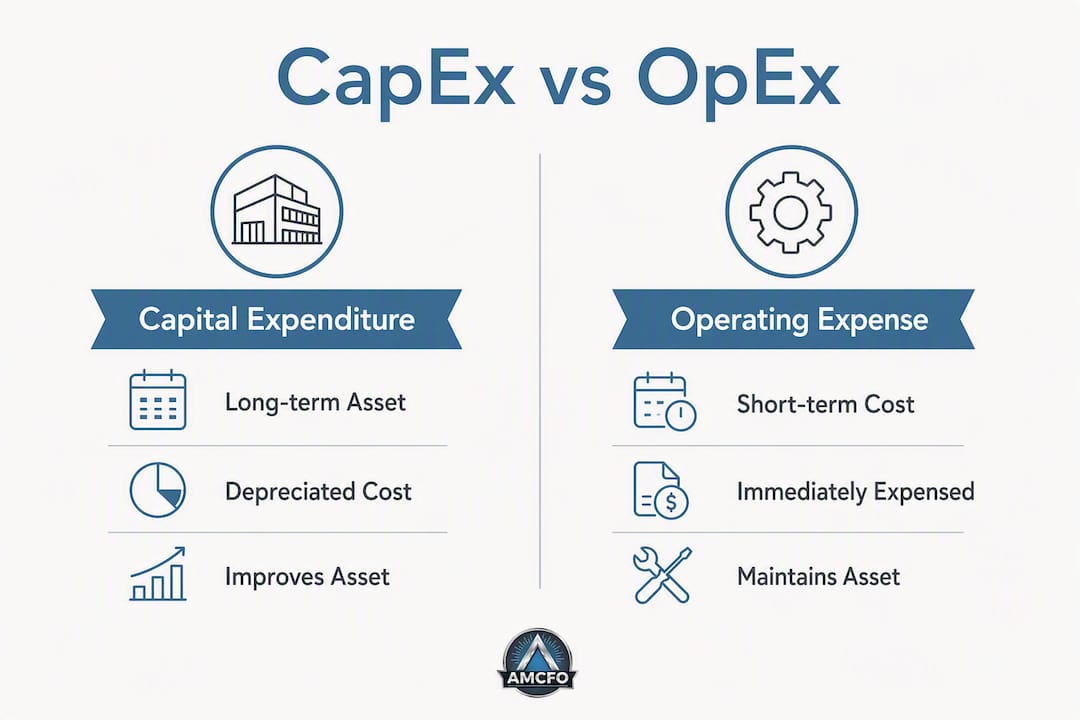
Capital expenditures are one-time investments in long-term assets. Operating expenses (OpEx) are the recurring costs of running the business day to day. The distinction sounds simple, but the financial-statement consequences are significant.
How each affects your financials:
- CapEx: Hits the balance sheet first, then flows to the income statement gradually through depreciation. No immediate P&L hit in the year of purchase.
- OpEx: Hits the income statement immediately and in full. Reduces taxable income in the current period.
The tax timing difference is where many small-business owners get tripped up. Expensing something that should be capitalized reduces taxable income now but overstates expenses. Capitalizing something that should be expensed inflates current-year net income and defers the tax deduction. Misclassification distorts both profitability and tax outcomes.
| Transaction | Classification | Reason |
|---|---|---|
| Buying a delivery truck | CapEx | Long-term asset, useful life > 1 year |
| Fuel and routine oil changes | OpEx | Recurring operating cost |
| Building a new warehouse | CapEx | Major long-term asset |
| Monthly rent for office space | OpEx | Recurring, no asset ownership |
| Replacing a broken HVAC unit | CapEx | Restores and extends useful life |
| Annual HVAC maintenance contract | OpEx | Routine upkeep, no life extension |
| Purchasing a patent | CapEx | Intangible asset with multi-year benefit |
| Monthly accounting software subscription | OpEx | No ownership, consumed period by period |

The HVAC example is worth pausing on. Replacing a unit entirely is CapEx because you are acquiring a new asset. Paying for the annual service contract is OpEx because you are maintaining existing capacity, not adding to it.
U.S. tax rules that change the CapEx calculation
Book depreciation under GAAP and tax depreciation under IRS rules are two separate calculations. You maintain both, and they rarely match.
Section 179 and bonus depreciation are the two tools that matter most for most businesses. Under U.S. tax practice, both allow businesses to elect immediate expensing for qualifying property rather than depreciating it over years. Section 179 lets you deduct the full cost of qualifying equipment and software in the year placed in service, up to an annual limit set by the IRS. Bonus depreciation allows an additional first-year deduction on qualifying new and used property, though the percentage has been phasing down under current law.
Practical note: Section 179 cannot create a tax loss — it is limited to your business's taxable income. Bonus depreciation has no such restriction, which makes it the more powerful tool for businesses with large CapEx years. Confirm current limits with your tax advisor, as Congress has adjusted these provisions repeatedly.
ASC 842 and lease accounting add another layer. Under ASC 842, many operating leases now require a right-of-use asset and a corresponding lease liability on the balance sheet. That presentation mimics CapEx even though the cash flows are classified differently. Lenders and analysts reading your balance sheet will see the asset; your tax return may treat the same lease as a simple rent deduction. Coordinating your accounting and tax teams on lease treatment avoids surprises.
Steps to coordinate book and tax CapEx treatment:
- Maintain a fixed-asset register that tracks both book and tax basis for every asset.
- Document Section 179 and bonus depreciation elections in writing each year.
- Flag new leases for ASC 842 review before signing.
- Reconcile book depreciation to tax depreciation annually as part of your tax-provision process.
- Involve a tax advisor before any large purchase to model the timing of deductions.
How to plan and budget CapEx the right way
Most businesses treat CapEx as a surprise. The ones that manage it well treat it as a forecast. Here is the planning sequence Amcfo uses with clients:
- Identify the need. Is this a growth investment, a replacement, or a regulatory requirement? The answer shapes the approval threshold.
- Estimate total cost. Include purchase price, freight, installation, training, and any site preparation. Underestimating total cost is the most common CapEx budgeting error.
- Assign useful life and salvage value. These drive your depreciation schedule and affect both book income and tax planning.
- Choose a depreciation method. Straight-line is standard for book purposes. Accelerated methods (MACRS for tax, double-declining balance for book) front-load the expense.
- Secure approval. Document who approved the purchase, the business justification, and the expected return.
- Track actuals vs. budget. Record actual costs as they are incurred and compare to the approved budget monthly.
Fields every CapEx tracker should include:
- Asset description and category
- Vendor and purchase date
- Total capitalized cost (all-in, not just invoice price)
- Estimated useful life and salvage value
- Depreciation method (book and tax)
- Section 179 or bonus depreciation election (yes/no)
- Budget vs. actual variance
CapEx levels reflect strategic intent: heavy growth-oriented spending signals expansion, while maintenance-focused spending signals capacity preservation. A fractional CFO can help you read that signal and align your spending plan with your actual growth goals.
Pro Tip: If you are making a significant single purchase, or if your total CapEx for the year represents a substantial portion of revenue, that is a good moment to bring in an advisor. The tax-timing decisions alone often pay for the consultation.
Common CapEx mistakes and how to fix them
Misclassifying repairs vs. improvements
The most frequent error is expensing a capital improvement as a repair. Replacing a roof is CapEx. Patching a leak is OpEx. The distinction turns on whether the work extends useful life or increases productive capacity — routine repairs stay on the income statement, but substantial upgrades that add value get capitalized. Expensing an improvement inflates current expenses and understates assets. Capitalizing a routine repair inflates assets and overstates net income.
Leaving costs out of the asset's basis
Many businesses capitalize only the invoice price and miss freight, installation, and setup costs. The full cost of acquiring an asset includes every dollar spent to bring it into service. Understating the asset's basis means understating depreciation expense every year going forward.
Other common errors:
- No written capitalization policy, so different staff members classify the same type of purchase differently.
- Inconsistent thresholds across departments or entities.
- Failing to retire assets from the fixed-asset register when they are disposed of or replaced.
- Not reconciling accumulated depreciation to the general ledger annually.
Corrective actions to take now:
- Pull your fixed-asset register and compare it to recent invoices. Look for large expenses coded to repairs that might be improvements.
- Write a one-page capitalization policy with a clear dollar threshold and examples.
- Reconcile accumulated depreciation to the general ledger at least once per year.
- Train anyone who codes vendor invoices on the difference between CapEx and OpEx.
Key Takeaways
A capital expenditure is recorded as a long-term asset and depreciated over time, not expensed immediately — and that single distinction drives your balance sheet, tax return, and cash flow statement in fundamentally different directions.
| Point | Details |
|---|---|
| Core definition | CapEx = spending on assets with useful life > 1 year; recorded on the balance sheet, not the income statement. |
| Accounting treatment | Capitalize the full all-in cost, then depreciate (tangible) or amortize (intangible) over the asset's useful life. |
| CapEx vs. OpEx | CapEx defers the expense; OpEx hits the P&L immediately — misclassifying either distorts profit and taxes. |
| U.S. tax tools | Section 179 and bonus depreciation can allow immediate expensing for qualifying assets, changing near-term tax liability. |
| Amcfo support | Amcfo helps businesses set capitalization policies, maintain fixed-asset registers, and coordinate book and tax treatment. |
Why most businesses get CapEx wrong until it costs them
There is a pattern Amcfo sees repeatedly: a business owner buys a $40,000 piece of equipment, codes the whole thing to an expense account because it "feels like a big cost," and then wonders why the income statement looks terrible and the tax return does not match expectations. The accounting is wrong in both directions simultaneously.
The deeper issue is that CapEx decisions are not just accounting decisions. They are strategic ones. A business that spends heavily on new equipment is making a bet on future revenue. A business that defers replacement CapEx is quietly running down its productive capacity. Neither of those bets shows up clearly on a P&L unless the CapEx is classified and tracked correctly.
What I find underappreciated is the policy layer. Most small businesses have no written capitalization policy. That means every bookkeeper, every office manager, and every new hire makes judgment calls independently. The result is a fixed-asset register full of inconsistencies that take hours to untangle at audit time. A single one-page document, reviewed annually, eliminates most of that friction.
The other thing worth saying plainly: the gap between book depreciation and tax depreciation is not a problem to solve. It is a tool to use. Section 179 and bonus depreciation exist precisely to let businesses accelerate deductions on qualifying assets. But you can only use them intentionally if someone is tracking the asset register and modeling the tax impact before the purchase, not after.
Amcfo handles CapEx accounting so you can focus on the decision
Getting CapEx right is not just about clean books. It affects your tax bill, your loan covenants, and the accuracy of every forecast you build on top of your financials.

Amcfo provides accounting and bookkeeping services that include fixed-asset tracking, depreciation schedule maintenance, and capitalization policy setup. For businesses facing larger or more complex CapEx decisions, Amcfo's fractional CFO services cover budgeting, tax coordination with your CPA, and ongoing oversight of your asset register. You get the financial infrastructure of a full finance team without the overhead of building one in-house.
If your fixed-asset register is out of date, your capitalization policy is unwritten, or you are about to make a significant equipment or technology purchase, reach out to Amcfo to schedule a consultation. The earlier you bring in the right support, the more options you have.
Authoritative sources for further reading
The sources below are the primary authorities for U.S. CapEx accounting and tax rules. Each covers a distinct layer of the topic.
| Source | What it covers | Why it is useful |
|---|---|---|
| IRS guidance | MACRS depreciation, Section 179, bonus depreciation | Official IRS guidance on tax depreciation methods and elections |
| FASB ASC guidance | Property, plant, and equipment under U.S. GAAP | Authoritative GAAP rules for recognizing and measuring long-lived assets |
| FASB ASC 842 | Lease accounting | Governs right-of-use asset recognition and balance-sheet presentation of leases |
| LII / Legal Information Institute — CapEx | Legal and financial definition of capital expenditures | Plain-language legal definition with cash flow statement context |
| OpenStax Principles of Accounting | Fixed-asset acquisition and cost capitalization | Free, peer-reviewed textbook covering journal entries and capitalizable costs |
This article is general educational information, not professional accounting, tax, or legal advice. Confirm the current rules and thresholds with a qualified CPA or tax advisor for your specific situation.