

A chief financial officer (CFO) is the highest-ranking finance executive responsible for an organization's fiscal health, financial strategy, and long-term financial direction. The CFO reports directly to the CEO, consults the board of directors, and serves as the primary architect of how a company manages, allocates, and grows its capital. For business owners and executives, understanding this role is not an academic exercise. It is the foundation for making smarter hiring decisions, structuring leadership teams, and knowing when financial expertise needs to move from the back office to the boardroom.
What is a CFO and what do they actually do?
The CFO role and responsibilities span far beyond signing off on financial statements. According to NetSuite, a CFO's core duties include building and leading finance teams, overseeing financial planning and analysis (FP&A), advising on mergers and acquisitions, securing funding, and serving as a strategic consultant to the CEO and board. That scope makes the CFO one of the most operationally influential executives in any organization.
Here is what a modern CFO owns on a day-to-day basis:
- Financial planning and analysis. The CFO leads budgeting cycles, forecasting models, and scenario planning. Every major capital decision runs through this function.
- Cash flow and liquidity management. Monitoring working capital, managing debt covenants, and protecting the company's ability to operate without interruption.
- Risk management. Identifying financial, regulatory, and operational risks before they become crises. This includes maintaining internal controls and audit readiness.
- Capital allocation. Deciding where to deploy resources across growth initiatives, cost reduction, and shareholder returns.
- Regulatory compliance. Under SOX Section 404, CEOs and CFOs must certify effective internal controls, embedding financial reporting discipline directly into organizational routines.
- Board and investor communication. Translating financial performance into clear narratives that build confidence with stakeholders.
Pro Tip: If your CFO is only producing backward-looking reports, you are underusing the role. A strong CFO spends at least as much time on forward-looking analysis as on historical reporting.
In private equity environments, the CFO job description intensifies considerably. PE-backed CFOs shift from monthly reporting to weekly operating reviews and take direct ownership of decision gates including pricing, hiring approvals, and spend governance. The finance function becomes the scoreboard. Operating teams own the plays, but the CFO controls the clock.

How does a CFO differ from a CEO and other executives?
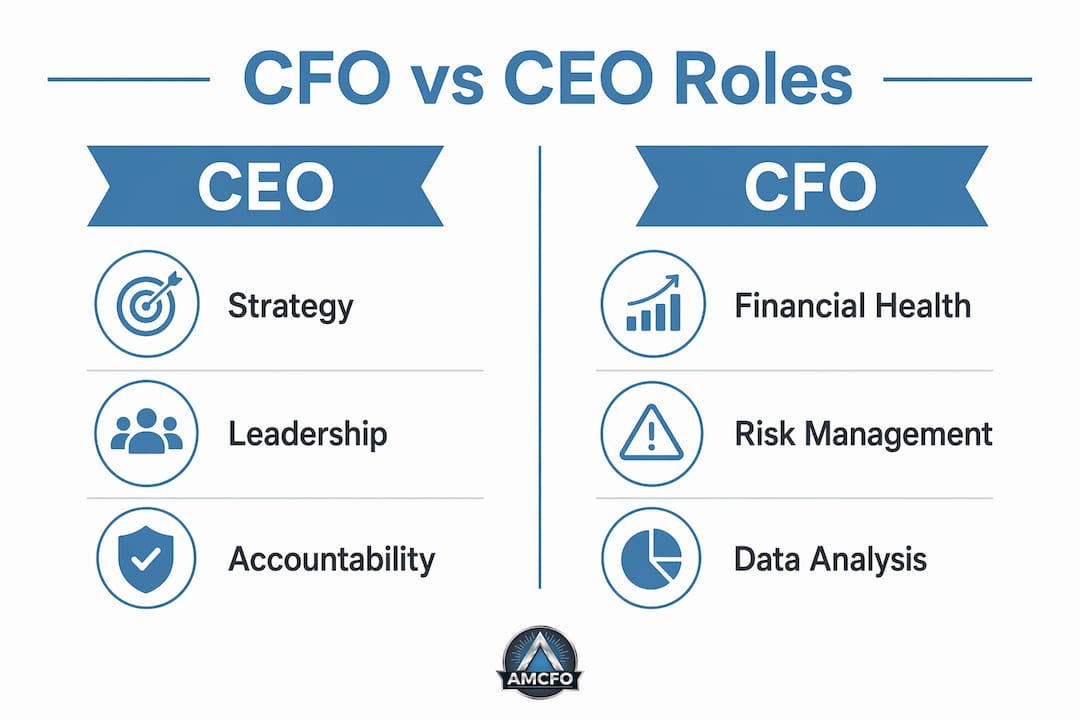
The difference between CFO and CEO is one of scope and focus, not seniority alone. The CEO carries accountability for the entire organization: culture, product, people, customers, and market position. The CFO carries accountability for the financial engine that makes everything else possible. These two roles are designed to be interdependent, not interchangeable.
| Dimension | CEO | CFO |
|---|---|---|
| Primary focus | Organizational strategy and leadership | Financial health and capital stewardship |
| Decision authority | All major business decisions | Financial policy, capital allocation, risk |
| Board relationship | Reports to and is accountable to the board | Advises board on financial matters and controls |
| External communication | Brand, vision, and stakeholder leadership | Investor relations, financial disclosures |
| Strategic input | Sets direction | Pressure-tests direction with financial data |
Forbes reports that CFOs are increasingly strategic partners to CEOs, interpreting data for future direction and pressure-testing business ideas rather than simply accounting for past results. This shift matters because it means the CFO is no longer a supporting character in strategy conversations. The CFO is a co-author of them. Forbes also notes a growing CFO-to-CEO career path in 2026, which signals just how much strategic weight the role now carries.
Other C-suite executives like the COO or CMO own specific operational domains. The CFO's distinction is that financial data cuts across every domain. A CFO reviewing the marketing budget is also reviewing customer acquisition economics. A CFO approving a new hire is also modeling headcount costs against revenue projections. That cross-functional financial lens is what separates the role from every other seat at the table.
What qualifications does an effective CFO need?
CFO qualifications combine formal credentials with hard-won operational experience. No single degree or certification produces a great CFO, but the most effective ones share a consistent profile.
- Financial and accounting foundation. A bachelor's degree in finance, accounting, or economics is standard. An MBA or CPA designation significantly strengthens credibility, particularly when working with boards and institutional investors.
- Strategic business acumen. The CFO must understand how financial decisions affect product development, hiring, customer retention, and competitive positioning. Pure accounting expertise without business context produces a controller, not a CFO.
- Leadership and communication skills. CFOs present to boards, negotiate with lenders, and manage finance teams. The ability to translate complex financial data into clear, confident narratives is non-negotiable.
- Regulatory and compliance knowledge. Familiarity with GAAP, IFRS where applicable, SOX requirements, and tax regulations protects the company from costly errors and enforcement actions.
- Technology and data literacy. Modern CFOs work with ERP platforms like NetSuite and SAP, financial modeling tools, and increasingly with AI-driven analytics. A CFO who cannot interrogate data systems is operating with a significant blind spot.
Pro Tip: When evaluating a CFO candidate, ask them to walk you through a forecast they built from scratch. How they explain their assumptions tells you more about their strategic thinking than any credential on their resume.
[Credible forecasting and consistent KPI reporting](https://www.mondaq.com/unitedstates/financial-services/1791582/when-the-ground-moves-beneath Your-feet-notes-from-a-pe-backed-cfo-forum) are among the most valued CFO deliverables, particularly for investor-backed companies. Investors reward businesses where the CFO has established a single, reliable source of financial truth. That discipline directly affects company valuation. The CFO career path typically runs through senior financial analyst, controller, or VP of Finance roles before reaching the C-suite, with most CFOs accumulating 15 or more years of progressive financial leadership before taking the top seat.
Why the CFO role is more strategic than ever in 2026
The importance of a CFO has expanded well beyond traditional financial stewardship. A 2026 survey by the Oliver Wyman Forum and the New York Stock Exchange found that 70% of CFOs rank strategy, portfolio management, growth, and transformation leadership among their top roles. That same survey found 72% expect this strategic scope to increase further. These are not aspirational numbers. They reflect a structural shift in how boards and CEOs deploy their CFOs.
The same research shows that 64% of CFOs prioritize growth and 60% prioritize cost management as the primary drivers of shareholder value. That combination is not a contradiction. It reflects the CFO's unique position as the executive who must simultaneously push for expansion and protect the margin that makes expansion sustainable.
"Finance acts as connective tissue linking strategy and operations in real time." — Oliver Wyman Forum / NYSE Survey, 2026
The CFO's role now includes finance transformation initiatives involving process redesign, data flow improvements, decision support systems, and workforce model changes. This means a modern CFO is as likely to be evaluating an AI-powered forecasting tool as reviewing a quarterly close. For business owners, this evolution has a direct implication: the CFO you needed five years ago and the CFO you need today are not the same person.
CFO succession planning has also become a board-level priority. Extended CFO transition periods are now structured to maintain investor confidence and preserve financial policy continuity. Companies like Vishay Precision Group have publicly structured CFO transitions to align incoming executives with existing capital allocation priorities, signaling that the role carries institutional weight that cannot be transferred overnight. For growing businesses, this underscores why CFO responsibilities at growing companies deserve deliberate planning, not reactive hiring.
Key takeaways
A CFO is the senior executive who translates financial data into strategic decisions, manages risk, and partners with the CEO and board to drive sustainable growth.
| Point | Details |
|---|---|
| CFO definition | The CFO is the highest-ranking finance executive, responsible for fiscal health and financial strategy. |
| Core responsibilities | CFO duties include FP&A, cash flow management, risk oversight, capital allocation, and regulatory compliance. |
| CFO vs. CEO distinction | The CEO sets organizational direction; the CFO pressure-tests that direction with financial data and controls. |
| Qualifications required | Effective CFOs combine accounting credentials, strategic business acumen, leadership skills, and technology literacy. |
| Strategic expansion | 70% of CFOs now rank strategy and transformation among their top roles, per the 2026 Oliver Wyman Forum survey. |
Why most business owners underestimate what a CFO actually changes
I have worked with enough business owners to know that the CFO conversation usually starts too late. By the time a company realizes it needs serious financial leadership, it has already made several expensive decisions without it. Pricing models that eroded margin. Hiring plans that outpaced revenue. Funding rounds negotiated without a credible forecast in hand.
What a strong CFO actually changes is the quality of the questions being asked before decisions are made. Not "can we afford this?" but "what does this cost us in three scenarios, and which one are we most likely in?" That shift in framing is worth more than any single financial report.
I also think the CFO-to-CEO pipeline that Forbes highlighted in 2026 is underappreciated by founders. When your CFO has the strategic range to eventually run a company, you are not just getting financial oversight. You are getting a co-pilot who understands the whole aircraft. That is a different hire than a controller with a better title.
For smaller businesses, the fractional CFO model solves the access problem without the full-time cost. The strategic value is the same. The engagement is simply structured differently. If you are a business owner who has never had a CFO in the room during a major decision, I would encourage you to find out what that feels like before the stakes get higher.
— Angelica
How Amcfo can provide the CFO leadership your business needs
Not every business is ready for a full-time CFO, but every business benefits from CFO-level thinking. Amcfo provides fractional CFO services designed for companies that need strategic financial leadership without the overhead of a full-time executive hire.

Amcfo's team works directly with business owners and executives on budgeting, forecasting, cash flow management, financial reporting, and strategic planning. Whether you need a one-time financial assessment or ongoing CFO advisory support, Amcfo structures each engagement around your specific business goals. The result is clearer financial visibility, more confident decision-making, and a finance function that actually supports growth. Reach out to Amcfo to explore how fractional CFO services can fit your organization.
FAQ
What is a CFO in simple terms?
A CFO is the senior executive responsible for managing a company's finances, including budgeting, forecasting, cash flow, risk, and financial strategy. The role reports to the CEO and advises the board on all financial matters.
What does a CFO do on a daily basis?
A CFO reviews financial performance data, oversees the finance team, advises on capital decisions, and communicates with investors or lenders. In high-growth or PE-backed companies, this includes weekly operating reviews and direct ownership of pricing and spend decisions.
What qualifications does a CFO need?
Most CFOs hold a degree in finance or accounting, often paired with an MBA or CPA certification, and bring 15 or more years of progressive financial leadership experience. Technology literacy and strong communication skills are equally important in 2026.
How is a CFO different from a controller or VP of Finance?
A controller manages accounting accuracy and compliance; a VP of Finance manages reporting and analysis. A CFO operates at the strategic level, advising the CEO and board on capital allocation, growth strategy, and enterprise risk.
Do small businesses need a CFO?
Small businesses benefit from CFO-level thinking even without a full-time hire. A fractional CFO provides the same strategic financial guidance on a part-time or project basis, making it accessible for companies that are not yet ready for a full-time executive.