

Converting from cash to accrual accounting is the right move for most growing U.S. businesses, and you can start the process this week. The three immediate actions: pick your conversion date (typically the first day of your current tax year), pull your accounts receivable aging, vendor ledger, and payroll accrual schedules to quantify every accrual item, and engage a CPA or tax counsel to assess whether you need to file IRS Form 3115 to formally change your tax accounting method.
Under accrual accounting, revenue is recognized when earned and expenses when incurred, regardless of when cash moves. That matching principle is what makes accrual-basis financials GAAP-conformant, audit-ready, and meaningful to lenders and investors.
Start here, inside 48 hours:
- Confirm your conversion date (first day of the tax year is cleanest for IRS purposes)
- Pull AR aging, open vendor bills, payroll accruals, prepaid schedules, and deferred revenue balances
- Determine whether your tax method will also change; if yes, Form 3115 and Section 481(a) are required
- Identify your accounting platform (QuickBooks, Xero, or ERP) and flag accounts that need remapping
Key Takeaways
A successful transition to accrual accounting requires three things executed in the right order: clean source data, correct opening balance journal entries, and a properly filed Form 3115 with a defensible Section 481(a) calculation.
| Point | Details |
|---|---|
| Choose the conversion date first | The first day of your tax year is the cleanest starting point for IRS purposes and opening balance accuracy. |
| Quantify all six accrual items | AR, AP, accrued liabilities, deferred revenue, prepaids, and inventory must all be captured before posting any entries. |
| File Form 3115 with tax counsel | A positive Section 481(a) adjustment can be spread over four years; missing the filing means the IRS imposes a method on its own terms. |
| Test software before go-live | Report toggles in QuickBooks and Xero are display filters, not method changes; confirm opening balances reconcile before running live transactions. |
| Amcfo runs the full conversion | Amcfo scopes and executes the conversion as a project, from cleanup and journal entries through Form 3115 coordination and software configuration. |
Table of Contents
- How does the transition to accrual accounting work, step by step?
- What are the U.S. tax requirements when you change accounting methods?
- How do you set up QuickBooks or Xero for accrual accounting?
- What does the transition timeline and cost look like?
- What are the most common problems during conversion, and how do you fix them?
- How Amcfo executes a cash-to-accrual conversion for clients
- The part of accrual conversion advice that most guides get wrong
- Amcfo handles the conversion so your team does not have to
- Sources
How does the transition to accrual accounting work, step by step?
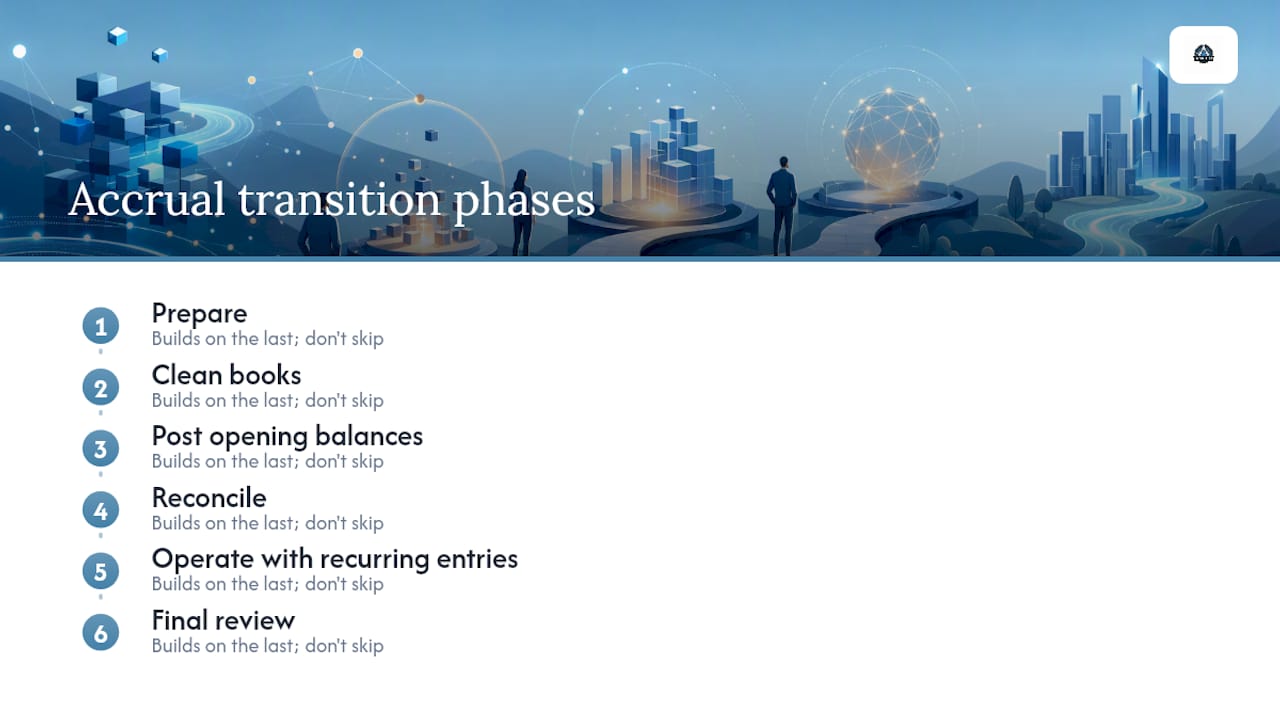
The conversion follows six phases. Each one builds on the last, and skipping any of them creates reconciliation problems that surface at the worst possible time: audit season or a lender's due diligence request.
Phase 1: Prepare
Gather source documents before touching the books. You need a year-end AR aging report, a complete vendor ledger with open bills, a payroll register showing accrued wages and benefits not yet paid, a prepaid expense schedule, a deferred revenue schedule, and a physical or system inventory count. Document the cutoff date for every report so your opening balances tie to a single moment in time.
Phase 2: Quantify accrual items
Work through each balance category:
- Accounts receivable: Total unpaid customer invoices as of the conversion date. These were never recorded as income under cash basis.
- Accounts payable: Total unpaid vendor bills. These were never recorded as expenses under cash basis.
- Accrued liabilities: Wages earned but not yet paid, accrued vacation, employer payroll taxes owed, and any other obligations incurred but not yet settled.
- Deferred revenue: Cash received from customers for services not yet delivered. Under accrual, this is a liability until earned.
- Prepaid expenses: Cash paid for future-period costs (insurance, rent, subscriptions). Under accrual, these are assets amortized over the benefit period.
- Inventory: Valued at cost (FIFO, LIFO, or weighted average) per your chosen method; confirm the count matches the general ledger.
- Fixed assets: Confirm depreciation schedules are current and that accumulated depreciation is recorded.
Phase 3: Clean the books
Reconcile your cash-basis general ledger before posting anything new. Resolve any uncleared bank items, duplicate entries, or misclassified transactions. A clean cash-basis close is the foundation for accurate opening accrual balances.
Phase 4: Post opening balance journal entries
Record the following entries on the first day of the accrual period. These are the standard adjustments that practitioners use to compute the Section 481(a) adjustment:
The net of all these entries flows into retained earnings and becomes the basis of your Section 481(a) calculation.
Phase 5: Reconcile
Prepare a cash-to-accrual reconciliation that starts with your cash-basis net income and walks to accrual-basis net income by adding AR, subtracting AP and accrued liabilities, adding prepaids, and subtracting deferred revenue. This document is what your CPA needs to complete Form 3115 and what an auditor will request first.

Phase 6: Operate
Run your first accrual-basis month-end close. Set up recurring accrual journal entries (monthly depreciation, prepaid amortization, payroll accruals) and reversing entries for temporary accruals so they do not double-count in the following period.
Pro Tip: Time your conversion to a month when AR is seasonally low and vendor bills are high. A smaller net positive 481(a) adjustment means a smaller incremental tax hit in year one, even when spread over four years.
What are the U.S. tax requirements when you change accounting methods?
The short answer: if your tax reporting method is also changing from cash to accrual, you must file Form 3115, Application for Change in Accounting Method, with the IRS. Section 481(a) of the Internal Revenue Code reconciles the difference between what you reported under the old method and what you would have reported under the new one.
Form 3115 filing checklist
Many cash-to-accrual changes qualify as automatic consent changes under Revenue Procedure 2015-13 (and its updates), meaning you do not need to wait for IRS approval before implementing the change. You still must file correctly:
- Attach a signed copy of Form 3115 to your timely filed tax return for the year of change
- File a duplicate copy with the IRS National Office in Ogden, Utah, by the same date
- Complete Schedule A if the change involves an inventory method
- Include a Section 481(a) adjustment statement showing the cumulative difference between cash-basis and accrual-basis income
- Attach a description of the change and the legal authority (the applicable Revenue Procedure)
- Confirm whether your specific method change is on the automatic consent list; if not, you need advance consent and a different filing timeline
Non-automatic consent changes require filing Form 3115 by the last day of the tax year preceding the year of change, which is a materially different deadline. Confirm your category with tax counsel before assuming automatic consent applies.
How Section 481(a) affects your cash flow
A positive Section 481(a) adjustment means your accrual-basis income exceeds what you reported under cash basis. That difference is additional taxable income. When you file proactively with Form 3115, the IRS generally allows you to spread a positive adjustment over four tax years, which softens the cash-flow impact considerably. A negative adjustment (accrual income is lower than cash-basis income) is taken entirely in the year of change, which is a benefit.
The practical implication: a business with significant outstanding accounts receivable and unpaid vendor bills at conversion may have a substantial net positive adjustment before other items, which can be spread over four years to avoid a single-year tax impact. Still, plan for it.
State tax considerations
A federal accounting-method change does not automatically carry through to every state. Several states require a separate notification or election, and some states do not conform to federal automatic consent procedures at all. Check your state's department of revenue rules after the federal filing is complete, and loop in your CPA on any states where the business has nexus.
Recommendation: Involve a CPA or tax counsel for the Section 481(a) calculation and Form 3115 preparation. The filing mechanics are specific enough that errors create IRS correspondence that is expensive to resolve.
How do you set up QuickBooks or Xero for accrual accounting?
Set your opening accrual balances on the first day of the tax year of change, test all reports before go-live, and confirm that your software's accounting method setting matches your tax method. One critical point Xero's guide makes explicit: toggling a report view between cash and accrual in your accounting software does not change your tax accounting method. That toggle is a display filter. The actual method change requires Form 3115 and proper opening-balance entries.
Import and configuration checklist
- Back up everything before making any changes to chart of accounts or opening balances
- Map your chart of accounts to add AR, AP, accrued liabilities, deferred revenue, and prepaid asset accounts if they do not already exist
- Import AR aging as open invoices dated on or before the conversion date; do not re-import cash receipts already recorded
- Import AP aging as open bills dated on or before the conversion date
- Enter inventory valuation as a single opening balance entry tied to your physical count
- Post opening balance journal entries (from Phase 4 above) as a single journal entry dated the first day of the accrual period
- Reconcile the balance sheet to confirm assets equal liabilities plus equity before running any accrual-period transactions
QuickBooks-specific notes
In QuickBooks Online, the accounting method setting under Company Settings controls report defaults, not your tax method. After posting opening balances, run a Balance Sheet and Profit & Loss on accrual basis for the first closed month and reconcile both to your cash-to-accrual workbook. Set up recurring journal entry templates for monthly depreciation and prepaid amortization. Use reversing journal entries for payroll accruals so the following month's actual payroll does not double-count.
Xero-specific notes
Xero handles cash vs. accrual reporting similarly: the toggle is a report filter. After importing open invoices and bills, run the Aged Receivables and Aged Payables reports to confirm balances match your source documents. Set up repeating journal entries for recurring accruals. Xero's bank reconciliation tool will flag unmatched items, which is a useful early-warning control.
Automation and ongoing controls
Build recurring accrual templates for every predictable monthly entry: depreciation, prepaid amortization, rent accruals, and payroll. Set reversing entries to fire automatically on the first of the following month for all temporary accruals. Run a reconciliation of AR aging to the AR general ledger balance at every month-end. These controls catch drift early, before it compounds into a material restatement.

What does the transition timeline and cost look like?
A small business with clean books can complete the conversion in 4–8 weeks. A mid-market company with multiple entities, inventory, or complex deferred revenue schedules should plan for 2–6 months, including a parallel-run period where both cash and accrual reports are produced simultaneously to validate accuracy.
Role and task matrix
| Task | Owner | Typical Time | Cost / Resource | Tax Filing Impact |
|---|---|---|---|---|
| Conversion date decision and scoping | Controller or fractional CFO | 1–3 days | Internal staff time | Sets Form 3115 tax year of change |
| Source data gathering (AR, AP, payroll, prepaids) | Bookkeeper or controller | 1–2 weeks | Internal or outsourced bookkeeping | Feeds 481(a) calculation |
| Books cleanup and reconciliation | Bookkeeper + CPA review | 1–3 weeks | Varies depending on complexity | Required before opening entries |
| Opening balance journal entries | Controller or fractional CFO | 2–5 days | Internal or fractional CFO engagement | Directly determines 481(a) amount |
| Form 3115 preparation and filing | CPA / tax counsel | 1–3 weeks | Varies depending on complexity | Required; drives IRS compliance |
| Software configuration (QuickBooks/Xero) | Bookkeeper or CFO | 3–7 days | Internal or varies by outsourced services | Ensures accrual-basis reporting |
| Parallel run and validation | Controller + CPA | 2–8 weeks | Internal staff time | Confirms accuracy before go-live |
Cost ranges above are illustrative. Actual fees vary widely based on business complexity, data quality, and whether you use internal staff, an external CPA, or a fractional CFO to manage the project.
When to run parallel reporting
A parallel run means producing both cash-basis and accrual-basis financials for the same period, typically one to three months, before fully cutting over. It is worth the effort for any business where lenders or investors are reviewing financials during the transition, where inventory or deferred revenue is material, or where the controller is new to accrual accounting. The IMF's phased transition guidance for public-sector entities makes the same argument: sequencing and piloting reduce the risk of material errors at go-live.
What are the most common problems during conversion, and how do you fix them?
Six problems account for the majority of conversion failures. Each one has a clear fix.
1. Poor source data quality. AR aging reports that do not match the general ledger, vendor bills missing from the system, and payroll records in a separate platform create gaps in opening balances. Fix: reconcile every source document to the GL before posting a single accrual entry. Do not post until the cash-basis books are clean.
2. Missed accruals. Accrued vacation, employer payroll taxes, and professional service invoices received but not entered are the most common omissions. Fix: run a checklist against every liability account and confirm with department heads that all obligations as of the conversion date are captured.
3. Duplicated revenue. This happens when cash receipts recorded under the old method are also recognized as earned revenue under the new method. Fix: the AR opening balance entry should include only invoices for which cash has not yet been received. Any invoice already paid before the conversion date stays in the cash-basis period.
4. Incorrect prepaid and deferred revenue classification. Prepaid expenses paid in a prior period but covering future months need to be reclassified as assets, not expenses. Deferred revenue received in advance needs to be reclassified as a liability. Fix: build a schedule for every prepaid and deferred item showing the original payment date, the coverage period, and the remaining balance at conversion.
5. Inventory valuation errors. Switching to accrual often surfaces inventory that was expensed under cash basis but should be capitalized. Fix: conduct a physical count at the conversion date, value it at cost under your chosen method, and post the difference as an inventory asset with a corresponding retained earnings adjustment.
6. Cash-flow shock from a positive 481(a) adjustment. A large AR balance at conversion creates a large positive adjustment and additional taxable income. Fix: model the 481(a) before committing to a conversion date. If the adjustment is material, consider whether timing the conversion to a lower-AR period reduces the hit.
Pro Tip: If your Section 481(a) adjustment creates a tax payment you did not budget for, work with your CPA to confirm the four-year spread is applied and adjust estimated tax payments for each of the four years accordingly. Missing an estimated payment in year one of the spread is a common and avoidable penalty.
Ongoing controls to prevent drift
- Reconcile AR aging to the AR GL balance every month-end
- Hold AP entries open until invoices are matched and approved
- Document every accrual estimate (payroll, warranty, legal) with a supporting calculation
- Run automated bank reconciliations weekly, not monthly
- Review deferred revenue schedules quarterly to confirm earned amounts are released correctly
How Amcfo executes a cash-to-accrual conversion for clients
Amcfo runs the conversion as a scoped project with defined deliverables, not an open-ended engagement. The process starts with a discovery call where the client provides year-end AR aging, a vendor ledger, payroll summaries, and a current chart of accounts. From there, Amcfo's team handles the technical execution while coordinating with the client's CPA or tax counsel on Form 3115 and the Section 481(a) calculation.
Methodology
- Discovery and scoping: Review source documents, identify data gaps, confirm the conversion date, and scope the cleanup required.
- Cleanup and quantification: Reconcile the cash-basis GL, resolve uncleared items, and build the full accrual-item schedule (AR, AP, accrued liabilities, prepaids, deferred revenue, inventory).
- Journal entry preparation: Prepare and review all opening balance journal entries, including the retained earnings adjustment, and produce the cash-to-accrual reconciliation workbook.
- Tax coordination: Provide the Section 481(a) calculation workbook and supporting documentation to the client's CPA or tax counsel for Form 3115 preparation.
- Software configuration: Set up or reconfigure QuickBooks or Xero with the correct account mapping, recurring accrual templates, and reversing entry schedules.
- Validation and month-one rollforward: Close the first accrual-basis month, reconcile all balance sheet accounts, and confirm that income statement results are accrual-compliant.
- Governance handover: Deliver a monthly control checklist and a knowledge-transfer session so the client's internal team can maintain accrual accounting going forward.
Client deliverables
- Cash-to-accrual reconciliation workbook
- Opening balance journal entries with supporting schedules
- Form 3115 support packet (481(a) calculation, adjustment statement, method-change description)
- Configured QuickBooks or Xero environment with recurring templates
- Monthly close control checklist
- Knowledge-transfer session for internal staff
To start a discovery conversation, contact Amcfo and have your most recent year-end AR aging, vendor ledger, and payroll summary ready. Those three documents let the team scope the project accurately in the first call.
The part of accrual conversion advice that most guides get wrong
Most articles about switching to accrual accounting treat Form 3115 as a footnote and the software setup as the main event. That framing is backwards, and it leads finance teams into a predictable trap: they configure QuickBooks correctly, post clean opening balances, and then discover six months later that their tax counsel needs a complete 481(a) workbook the team never built.
The Section 481(a) adjustment is not a tax technicality you hand off at the end. It is the financial consequence of every decision you made during the conversion: which conversion date you chose, how you valued inventory, whether you captured every accrued liability. Getting that calculation right requires the same rigor as the journal entries themselves, and it needs to happen in parallel with the bookkeeping work, not after it.
The other thing most guides underestimate is data quality. A conversion built on an AR aging that does not reconcile to the GL, or a vendor ledger with missing bills, will produce opening balances that are wrong from day one. No amount of software configuration fixes a bad source document. The cleanup phase is where most projects either succeed or quietly fail, and it is the phase that gets the least attention in how-to articles.
The businesses that convert cleanly are the ones that treat this as a finance project with a project manager, a defined scope, and a reconciliation checkpoint before anything gets posted. Whether that project manager is an internal controller, an external CPA, or a fractional CFO, the discipline is the same. The conversion is not done when the opening entries are posted. It is done when the first three accrual-basis month-ends close cleanly and the balance sheet reconciles without manual intervention.
Amcfo handles the conversion so your team does not have to

For finance teams that want the conversion done right without pulling an internal controller off their day job for two months, Amcfo offers a project-based accrual conversion engagement that covers every phase: books cleanup, opening balance journal entries, Form 3115 coordination with your CPA, QuickBooks or Xero configuration, and a documented handoff so your team can maintain accrual accounting independently.
The engagement is scoped to your business, not a fixed package. A clean small business might close in four to six weeks. A company with inventory, multiple revenue streams, or a messy GL history gets a longer runway and a parallel-run period built in. Either way, you get a reconciliation workbook, a Form 3115 support packet, and a configured accounting environment, not just advice.
To get started, visit Amcfo's fractional CFO services and book a discovery call. Have your most recent AR aging, vendor ledger, and payroll summary ready, and the team can scope the project accurately in the first conversation.
This article is general information, not a substitute for advice from a qualified financial advisor. Consult a qualified financial professional about your own circumstances before acting on anything here.
Sources
Start with the IRS Form 3115 instructions and a practitioner-oriented conversion checklist before consulting any other resource.
- Irs
- Cash Basis to Accrual Conversion: IRS Rules and Form 3115 - LegalClarity
- Beancount
- Cash vs accrual accounting: key differences and how to choose | Xero US
- Imf
State tax note: After completing the federal Form 3115 filing, check your state's department of revenue for conformity rules. Several states require a separate notification or do not adopt federal automatic consent procedures, and the rules vary enough that a state-by-state review with your CPA is worth the time.