

Startup accounting is the structured process of tracking, organizing, and reporting a new company's financial activity to manage cash flow, meet compliance requirements, and support fundraising. 82% of failed startups cite poor cash flow management as a primary cause, and 29% run out of money before gaining traction. Those numbers make one thing clear: accounting is not a back-office task you delegate later. It is the financial foundation your company stands on from day one. Tools like QuickBooks and HelloBooks give founders a starting point, but the right approach depends on your stage, your investors, and how fast you plan to grow.
What are the fundamental startup accounting principles?
Startup accounting differs from standard small business bookkeeping in ways that catch most founders off guard. The core distinction starts with your accounting method.
Accrual vs. cash basis accounting is the first decision every founder faces. Cash basis records money when it moves in or out of your bank account. Accrual basis records revenue when it is earned and expenses when they are incurred, regardless of when cash changes hands. Accrual basis accounting gives investors and auditors the GAAP-compliant financials they expect at fundraises. Cash basis may work at the very earliest stage with simple transactions, but you will likely need to restate your books before your first institutional raise.
GAAP compliance adds another layer of complexity unique to startups. Two standards trip up founders most often:
- ASC 606 governs revenue recognition. If you collect annual subscription payments upfront, you cannot book the full amount as revenue immediately. You recognize it ratably over the subscription term. Deferred revenue under ASC 606 is a concept most general accountants handle poorly for SaaS or subscription businesses.
- ASC 350-40 covers capitalized software development costs. Internal engineering costs that meet specific criteria must be capitalized on your balance sheet rather than expensed, which directly affects your reported profitability.
- ASC 718 applies the moment you issue stock options or equity awards. It requires you to calculate and record stock-based compensation expense using a fair value model, which typically requires a 409A valuation.
Pro Tip: Get a 409A valuation done before you issue your first stock options. Waiting until Series A forces you to retroactively value earlier grants, which is expensive and creates audit risk.
Equity instruments like SAFEs and convertible notes also require careful accounting. A SAFE is not debt and not equity until it converts, and classifying it incorrectly on your balance sheet will create problems with future investors and auditors.
How does startup accounting evolve across funding stages?
The accounting infrastructure a pre-seed company needs looks nothing like what a Series B company requires. Stage-by-stage accounting requirements escalate with each funding milestone, and founders who ignore this pattern pay for it later.
| Stage | Core accounting needs | Key additions |
|---|---|---|
| Pre-seed | Cash basis or basic accrual bookkeeping | Separate business bank account, basic chart of accounts |
| Seed | Accrual bookkeeping, GAAP financials | 409A valuation, investor reporting package |
| Series A | Full GAAP compliance, ASC 718 tracking | Audited financials, cap table integration, FP&A function |
| Series B | Consolidated reporting, board-level financials | Full FP&A, multi-entity accounting, external audit |
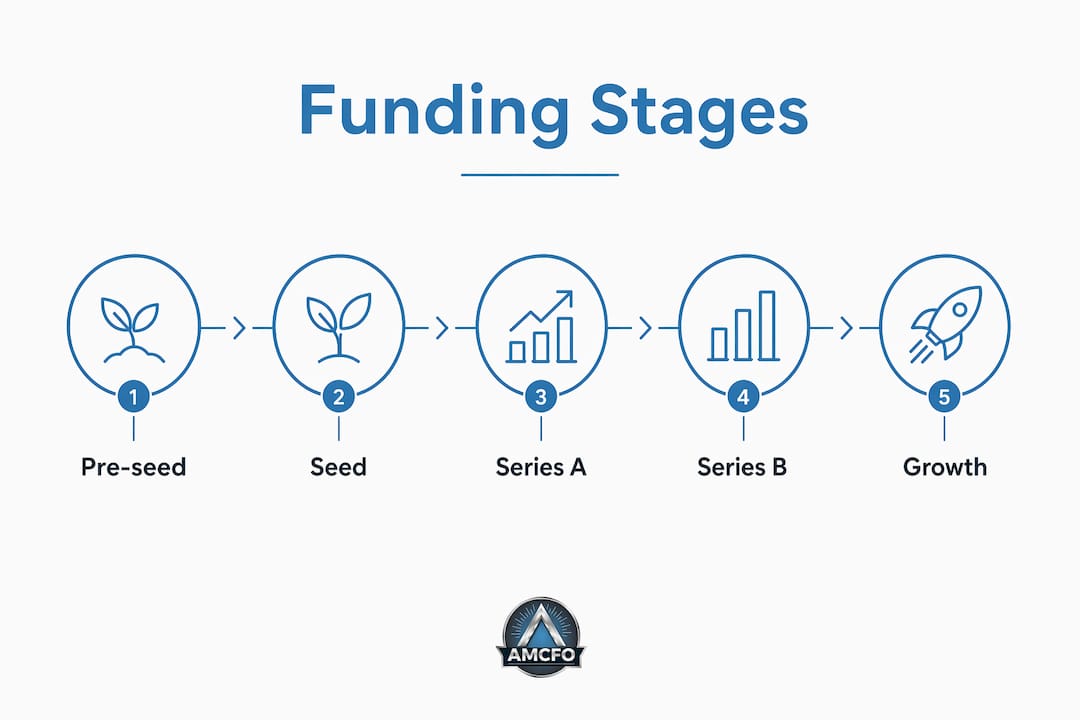
At the pre-seed stage, your goal is separation and organization. Open a dedicated business bank account, set up a chart of accounts in QuickBooks or a comparable platform, and record every transaction. This takes less than a day to set up and saves weeks of cleanup later.
At the seed stage, investors expect a monthly reporting package. That typically means a profit and loss statement, balance sheet, and cash flow statement prepared on an accrual basis. You also need your first 409A valuation before issuing options to employees.

Series A is where accounting complexity spikes. Your lead investor will likely require audited financials before closing. That audit will surface every gap in your books going back to founding. Founders who delay proper accounting infrastructure routinely face $55,000–$145,000 in retroactive cleanup costs before Series A closes. That figure covers restated financials, equity reclassification, ASC 718 calculations, 409A valuations, and audit preparation.
Pro Tip: Hire a fractional CFO or outsourced accounting firm with startup experience at the seed stage, not at Series A. The cost is a fraction of what you will pay to clean up two years of messy books under audit pressure.
Series B demands a full financial planning and analysis function. You need rolling forecasts, department-level budgets, and consolidated reporting if you have subsidiaries. This is the stage where a full-time VP of Finance or CFO typically joins the team.
What software and services best support startup accounting in 2026?
The right tool depends on your stage and complexity. Here is how the options break down.
QuickBooks Online remains the most widely used platform for early-stage startups. It handles basic accrual bookkeeping, connects to most bank feeds, and integrates with payroll providers like Gusto. Most outsourced bookkeepers and accountants know it well, which makes hiring easier.
HelloBooks is built specifically for venture-backed and SaaS startups. It automates revenue deferral, recognizes revenue across subscription terms, integrates banking and payment feeds, and links cap table data to accounting automatically. That last feature matters enormously when you are tracking stock-based compensation under ASC 718. Startup-specific accounting software pre-maps charts of accounts and automates deferred revenue recognition, reducing errors and eliminating manual spreadsheet management.
Beyond software, you have three service models to choose from:
- DIY bookkeeping works at pre-seed when transactions are simple and volume is low. The risk is that founders underestimate complexity and fall behind, creating a backlog that costs more to fix than it would have cost to outsource from the start.
- Outsourced bookkeeping services give you a dedicated team handling monthly close, reconciliations, and financial statements. This is the right move at seed stage for most startups.
- Fractional CFO services add strategic financial leadership without the cost of a full-time hire. A fractional CFO builds your financial model, prepares investor reporting, manages your audit process, and advises on cash flow strategy. This model fits Series A companies that need CFO-level thinking but are not ready to hire one full time.
For scaling financial operations beyond basic bookkeeping, the fractional model consistently delivers more value per dollar than hiring prematurely.
How can startups manage cash flow effectively to prevent failure?
Cash flow management is the single most important financial discipline for any startup. The 82% failure rate tied to cash flow problems is not about companies running unprofitable businesses. Many of those companies had revenue. They failed because they could not see their cash position clearly enough to act before it was too late.
Effective financial planning integrates budgeting, forecasting, cash flow management, and resource allocation into a single view. That view keeps founders from making hiring or spending decisions based on bank balance alone.
Practical cash flow management for startups comes down to four habits:
- Track burn rate weekly. Burn rate is the net cash you spend each month. Divide your cash on hand by your monthly burn to get your runway in months. Investors will ask for this number. You should know it without looking it up.
- Separate operating and reserve cash. Keep at least three months of operating expenses in a separate account. This buffer prevents a slow collections month from becoming a payroll crisis.
- Time your payables strategically. Pay vendors at the end of their payment terms, not immediately. That discipline alone can add weeks of runway without affecting relationships.
- Accelerate receivables. Invoice immediately upon delivery. Offer net-15 terms instead of net-30 where possible. Follow up on overdue invoices within 48 hours.
A startup financial model integrates revenue, costs, headcount, and cash flow into a single runway metric. That model is not just for investors. It is the tool you use every month to decide whether you can afford to hire, expand, or slow down spending.
For deeper guidance on cash flow best practices, the principles that apply to established businesses apply equally to startups, with even less margin for error.
What common mistakes do startups make in accounting?
Most accounting mistakes at startups are not errors of ignorance. They are errors of delay. Founders know they need proper books. They just keep pushing it off until a funding round forces the issue.
- Mixing personal and business finances. This is the most common mistake at the pre-seed stage. Running business expenses through a personal account makes bookkeeping nearly impossible and creates tax liability. Open a business checking account before you spend your first dollar.
- Skipping equity instrument accounting. Issuing stock options without a 409A valuation or recording SAFEs incorrectly creates a compounding problem. Each round of funding adds complexity on top of the original error. Correcting it under audit pressure costs far more than doing it right the first time.
- Delaying the switch to accrual accounting. Founders on cash basis often do not realize their financials are not GAAP-compliant until a lead investor requests audited statements. Restating two years of cash basis books to accrual is a significant and expensive project.
- Inconsistent categorization. Booking the same type of expense to different accounts in different months makes your financials unreliable. Investors and auditors will flag this immediately. Set up a chart of accounts early and apply it consistently.
- Ignoring tax planning. Startup tax strategies like the R&D tax credit under IRC Section 41 can generate significant cash savings. Many early-stage startups qualify but never claim the credit because they do not have an accountant who knows to look for it.
Pro Tip: The R&D tax credit is available to startups with qualifying research expenses, including software development costs. A startup-experienced CPA can identify eligible expenses and apply the credit against payroll taxes, which is especially valuable before you are profitable.
For founders just getting started, the bookkeeping fundamentals covered in a structured startup guide will prevent the most common early-stage errors.
Key takeaways
Startup accounting is the financial infrastructure that determines whether your company can raise money, manage cash, and scale without crisis.
| Point | Details |
|---|---|
| Start with accrual accounting | Accrual basis gives investors GAAP-compliant financials and prevents costly restatements at fundraising. |
| Match accounting to your stage | Each funding milestone from pre-seed to Series B adds specific accounting requirements you must meet. |
| Act before cleanup costs hit | Delaying proper infrastructure leads to $55,000–$145,000 in corrective costs before Series A closes. |
| Manage cash flow weekly | Track burn rate and runway every week, not monthly, to catch problems before they become crises. |
| Use startup-specific software | Tools like HelloBooks and QuickBooks automate startup-specific tasks that general platforms handle poorly. |
Why accounting is the founder's most underrated growth tool
I have worked with enough early-stage founders to know the pattern. Accounting gets treated as something to sort out later, after product-market fit, after the next hire, after the fundraise. The founders who think that way are the ones calling me in a panic six months before their Series A, staring at a $90,000 cleanup estimate and a three-month timeline they do not have.
The founders who get this right early share one mindset: they treat their financials as a decision-making tool, not a compliance obligation. When you know your burn rate, your runway, and your revenue recognition schedule, you make better decisions. You hire when you can actually afford to. You raise before you are desperate. You walk into investor meetings with numbers you can defend.
The accounting infrastructure you build at seed stage is not overhead. It is the system that tells you whether your business model actually works. I have seen startups with strong revenue growth run out of cash because no one was watching the timing of inflows and outflows. I have also seen lean startups extend their runway by six months just by tightening their collections process and renegotiating payment terms with vendors.
The tools exist. The service models exist. The only thing standing between most founders and solid financial management is the decision to prioritize it now instead of later. Make that decision before a funding round forces it.
— Angelica
How Amcfo helps startups build financial systems that scale
Amcfo works with early-stage and growth-stage startups that need more than basic bookkeeping. Whether you are setting up your chart of accounts for the first time or preparing for a Series A audit, Amcfo's accounting and bookkeeping services are built around the specific needs of founders.

The fractional CFO packages Amcfo offers give you strategic financial leadership at a cost that fits a startup budget. That includes cash flow forecasting, investor reporting, tax coordination, and QuickBooks setup and cleanup. You get CFO-level thinking without the full-time salary. If you are ready to stop guessing at your numbers and start making decisions with confidence, Amcfo is the team to call.
FAQ
What is startup accounting?
Startup accounting is the process of tracking, organizing, and reporting a new company's financial transactions to manage cash flow, meet compliance requirements, and support investor reporting. It differs from standard small business accounting because of startup-specific requirements like GAAP compliance, equity instrument accounting, and deferred revenue recognition.
When should a startup switch to accrual accounting?
Switch to accrual accounting before your seed round at the latest. Accrual basis is required for GAAP-compliant financials, and most institutional investors expect it from the moment they review your books.
How much does startup accounting cleanup cost?
Founders who delay proper accounting infrastructure typically face $55,000–$145,000 in retroactive cleanup costs before Series A. That covers restated financials, equity reclassification, ASC 718 calculations, and audit preparation.
What is the best accounting software for startups?
QuickBooks Online works well for early-stage startups with straightforward transactions. HelloBooks is built specifically for venture-backed and SaaS startups, with automated deferred revenue recognition and cap table integration built in.
What startup tax strategies should founders know about?
The R&D tax credit under IRC Section 41 is the most valuable and most overlooked credit for early-stage startups. Qualifying software development and research expenses can generate credits applied against payroll taxes, even before the company is profitable.