

If you run a business or work in finance, understanding what is controller vs CFO is more than a titles exercise. Confuse the two, and you risk under-hiring, over-paying, or leaving critical gaps in your financial leadership. The controller and the CFO are both vital, but they serve entirely different purposes. One is focused on keeping the books accurate and compliant. The other is focused on where the company is going financially. This article breaks down each role with precision so you can make smarter decisions about your finance team.
Table of Contents
- Key takeaways
- What is controller vs CFO: defining each role
- What a CFO actually does
- Comparing controller vs CFO responsibilities side by side
- When to hire a controller, when to hire a CFO
- How to structure these roles for maximum effectiveness
- My take on the controller vs CFO dynamic
- Get the financial leadership your business deserves
- FAQ
Key takeaways
| Point | Details |
|---|---|
| Controllers own the past | Controllers focus on accurate financial recordkeeping, reporting, and compliance with regulations. |
| CFOs own the future | CFOs lead financial strategy, forecasting, capital allocation, and advising senior leadership. |
| Hierarchy is clear | The CFO typically supervises the controller and uses their reports for strategic decision making. |
| Roles can overlap early on | In smaller companies, one person may perform both functions before the business scales. |
| Outsourcing is a real option | Fractional CFO services let growing businesses access CFO-level strategy without a full-time hire. |
What is controller vs CFO: defining each role
Start with the controller, because this role often gets misunderstood as a glorified bookkeeper. It is not. A financial controller is the senior accounting expert inside your organization. They are responsible for the integrity of every number that flows through your financial statements.
Controller duties include overseeing the entire accounting department, managing the monthly close process, maintaining internal controls, and preparing financial statements in compliance with GAAP or IFRS standards. Controllers prepare income statements, balance sheets, and cash flow statements and serve as the primary point of contact for auditors and tax authorities. They are the people who make sure your books are audit-ready at any given moment.
From a qualifications standpoint, controllers often hold CPA licenses and sometimes MBAs, which reflects the depth of technical accounting expertise required. They are wired for accuracy, process, and compliance. Their world is largely historical: what happened last quarter, whether it was recorded correctly, and whether it holds up under scrutiny.
The controller sits in the organizational hierarchy below the CFO but above the accounting staff. In mid-size to large companies, this person leads a team of staff accountants, accounts payable specialists, and payroll processors. Think of the controller as the engine room of your finance function.
Pro Tip: If your business generates more than $3 million in annual revenue and you do not have a dedicated controller or a structured accounting function, you are likely making strategic decisions on unreliable numbers.
What a CFO actually does
The CFO is the chief financial officer, a title that comes with a very different set of priorities. While the controller is focused on recording what happened, the CFO is focused on what should happen next.

CFO responsibilities include leading the company's financial strategy, making capital allocation decisions, managing investor and lender relationships, overseeing financial planning and analysis (FP&A), and advising the CEO and board on major business decisions. The CFO job description is fundamentally forward-looking. Forecasting, budgeting, fundraising strategy, risk management, and mergers and acquisitions all fall within this role.
Here is a look at the core CFO vs controller roles in terms of daily focus:
- CFO: Multi-year financial forecasting and long-range planning
- CFO: Capital structure decisions, including debt, equity, and reinvestment
- CFO: Investor relations and board-level financial communication
- CFO: Enterprise risk assessment and mitigation
- CFO: Strategic partnership with the CEO on growth initiatives
The CFO role has evolved into a strategic partner to the CEO, moving far beyond compliance and financial reviews into shaping the direction of the company. This shift means today's CFO spends a meaningful part of their week in conversations about pricing strategy, market expansion, and resource allocation, not just reviewing reports.
Typical CFOs come from backgrounds in investment banking, corporate finance, FP&A, or public accounting. They tend to hold MBAs or CPA credentials, but their edge is leadership and strategic judgment, not technical accounting precision.
Pro Tip: A CFO without a strong controller is flying blind. The quality of a CFO's strategic decisions depends entirely on the accuracy of the data the controller produces.
Comparing controller vs CFO responsibilities side by side
The clearest way to understand the difference between CFO and controller is to look at them together. Here is a direct comparison:
| Category | Controller | CFO |
|---|---|---|
| Primary focus | Accuracy of historical financial data | Forward-looking strategy and planning |
| Key output | Financial statements, compliance reports | Forecasts, capital plans, board presentations |
| Reporting to | CFO | CEO and Board of Directors |
| Team oversight | Accounting staff | Controller, FP&A team, treasury |
| Typical credential | CPA | MBA or CPA with executive experience |
| Time horizon | Past and present | Present and future |
| Success metric | Clean audits, zero material errors | Revenue growth, capital efficiency, risk management |
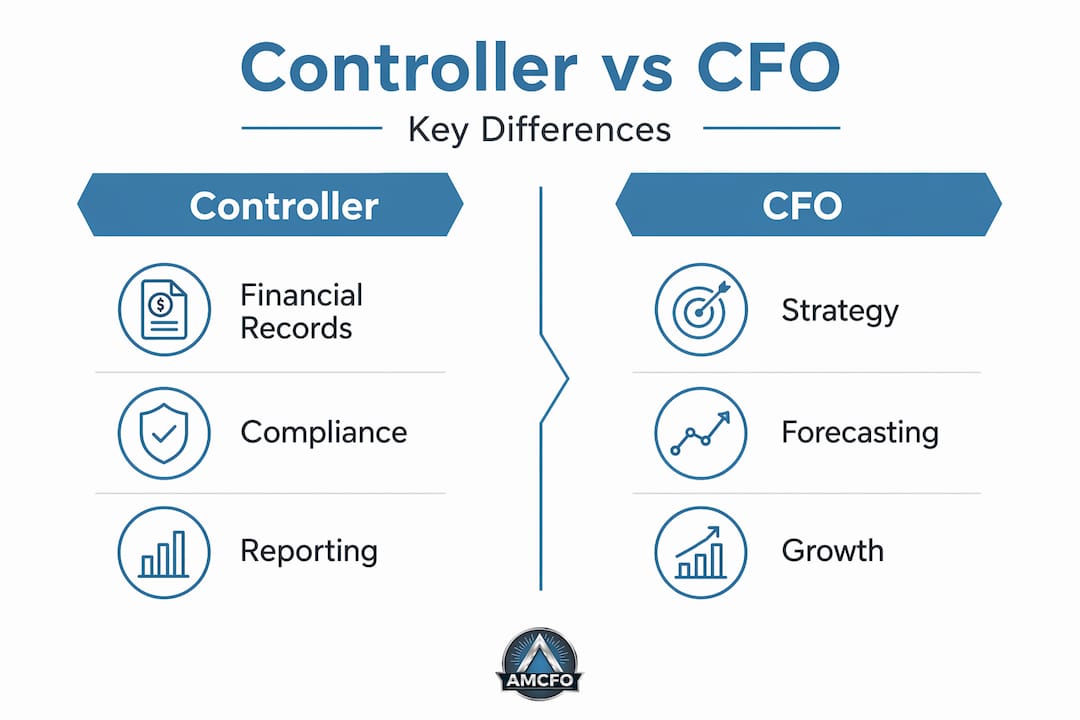
The relationship between the two roles is genuinely interdependent. The CFO oversees both the controller and the FP&A function and relies on the controller's accurate accounting to build any meaningful financial model or forecast. A CFO who cannot trust the books cannot make a credible capital allocation decision. This is why the controller's focus on reporting accuracy and operational excellence is not a supporting role. It is a foundational one.
Here is how the workflow typically flows between the two roles in a well-functioning finance department:
- The accounting team records transactions under the controller's oversight.
- The controller closes the books, prepares financial statements, and flags anomalies.
- The controller shares finalized reports with the CFO.
- The CFO analyzes trends, compares actuals to forecasts, and assesses strategic implications.
- The CFO presents findings and recommendations to the CEO and board.
In smaller organizations, these steps may be compressed. One person might handle both roles. But as the business grows, that compression creates risk.
When to hire a controller, when to hire a CFO
The size and complexity of your business drive this decision more than anything else. In smaller companies, one person often acts as both controller and CFO, but roles need to separate as businesses scale. Keeping one person in both roles too long creates bottlenecks, blind spots, and burnout.
Here is a general framework for thinking about when each role becomes necessary:
- You need a controller first when your transaction volume, reporting complexity, or audit exposure requires dedicated accounting oversight. This typically happens between $1 million and $5 million in annual revenue.
- You need a CFO-level thinking when you are raising capital, planning for major growth, managing investor relationships, or making acquisition decisions. This can come earlier than you expect.
- You might be able to use a fractional CFO if you need strategic financial guidance but do not yet have the budget or the need for a full-time executive. Fractional CFO benefits for growing businesses include access to high-level strategy without the full-time executive salary.
The career path frequently runs from controller to CFO. Controllers who develop strategic skills, build their leadership capabilities, and gain exposure to investor or board-level conversations are natural candidates for CFO roles. That progression is common enough that many CFOs describe their controller experience as the most formative part of their career.
It is also worth knowing that interim situations happen. Controllers sometimes temporarily assume CFO responsibilities during transitions or vacancies. This can work for short periods, but the dual burden typically affects the quality of both functions over time.
How to structure these roles for maximum effectiveness
Knowing the difference between the roles is only useful if you act on it. Here is how to get the most out of your controller and CFO, whether you employ them full-time or use outside support.
Clarity in job design matters more than most business owners realize. Write out the specific responsibilities for each role and where the handoffs happen. If your controller is spending time on strategic forecasting because no CFO exists, acknowledge that explicitly and plan for the transition. Ambiguity in financial leadership is expensive.
When you are hiring or evaluating:
- For a controller, prioritize technical depth in GAAP compliance, experience managing a month-end close cycle, and a track record with auditors and tax authorities.
- For a CFO, prioritize strategic communication skills, experience with capital markets or growth planning, and the ability to translate complex financial data into business decisions that a non-financial executive can act on.
- For either role, look for someone who has worked at your business size and stage before. A CFO from a $500 million company may be poorly calibrated for a $10 million one.
The collaboration between controller and CFO in financial reporting is where strategy and operations meet. Controller reports that feed into financial modeling allow the CFO to build reliable forecasts and present credible numbers to lenders or investors. That feedback loop is the foundation of sound financial leadership.
Pro Tip: If you are a business owner acting as your own CFO, be honest about which decisions require strategic finance expertise you may not have. Bringing in a fractional CFO for key decisions is far less expensive than making a capital allocation mistake.
My take on the controller vs CFO dynamic
I have worked with companies at every stage, from startups managing books in spreadsheets to mid-market firms with full finance departments. The most common mistake I see is not misunderstanding what each role does. It is underestimating how much each role depends on the other.
I have watched businesses hire a CFO-level person and skip the controller function. The result is almost always the same: the CFO ends up doing cleanup accounting work instead of strategy because no one else can guarantee the numbers are right. That is an expensive mismatch. A $200,000 CFO spending 40% of their time on bank reconciliations is a $80,000 accounting problem hiding inside a strategic hire.
The phrase that sticks with me most comes from a simple but accurate idea: the CFO is the strategist; the controller is the operator. Neither role is lesser. They are different instruments playing the same piece. When they work well together, your financial function gives leadership the confidence to make big decisions and the discipline to execute them accurately.
What I encourage every business owner to do is think about this before the need becomes urgent. Figure out which function is underbuilt in your organization right now. Not the title, but the actual work. Is your historical reporting solid? Is your forward-looking strategy actually grounded in financial modeling? Those two questions will tell you exactly where to invest.
— Angelica
Get the financial leadership your business deserves
If this article clarified the difference between controller vs CFO roles, the next practical step is understanding what that structure should look like inside your own business.

Amcfo provides fractional CFO services designed for businesses that need strategic financial leadership without the cost of a full-time executive hire. Whether you need CFO-level strategy, structured accounting and bookkeeping support, or both, Amcfo builds the financial function your stage of growth actually requires. From cash flow forecasting and budgeting to tax coordination and financial analysis, the team at Amcfo fills the gaps so your numbers work for your decisions, not against them. Reach out to learn how Amcfo can support your financial leadership structure.
FAQ
What is the main difference between a controller and a CFO?
The controller manages accurate financial recordkeeping, compliance, and reporting. The CFO leads financial strategy, forecasting, and capital allocation across the organization.
Does a CFO manage the controller?
Yes. The CFO typically supervises the controller along with the FP&A function, using the controller's accurate financial data to inform strategic decisions.
Can a controller become a CFO?
Absolutely. The controller-to-CFO path is one of the most common in corporate finance. Controllers who develop strategic skills and leadership experience are strong candidates for CFO roles.
Do small businesses need both a controller and a CFO?
Not always at the same time. Smaller businesses often combine both functions in one person or use a fractional CFO alongside an outsourced accounting team until they scale enough to justify both full-time roles.
What qualifications does a controller need compared to a CFO?
Controllers typically hold CPA licenses and accounting credentials, while CFOs more often have MBAs combined with broad finance or executive leadership experience.