

Strategic planning is the deliberate process organizations use to set priorities, allocate resources, and define measurable goals that drive long-term success. Done well, it turns ambition into a structured path forward. Structured planning increases the likelihood of successful execution by 2.5 times compared to unstructured approaches. That number alone explains why business leaders who treat planning as a formal discipline consistently outperform those who rely on intuition. Frameworks like the Balanced Scorecard, tools like ClearPoint Strategy, and diagnostic methods used by growth consultants all reflect the same truth: direction without structure is just wishful thinking.
What frameworks define effective strategic planning?
The strategic planning process is not a single meeting or an annual offsite. It is a structured sequence of decisions that moves from diagnosis to execution. Growth-stage companies typically spend 3–4 weeks in the diagnostic phase alone, covering stakeholder interviews, financial analysis, market assessment, and customer segmentation. That investment in diagnosis pays off because it grounds the entire plan in reality rather than assumption.
The most widely used frameworks each solve a different part of the planning problem.

| Framework | Core Strength | Best For |
|---|---|---|
| Balanced Scorecard | Connects financial and non-financial goals | Mid-size to large organizations |
| Reverse Strategy Map | Works backward from desired outcomes | Teams needing clarity on cause and effect |
| Continuous Planning | Replaces static plans with rolling updates | Fast-moving or volatile industries |
| OKRs (Objectives and Key Results) | Aligns team-level goals to company priorities | High-growth companies with distributed teams |
After selecting a framework, the planning process follows a clear sequence. First, run a diagnostic to establish your baseline: financial performance, market position, and capability gaps. Second, set priorities by identifying the 3–5 strategic focus areas that will move the organization forward. Third, allocate resources explicitly to each priority, naming budget, people, and time. Fourth, build an execution roadmap with named owners, milestones, and measurement criteria.
- Diagnostic phase: Financial baseline, market stress tests, and gap analysis
- Priority setting: Limit to 3–5 areas to maintain focus and feasibility
- Resource allocation: Assign budget and talent to each priority explicitly
- Execution roadmap: Define owners, timelines, and measurable outcomes for every initiative
Effective strategic roadmaps focus on 3–5 priorities, each with a named owner, resource requirements, timelines, and measurable outcomes. That specificity is what separates a plan that executes from one that collects dust.
Pro Tip: Before finalizing your framework choice, run a one-page diagnostic that maps your current financial position, your top three market threats, and your single biggest internal capability gap. That document becomes the foundation every framework needs to work.
How do you set goals that actually get executed?
The most common reason strategic goals fail is not poor ambition. It is poor construction. Goal-setting must be operational, not just aspirational, to avoid the "vision fallacy" where goals reflect what leaders wish were true rather than what the organization can realistically achieve.
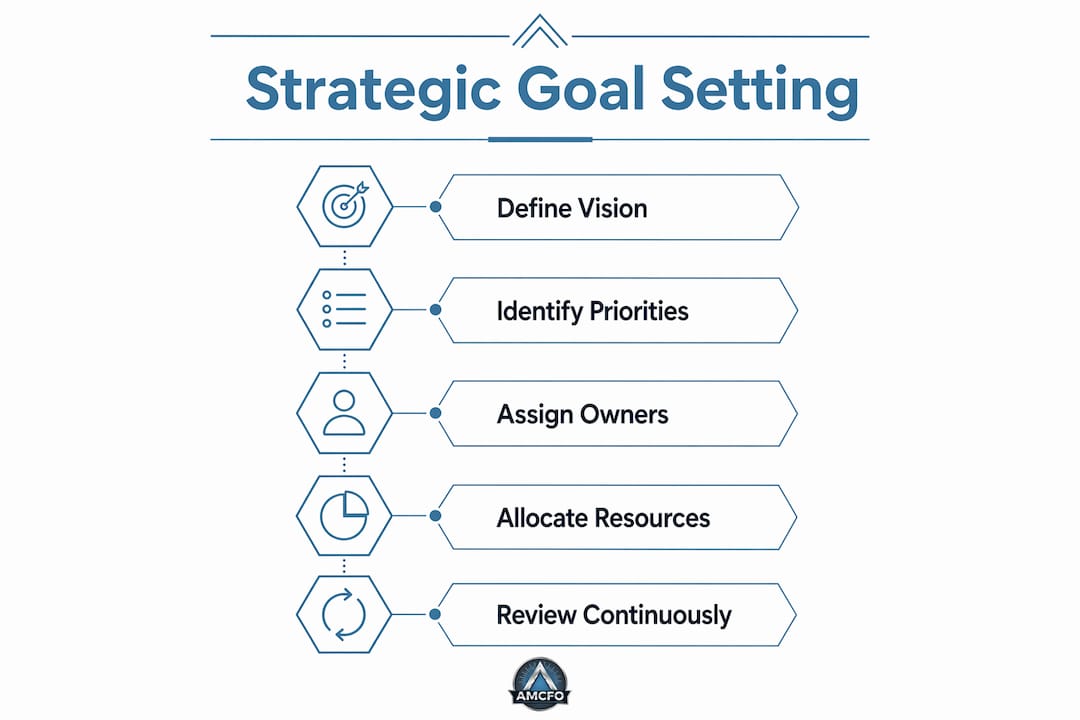
The ideal goal portfolio contains 5–9 goals, balancing specificity with the team's actual capacity to execute. Fewer than five often signals under-ambition. More than nine guarantees dilution. Each goal in that range needs three non-negotiable elements: a single named owner, a measurable outcome, and a realistic timeline.
Here is a proven sequence for building effective strategic goals:
- Start with evidence. Pull your financial baseline, customer data, and competitive position before writing a single goal.
- Define the outcome, not the activity. "Increase gross margin to 42% by Q3" beats "improve profitability."
- Assign one owner. Not a team, not a department. One person who is accountable for the result.
- Set a 90-day update cadence. Goals without scheduled reviews stagnate. Goals untouched for 90+ days typically stall and may go unaddressed for three or more years.
- Validate from the bottom up. Ask the people doing the work whether the goal is achievable given current resources and constraints.
- Connect each goal to a leading indicator. Know what early signal tells you the goal is on track before the deadline arrives.
Confusing vision with strategy is a persistent leadership failure. Vision defines where you want to go. Strategy defines the specific, adjustable route to get there. Vision should stay steady. Strategy should flex as you learn. Leaders who lock in a strategy as firmly as their vision lose the ability to adapt when conditions change.
Pro Tip: Apply the 5 Whys analysis to each proposed goal before approving it. Ask "why does this matter?" five times. If you cannot reach a concrete business outcome by the fifth answer, the goal is not ready.
Why does continuous planning beat static annual plans?
Static multi-year plans assume a level of market predictability that no longer exists. Moving from episodic to continuous planning is now a prerequisite for navigating volatility effectively. The difference is not just frequency. It is a fundamentally different relationship with uncertainty.
Continuous planning uses scenario analysis, probability weighting, and rolling updates to respond to market shifts rather than waiting for the next annual cycle. Monitoring leading indicators and applying real options analysis allows organizations to adapt early, before a market shift becomes a crisis.
Two cognitive biases consistently undermine static planning. Confirmation bias causes leaders to favor data that supports existing plans. Sunk-cost thinking causes them to continue investing in failing initiatives because of past commitments. Continuous planning counters both by building regular reassessment into the process itself.
"Strategy must be adjusted as teams learn, while vision remains steady." — Strategy, Vision and Goal Setting Distinctions
Practical elements of a continuous planning model include:
- Quarterly scenario reviews: Identify 3–5 plausible futures and assign probability weights to each
- Rolling 12-month roadmaps: Update priorities and resource allocation every quarter, not every year
- Leading indicator dashboards: Track early signals, not just lagging results
- Structured assumption logs: Document the assumptions behind each strategic bet and review them regularly
Companies that have adopted continuous planning, including those in technology and consumer goods sectors, report faster responses to competitive threats and fewer costly strategy reversals. The agility comes not from moving faster but from deciding sooner.
Pro Tip: Schedule a 90-minute "strategy health check" every quarter with your leadership team. Review your top three assumptions, your leading indicators, and any scenario that has changed in probability. That single habit replaces most of what annual planning retreats try to accomplish.
How do you turn a strategic plan into operational execution?
A plan that does not execute is not a plan. It is a document. Organizations typically experience a 10–11 month execution cycle, with ongoing adjustment phases built in. That timeline means execution is not a sprint. It is a managed process that requires governance, accountability, and regular course correction.
The most critical execution variable is ownership. Every strategic priority needs one named person who is responsible for results, not just activities. Without that clarity, priorities compete for attention and nothing gets the focus it needs.
Resource allocation is the second execution lever most leaders underuse. Declaring a priority without shifting budget, headcount, or leadership attention to it is not a commitment. It is a wish. Effective execution planning explicitly connects each strategic priority to resource decisions, project portfolio management, and cross-functional coordination.
Fractional executives, including fractional CFOs, play a growing role in execution for mid-market companies. They bring senior-level accountability to financial alignment and strategic budgeting without the cost of a full-time hire. That model works especially well when a company is executing a new strategy that requires financial modeling, scenario analysis, or investor reporting.
Best practices for sustaining execution momentum:
- Weekly owner check-ins: Brief, structured updates from each goal owner on progress and blockers
- Monthly governance reviews: Leadership team reviews all active priorities against plan
- Quarterly reforecasting: Adjust resource allocation based on actual results and updated assumptions
- Red/yellow/green dashboards: Visual tracking of goal status creates shared accountability
- Formal stall protocols: Define in advance what triggers a goal reassignment or removal
The organizations that execute best treat their strategic management process as a living system, not a calendar event. They build the review cadence into their operating rhythm so that strategy and operations stay connected throughout the year.
Key takeaways
Effective strategic planning requires a structured process, limited goals with named owners, and a continuous review cadence to translate direction into measurable results.
| Point | Details |
|---|---|
| Use a structured framework | Choose from Balanced Scorecard, OKRs, or Continuous Planning based on your organization's stage and pace. |
| Limit goals to 5–9 | A constrained goal portfolio allows teams to own, measure, and report progress within a 12–18 month span. |
| Assign single owners | Every goal needs one named accountable person with defined KPIs and a 90-day update schedule. |
| Shift to continuous planning | Replace annual static plans with rolling quarterly reviews that use scenario analysis and leading indicators. |
| Connect strategy to resources | Execution fails when priorities are declared without shifting budget, headcount, or leadership attention to match. |
The planning mistake i see most often
Most strategic plans I have reviewed share one flaw: they are written for the boardroom, not for the people who have to execute them. Leaders spend weeks crafting vision statements and multi-year projections, then hand the document to managers who have no idea which three things actually matter most this quarter.
The fix is not a better template. It is a different discipline. Limit your goals before you start planning, not after. Limiting goals to what the team can actively own within 12–18 months is the single highest-leverage decision in the entire process. Everything else, the frameworks, the dashboards, the governance meetings, only works if the goal list is short enough to be real.
I have also seen organizations confuse a bold vision with a clear strategy. Vision tells you where you want to be. Strategy tells you the specific choices you are making right now to get there. When those two things blur together, you get plans that sound inspiring but provide no guidance when a real decision needs to be made.
The leaders who execute well share one habit: they treat their strategy as a hypothesis, not a declaration. They build in the assumption that they will be wrong about something, and they create the review processes to find out what that is before it becomes expensive. That mindset, grounded in evidence-based diagnostics and honest financial baselines, is what separates plans that drive growth from plans that just describe it.
— Angelica
How Amcfo supports your strategic execution
Developing a sound strategy is one challenge. Executing it with financial discipline is another. Amcfo works with business leaders to align financial planning with strategic priorities, so your numbers reflect your direction and your direction is grounded in your numbers.

From fractional CFO services that provide senior-level financial oversight to business consulting that supports goal-setting, resource allocation, and execution governance, Amcfo gives growing companies the financial infrastructure their strategies require. Whether you need ongoing CFO guidance, budgeting support, or a financial model built around your strategic roadmap, Amcfo tailors its services to where you are and where you are going. Explore how Amcfo can support your next planning cycle.
FAQ
What is strategic planning in business?
Strategic planning is the formal process by which an organization sets its long-term direction, defines measurable priorities, and allocates resources to achieve sustained growth. It typically involves a diagnostic phase, goal-setting, resource allocation, and an execution roadmap with named owners and timelines.
How many strategic goals should a company have?
The ideal range is 5–9 goals, according to research from ClearPoint Strategy. Fewer goals allow teams to maintain ownership and reporting clarity across a 12–18 month execution cycle.
How long does strategic plan execution take?
Most organizations operate on an 18-month planning cycle, with a median execution time of approximately 10–11 months. Adjustment phases are built into that cycle to allow for course correction as conditions change.
What is the difference between vision and strategy?
Vision defines the destination, the long-term outcome the organization is working toward. Strategy defines the specific, adjustable route to reach that destination. Vision should remain steady while strategy flexes as the organization learns and conditions shift.
Why do most strategic plans fail?
Most plans fail due to unclear goal ownership, goals that are too aspirational to execute, and the absence of a continuous review process. Goals without a named owner and a 90-day update cadence typically stall within three months and may go unaddressed for years.