

A business growth strategy is a measurable, goal-driven plan that directs how your company increases revenue, expands market share, and builds operational capacity over a defined period. Without one, growth becomes reactive and expensive. Wells Fargo advises tailoring growth strategies using sales data and competitive analysis to set targets like revenue milestones or customer acquisition numbers. Harvard Business School frames the challenge as one of value creation and capture, where the strategy must adapt as the business moves through each growth phase. The entrepreneurs who scale successfully treat growth as a system, not a stroke of luck.
What measurable goals and financial planning underpin a successful business growth strategy?
Every effective business growth strategy begins with a number you can defend. Revenue targets, customer acquisition goals, gross margin thresholds, and market share percentages all qualify. Vague ambitions like "grow faster" give your team nothing to optimize against. Wells Fargo recommends integrating financing into strategy design from the start, not as an afterthought, because available capital directly shapes which growth moves are executable.
Financial planning for growth means mapping each funding tool to its best use case. Credit cards work for short-cycle operating expenses. Business lines of credit cover working capital gaps during seasonal swings. SBA 7(a) loans fund acquisitions and long-term working capital, while SBA 504 loans target fixed assets like equipment and real estate. Notably, the SBA now allows eligible borrowers to combine 7(a) and 504 loans for up to $10 million in total financing, a significant expansion for capital-intensive growth projects.
| Funding tool | Best use | Key consideration |
|---|---|---|
| Business credit card | Short-term operating costs | High interest if not paid monthly |
| Line of credit | Working capital, seasonal gaps | Revolving, flexible draw |
| SBA 7(a) loan | Acquisitions, long-term capital | Up to $5M, broad eligibility |
| SBA 504 loan | Equipment, real estate | Fixed rate, up to $5.5M |
| Combined 7(a) + 504 | Large capital projects | Up to $10M as of July 2026 |
Pro Tip: Build your financial model before you choose a funding vehicle. Know your projected cash burn, repayment capacity, and break-even timeline. Lenders and investors both reward founders who arrive with numbers, not narratives.
How can AI and analytics accelerate growth opportunity identification?
Most business owners treat analytics as a rearview mirror. They review last quarter's numbers and adjust. BCG's 2026 research shows that AI detects early innovation signals before competitors act, turning analytics into a forward-looking radar rather than a historical report. That shift in how you use data is where the real competitive advantage lives.

AI tools analyze customer behavior patterns, competitor pricing moves, and market sentiment in real time. A retail business using AI-powered analytics might detect a drop in repeat purchase rates three weeks before it shows up in monthly revenue figures, leaving time to intervene with a targeted retention campaign. That early warning capability is what BCG calls the "insight advantage."
Four AI-driven growth accelerators worth building into your strategy:
- Automated market signal monitoring: AI scans competitor activity, pricing changes, and search trend shifts continuously, flagging opportunities your team would miss manually.
- Customer segmentation at scale: Machine learning clusters customers by behavior, not just demographics, revealing high-value segments that generic reporting obscures.
- Churn prediction models: Predictive algorithms identify at-risk accounts before they cancel, giving your team a window to act.
- Demand forecasting: AI-generated forecasts reduce inventory overstock and stockouts, directly improving cash flow and margin.
Pro Tip: AI outputs are only as good as the human judgment applied to them. Assign a specific team member to review AI-generated alerts weekly and translate findings into concrete tactical decisions. Unreviewed dashboards do not drive growth.
What are key growth strategy examples and paths for expansion?
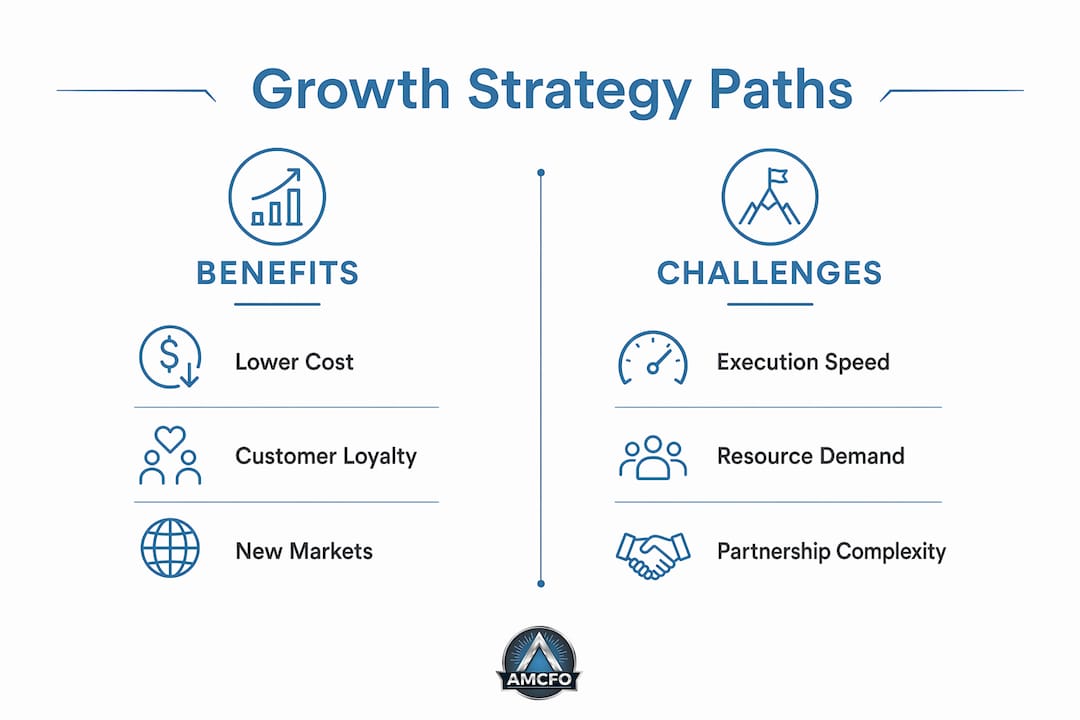
Harvard Business School identifies four primary growth paths: market penetration, product or service development, market expansion, and strategic partnerships. Each carries a different risk profile and capital requirement. The most effective business expansion plans combine two or more of these paths rather than betting everything on one.
Market penetration focuses on selling more of your existing product to your current market. This is the lowest-risk path and often the most overlooked. A restaurant chain increasing table turns through reservation software or a SaaS company reducing churn through better onboarding both qualify as penetration strategies. The goal is extracting more value from what you already have before spending on new markets.
| Growth path | Core benefit | Primary challenge |
|---|---|---|
| Market penetration | Lower cost, faster execution | Limited ceiling in saturated markets |
| Product/service development | Deepens customer relationships | R&D cost and time to market |
| Market expansion | Opens new revenue streams | Requires local market knowledge |
| Strategic partnerships | Shared resources, faster reach | Alignment and trust take time |
| Combination strategy | Maximizes impact across fronts | Requires strong operational capacity |
Product development works well when you have a loyal customer base hungry for adjacent solutions. A bookkeeping firm adding fractional CFO services is a textbook example. Market expansion, whether geographic or demographic, carries higher execution risk but unlocks growth ceilings that penetration alone cannot break. Strategic partnerships, like co-marketing agreements or distribution deals, let you access new audiences without building from scratch.
How do unit economics influence sustainable growth?
Unit economics are the financial metrics that tell you whether each new customer makes you money or costs you money. The three metrics that matter most are customer acquisition cost (CAC), lifetime value (LTV), and CAC payback period. A healthy LTV:CAC ratio sits at 3:1 or higher, meaning every dollar spent acquiring a customer returns three dollars in lifetime revenue. A ratio below 2:1 signals that your acquisition model is burning capital faster than customers can repay it.
CAC payback period measures how many months it takes to recover what you spent acquiring a customer. For SaaS companies, Bessemer Venture Partners benchmarks a healthy payback period at under 12 months. Beyond 18 months, cash flow strain becomes a real operational risk, particularly for businesses without deep reserves or credit access. Tracking payback trends alongside net revenue retention gives you a complete picture of whether your growth model is self-funding or self-defeating.
Ignoring these metrics is the most common reason fast-growing businesses run out of cash. A company adding 200 new customers per month while spending $800 per acquisition and generating $1,200 in lifetime value is not growing. It is slowly going broke with impressive top-line numbers.
Tactics that directly improve unit economics:
- Reduce churn: A 5% improvement in retention can increase LTV by 25% to 95%, depending on your pricing model. Invest in onboarding and customer success before adding more acquisition spend.
- Increase average revenue per user (ARPU): Upsell and cross-sell to existing customers. The cost to expand an existing account is a fraction of acquiring a new one.
- Lower CAC through channel mix: Organic search, referral programs, and content marketing carry lower CAC than paid channels. Shift budget toward channels with proven payback under your target threshold.
- Improve conversion rates: A 10% lift in trial-to-paid conversion reduces CAC without touching your ad spend.
What operational and people planning considerations support scaling?
Workday's 2026 research makes a point most growth plans ignore: scaling demands include process and people planning, not just sales initiatives. A company that doubles revenue without doubling its operational capacity creates bottlenecks that erode the customer experience and burn out the team. Growth without infrastructure is just organized chaos.
Cross-functional alignment means your finance, operations, HR, and sales teams are working from the same growth assumptions. If sales is targeting 40% revenue growth but HR has not planned the hiring pipeline to support it, the gap shows up as missed delivery timelines and declining service quality. BCG's CEO growth guide is direct on this point: growth fails when treated as inspiration rather than disciplined management mobilizing the whole organization.
Before rolling out new tools or AI systems, HBR recommends an operating model readiness check. Even successful pilots stall without concurrent process and governance adaptations. Key readiness factors to evaluate:
- Process documentation: Are your core workflows written down and repeatable, or do they live in one person's head?
- Data infrastructure: Can your systems produce the reports your growth strategy requires, or will you be flying blind?
- Hiring pipeline: Does your recruiting capacity match your projected headcount needs for the next 12 months?
- Financial controls: Are your bookkeeping and reporting accurate enough to make capital allocation decisions with confidence?
Consulting resources like business process optimization services exist precisely to close these gaps before they become growth blockers.
Key takeaways
A sustainable business growth strategy requires measurable goals, disciplined financial planning, and operational readiness working together before you scale.
| Point | Details |
|---|---|
| Define measurable goals first | Set specific revenue, CAC, and market share targets before choosing a growth path. |
| Match funding to purpose | Use SBA loans, credit lines, and equity strategically based on repayment capacity and project type. |
| Use AI as a radar, not a report | Deploy AI analytics to detect market shifts early, then act on findings with human judgment. |
| Monitor unit economics as gating metrics | A 3:1 LTV:CAC ratio and sub-12-month payback period are minimum thresholds for scaling safely. |
| Align operations before you accelerate | Cross-functional readiness in HR, finance, and process is what separates growth from chaos. |
Where most growth plans quietly break down
I have worked with enough business owners to know that the strategy document is rarely the problem. The problem is what happens between the document and the execution. Most entrepreneurs I see are not short on ambition or ideas. They are short on financial clarity and operational honesty.
The unit economics conversation is where I see the most avoidance. Founders will celebrate 30% revenue growth while quietly ignoring that their CAC payback has stretched from 8 months to 22 months. That is not growth. That is a cash flow crisis with a good press release. BCG's point about disciplined management resonates with me because inspiration is genuinely abundant in entrepreneurship. Discipline is the scarce resource.
I also push back on the instinct to add tools before fixing processes. I have seen companies spend six figures on AI platforms that produced beautiful dashboards nobody acted on, because the underlying workflow had no owner and no decision-making cadence attached to it. HBR's readiness check framework is not bureaucracy. It is the difference between a pilot that scales and a pilot that dies quietly.
The entrepreneurs I see scale well share one habit: they treat their financial model as a living document, not a fundraising artifact. They know their numbers, they update them monthly, and they make decisions from them. That habit, more than any single strategy, is what separates the businesses that grow from the ones that just get bigger.
— Angelica
How Amcfo helps you execute your growth strategy with financial confidence
Growth strategy without financial infrastructure is a plan with no engine. Amcfo's fractional CFO services give business owners the financial leadership they need to set measurable goals, model funding scenarios, and track unit economics without hiring a full-time CFO. Whether you are preparing for an SBA loan, optimizing your LTV:CAC ratio, or building a 12-month growth forecast, Amcfo provides the financial clarity that turns strategy into execution.

From bookkeeping and QuickBooks cleanup to budgeting, forecasting, and ongoing CFO consulting, Amcfo's financial management services are built around the real decisions growing businesses face. If your growth plan needs a financial foundation, that is exactly what Amcfo builds.
FAQ
What is a business growth strategy?
A business growth strategy is a measurable, goal-driven plan that defines how a company will increase revenue, market share, or operational capacity over a set period. It aligns customer needs, competitive positioning, and financial resources into a coordinated set of actions.
What are the four main growth strategy examples?
The four primary paths are market penetration, product or service development, market expansion, and strategic partnerships. Most successful businesses combine two or more of these paths to maximize impact while managing risk.
What LTV:CAC ratio signals healthy growth?
A 3:1 LTV:CAC ratio is the standard benchmark for sustainable growth, meaning each customer generates three times what it cost to acquire them. Ratios below 2:1 indicate the acquisition model is consuming capital faster than customers return it.
How does AI fit into strategic planning for growth?
AI accelerates growth by detecting market signals, predicting churn, and segmenting customers in real time, giving businesses an early-mover advantage. BCG identifies this "insight advantage" as one of the four primary ways AI drives measurable growth outcomes.
When should a business hire a fractional CFO for growth planning?
A fractional CFO becomes valuable when a business needs financial modeling, funding strategy, or unit economics analysis but cannot justify a full-time CFO salary. This is especially relevant during scaling phases when financial decisions carry the highest consequence.