

The most reliable way to run SaaS revenue forecasting is to build an MRR/ARR waterfall segmented by customer cohort, then wrap it in three named scenarios. Start by checking three drivers every month: new MRR, expansion MRR, and churn. Before trusting any output, reconcile the model to recognized revenue under ASC 606 rather than to billings or cash alone.
TL;DR:
- A reliable SaaS forecast relies on a detailed MRR/ARR waterfall segmented by customer cohort and includes three scenarios with explicit assumptions.
- Key metrics should be reconciled with recognized revenue under ASC 606 to prevent errors from mixing booking, billing, and recognized income.
- Forecasting models need to match the sales approach, with cohort analysis best for subscription retention, pipeline for sales-led growth, and usage-based models for consumption-driven revenue.
- Regular reconciliation to billing data, segmenting churn by renewal cohort, and maintaining a separate cash forecast are essential controls to keep forecasts accurate.
- Moving from spreadsheets to connected FP&A tools is recommended once actuals require manual updates or multiple versions become unmanageable.
Table of Contents
- What Metrics Does SaaS Revenue Forecasting Actually Require?
- Which Forecasting Model Fits Your SaaS Business?
- How Do You Build a SaaS Forecast Step by Step?
- How Should You Structure Scenario Planning and Ownership?
- How Does ASC 606 Change What You Forecast?
- What Data Controls Keep a Forecast Honest?
- Should You Use a Spreadsheet or Connected FP&A Software?
- How Should Forecasts Show Up in Board Reporting?
- What Fractional CFOs See Most Often
- How Amcfo Helps You Operationalize a SaaS Forecast
- Sources
- FAQ
What Metrics Does SaaS Revenue Forecasting Actually Require?
Forecasting breaks down fast when finance, sales, and customer success each define the same word differently. Before building any model, get everyone using the same numbers.
Monthly recurring revenue (MRR) is the recurring subscription revenue normalized to a monthly figure. Annual recurring revenue (ARR) is usually just ending MRR multiplied by 12, according to Stripe's forecasting guide. That shortcut works fine for steady-state businesses, but it distorts fast-growing or highly seasonal companies where a single month's MRR doesn't represent the year.
The waterfall components matter more than the totals:
- New MRR from newly signed customers in the period
- Expansion MRR from upsells, seat additions, or plan upgrades
- Contraction MRR from downgrades or reduced usage
- Churned MRR from canceled accounts
- Logo churn (customers lost) versus revenue churn (dollars lost) — the two rarely move together, and conflating them hides which one is actually the problem
Then there's the language of the money itself. Bookings are signed contract value. Billings are what you've actually invoiced. Deferred revenue sits on the balance sheet until it's earned. Recognized revenue is what shows up on the income statement under GAAP. A $120,000 annual contract might book in January, bill in January, and recognize at $10,000 a month for a year. Mixing these up is the single most common error finance teams make when a board asks "why doesn't the forecast match the P&L?"
Which Forecasting Model Fits Your SaaS Business?
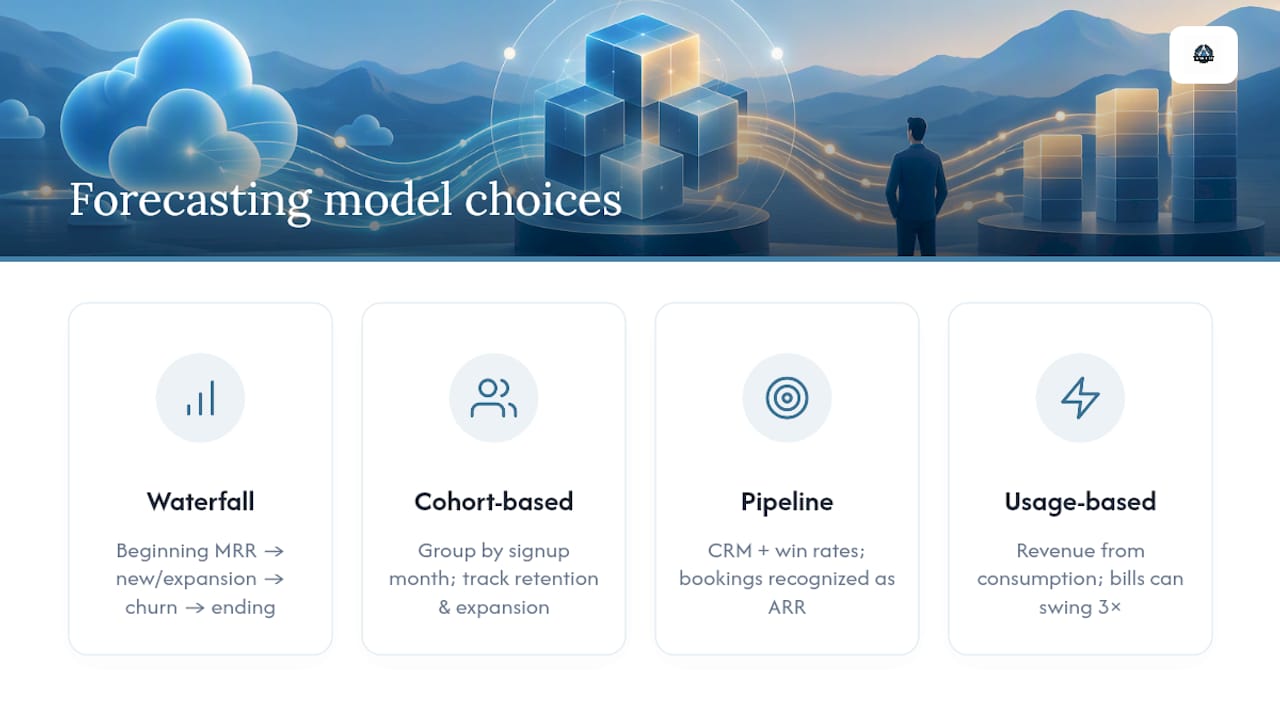
No single model works for every revenue mix. The waterfall is the baseline everyone should build first, but the model you layer on top depends on how you sell.
The MRR/ARR waterfall starts with beginning MRR, adds new and expansion MRR, subtracts contraction and churned MRR, and lands on ending MRR. It's the foundation of SaaS revenue forecasting because it forces every driver into its own line instead of hiding inside one growth number.
Cohort-based forecasting groups customers by signup month or contract start date, then tracks retention, expansion, and contraction separately for each group. This exposes what an aggregate model can't: a cohort acquired through a discount promotion churning faster than one acquired through referrals, for instance. Cohort models tend to work best with 6 to 24 months of monthly history behind them.
Pipeline or bookings forecasting starts with CRM opportunity data, applies win rates by stage, and converts closed bookings into ARR recognized over the contract term. This is the right primary model for sales-led businesses where a rep-driven pipeline, not self-serve signups, is the real growth engine.
Usage-based forecasting models revenue off consumption, not seat counts. It fits companies billing on API calls, data volume, or compute, where a customer's monthly bill can swing 3x with no change in headcount.
Most real businesses blend two or three: cohort analysis for the core subscription base, pipeline forecasting for new enterprise logos, and usage curves for consumption add-ons.
How Do You Build a SaaS Forecast Step by Step?
Building a forecast that survives contact with the board is a sequence, not a single spreadsheet tab. Skip a step and the whole thing collapses the first time actuals come in.
- Define the question and horizon. Are you forecasting ARR for board reporting, MRR for operational tracking, or cash for runway planning? Each needs a different structure and update frequency.
- Assemble your inputs. Pull from the billing system (Stripe, Chargebee, or similar), CRM pipeline data, product usage logs, contract start and renewal dates, and payment terms. Gaps here are where forecasts quietly go wrong.
- Build the core model. Construct cohort tables, derive churn and expansion curves per cohort, and set explicit rules for converting bookings into recognized ARR over the contract term.
- Create three named scenarios. Base, upside, and downside cases each need dated assumptions and a named owner, not just adjusted percentages pulled from thin air, per Stripe's guidance on scenario inputs.
- Validate against actuals. Run a closed-month reconciliation tying your model's ending MRR to the billing system, then back-test last quarter's forecast against what actually happened.
- Set the update cadence. Decide who updates pipeline assumptions, who updates churn curves, and how often the whole model refreshes. Monthly is standard for most SaaS companies; weekly for anyone approaching a fundraise or facing cash constraints.
The gap between a forecast that holds up and one that quietly drifts almost always traces back to step 5. Teams build elaborate models, then never check them against what the billing system actually says happened.
How Should You Structure Scenario Planning and Ownership?
A forecast with one number is a guess wearing a spreadsheet costume. A forecast with three named, dated, owned scenarios is a planning tool.
Build at minimum a base, upside, and downside case, with explicit and dated assumptions behind each one rather than a vague sense of optimism or caution. Assign ownership so assumptions are testable against a real person's judgment:
- Sales owns pipeline volume and stage-to-close conversion rates
- Customer success owns retention and expansion assumptions
- Product owns usage-driver assumptions for consumption-based revenue
- Finance owns metric definitions, model mechanics, and reconciliation to the ledger
Keep an assumptions register that logs who set each number, when, and on what basis. Revisit it every time something changes the game: a pricing shift, a new hire in sales, a go-to-market pivot into a new segment. Scenario planning that never updates its assumptions is just a base case with two extra tabs nobody opens.
How Does ASC 606 Change What You Forecast?
Forecasted ARR and recognized revenue are not the same number, and treating them as interchangeable is where a lot of finance teams get burned in front of their board.
ASC 606 requires revenue recognition through five steps: identify the contract, identify performance obligations, determine the transaction price, allocate that price across obligations, and recognize revenue as each obligation is satisfied. For a standard subscription, that usually means ratable recognition over the contract term regardless of how or when you invoiced it.
Billing cadence changes the mechanics without changing the underlying rule. An annual contract billed upfront creates a large deferred revenue balance that amortizes monthly. A monthly-billed contract recognizes revenue close to when cash arrives. SEC filings on subscription businesses show how deferred revenue and remaining performance obligations determine exactly how much of your forecasted ARR converts to recognized revenue in any given period.
A practical reconciliation checklist:
- Tie ending ARR/MRR in the model to the billing system, not to a manually maintained tab
- Confirm deferred revenue amortization matches contract terms, not billing dates
- Flag multi-element contracts (software plus services) that need separate performance obligations
- Track contract modifications, which can trigger prospective or cumulative catch-up adjustments
What Data Controls Keep a Forecast Honest?
Every forecast drifts from reality eventually. The question is whether you catch it in month one or month six.
The closed-month reconciliation rule is non-negotiable: ending MRR in your model has to tie to the billing system, with a documented bridge covering new, expansion, contraction, churn, reactivations, currency effects, and manual adjustments. An unreconciled opening balance doesn't just create one bad month. It compounds every month after.
Avoid applying one blended churn rate across a customer base with staggered renewal dates. Renewal-date-driven cohorts churn in clusters tied to contract anniversaries, not evenly across the calendar, and a single blended rate smooths over exactly the timing risk you need to see coming.
Revenue accuracy alone doesn't guarantee operational health. A forecast can show healthy ARR growth while collections quietly fall behind, which is why a separate 13-week cash forecast matters alongside the revenue model.
- Build a documented monthly bridge, not a single ending number
- Segment churn by renewal cohort, never blend it across the base
- Run a 13-week rolling cash forecast independent of the ARR model
- Maintain a collections schedule tracking days sales outstanding by segment
Pro Tip: *Centralize every assumption in one register with the owner's name, the date it was set, and the source it came from. Then automate a monthly drift report comparing forecasted MRR to actual closed-month MRR.
Should You Use a Spreadsheet or Connected FP&A Software?
Most SaaS companies start in a spreadsheet, and that's the right call until it isn't. A minimal, functional model needs three connected parts: a revenue and ARR build, a headcount and expense driver plan, and a rolling forecast that ties the two together.
You've outgrown spreadsheets when actuals require manual re-entry every month, when sales, finance, and customer success maintain three versions of "the number," or when the model breaks every time someone adds a row. Building a structured financial forecasting process before that breakdown happens saves the rebuild later.
When you do move to connected tools, prioritize in this order: connect billing as the single source of truth, automate cohort table generation, integrate CRM pipeline data, then build dashboards. A well-built dashboard, like the approach outlined in this guide to financial dashboards in Power BI, should surface forecast-versus-actual variance, net revenue retention, the bookings-to-ARR bridge, and a rolling 13-week cash view without anyone opening a spreadsheet.
How Should Forecasts Show Up in Board Reporting?
A board deck built from a forecast should answer one question: what changed, and what are we doing about it? That means the monthly ARR bridge, the biggest forecast drivers, the scenario waterfall, and a variance analysis against last month's forecast.
Watch specifically for cohort deterioration, expansion slowdowns, and pipeline shortfalls against target. Each of these signals a different fix, and burying them inside one aggregate growth number is how a board gets surprised in month five by a problem finance saw coming in month two.
An FP&A packet can carry more operational detail: driver-level variance, department spend against budget, cohort tables. A board deck needs the compressed version: three or four charts, the scenario range, and a clear statement of which assumptions moved and why.
- Monthly ARR bridge broken into new, expansion, contraction, and churn
- Scenario waterfall showing base, upside, and downside outcomes
- Variance analysis comparing this month's actuals to last month's forecast
- A named list of assumptions that changed since the last board meeting
What Fractional CFOs See Most Often
The same three mistakes show up across most SaaS companies: treating ARR growth as if it were cash in the bank, applying one churn rate to a base that actually churns in cohort-driven waves, and running a forecast that nobody specifically owns.
The fix is rarely a better spreadsheet. It's assigning owners, running the cohort analysis honestly, reconciling to the billing system every closed month, and keeping a short-term cash schedule next to the revenue model. Teams that get this right stop being surprised by their own numbers.
— Angelica
How Amcfo Helps You Operationalize a SaaS Forecast
Repeated forecast misses, an MRR model nobody has reconciled to billing in three months, or scenarios with no named owner are usually signs the forecast needs outside expertise, not another spreadsheet rebuild. Amcfo's fractional CFO services bring senior financial oversight to that exact problem: building the cohort model, assigning driver ownership across sales, customer success, and product, and reconciling forecasted ARR to recognized revenue every closed month.

Amcfo also handles the groundwork a forecast depends on: QuickBooks cleanup and billing reconciliation so your revenue data is trustworthy before it ever hits a model, plus ongoing monthly FP&A support once the forecast is built. Because the model is modular, you bring in exactly the level of financial leadership your stage requires, rather than paying for a full-time executive you don't yet need. If your last three forecasts missed by double digits or nobody on the team can explain the churn number with confidence, talk to Amcfo about fractional CFO support and get the reconciliation and cohort model built this quarter.
This article is general information, not a substitute for advice from a qualified financial advisor. Consult a qualified financial professional about your own circumstances before acting on anything here.
Sources
- SaaS revenue forecasting: models, metrics, and best practices | Stripe
- SEC filing excerpt on ASC 606 revenue recognition
- Forecasting with cohort-based models | ODSC
- SaaS financial model template (free, Excel and Google Sheets) | Aleph
FAQ
What Is the 3-3-2-2-2 Rule of SaaS?
The 3-3-2-2-2 rule is a growth benchmark suggesting a SaaS company should triple revenue in years one and two, then double it in each of the following three years. It's used as a rough growth trajectory target, not a forecasting method. Use it for context when setting upside-case growth assumptions, but build your actual forecast on the MRR/ARR waterfall and cohort data instead.
What's the Best Tool for SaaS Revenue Recognition?
There's no single tool that fits every SaaS company. A basic spreadsheet model with a proper revenue build, headcount plan, and rolling forecast works fine early on, per Aleph's modeling guidance, and connected FP&A platforms make sense once manual actuals uploads and cross-team version conflicts become routine. Amcfo helps businesses reconcile billing data and set up the QuickBooks structure that any recognition tool depends on.
What Is the Rule of 40 in SaaS?
The Rule of 40 states that a healthy SaaS company's growth rate plus profit margin should generally add up to 40% or more. Analysis by McKinsey found that a relatively small share of company-years in its sample exceeded that benchmark, supporting its use mainly as a quarterly trend diagnostic between growth and cash generation rather than a strict forecasting target.
Is SaaS Being Replaced by AI?
AI is changing how SaaS products are built and priced, particularly as usage-based and consumption pricing models grow alongside traditional seat licensing, but it hasn't replaced the subscription business model. For forecasting purposes, this shift means more companies now need to blend usage-driven forecasting with the traditional MRR/ARR waterfall rather than relying on seat counts alone.
How Often Should a SaaS Company Update Its Revenue Forecast?
Most SaaS companies update their forecast monthly, tied to the closed-month reconciliation against the billing system. Companies approaching a fundraise, facing tight cash runway, or navigating a major pricing or go-to-market change often move to weekly updates on the most volatile drivers, like pipeline conversion and expansion revenue.