

Reasonable salary is what an unrelated employer would pay someone to do your exact job, and the IRS can reclassify your S corp distributions as wages if that number looks too low. The fix starts now, not after a notice arrives: build a short written analysis using Bureau of Labor Statistics data or a comparable-salary survey, then file it away with your corporate records before you run next month's payroll.
TL;DR:
- Building a written analysis based on BLS or comparable salary surveys before payroll is essential to demonstrate reasonable compensation and avoid IRS reclassification risks.
- The IRS considers nine factors, notably duties performed, hours worked, and industry wages, with particular emphasis on market data and time logs for defense.
- Combining the market approach and many-hats method, then documenting calculations in a board resolution, creates a strong defense against audit challenges.
- Regular payroll filings and maintaining contemporaneous records, such as job descriptions, wage sources, and meeting minutes, are critical to validate your salary calculations.
- Common triggers for audits include high distributions relative to wages, sudden salary drops, and disproportionately low wages compared to non-shareholder employees.
Table of Contents
- What Does the IRS Require for S Corp Reasonable Salary?
- What Are the Nine Factors the IRS Uses to Judge Reasonable Compensation?
- How Do You Calculate a Defensible S Corp Salary?
- What Documentation Proves Your S Corp Salary Is Reasonable?
- What Triggers an S Corp Reasonable Salary Audit?
- Two Worked Examples: Consulting Owner and Retail Owner
- What Payroll Steps Follow After You Set an S Corp Salary?
- How AmCFO Builds a Defensible Compensation Package
- Amcfo Turns Your Salary Number Into a Documented, Payroll-Ready File
- Where to Verify These Numbers Yourself
- Sources
What Does the IRS Require for S Corp Reasonable Salary?
The rule itself is short. Form 1120-S instructions say a shareholder-employee who performs "more than minor services" for the corporation must receive reasonable compensation before any profit distributions go out. The IRS page on S corporation compensation restates this directly and lays out the agency's authority to recharacterize distributions as wages when compensation looks artificially low.
The legal hook here is the definition of "employee" under the FICA and FUTA rules. A corporate officer who provides substantial services to the business counts as an employee for employment tax purposes, full stop, regardless of what the shareholder agreement calls the payments. The IRS guidance on S corporation officers confirms that courts have upheld this repeatedly when owners tried to route compensation through distributions to dodge payroll taxes.
When you build your documentation file, cite these sources directly:
- Form 1120-S instructions (officer compensation requirement)
- IRS Fact Sheet FS-2008-25 (the nine-factor reasonable compensation test)
- The IRS page on S corporation employees, shareholders, and corporate officers
- Treasury Regulation guidance on employment tax status for corporate officers
Referencing the actual IRS language, not a paraphrase from a blog post, gives your file more weight if an examiner ever asks how you arrived at your number.
What Are the Nine Factors the IRS Uses to Judge Reasonable Compensation?
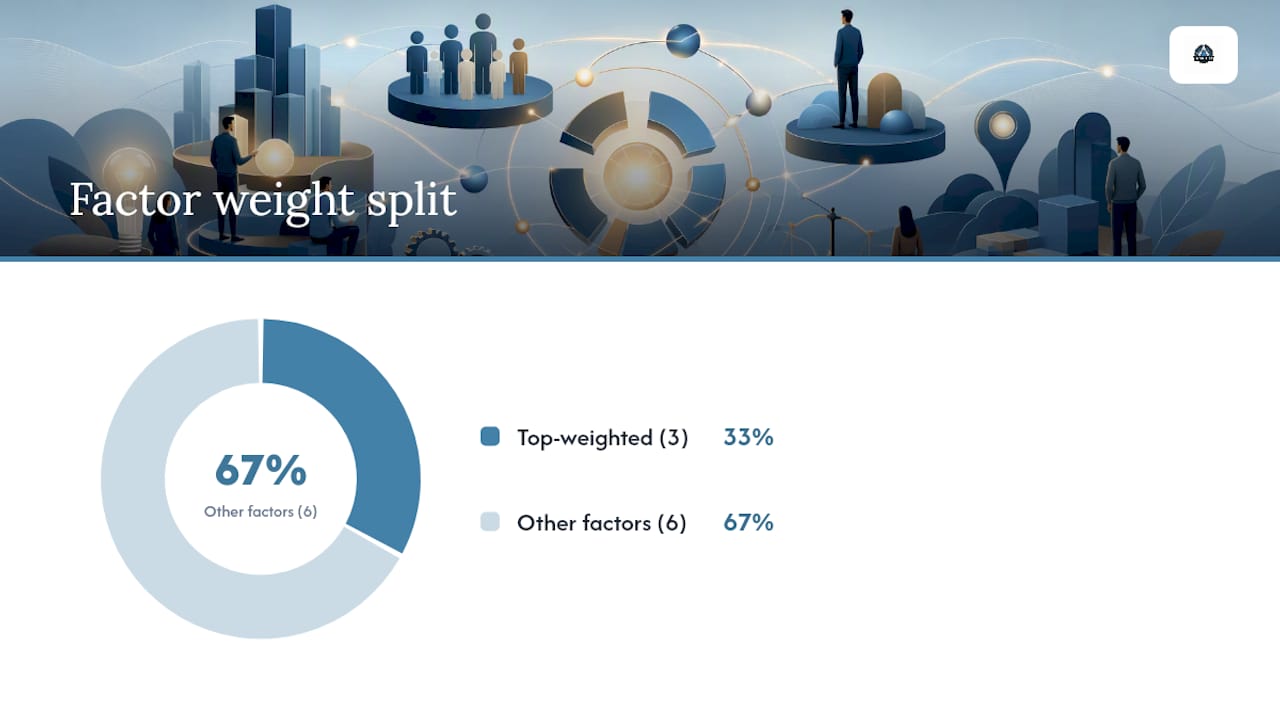
FS-2008-25 lays out nine factors examiners weigh when they decide whether an officer's pay reflects reasonable compensation. Three of them tend to carry the most weight in practice: the training and experience required for the role, what comparable businesses pay for similar work, and how much time the owner actually devotes to the company.
Here's each factor with the evidence that proves it:
- Training and experience — resume, professional licenses, prior W-2s from similar roles
- Duties and responsibilities — a written job description with a rough time allocation by task
- Time and effort devoted to the business — a calendar log or timesheet covering a representative period
- Dividend history — a record of distributions paid in prior years, for comparison against wages
- Payments to non-shareholder employees — payroll records showing what you pay staff for comparable work
- Timing and manner of paying bonuses — board minutes documenting bonus decisions and rationale
- What comparable businesses pay for similar services — BLS Occupational Employment Statistics printouts or a paid salary survey
- Compensation agreements — any employment contract or officer compensation policy on file
- The formula used to determine compensation — a written methodology note explaining your calculation
Pro Tip: Pull your BLS comparables before you set next year's salary, not after a notice letter arrives. An examiner reconstructing your file two years later will trust numbers you can date and source, not numbers you assemble under deadline pressure.
How Do You Calculate a Defensible S Corp Salary?
Three methods dominate practitioner guidance, and each fits a different type of business. Running two of them and reporting a range, rather than a single number, gives you more room to defend the figure if it's ever questioned, according to practitioner guidance from Gusto.
1. The market approach. Match your role to the closest BLS OES occupation code, then pull the wage percentile that fits your experience level and local labor market. A solo IT consultant might map to "Computer Systems Analysts"; a retail-shop owner might map to "General and Operations Managers." Adjust up or down for firm size, years in the role, and metro cost of living.
2. The cost, or many-hats, approach. Most small S corp owners wear several functional hats in one week. Break your work into three to six core activities, such as sales, operations, bookkeeping, and customer service, then estimate the percentage of your time each one consumes. Match each activity to its own market rate and compute a weighted average across the whole mix.
3. The income approach. This method treats compensation as what's left after subtracting a reasonable return to the shareholder as investor, rather than as employee. It works best as a sanity check on the other two methods, since courts have historically favored comparable-wage evidence over investor-return theory alone.
For most single-owner or small-team S corps, running the market approach and the many-hats approach side by side, then landing on a number inside the range where they overlap, produces the most defensible result:
- Map duties to BLS occupation codes
- Assign time percentages to each duty cluster
- Pull wage percentiles for each mapped occupation
- Calculate a weighted average across the many-hats components
- Cross-check the result against a straight market-comparable search for your primary title
- Document the final number and the reasoning behind it in writing
What Documentation Proves Your S Corp Salary Is Reasonable?
A number without paper behind it is an opinion, not a defense. Keep these documents together in one file, updated annually:
- A written job description with time allocation by function
- BLS OES printouts or salary survey excerpts for each mapped occupation
- Payroll registers and W-2s for the officer and any comparable employees
- Board minutes or a written resolution approving the compensation figure
- A signed methodology statement explaining how the number was calculated
Board resolution language doesn't need to be complicated. Something like: "The Board has reviewed comparable market data for the position of [title], including Bureau of Labor Statistics wage percentiles for [occupation code], and approves annual compensation of $[amount], effective [date]." A methodology note can follow the same plain format: state the approach used, the data sources consulted, and the date the analysis was performed.
Contemporaneous documentation, meaning records created at the time the decision was made rather than reconstructed later, materially improves your odds of penalty relief even in years the IRS adjusts your compensation, based on analysis published in The Tax Adviser. Examiners and courts both give more credit to a file that was clearly built in real time.
Pro Tip: Date and save every printout the day you pull it. A BLS wage table downloaded three years after the fact looks like a defense built after the audit letter, not before it.
What Triggers an S Corp Reasonable Salary Audit?
A handful of patterns show up again and again in cases the IRS pursues. High distributions paired with a tiny W-2 wage is the most common trigger, especially when there's no written analysis behind the number. A sudden drop in salary from one year to the next, with no corresponding drop in duties, also draws attention. So does an officer compensation figure that sits far below what non-shareholder employees earn for comparable work at the same company.
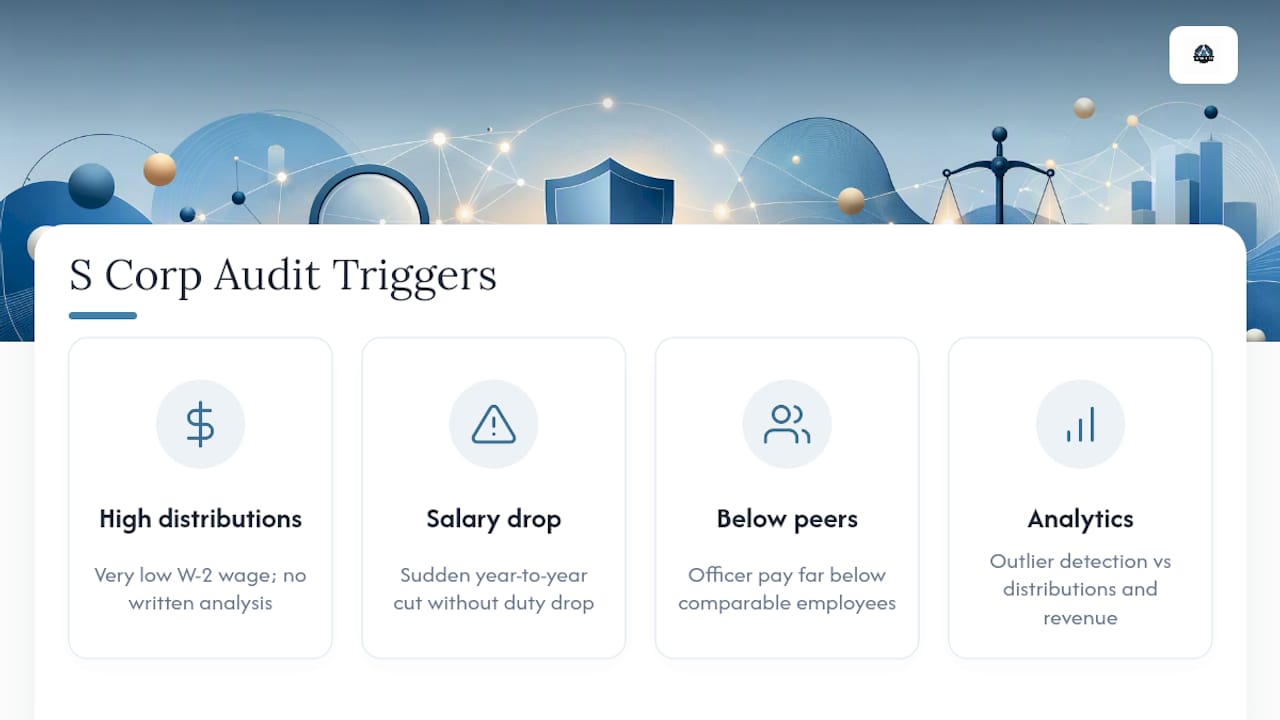
The IRS increasingly uses data analytics to flag anomalies where officer wages look disproportionately low relative to distributions and total revenue, which means outlier detection catches these patterns faster than it used to.
The consequences of a successful reclassification are not minor: back payroll taxes on the reclassified amount, interest from the original due date, and potentially accuracy-related penalties on top. The government's own market analysis carried the day in David E. Watson, P.C. v. United States, where the court adopted the IRS's comparable-wage evidence over the owner's much lower reported salary, resulting in a substantial back-tax bill.
If prior years look weak, the fix is straightforward even if not painless: reconstruct a reasonable compensation figure using the methods above, issue catch-up W-2s where appropriate, and talk to a tax professional before you file anything retroactively.
Two Worked Examples: Consulting Owner and Retail Owner
Example 1: Solo consulting owner, many-hats method. Say you run a one-person marketing consultancy.
- Map strategy work to "Management Analysts" and pull a market rate for that occupation and region from BLS OES data
- Map execution work to "Advertising and Promotions Managers" or a closer-fitting title, and pull its rate
- Map administrative work to "Bookkeeping, Accounting, and Auditing Clerks"
- Multiply each occupation's rate by its time percentage
- Sum the three weighted components into an annual salary figure
If strategy work commands roughly $95,000 full time, execution work roughly $70,000, and admin work roughly $45,000, your weighted total works out to about $79,500 (0.50 × $95,000 + 0.30 × $70,000 + 0.20 × $45,000). Round to a clean figure, document the math in your methodology note, and set that as your W-2 salary going forward.
Example 2: Retail shop owner, market-comparable method. A retail owner running a single storefront with two employees maps most closely to "General and Operations Managers" in BLS data for their metro area. Rather than splitting time across many functions, this owner spends nearly all working hours on management duties: staffing, purchasing, and overseeing daily operations.
- Pull the BLS OES wage percentile for General and Operations Managers in the relevant metro area
- Adjust downward slightly for a single small location versus a multi-site operation
- Cross-check against what the owner pays a comparable assistant manager, then apply a reasonable premium for ownership-level responsibility
Both examples convert cleanly into board resolution language: state the mapped occupation, the data source, the date pulled, and the final approved figure. That paper trail is what lets an examiner, or your own accountant two years later, reproduce your logic without guesswork.
What Payroll Steps Follow After You Set an S Corp Salary?
Once you land on a number, payroll compliance kicks in immediately. You'll file Form 941 quarterly to report withheld income and payroll taxes, Form 940 annually for federal unemployment tax, and W-2/W-3 forms at year-end summarizing wages paid. Deposit timing depends on your total tax liability: most small S corps land on a monthly deposit schedule, though larger payrolls can trigger semiweekly deposits, detailed in AmCFO's payroll support guide.
The Social Security taxable wage base rises most years, which directly affects how much payroll tax applies to salary versus how much flows through as distributions above that threshold. That distinction matters more as your salary figure climbs closer to the wage base ceiling, since income above it avoids the Social Security portion of FICA even though Medicare tax keeps applying without a cap.
- File Form 941 quarterly and Form 940 annually
- Match your deposit schedule to your total employment tax liability
- Issue W-2s and W-3s by the January deadline
- Run year-end bonuses through payroll, not as a separate distribution, if they compensate for services
Keep your payroll cadence consistent throughout the year rather than lump-summing salary at year-end. A single December paycheck labeled as annual "reasonable compensation" looks far less credible to an examiner than twelve months of regular payroll runs.
How AmCFO Builds a Defensible Compensation Package
A typical process starts with a duties inventory, then maps those duties to BLS occupations, pulls third-party comparables, drafts board resolution language, and sets up payroll to match. If you're comfortable pulling BLS data and writing your own methodology note, the DIY path outlined above works fine. Owners juggling multiple locations, complex time splits, or prior-year gaps usually get more value from a fractional CFO who's built these files before. See our guide on owner draw versus salary for the mechanics of paying yourself correctly.
Amcfo Turns Your Salary Number Into a Documented, Payroll-Ready File
A defensible salary figure only protects you if it's backed by paperwork an examiner can follow, and building that file while running a business is where most owners run out of time. Professional services can handle both halves: the compensation analysis and the payroll setup that puts your number into action correctly from the first paycheck forward.

Our fractional CFO services include mapping your duties to BLS comparables, drafting the board resolution language, and documenting the methodology so it holds up if the IRS ever asks. Once the number is set, our accounting and bookkeeping team gets payroll, W-2 reporting, and deposit schedules running correctly from day one. If your current salary was picked without any analysis behind it, or your prior years look thin on documentation, consider scheduling a compensation review and getting a written file in place before your next payroll run.
Where to Verify These Numbers Yourself
- IRS S corporation compensation guidance and Form 1120-S instructions
- BLS Occupational Employment Statistics for market comparables
- Form 941 details for payroll filing requirements
Sources
- S corporation compensation and medical insurance issues | Internal Revenue Service
- BLS wage data | Bureau of Labor Statistics
- Calculate a Reasonable Salary as an S Corp | Gusto