

BLUF: whether you take an owner's draw or a salary comes down to your business entity, not personal preference. Sole proprietors and default LLCs use draws because the IRS doesn't treat you as an employee of your own business. S corp and C corp owner-employees who actively work in the business must run payroll and pay themselves a reasonable salary before taking any additional distributions.
The tax mechanics diverge sharply from there:
- Owner's draw: No tax withholding happens at the time of the draw. You owe self-employment tax and income tax on your share of business profit, paid through quarterly estimated payments.
- Salary: Federal, state, Social Security, and Medicare taxes get withheld automatically, and the wage itself is a deductible business expense.
- Entity determines the choice. You don't pick a method because it sounds better on paper. Your entity structure picks it for you.
Key Takeaways
Your business entity determines whether you use an owner's draw or a salary, and that choice drives materially different tax, retirement, and unemployment outcomes.
| Point | Details |
|---|---|
| Entity decides the method | Sole proprietors and default LLCs take draws; S corp and C corp owner-employees must run payroll. |
| Draws require self-discipline | Set aside 25% to 30% of every draw for federal and state estimated taxes, automatically. |
| Reasonable compensation must be documented | Use BLS wage data, a job description, and an annual memo to defend an S corp salary. |
| Salary builds retirement and Social Security credit | Only W2 wages count toward 401(k) limits and your lifetime Social Security earnings record. |
| Bring in expertise before electing S corp | Amcfo's fractional CFO and bookkeeping services model the trade-off and set up payroll correctly the first time. |
Table of Contents
- Owner Draw vs Salary: Definitions and Bookkeeping Treatment
- Tax Implications of Owner Draws vs Salary
- Which Pay Method Applies to Your Business Entity
- Setting Reasonable Compensation for S Corp Owners
- How to Pay Yourself: A Practical 30 to 90 Day Plan
- Common Owner Pay Mistakes We See at Amcfo
- Owner Draws vs Salary and Retirement Plan Contributions
- Unemployment Benefits: How Draws and Salary Affect Eligibility
- How Owner Payroll Actually Gets Processed
- Social Security and Medicare: Draw vs Salary Differences
- How Amcfo Helps You Pay Yourself Correctly
- Sources
Owner Draw vs Salary: Definitions and Bookkeeping Treatment
An owner's draw is money you pull from the business for personal use, and it reduces your equity in the company. It never touches the profit and loss statement. Salary, by contrast, is a payroll expense that lowers the business's taxable income the same way paying any other employee does.
That distinction trips up more bookkeepers than you'd expect. A BizBooks Pro breakdown of owner's draw versus salary confirms the standard treatment: draws hit the owner's equity or capital account, never an expense line.
Here's what the entries actually look like:
- Recording a draw: Debit Owner's Draw (an equity contra account), credit Cash. That's it. No tax accounts involved, because nothing has been withheld yet.
- Recording salary: Debit Salary Expense for the gross wage, then credit Cash for the net amount paid and credit separate liability accounts for federal withholding, FICA, and any state withholding. Those liability accounts get cleared when you remit the payroll taxes.
The most common error is booking a draw as an "owner compensation" expense on the P&L. That artificially deflates profit, which then throws off everything downstream, loan applications, tax projections, valuation conversations. The fix is a reclassifying journal entry moving the amount from expense to the equity draw account, then reconciling the owner's capital account so the balance sheet reflects reality.
Pro Tip: Reconcile your draws to the owner's capital account every month, not just at tax time. Catching a misclassified draw in February is a five-minute fix. Catching it in December, after twelve months of distorted P&L reports, means redoing a year of financial analysis.
Tax Implications of Owner Draws vs Salary
Draws pass through as part of your net business profit, reported on Schedule C, and taxed at your ordinary income rate plus self-employment tax, currently 15.3% covering Social Security and Medicare, according to IRS guidance on self-employment tax. Nobody withholds anything for you. You're responsible for calculating and sending quarterly estimated payments to the IRS, and usually to your state, four times a year.
Miss those payments and the IRS can charge an underpayment penalty even if you pay the full balance by April. That's the detail that catches new business owners off guard: it's not enough to owe the right amount by tax day. You have to pay it on roughly the right schedule throughout the year.
Salary works differently. Your business withholds federal income tax, Social Security, and Medicare from each paycheck, based on the W4 you file with yourself as an employee. The business also pays employer-side FICA, matching the Social Security and Medicare contributions, and that employer portion is a deductible expense. Wages you pay yourself reduce the business's taxable income directly, which draws never do.
This is where S corp status changes the math. If you elect S corp taxation, the IRS requires reasonable compensation for any owner who actively works in the business, but anything paid above that salary as a distribution is not subject to self-employment tax.
- The catch is that salary has to be genuinely reasonable for the work performed, not artificially low to dodge payroll taxes.
- The IRS actively audits this pattern, and S corp owners who pay themselves $20,000 in salary while taking $150,000 in distributions are a known red flag.
- Practitioner guidance from QuickBooks on paying yourself as a business owner echoes the same warning across the industry: the tax savings only hold up if the salary can survive scrutiny.
State tax treatment adds another layer. Some states tax pass-through income differently, and a handful impose their own reasonable-compensation standards or franchise taxes tied to how owners are paid. If your business operates in California, New York, or Texas, in particular, check your state's payroll tax agency rules before assuming federal guidance covers you completely. It usually doesn't, entirely.
Which Pay Method Applies to Your Business Entity
Your entity type isn't a formality. It's the rule that decides whether you're even allowed to take a salary.
- Sole proprietors and single-member LLCs (taxed by default as disregarded entities) can only take draws. The IRS doesn't recognize you as your own employee, so running payroll for yourself in this structure isn't just unnecessary, it's incorrect. Profit and loss flows to Schedule C on your personal return.
- Partnerships and multi-member LLCs work similarly, using draws or, in some cases, guaranteed payments for services rendered to the partnership. Each partner receives a Schedule K-1 reporting their share of income, which they report and pay tax on personally, regardless of how much cash they actually drew out.
- S corporations require every owner who performs meaningful work in the business to be on payroll, drawing a W2 salary that reflects fair market value for that role. Profit beyond that salary can be taken as a distribution, which is where the self-employment tax savings show up. Filing Form 2553 to elect S corp status is the formal step that triggers this requirement.
- C corporations almost always pay owners a salary, since it's treated as ordinary payroll. If the corporation issues dividends on top of that, those dividends are a separate, second taxable event, taxed at the corporate level and again on the owner's personal return. That double taxation is the main reason most small businesses avoid C corp status unless they have a specific reason for it, like raising outside investment.
Pro Tip: If you're running an LLC and unsure whether you've made an S corp election, check your IRS confirmation letter (CP261) or ask your accountant to pull your entity classification. Owners sometimes elect S corp status years ago and forget, which means they may already be required to run payroll and simply haven't been.
Setting Reasonable Compensation for S Corp Owners
The IRS doesn't hand you a formula for reasonable compensation, but its examiners look at a consistent set of factors when they challenge a salary as too low.
- Your actual duties and time commitment. A part-time owner working ten hours a week justifies a lower salary than someone running the business full time.
- Comparable pay for similar roles, based on training, experience, and what the position would cost to fill externally.
- What the business would pay a non-owner to do the same job, if one existed.
- Consistency with how the company compensates other employees in similar or adjacent roles.
The most defensible way to benchmark this is with independent wage data, not a guess. The Bureau of Labor Statistics Occupational Employment and Wage Statistics program publishes median and percentile wage data by occupation and region, and it's the source most CPAs pull when justifying an S corp owner's salary during an audit.
Build a simple documentation file and update it annually:
- A written job description matching your actual responsibilities
- Printed BLS OES wage data or an industry salary survey for your role and region
- A short annual memo explaining how you arrived at the number, dated and signed
- Payroll records showing consistent, timely wage payments
Practitioners generally recommend revisiting the number every year as revenue, role, and market wages shift. A salary that was reasonable at $200,000 in revenue may look thin at $800,000.
How to Pay Yourself: A Practical 30 to 90 Day Plan
Paying yourself well isn't about picking the "better" method. It's about matching the method to your entity, then building habits that keep you out of trouble with the IRS and out of cash-flow surprises.
- Week one: confirm your entity's requirement. If you're a sole proprietor or default LLC, you're on draws, full stop. If you've elected S corp status, you need payroll running, not "eventually," now.
- If you're on draws, open a separate tax reserve account and automate a transfer of 25% to 30% of each draw into it. That figure comes directly from practitioner guidance on paying yourself as a business owner, and it covers both federal self-employment tax and income tax, with room for state liability. A tool like Ledgery can help automate that transfer so it happens without you thinking about it.
- Calendar your quarterly estimated payment dates and set a reminder ten days before each one, not the day of.
- If your net profit is consistently landing in the $50,000 to $60,000 range or higher, it's worth running the numbers on an S corp election. That's a rule of thumb, not a rule. The math depends on your state's payroll tax costs, your industry, and how much payroll administration you're willing to take on, so treat it as the trigger to run projections, not the trigger to file the election blind.
- Reconcile the owner's capital account monthly, comparing draws taken against equity and profit. This catches misclassifications early and keeps your balance sheet honest.
- Bring in a CPA or fractional CFO before you flip the S corp switch. The payroll setup, reasonable compensation benchmarking, and first-year compliance filings are exactly the kind of one-time complexity where an outside second opinion pays for itself.
Pro Tip: Set your tax reserve transfer to happen the same day you take a draw, automatically, not manually at month end. The owners who get caught short in April are almost always the ones who "meant to set money aside" instead of automating it.
Common Owner Pay Mistakes We See at Amcfo
The mistakes are remarkably consistent across clients. Draws get booked as expenses, which understates profit and misleads everyone from the owner to the bank. S corp owners set salaries too low, then get flagged when distributions dwarf the W2 wage on their own tax return. And plenty of owners take draws with no tax reserve at all, then discover in March that six figures of profit means a five-figure tax bill they didn't plan for.
The fix is almost always the same three moves:
- Reconcile draws against the owner's capital account every month, not once a year.
- Reserve 25% to 30% of every draw the moment it's taken, automatically.
- Review S corp salary annually against current BLS wage benchmarks, not the number you set three years ago.
Fractional CFO support tends to add the most value at three specific moments: modeling whether an S corp election actually pencils out for your numbers, setting up payroll correctly the first time, and building the documentation trail that holds up if the IRS ever asks why your salary is what it is.
Owner Draws vs Salary and Retirement Plan Contributions
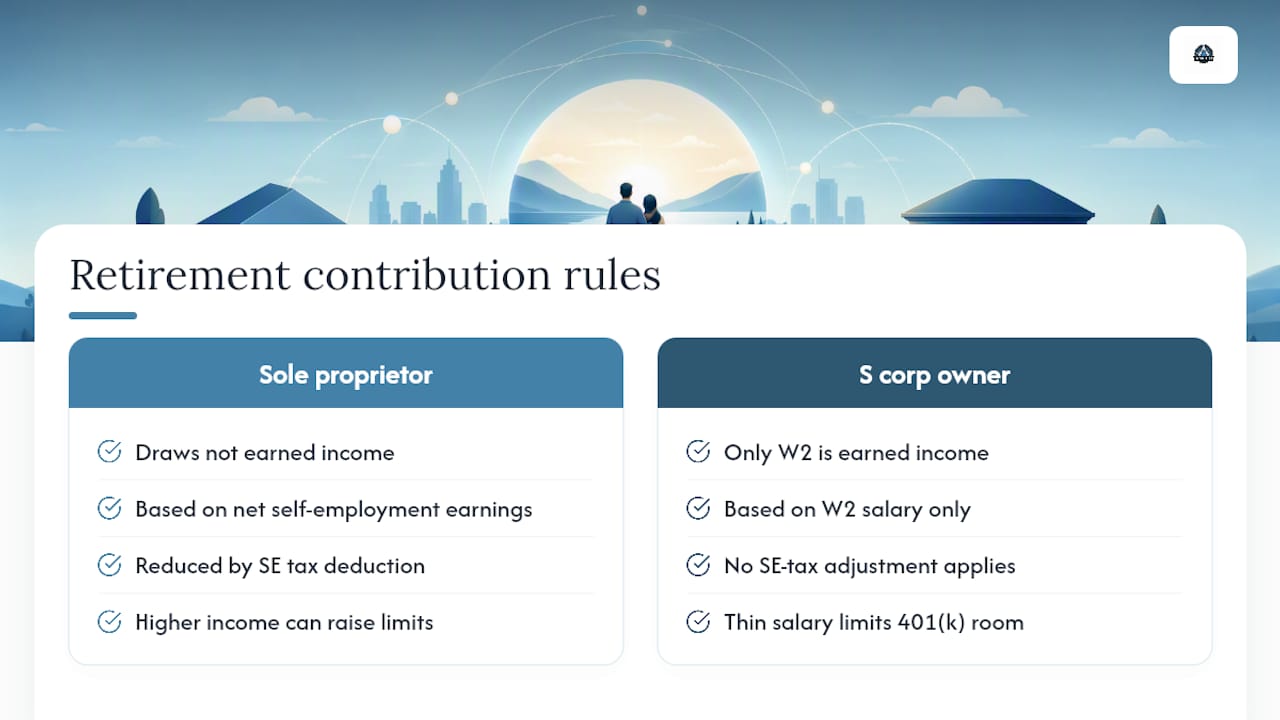
Retirement accounts care about "earned income," and draws don't count as earned income the way W2 wages do. If you're a sole proprietor contributing to a SEP IRA or Solo 401(k), your contribution limit is based on net self-employment earnings, not the dollar amount you drew from the business, and the calculation involves a specific reduction for the deductible portion of self-employment tax.
S corp owners face a cleaner, if stricter, rule: only W2 salary counts toward retirement plan contribution limits. Distributions taken on top of that salary don't count at all. That means an S corp owner who pays themselves a thin salary to save on self-employment tax is also shrinking their own 401(k) contribution room, sometimes without realizing it.
This creates a real trade-off worth running the numbers on. A slightly higher reasonable salary might cost a bit more in payroll tax, but it can unlock meaningfully larger retirement contributions, especially for owners running a Solo 401(k) with both employee deferral and employer profit-sharing components. The math isn't intuitive, and it's easy to optimize for this year's tax bill while quietly capping your own long-term retirement savings.
Anyone weighing this trade-off benefits from projecting both scenarios, current-year tax savings versus long-term retirement contribution capacity, before locking in a salary figure for the year.
Unemployment Benefits: How Draws and Salary Affect Eligibility
Unemployment insurance eligibility hinges on whether you've paid into the system through payroll taxes, and that's where draws and salary produce very different outcomes.
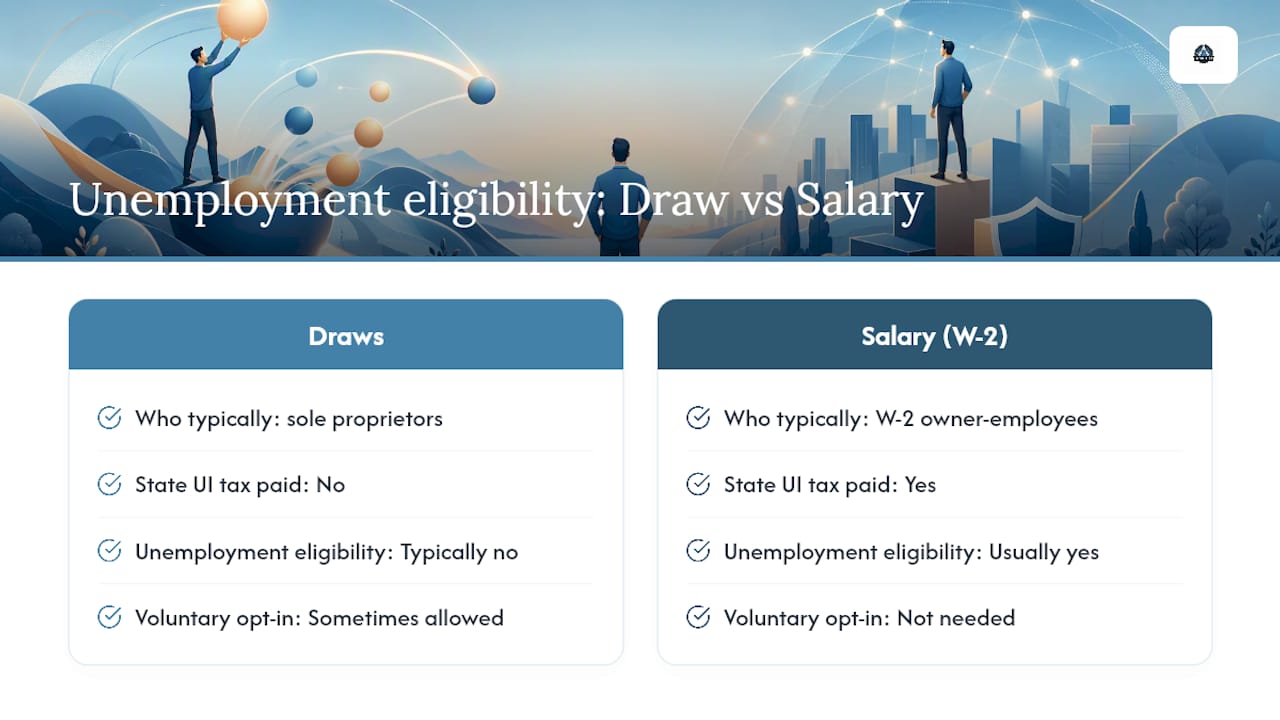
Owners who take draws exclusively, sole proprietors and default LLC members, generally haven't paid state unemployment insurance taxes on that income, because draws aren't wages. That typically means no unemployment benefit eligibility tied to that income if the business closes or slows down, though rules vary by state and some self-employed owners opt into voluntary coverage where their state allows it.
Owners who take a W2 salary, including S corp owner-employees, are usually covered the same way any employee is, because the business has been paying state unemployment insurance tax on those wages all along. If the business later can't sustain that salary, the owner may be eligible to file a claim, subject to their state's specific rules on owner-employees, which can be more restrictive than they are for regular employees.
This is one more argument for treating your own paycheck as a real payroll transaction rather than an informal draw, especially if you're the kind of owner who wants a safety net that mirrors what you'd offer any other employee. Check your specific state's unemployment agency for owner-employee eligibility rules before assuming coverage applies.
How Owner Payroll Actually Gets Processed
Running payroll for yourself as an S corp or C corp owner isn't fundamentally different from running it for any employee, but there are filings you can't skip.
You'll need an Employer Identification Number, a payroll system or provider calculating withholding correctly, and a regular pay schedule, weekly, biweekly, or monthly, that stays consistent. Each pay period, the business withholds federal income tax, Social Security, and Medicare from your wages and remits the employer-matching FICA alongside it.
Quarterly, the business files Form 941 to report withheld income and payroll taxes. Annually, you'll issue yourself a W2 and file Form 940 for federal unemployment tax, plus whatever state unemployment and withholding forms your state requires. Depositing withheld payroll taxes on time matters more than most owners realize, the penalties for late payroll tax deposits scale up quickly and apply even when the eventual annual filing is correct.
Most owners in this position use a payroll provider rather than calculating withholding by hand, both for accuracy and because the filing deadlines are unforgiving. If you've never set this up before, get it built correctly on the first payroll run, retroactively fixing a botched payroll setup after two or three quarters is a far bigger headache than doing it right at the start.
Social Security and Medicare: Draw vs Salary Differences
Both methods eventually contribute to Social Security and Medicare, but through different mechanisms, and the difference matters for your future benefit calculation, not just this year's tax bill.
Draws generate Social Security and Medicare contributions through self-employment tax, calculated on your net Schedule C or K-1 profit and reported when you file your annual return. Salary generates the same two programs through ongoing payroll withholding, split between employee and employer portions, reported quarterly and reconciled annually on your W2.
Here's the part that actually affects your retirement: Social Security benefits are calculated from your lifetime record of covered earnings. An S corp owner who deliberately keeps salary artificially low to minimize payroll tax is also shrinking their own Social Security earnings record, which can mean a smaller benefit check decades from now. It's a long-term cost that rarely shows up in the year-to-year tax planning conversation, but it's real.
Whichever method applies to your entity, the contributions get credited the same way in the end, toward the same 35-year earnings calculation the Social Security Administration uses. The difference is in how much gets credited each year, and that's a direct function of the compensation number you chose.
A CFO's Honest Take on Paying Yourself
The pattern I see most with clients isn't confusion over the rules. It's owners defaulting to whichever method feels less like paperwork, then backing into the tax consequences a year later. I've watched an S corp owner set a $30,000 salary against $180,000 in distributions because a forum post said it was fine. It wasn't fine. It was an audit waiting to happen, and it cost more in penalties than three years of properly run payroll ever would have.
The owners who get this right treat their own paycheck with the same rigor they'd apply to hiring their first real employee.
— Angelica
How Amcfo Helps You Pay Yourself Correctly
Amcfo gives you what a payroll app or a Google search can't: someone who looks at your specific entity, your specific profit trend, and tells you whether an S corp election actually makes sense for your numbers, not just in theory.

If you're currently on draws and wondering whether you've outgrown that structure, or you're an S corp owner who suspects your salary wouldn't survive an audit, those are exactly the moments to bring in outside eyes. Amcfo's team handles the full range: setting up payroll correctly the first time, reconciling draws that got mis-booked as expenses, running the reasonable-compensation benchmarking with real wage data, and modeling what an S corp election would actually save you versus what it would cost in payroll administration. For owners who want ongoing eyes on the decision rather than a one-time fix, fractional CFO services build that compensation review into your regular financial planning cycle. If your books need a cleanup first, start with bookkeeping and accounting support to get your draw and salary transactions classified correctly before the next tax season.
Sources
This article draws on primary IRS guidance covering paying yourself as a business owner, self-employment tax rules, and S corp election requirements. Wage benchmarking data comes from the Bureau of Labor Statistics, and practitioner framing on entity rules and tax-reserve percentages comes from QuickBooks's guide to paying yourself.
This article is general information, not a substitute for advice from a qualified financial advisor. Consult a qualified financial professional about your own circumstances before acting on anything here.
- Self-Employment Tax (Social Security and Medicare Taxes) | IRS
- Occupational Employment and Wage Statistics (OES) | BLS
- Owner's draw vs. salary: how to pay yourself as a business owner | QuickBooks