

Fix invoice accuracy first, then billing timing, collections cadence, cash application, and selective credit enforcement, in that order. That sequence matters because it moves cash fastest with the least friction. Some of these levers pay off within a single billing cycle; the structural ones compound over a quarter. With a disciplined 90 day plan, most businesses can meaningfully reduce DSO without straining customer relationships or slowing sales, and a partner with expertise in financial management can help build that plan and keep it running.
TL;DR:
- Fix invoice accuracy before adjusting billing timing or credit enforcement to prevent delays caused by errors and disputes.
- Implement a disciplined 90-day plan that includes automating reminders and applying payments promptly to reduce DSO by 10 to 15 days.
- Use segmentation and clear credit tiers to tighten terms selectively without risking significant sales loss.
- Prioritize sequencing fixes—accuracy and cadence—before rushing into automation, and assign ownership for each step to sustain progress.
- Track key metrics such as dispute rate, unapplied cash, and collections effectiveness weekly to ensure durable, measurable improvements.
Table of Contents
- How to Calculate DSO and Set a Realistic Target
- The Operational Playbook: What to Fix First
- Which AR Automation Features Actually Move DSO
- Tightening Credit Terms Without Losing Sales
- A 30/60/90 Day Plan to Reduce DSO
- The Metrics That Predict Durable Progress
- Getting Buy-In Across the Team
- Where DSO Programs Usually Stall
- What Actually Moves the Needle: An AmCFO Perspective
- How Amcfo Helps You Reduce DSO for Good
- Sources
- FAQ
How to Calculate DSO and Set a Realistic Target
The standard formula is simple: (Accounts Receivable ÷ Credit Sales) × Number of Days. If a company carries $600,000 in receivables and posted $3,600,000 in credit sales over a 90 day quarter, DSO comes out to (600,000 ÷ 3,600,000) × 90 = 15 days. That's the average number of days it takes to collect after a sale, and it's the figure Investopedia's DSO reference treats as the industry standard.
That basic formula assumes fairly even sales across the period. When revenue is lumpy or seasonal, use the count-back method instead: start with the most recent month's sales, subtract that from total receivables, then work backward month by month until you exhaust the AR balance. This gives a truer read when a big December push or a slow August skews the average.
Benchmarks vary by industry, but a DSO under roughly 45 days is a reasonable target for many B2B businesses, per Investopedia's guidance. To set your own target:
- Pull your trailing 12 month DSO as a baseline, not just last quarter's number.
- Compare against your specific industry range, not a generic cross-industry average.
- Aim for a 10 to 15 day reduction in the first 90 days if you're starting from a high baseline. Case-based programs that combine segmentation, automation, and dispute service level agreements often land in that range, according to Datasive's 90 day DSO analysis.
- Reset the target quarterly as your baseline improves.
The Operational Playbook: What to Fix First
Sequencing beats intensity here. Fixing five things in order, rather than attacking all of them at once, produces faster, more durable results because each fix removes friction that would otherwise blunt the next one, a pattern Rex's DSO strategy guide backs up directly.
1. Invoice accuracy. Before an invoice goes out, confirm the purchase order number, line item amounts, tax calculation, remit-to name and account, and payment terms all match what the customer expects. Build a two-minute pre-send checklist and assign someone to run it, not just review it after a customer flags an error.
2. Billing timing. Invoice the same day as delivery or milestone completion, not two weeks later during a batch run. Every day between fulfillment and invoicing is a day added to your real collection cycle, even though it won't show up in your DSO math the same way late payment does.
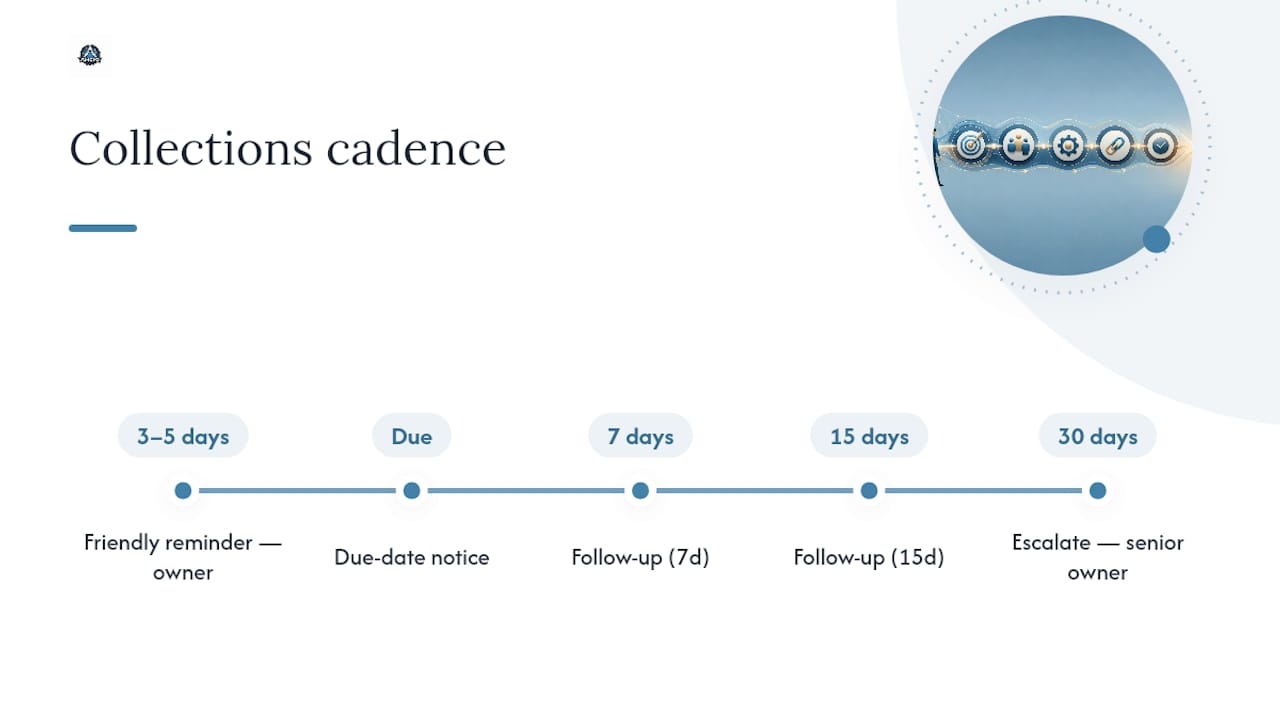
3. Collections cadence. Set a fixed rhythm: a friendly reminder three to five days before the due date, a due-date notice, then escalating follow-ups at 7, 15, and 30 days past due. Assign clear ownership so accounts don't fall through the cracks between reps, and make sure someone owns escalation past 30 days specifically.
4. Cash application. Apply payments the same day they land, and automate matching wherever possible. Rex's research notes that faster cash application prevents inflated reported DSO and stops teams from chasing invoices that are already paid. Build a clear process for partial payments and consolidated remittances (one check covering five invoices), and assign an owner for coding short pays so they don't sit in limbo.
5. Dispute handling and payment friction. Give every dispute a service level agreement, a named owner, and a triage code (pricing error, quality claim, wrong PO). Pause collections outreach on disputed amounts only, never on the full invoice, so you don't stall payment on the undisputed portion. On the payment side, embed a payment link directly in the invoice and accept multiple methods. A partner like Roll With Paid can help remove friction from the payment step itself, including testing one-click payment options that shorten the gap between "reminder sent" and "cash received."
Pro Tip: Don't skip straight to automation before your invoices are clean. Automating a broken process just sends errors faster.
Which AR Automation Features Actually Move DSO
Not all AR software delivers the same return. Three features carry most of the weight: automated dunning sequences, automatic cash application, and self-service payment portals. Everything else is a nice-to-have.
Automated dunning that adapts to context outperforms static templates. A reminder that references the customer's specific invoice history and recent replies gets a better response than a generic "your payment is due" email sent on a fixed schedule. JPMorgan's research on AR turnover finds that automated, consistent dunning sequences materially improve collections speed compared with manual follow-up, largely because they remove the human tendency to skip a reminder when the week gets busy.
Before buying anything, run three integration checks:
- Confirm your accounting system or ERP has a clean connector, not a manual export/import workaround.
- Verify remittance data actually flows into your reconciliation workflow instead of landing in a shared inbox someone has to check.
- Test that partial and split payments route correctly before going live, not after your first messy remittance.
Reported DSO improvements from automated cash application alone can be significant, since unmatched cash sitting in suspense accounts artificially inflates the outstanding balance shown in your AR aging, per Rex's findings.
For a small AR team, a lightweight workflow tool bolted onto your existing accounting software usually suffices. Once you're managing thousands of invoices a month or juggling multiple entities, an integrated AR platform with built-in dunning and cash application starts to earn its cost. Outreach tools built for scaled, personalized follow-up, like RevRing's predictive dialer platform, can also help when phone-based collections are still part of your process for high-value or overdue accounts.
Tightening Credit Terms Without Losing Sales
Segment customers into risk tiers using payment history, dispute frequency, and, where available, third-party credit checks. This isn't about punishing every slow payer equally. A customer who pays 10 days late once a year looks very different from one who's chronically 45 days out.
A workable tier structure looks like this:
- Tier 1 (strong history): standard net 30 terms, no additional requirements.
- Tier 2 (mixed history): net 15 terms or a deposit requirement on new large orders.
- Tier 3 (high risk or new accounts): prepayment or credit card only until a payment history builds.
- Automatic hold trigger: any account 60+ days past due gets a shipment or service hold until finance clears it.
Log every exception to the policy, and require visible sign-off from sales or operations leadership before granting one. An undocumented exception today becomes next quarter's write-off. Allianz Trade's guidance on reducing DSO makes a fair point here: tightening terms too aggressively can cost you revenue, so sequence the operational fixes first and treat credit tightening as a scalpel, not a blanket policy.
Early-pay discounts can help too, but run the math before offering one. If your cost of capital is well under that annualized rate, it's worth offering to select accounts. If it isn't, skip it and lean on the collections cadence instead.
A 30/60/90 Day Plan to Reduce DSO
Days 1 to 30: Calculate your true baseline DSO using both the standard formula and the count-back method. Fix the invoice accuracy checklist, clear the backlog of unapplied cash sitting in suspense, and deploy a basic dunning cadence, even a manual one, for anything already past due.
Days 31 to 60: Automate the dunning sequence so reminders go out without someone remembering to click send. Put dispute service level agreements in place with named owners, and roll out the customer risk tiers so collections effort goes where it matters most.
Days 61 to 90: Enforce the credit policy consistently, including holds for accounts that breach agreed terms. Launch early-pay discounts for accounts where the math works, and put a weekly reporting rhythm in place so leadership sees progress without asking for it.
- Assign one person as the DSO program owner from day one; shared ownership means no ownership.
- Run a 15 minute weekly standup reviewing top 10 overdue accounts, disputes opened and closed, and cash applied.
- Report cash unlocked in dollars, not just days improved. Finance leadership responds to dollars faster than percentages.
- Reforecast your target every 30 days as the baseline shifts.
Pro Tip: Track "cash unlocked" as a running total from day one. A number that grows week over week keeps the whole team motivated in a way an abstract DSO figure never does.
Mid-market companies running this kind of structured 90 day program commonly see 10 to 15 day DSO reductions, according to Datasive's case research, particularly when finance owns the cadence rather than leaving it to whoever in sales has spare time.
The Metrics That Predict Durable Progress
Five numbers tell you whether your program is actually working, not just busy:
- DSO, tracked weekly against your rolling target.
- AR aging buckets (current, 1 to 30, 31 to 60, 61 to 90, 90-plus), since a shrinking current bucket with a growing 90-plus bucket means trouble, even if average DSO looks flat.
- Dispute rate, the percentage of invoices disputed, which flags upstream accuracy problems before they show up in cash flow.
- Unapplied cash percentage, the share of received payments sitting unmatched, which directly inflates your reported DSO.
- Collections effectiveness index, a measure of how much of what's collectible actually gets collected in a given period.
Run a weekly operational dashboard for the AR team and a monthly executive summary that translates days into dollars. That conversion is what gets leadership's attention. A business with annual revenue that cuts DSO by about 10 days frees up a substantial amount of cash, according to Rex's calculation model, since every day of DSO removed equals roughly one day of revenue converted from receivable to cash. That math scales down cleanly for smaller companies too.
Getting Buy-In Across the Team
DSO improvement fails more often from poor internal communication than from bad tactics. Sales teams that don't understand why a deal got held for a credit check will fight the policy, and AR clerks who don't know why a dispute code matters will skip logging it correctly.
Start training with the "why," not the "what." Show the sales team the dollar impact of DSO in terms they respond to: a $1.4 million cash swing from a 10 day improvement is a number worth their attention, and it isn't coming out of their commission.
Give collections staff scripts and escalation paths, not just a list of overdue accounts. A rep who knows exactly what to say on day 15 versus day 45 collects more consistently than one improvising each call.
Loop credit policy changes through sales leadership before they go live, not after a customer complains. A held shipment that surprises an account manager creates far more internal friction than the policy itself ever will.
Report progress in a short, visual weekly update that goes to finance, sales leadership, and operations together. Shared visibility keeps everyone rowing the same direction, and it catches disagreements about a specific account before they turn into a stalled invoice sitting for three weeks while two departments blame each other.
Where DSO Programs Usually Stall
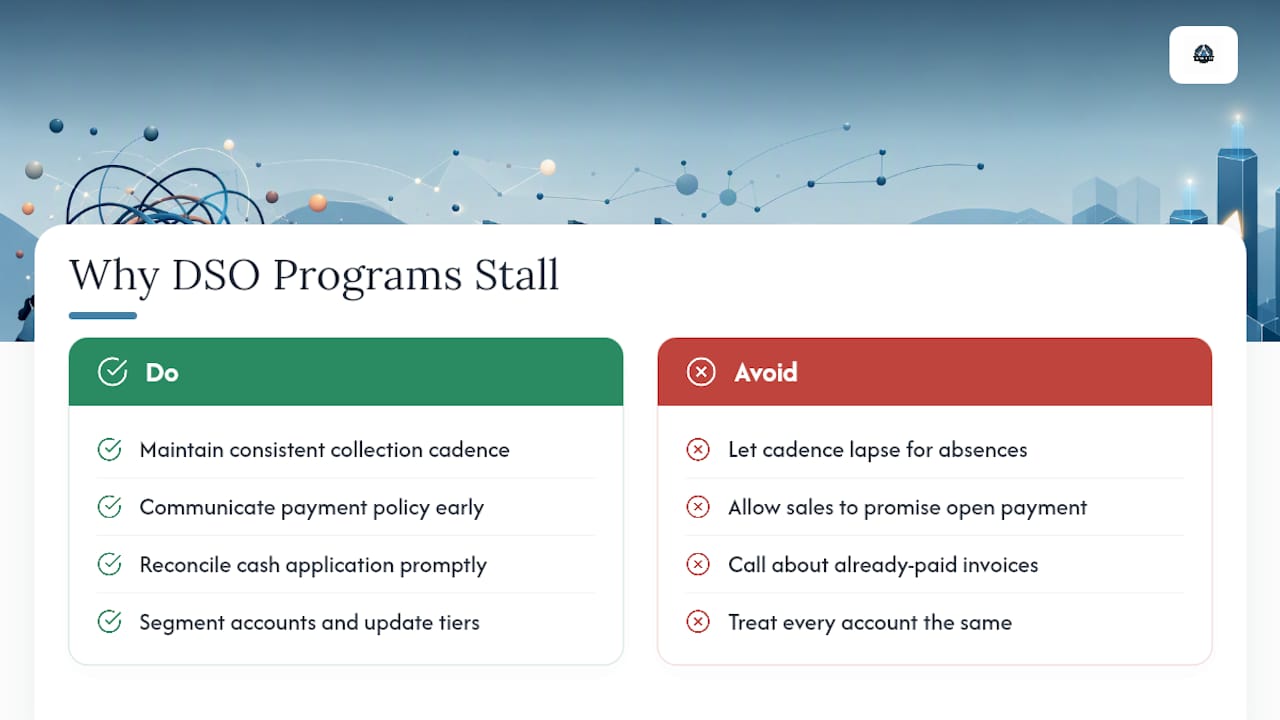
The most common failure isn't a bad tactic. It's inconsistent execution. A cadence that runs perfectly for three weeks and then quietly stops when someone goes on vacation isn't a cadence, it's a false start.
Sales protecting relationships at cash flow's expense is the second most common pitfall. A sales rep who tells a customer "don't worry about it, pay whenever" undoes weeks of AR discipline in one sentence. The fix is policy clarity communicated before the friction point, not a fight after.
Chasing already-paid invoices wastes real hours and damages customer trust, and it happens constantly when cash application lags behind bank deposits by several days. If your collections team is calling about an invoice the customer paid last week, the credibility cost outlasts the cash cost.
Treating every account the same burns effort on low-risk customers who'd pay anyway while high-risk accounts get the same single reminder as everyone else. Segmentation fixes this, but only if someone maintains the tiers instead of setting them once and forgetting them.
Overcorrecting on credit terms is the trap that looks like progress but isn't. Tightening every customer's terms at once might drop DSO on paper while quietly costing sales volume that never shows up on the AR dashboard, only on the revenue line a quarter later. Sequence the fixes: accuracy and cadence first, credit tightening only where the risk tiers actually justify it.
What Actually Moves the Needle: An AmCFO Perspective
Most DSO advice online reads like a checklist assembled by someone who's never had to sit across from a sales VP and explain why an account just got put on hold. The tactics aren't wrong. What's usually missing is sequencing and ownership, and those two things determine whether a DSO program lasts 90 days or dies in week three.
Businesses working with financial consulting firms on accounts receivable cleanups, whether through bookkeeping engagements, fractional CFO support, or a dedicated AR process review, often have the same starting point: reasonably solid collections instincts but no consistent system behind them. The first week of an engagement typically involves pulling a true DSO baseline, auditing the last quarter of invoices for accuracy errors, and checking how much cash is sitting unapplied in suspense accounts. That third check alone often surfaces more "phantom DSO" than any collections tactic fixes.
The uncomfortable truth is that most companies don't have a collections problem. They have an accuracy and consistency problem wearing a collections costume. Fix the invoice before you fix the follow-up.
— Angelica
How Amcfo Helps You Reduce DSO for Good
Outsourcing financial management is an alternative to hiring a full internal finance team just to get your receivables under control. Unlike a generic AR software rollout that provides tools without dedicated support, some firms combine process redesign with personnel who execute it, cleaning up the books, fixing invoice accuracy, and building the cadence your team follows every week, not just the first one.

Depending on where your AR process stands, that starts with a bookkeeping and accounting cleanup to fix the data your DSO number is built on, or with a full fractional CFO engagement that redesigns the collections cadence, credit tiers, and reporting rhythm covered in this playbook. Engagements often start with a baseline review in the first two weeks, followed by a phased rollout that mirrors the 30/60/90 structure outlined above, with weekly check-ins and a monthly executive summary built in from the start.
If your receivables process is losing days you can't afford to lose, request a consultation through Amcfo's fractional CFO services page and get a straight answer on what's actually slowing your collections down.
Sources
- How to reduce DSO and free up cash fast | Rex
- AR turnover and DSO | JPMorgan
- How to Cut DSO in a Mid-Market Company in 90 Days | Datasive
FAQ
What Does It Mean to Reduce DSO?
Reducing DSO means shortening the average number of days it takes to collect payment after a sale, which converts receivables into usable cash faster without generating any new revenue.
What Strategies Work Best to Reduce DSO?
The fastest results come from sequencing fixes: correct invoice accuracy first, bill immediately upon delivery, run a consistent collections cadence, apply cash the same day it's received, and enforce credit terms selectively for higher-risk accounts.
Is a Lower DSO Always Better?
A lower DSO generally signals healthier cash flow and lower collection risk, though a DSO cut achieved by turning away legitimate credit customers or damaging relationships can cost more in lost revenue than it saves in cash timing.
What Causes a High DSO?
High DSO usually stems from inaccurate invoices that trigger disputes, delayed billing after delivery, inconsistent follow-up on overdue accounts, unapplied cash sitting in suspense, and credit terms that aren't enforced consistently.