

The accounts receivable process is the sequence of steps that turns a completed sale into collected cash, from credit approval through invoicing, payment, and reconciliation. Run well, it makes cash flow predictable, shortens Days Sales Outstanding (DSO), and lowers the odds of write-offs. Companies that treat it as a managed workflow, rather than a once-a-month scramble, collect faster and fight fewer disputes.
TL;DR:
- Implementing strict credit assessment and customer onboarding procedures prevents extending credit to unreliable customers, reducing write-offs and increasing collection speed.
- Sending invoices immediately after shipment with complete, accurate details and using customer-preferred delivery channels minimizes delays and disputes.
- Automating cash application and remittance matching accelerates cash posting, decreases aging buckets, and improves overall DSO performance.
- Focusing on early-stage fixes, such as error reduction and process consistency, is more effective for lowering DSO than solely relying on collection efforts.
- Outsourcing AR functions is advisable when internal systems are disconnected, DSO is consistently rising, or staff lacks the expertise, with clear targets and timelines being essential.
Table of Contents
- What Are the Steps in the Accounts Receivable Process?
- How Can You Improve Accounts Receivable and Cut DSO?
- Which Accounts Receivable Metrics Actually Matter?
- What Controls Protect Your Receivables From Fraud and Errors?
- Which AR Tasks Should You Automate First?
- A 90-Day Plan to Stabilize Your Receivables
- When Does It Make Sense to Outsource Accounts Receivable?
- Get Hands-On Help Fixing Your Receivables
- Sources
What Are the Steps in the Accounts Receivable Process?
The accounts receivable cycle sits at the tail end of order-to-cash, and it only works when each stage hands off cleanly to the next. A process map view of AR shows credit assessment, invoicing, cash application, collections, dispute handling, and reconciliation as one continuous chain rather than separate departments doing separate jobs. Break any single link and the delay shows up weeks later in your aging report.
Here's the workflow broken into its practical stages, with the checks that actually catch problems before they become bad debt.
-
Credit assessment and customer onboarding. Before you extend terms to a new customer, pull a credit reference or check a business credit report, set a specific credit limit tied to that customer's risk profile, and document the approval. Skipping this step is the single most common reason small companies end up chasing invoices from customers who were never going to pay reliably. Revisit limits annually, or sooner if a customer's order volume jumps or payment behavior slips.
-
Order entry, fulfillment, and invoice generation. The clock on your DSO starts the moment the invoice should have gone out, not when it actually does. A study of the order-to-cash cycle shows that a delayed or inaccurate invoice at this stage creates downstream delays that compound for weeks. Generate invoices the same day goods ship or service is delivered, and match every line item against the purchase order or contract before it goes out. A wrong quantity or a missing PO number is the fastest way to trigger a 30-day dispute over a $200 error.
-
Invoice delivery and required fields. Send through the channel your customer's payables team actually uses, whether that's email, EDI, or direct upload to an accounts payable portal. Every invoice needs the basics: invoice number, PO reference, itemized charges, payment terms, due date, and remittance instructions. Missing any one of these gives a customer's AP department a legitimate excuse to hold payment.
-
Payment receipt and remittance capture. Payments now arrive through ACH, wire, credit card, check, and portal-based payment. Each rail carries different remittance detail, and capturing that detail (which invoice a payment covers, any discount taken) at the point of receipt saves your cash application team hours later.
-
Cash application. This is where payments get matched to open invoices. Split payments, short pays, and unapplied cash are the three things that quietly inflate your aging report if cash application lags. An invoice sitting "unpaid" for two weeks because nobody matched a wire transfer is not a collections problem, it is a cash application backlog dressed up as one.
-
Collections and dispute routing. Once an invoice crosses its due date, a structured dunning sequence kicks in: a friendly reminder, then a firmer follow-up, then a call. Disputes need their own lane. A customer disputing $500 of a $10,000 invoice should never hold up payment on the undisputed $9,500, but that only happens if your process explicitly separates disputed and undisputed amounts at the line-item level.
-
Month-end reconciliation and sub-ledger controls. Close the loop by reconciling the AR sub-ledger against the general ledger every month, not once a quarter. Independent reconciliation, meaning someone other than the person applying cash, catches errors and prevents fraud from hiding inside a busy ledger. This is also where you confirm your reconciliation process is airtight before it hits your financial statements.
Map these seven stages against your own systems and you'll usually find the bottleneck isn't collections, it's somewhere upstream. Fixing a late invoicing habit does more for DSO than any number of stern collection calls. For a broader breakdown of how each of these pieces fits together, Amcfo's guide to accounts receivable fundamentals covers the workflow in more depth.
How Can You Improve Accounts Receivable and Cut DSO?
Improving accounts receivable performance means pulling three separate levers at three separate points in the cycle: upstream at the terms you set, midstream at how you invoice and collect, and downstream at how fast you turn a received payment into applied cash. Most companies only pull one of these levers and wonder why DSO barely moves.
Upstream: set terms that work in your favor.
- Agree on payment terms before the first invoice goes out, not after the first late payment.
- Consider a 2/10 net 30 structure, which gives a 2% discount for payment within 10 days against a standard 30-day term, to pull cash forward from customers who can pay early.
- Reserve longer terms (net 60, net 90) for your most reliable, highest-volume accounts only. Do not extend them as a default courtesy.
Midstream: eliminate the reasons invoices get held.
- Invoice the same day work is completed. Every day of delay here is a day added to your DSO regardless of how good your collections team is.
- Audit invoices against POs and contracts before sending, since a single wrong line item can stall payment for weeks.
- Segment customers by size, risk, and payment history so your team spends collection hours on the accounts that matter, not chasing a $150 balance with the same urgency as a $50,000 one.
- Submit directly to buyer AP portals where customers use them. AP portals and disputes are a frequent, silent cause of invoice delay, and proactively uploading invoices there instead of waiting for a customer to key them in shortens the cycle measurably.
- Automate your dunning sequence so reminders go out on schedule without depending on someone remembering to send them.
- Offer more than one payment method. A customer who has to cut a check because that's the only option you gave them will pay slower than one who can click a portal link and pay by card or ACH.
Downstream: make cash application and reporting trustworthy.
- Speed up cash application so payments post within a day or two of receipt, not a week.
- Keep your aging report honest. If disputed or short-paid invoices sit in the same bucket as clean unpaid invoices, your 90+ day column will always look worse (or better) than reality, and neither helps you prioritize.
- Review AR performance on a fixed cadence, weekly for collections, monthly for trend reporting to leadership, so problems get caught while they're still small.
Pro Tip: Run a quarterly "invoice audit" on your ten largest customers before you touch collections tactics. If half of your late payments trace back to invoice errors rather than customer unwillingness to pay, no amount of dunning automation will fix the real problem.
None of these tactics work in isolation. A generous 2/10 net 30 discount does nothing if your invoices go out five days late. Fixing the sequence, not just the individual steps, is what moves DSO.
Which Accounts Receivable Metrics Actually Matter?
DSO is the headline number, but it lies to you if you read it alone. Days Sales Outstanding measures the average number of days it takes to collect payment after a sale, typically calculated as (accounts receivable ÷ total credit sales) × number of days in the period. A rising DSO signals slower collections, but it doesn't tell you whether the cause is bad customers, bad invoicing, or a cash application backlog masquerading as unpaid balances.
That's why combining DSO with the Collections Effectiveness Index (CEI) and aging-bucket trends gives a fuller picture than DSO alone. CEI measures what percentage of receivables due were actually collected in a period, which strips out the noise that timing differences add to raw DSO. Days to Pay (DTP), a related but separate metric, tracks how long a specific invoice took to get paid from its due date rather than averaging across your whole portfolio.
| Metric | What it measures | Why it matters |
|---|---|---|
| DSO | Average days to collect after a sale | Headline cash flow health indicator |
| DTP | Days from due date to actual payment | Isolates late-payment behavior by invoice |
| CEI | Percentage of receivables collected in a period | Corrects for timing distortion in DSO |
| Aging buckets (to 90+ days) | Balance distribution by age | Flags where collection risk concentrates |
| Touchless match rate | Percentage of cash applied without manual review | Signals cash application efficiency and automation health |
Watch the 90+ day bucket closest. A healthy AR portfolio keeps that bucket small and shrinking, since balances that age past 90 days collect at a fraction of the rate of fresh invoices. Your touchless match rate, the share of incoming payments your system applies automatically without a human touching them, tells you how much of your cash application team's time is going to genuine exceptions versus routine matching that software should handle.
Review DSO and aging weekly at the collections level, and roll CEI and touchless match rate into a monthly report for finance leadership. That cadence catches deterioration early enough to act on it, rather than discovering a problem in a quarterly board deck three months too late.
What Controls Protect Your Receivables From Fraud and Errors?
The biggest fraud risk in accounts receivable is lapping, where an employee covers a shortfall on one customer's account by misapplying a later payment from a different customer, then repeats the cover-up indefinitely. It works because a single person controls both cash receipt and cash application. Break that single point of control and lapping becomes far harder to sustain.
- Separate cash application duties from collections and from write-off approval. No one person should touch a receivable at every stage of its life.
- Require dual approval, or a formal delegation-of-authority matrix, for any write-off above a set dollar threshold. A collector who can also write off the balance they failed to collect has an obvious incentive problem.
- Run independent reconciliations of the AR sub-ledger against the general ledger every month, performed by someone outside the cash application function, and review exceptions individually rather than batch-approving them.
- Build automated audit trails into your delegation-of-authority workflow so every write-off and adjustment has a documented approval chain, which discourages abuse and speeds up any later audit.
- Set escalation triggers for balances that age past a defined threshold (commonly 60 or 90 days) or disputes that stay open longer than a set number of days, so aged problems surface to management automatically instead of sitting quietly on someone's desk.
Revenue recognition adds a second layer of exposure that has nothing to do with fraud and everything to do with timing. Under ASC 606, revenue gets recognized when control of the good or service transfers to the customer, not necessarily when the invoice goes out or the cash arrives. If your invoicing timing and your revenue recognition timing drift apart, your AR aging and your income statement stop telling the same story, and that gap is exactly what auditors probe first.
Which AR Tasks Should You Automate First?
Not every part of accounts receivable deserves automation on day one. Prioritize the tasks that are high-volume, rules-based, and currently eating the most staff hours, since that's where automation pays back fastest.
- Invoice delivery. Automating generation and delivery removes the single most common cause of self-inflicted delay: invoices that go out late because someone had to remember to send them.
- AP portal submission. Software that automatically formats and uploads invoices to a customer's buyer portal removes a manual step that otherwise depends entirely on someone's memory.
- Collections dunning. Rules-based reminder sequences free your collectors to spend their time on judgment calls and genuine exceptions instead of routine follow-ups, which is where human effort actually moves the needle on hard-to-collect accounts.
- Cash application matching. This is usually the highest-ROI automation target, since manual matching of remittance detail to open invoices is slow, error-prone, and directly delays your aging report accuracy.
- Dashboards and reporting. Automated DSO, CEI, and aging reports remove the multi-day lag that comes from building these numbers by hand every month.
When applied across the full AR lifecycle, automating invoice delivery, digital payments, AI-driven collections, and cash application together produce a materially larger DSO reduction than automating any single step in isolation. The reason is straightforward: an automated cash application step still waits on a manual invoicing step, so partial automation just moves your bottleneck rather than removing it.
Before you buy anything, confirm integration requirements with your ERP and your existing remittance capture setup. A tool that can't sync cleanly with your general ledger creates a second reconciliation problem on top of the one you were trying to solve. Run a pilot on one customer segment first, track DSO, CEI, and touchless match rate for 60 to 90 days, and only scale the tool company-wide once those numbers move in the right direction.
A 90-Day Plan to Stabilize Your Receivables
You don't need a year-long transformation project to see real DSO improvement. Most of the gains come from fixing the basics fast and layering in automation once you've proven the fundamentals work.
- Days 1 to 30 (quick wins, owned by AR lead): Audit your last 90 days of invoices for errors, missing PO numbers, and late delivery. Enforce payment terms consistently, including following up on the first late day rather than waiting a week. Turn on automated dunning reminders for your top 20 customers by revenue. Success metric: invoice error rate drops and your top accounts start seeing timely reminders.
- Days 31 to 60 (medium projects, owned by controller): Pilot cash application automation on one business unit or customer segment. Segment your full customer base by risk and size. Build a basic DSO and aging dashboard. Success metric: touchless match rate improves and you have a working segmentation model.
- Days 61 to 90 (scale, owned by CFO or finance lead): Integrate AP portal submission for customers who use one. Update your written credit and write-off policies to match the delegation-of-authority controls you've put in place. Set a permanent weekly collections cadence and monthly leadership reporting rhythm. Success metric: DSO trend line turns downward and stays there.
Pro Tip: Don't wait until day 90 to report progress. Share a two-line DSO and CEI update with leadership at the 30-day mark, even if the numbers haven't moved much yet. Early visibility buys you patience for the 60 and 90-day work.
When Does It Make Sense to Outsource Accounts Receivable?
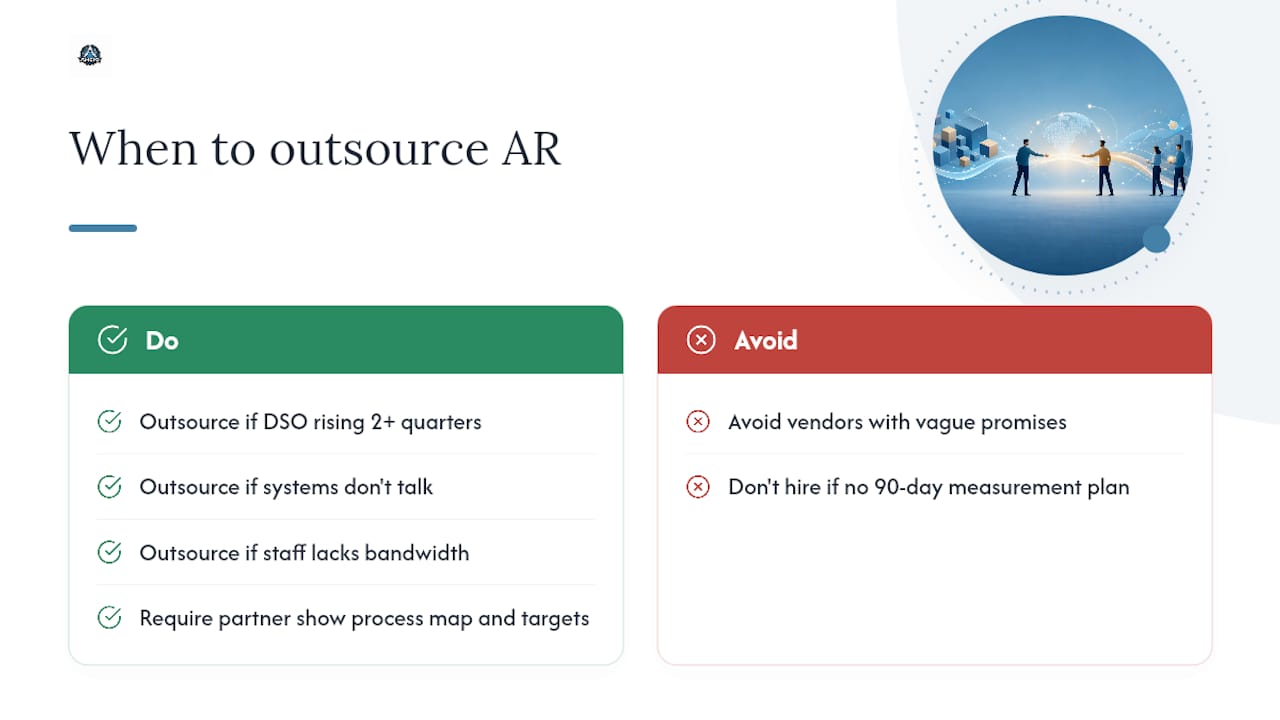
If DSO has been climbing for two or more consecutive quarters, your systems don't talk to each other, or nobody on staff has the bandwidth to build the controls this article describes, that's the signal to bring in outside help. In-house teams often know exactly what's wrong but lack the hours or the specialized experience to fix it properly.
Amcfo works with companies at exactly that stage, through engagements that range from a one-time bookkeeping cleanup to ongoing fractional CFO oversight of the whole AR function. A good outsourcing partner should show you a clear process map, concrete DSO and CEI targets, and a realistic timeline, not vague promises. If a vendor can't explain how they'll measure progress in the first 90 days, keep looking.
— Angelica
Get Hands-On Help Fixing Your Receivables
Amcfo gives you what a general bookkeeping hire usually can't: a team that has already fixed the exact invoicing gaps, cash application backlogs, and reconciliation lapses this article walks through, across companies of different sizes and industries. Instead of hiring and training an internal AR specialist from scratch, you get a fractional CFO team that plugs straight into your existing systems and starts closing the gaps within weeks, not quarters.

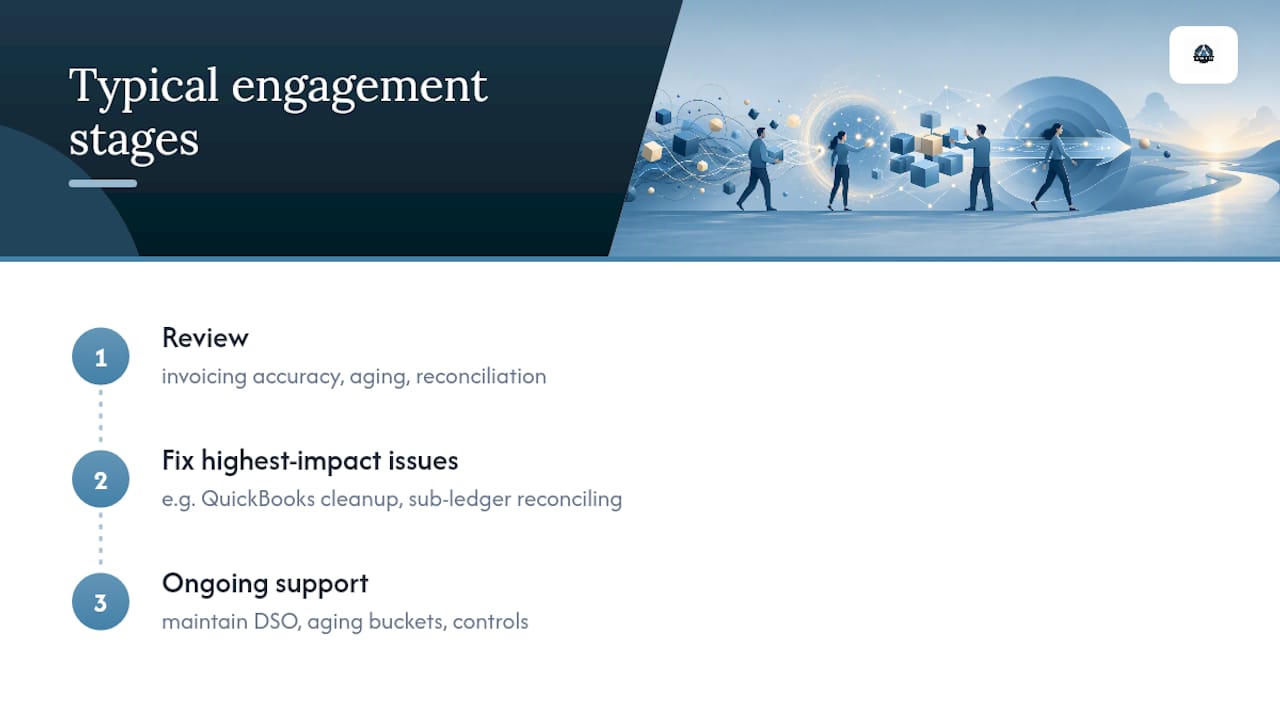
A typical engagement starts with a review of your invoicing accuracy, aging report, and reconciliation process, then moves into fixing the highest-impact issues first, whether that's a QuickBooks cleanup that's been overdue for a year or a full sub-ledger reconciliation that hasn't happened properly in months. From there, ongoing support keeps your DSO trend, aging buckets, and controls on track instead of drifting again six months later.
If your receivables need more than a quick fix, request a consultation with Amcfo and get a clear picture of where your AR process stands today and what fixing it would actually involve.
Sources
For readers who want the primary sources behind the workflow and metrics covered here, J.P. Morgan's treasury guidance on accounts receivable management and its breakdown of net payment terms both cover working capital impact in more depth. Billtrust's seven strategies for reducing DSO expands on the automation evidence cited throughout this guide, and the accounts receivable process map from BA Copilot is worth reviewing if you want to visualize the full order-to-cash handoff chain.
- Net payment terms — benefits of net 30/60/90 terms | J.P. Morgan
- Accounts receivable process map — BA Copilot
- How to reduce DSO: 7 strategies for AR teams | Billtrust