

The financial close process is the structured sequence of accounting tasks performed at the end of a reporting period to finalize all balances and produce auditable financial statements. It runs on a monthly, quarterly, or annual cycle and covers far more ground than simply "closing the books." Think of it as the full accounting sprint: every transaction gets recorded, every account gets reconciled, every adjustment gets posted, and the resulting financials get reviewed before anyone signs off.
The core components of a complete financial close include:
- Transaction identification and recording in the general journal
- Posting entries to the general ledger
- Trial balance preparation to check that debits equal credits
- Account reconciliations to verify balances against source documents
- Adjusting journal entries for accruals, deferrals, and corrections
- Intercompany eliminations for consolidated entities
- Financial statement preparation (income statement, balance sheet, cash flow)
- Final review, approval, and period lock
Each of these steps feeds the next. Skip one, and the financial statements you produce at the end are unreliable.
Why the financial close process matters for your business
The financial close process is essential for producing accurate financial statements that both internal leadership and external stakeholders rely on to make informed decisions and maintain compliance. Without a disciplined close, you are essentially guessing at your company's financial position.
The close establishes what practitioners call a "single version of the truth." Every department, every executive, and every auditor works from the same set of numbers. That alignment is what makes budgeting, forecasting, and strategic planning credible rather than contested.
Key reasons the financial close process deserves serious attention:
- Audit readiness: A well-documented close produces the evidence trail auditors need, reducing the time and cost of external reviews.
- Regulatory compliance: Public companies face SEC reporting deadlines; private companies face lender covenants and tax filing requirements. A late or inaccurate close creates real legal exposure.
- Decision quality: Executives making capital allocation decisions need financials they can trust. Stale or error-prone reports lead to bad calls.
- Investor and lender confidence: Banks and investors scrutinize financial statements before extending credit or capital. Sloppy closes erode that confidence fast.
- Operational visibility: Monthly closes give management a timely read on margins, cash flow, and expense trends before small problems become large ones.
2026 industry standard: Accuracy must take priority over speed in the financial close. A fast close that produces unreliable numbers is worse than a slower one that gets it right, because correcting restated financials costs far more than the time saved.
Key steps in the financial close process
The financial close follows a defined sequence. Rushing any step or skipping it entirely tends to surface as an error later, usually at the worst possible moment.
-
Identify and record transactions. Every financial event during the period gets captured in the general journal. This includes revenue, expenses, payroll, asset purchases, and any other activity that affects the books. The accounting team owns this step, often with support from department managers who approve and code their own expenses.
-
Post entries to the general ledger. Journal entries move from the sub-ledgers (accounts payable, accounts receivable, payroll) into the general ledger. Modern ERP systems handle much of this automatically, but manual entries still require human review.
-
Prepare a trial balance. The trial balance lists every account with its ending debit or credit balance. Its purpose is simple: confirm that total debits equal total credits. Any imbalance signals a posting error that must be resolved before moving forward.
-
Reconcile accounts. This is where most of the real work happens. The team compares general ledger balances against external statements (bank statements, credit card statements, vendor invoices) and internal sub-ledgers. Reconciliations catch duplicate entries, missing transactions, and timing differences. A robust financial close framework treats reconciliation as a gated phase with defined ownership, not a task anyone can pick up and put down.
-
Post adjusting journal entries. Accruals for expenses incurred but not yet billed, deferrals for revenue received but not yet earned, depreciation, and prepaid amortization all get recorded here. These entries align the financials with the accrual basis of accounting required under U.S. GAAP.
-
Run a second trial balance. After adjustments, the team runs an adjusted trial balance to confirm the books still balance and that the adjusting entries landed correctly.
-
Prepare financial statements. The income statement, balance sheet, and statement of cash flows get assembled from the adjusted trial balance. For consolidated entities, intercompany transactions get eliminated at this stage. The financial close steps culminate here, with reports issued to stakeholders once approved.
-
Final review, approval, and period lock. Senior finance leadership reviews the financials for reasonableness, often using flux analysis to compare current period results against prior periods and budget. Once approved, the accounting period gets locked to prevent any further changes. A post-close review then documents what went well and what needs fixing for the next cycle.
Financial close vs. closing the books: what's the difference?
Finance professionals use these two terms interchangeably, but they describe different things. Understanding the distinction matters for control design and audit documentation.
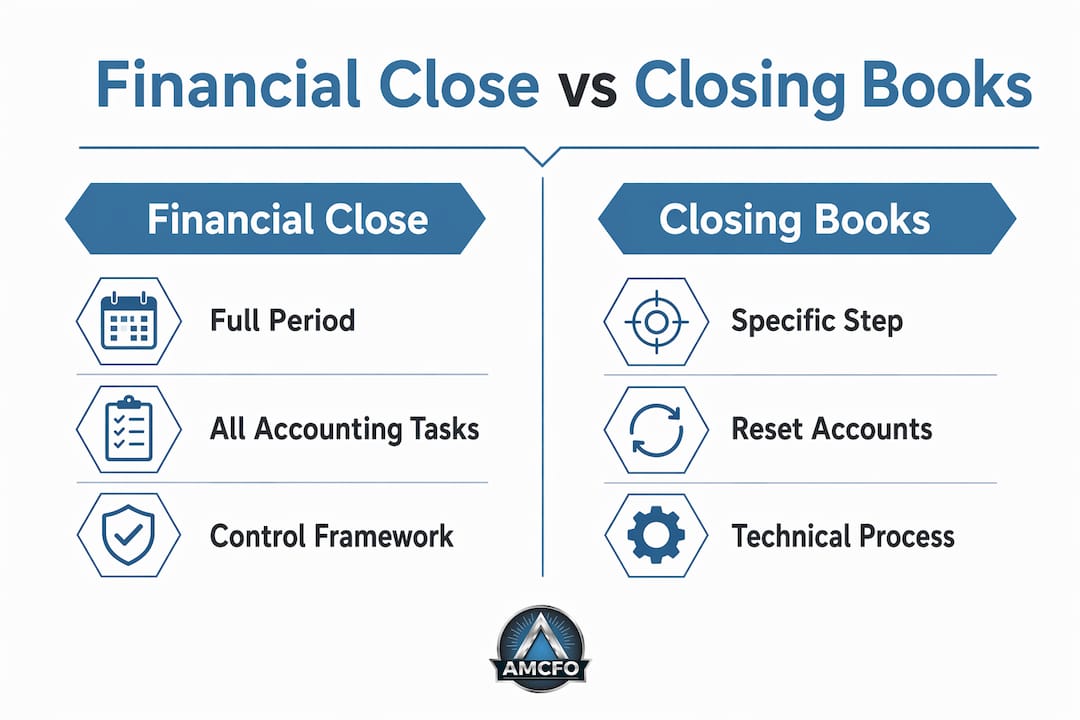
Closing the books is a specific technical step. It involves resetting temporary accounts (revenue, expense, and dividend accounts) to zero by transferring their balances to retained earnings, then locking the balance sheet so no further entries can post to that period. It is the last step of the financial close process, not the whole thing.
The financial close process is the overarching framework that includes every task from the first journal entry of the period through the final approval and lock.
| Dimension | Financial close process | Closing the books |
|---|---|---|
| Scope | All accounting tasks for the period | Final reset and lock of accounts |
| Timing | Spans days or weeks | Single event at period end |
| Output | Auditable financial statements | Zero-balanced temporary accounts, locked ledger |
| Ownership | Entire finance team | Controller or senior accountant |
| Purpose | Accuracy, compliance, reporting | Prevent further changes to closed period |
Treating "closing the books" as synonymous with the full close process is a common mistake that leads to weak controls. Teams that conflate the two often skip reconciliation reviews or skip flux analysis, then wonder why auditors find errors.
Best practices for a more efficient financial close
The most effective financial close processes in 2026 have shifted from task-based thinking to control-based thinking. The difference is significant. A task-based approach asks "did we complete the checklist?" A control-based approach asks "did we map every action to a specific risk, assign ownership, and document evidence?"
Continuous accounting is the clearest expression of this shift. Rather than stacking all reconciliations and adjustments into a frantic end-of-period sprint, continuous accounting distributes that work throughout the month. Reconciliations happen as transactions occur. Accruals get estimated and updated in real time. By the time the period ends, most of the heavy lifting is already done.
Pro Tip: Before adopting any new close technology, document your current close as a control map, not just a task list. Identify which steps address accuracy risk, which address completeness risk, and which address cutoff risk. That map tells you exactly where automation will have the most impact and where human judgment is still required.
Practical best practices worth implementing now:
- Assign a named owner to every close task. Shared ownership is no ownership. Each reconciliation, each journal entry, each approval step needs one person accountable for it.
- Set internal deadlines earlier than external ones. If your board package is due on the 10th, your close should be complete by the 7th. Buffer time catches late sub-ledger feeds and last-minute adjustments.
- Standardize your journal entry templates. Inconsistent formatting wastes review time and introduces errors. A standard template with required fields (account, amount, description, supporting document reference) cuts review time significantly.
- Use a financial close checklist. A documented checklist, reviewed and updated after every close, serves as both a control and a training tool for new team members.
- Run post-close retrospectives. After each close, spend 30 minutes identifying what caused delays and what produced errors. Systemic fixes compound over time; quick patches do not.
- Lock periods promptly. Leaving a prior period open invites unauthorized or accidental entries that distort comparatives.
- Invest in financial controls documentation. A defensible close is one where every material balance has a reconciliation, every reconciliation has a reviewer, and every reviewer has a documented approval.
Common challenges and risks during the financial close
The financial close process breaks down in predictable ways. Knowing where the failure points are helps you build controls before they become problems.

Manual, spreadsheet-driven processes are the single biggest risk factor. Spreadsheets have no audit trail, no version control, and no built-in workflow. A formula error in a consolidation model can cascade through every financial statement without triggering any alert. Moving to continuous accounting and purpose-built tools reduces this exposure materially.
Unclear ownership creates gaps. When two people both think the other is responsible for a reconciliation, it does not get done. When no one owns the intercompany elimination, it gets done inconsistently. Clear role assignment, documented in the close checklist, is the fix.
Late data from sub-ledgers or departments is a chronic problem, especially in companies where non-finance teams control expense coding. Payroll feeds, expense reports, and vendor invoices that arrive after the close deadline force either a late close or an estimated accrual that needs to be trued up later.
Insufficient review time is a consequence of compressing the close. When the team spends 90% of the available time on data entry and reconciliation, there is almost no time left for flux analysis and management review. That is exactly when material errors slip through to the final statements.
Audit trail gaps surface during external audits and create delays. Every adjusting entry needs a supporting document. Every reconciliation needs a reviewer signature. Missing evidence does not just slow audits; it raises questions about the reliability of the entire close.
Tools and technologies that support financial close automation
Technology does not replace the financial close process. It removes the friction that makes the process slow and error-prone.

ERP systems like NetSuite centralize the general ledger, sub-ledgers, and reporting in one platform. That integration eliminates the manual data transfers between systems that introduce errors and consume hours of reconciliation time. NetSuite's automated journal posting, period-close workflows, and role-based approval routing address several of the most common close bottlenecks simultaneously.
Account reconciliation platforms like BlackLine automate the matching of general ledger balances against bank statements, intercompany accounts, and sub-ledger data. BlackLine's workflow engine assigns reconciliations to specific preparers and reviewers, tracks completion status in real time, and flags unreconciled items before they reach the review stage. For finance teams running hundreds of reconciliations per close, that visibility alone changes the dynamic.
Close management software adds a project management layer on top of the accounting work, tracking task completion, deadlines, and dependencies across the team. When a reconciliation is late, the system flags it and the downstream tasks that depend on it.
Reporting and consolidation tools handle intercompany eliminations, currency translation, and financial statement assembly, tasks that are tedious and error-prone in spreadsheets. Automated consolidation also supports financial reporting best practices by producing consistent, auditable outputs every period.
The right technology stack depends on company size and complexity. A small business may need only a well-configured accounting platform. A mid-market company running multiple entities almost certainly needs dedicated reconciliation and close management tools on top of its ERP.
How long does the financial close process typically take?
Close duration varies by company size, complexity, and process maturity. Most finance teams target a monthly close within roughly one to two weeks. High-performing teams at well-organized companies often complete theirs in under a week. Teams relying heavily on manual processes take significantly longer.
Defined review gates and documented evidence are what separate a repeatable, fast close from one that drags. Without gates, work expands to fill the available time. With them, each phase has a hard deadline and a clear handoff point.
Quarterly closes typically take longer because they include additional analytical work, board reporting, and sometimes external review. Annual closes are the most complex, often running several weeks. Large organizations frequently manage the annual close while simultaneously running monthly closes for the new fiscal year, which demands precise data separation and careful coordination across the accounting team.
A few factors that reliably shorten close duration: continuous accounting practices that distribute reconciliation work throughout the month, ERP automation that eliminates manual data transfers, and a close checklist that every team member follows without exception. If your close is consistently running longer than 10 business days, the bottleneck is almost always one of three things: late data, unclear ownership, or insufficient automation.
If your close process feels more like a fire drill than a controlled procedure, Amcfo can help. Our accounting and bookkeeping services are built to bring structure, accuracy, and speed to your financial close cycle. For businesses that need senior-level oversight without a full-time hire, our fractional CFO services provide the financial leadership to design and manage a close process that holds up to scrutiny.

Key takeaways
The financial close process is a structured, multi-step accounting cycle that produces auditable financial statements, and accuracy must take priority over speed at every stage.
| Point | Details |
|---|---|
| Financial close vs. closing the books | Closing the books is one final step; the full close process spans reconciliations, adjustments, and approvals across days or weeks. |
| Accuracy over speed | A fast close with unreliable numbers costs more to correct than a careful close done right the first time. |
| Ownership drives reliability | Every task in the close checklist needs a named owner; shared responsibility creates gaps that auditors find. |
| Automation reduces risk | Tools like NetSuite and BlackLine eliminate manual data transfers and track reconciliation completion in real time. |
| Post-close retrospectives compound improvement | Reviewing what caused delays after each close produces systemic fixes that shorten every subsequent cycle. |